


Highlights
- The multi-trillion dollar P2P market requires exploration of its current value and creates an opportunity to build a p2p payment app.
- Exploration of essential MVP features that include upcoming AI-driven fraud prevention technology that will emerge in 2026.
- The complete technology used in p2p payment app development and costs for various regions appear in this open financial analysis.
- Modern fintech application development needs to comply with strict security standards, which demand understanding by all developers.
- Highlights
- Introduction
- What Is a Peer-to-Peer Payment App and How It Works?
- Types of Peer-to-Peer Payment Apps
- Must-Have Features in P2P Payment App
- How to Build a P2P Payment App?
- Technology Stack Required in Developing P2P Payment App
- How Much Does it Cost to Develop a P2P App?
- Key Challenges While Building a P2P Payment App
- P2P Payment App Monetization Strategies
- Future Trends in P2P Payment Apps
- Security & Compliance Requirements in P2P App Development
- Why Choose Octal IT Solution for P2P Payment App Development?
- Concluding Words
- FAQs
Introduction
Could you imagine a world where “sending money” is as simple as sending a text message? The concept has become a worldwide standard because it exists beyond its original futuristic vision. The p2p payment app development field will serve as the foundation for digital economy growth during the upcoming ten years. The global P2P payments market will reach a value of $11.67 trillion by 2032, according to recent Straits Research reports showing a 17.53% CAGR growth rate.
The Gen-Z generation creates a cashless society through their payment habits, while p2p payment solutions become part of their social interactions. Businesses need to learn how to build a p2p payment app that provides fast service and strong protection because this skill will help them succeed in the profitable industry.
What Is a Peer-to-Peer Payment App and How It Works?
A Peer-to-Peer payment application function is a digital system that permits users to make direct money transfers between their bank accounts or digital wallets through mobile devices to other users. The system processes transactions without requiring users to wait for intermediaries or handle cash.
How it works:
- User Onboarding: The user registers his account while he completes a digital KYC process.
- Linkage: The user connects their credit card, debit card, or bank account through a secure peer to peer payments API development tool like Plaid.
- Initiation: The sender uses the recipient’s phone number, email, or QR code to send money.
- Authorization: The app verifies the transaction through biometric authentication or a PIN.
- Transfer: The system transfers money through “real-time rails” and ACH, while both parties receive immediate updates.
- Digital Wallet: This provides users with an integrated cryptocurrency wallet development module, enabling them to store funds for quicker international transactions.
Types of Peer-to-Peer Payment Apps
You need to select a business model that supports your organization’s objectives. The finance mobile app development process has different user needs that each type of application resolves through its specific features.
1. Standalone Services
These function as independent systems like Venmo and PayPal to maintain user accounts while displaying transaction activities through their social networks.
2. Bank-Centric Solutions
These apps, like Zelle, enable users to perform bank transfers through its direct integration with banking systems and enable users to transfer funds between banks without using external wallets.
3. Social & Messaging-Based
WhatsApp Pay and Telegram both let users make payments through their chat platforms, creating a more user-friendly experience for payment app development.
4. Crypto-Powered P2Ps
The applications use Web3 and stablecoins to create worldwide payment systems that operate with almost no transaction costs, which require particular skills from digital wallet app development firms.
Must-Have Features in P2P Payment App
Your platform must offer essential features to lead the entire market. The current finance application development process requires user retention as the main goal through these essential characteristics.
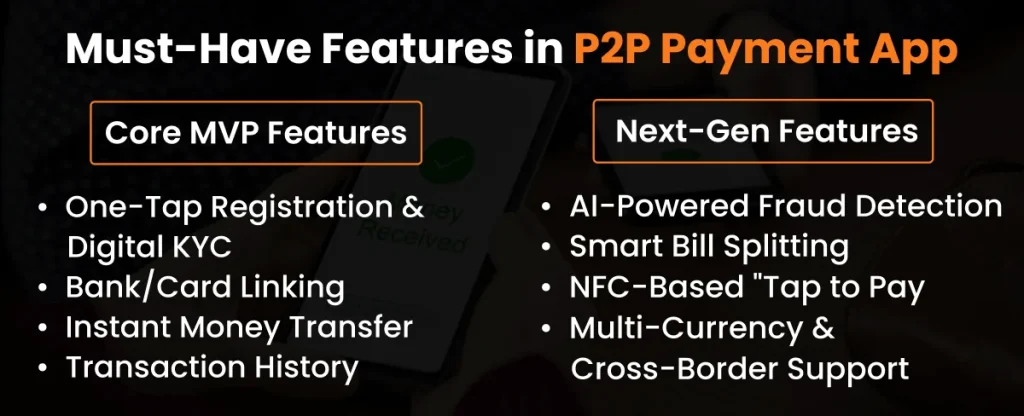
A. Core MVP Features:
1. One-Tap Registration & Digital KYC
Frictionless onboarding is vital. The system needs both automated document verification and security measures without creating any delays.
2. Bank/Card Linking
Securely connects financial institutions through industry-approved p2p payment connection solutions.
3. Instant Money Transfer
The term instant only applies to 2026. The system requires you to use real-time payment systems, including FedNow or UPI.
4. Transaction History
The system provides a complete record of all previous activities, which users can search through to create digital receipts.
B. Next-Gen Features for Competitive Edge:
1. AI-Powered Fraud Detection
The system uses machine learning technology to identify suspicious activities, including big money transfers from unknown regions.
2. Smart Bill Splitting
The younger audience needs this feature to easily share costs for dining expenses and housing payments.
3. NFC-Based “Tap to Pay”
Users can transfer payments to each other by creating physical contact between their mobile devices.
4. Multi-Currency & Cross-Border Support
Digital wallet applications require stablecoin integration because it enables users to make low-cost international transfers instantly.
How to Build a P2P Payment App?
A financial product needs a structured development process that ensures both technical stability and legal compliance. The best P2P payment app development company follows this process to create new applications:
1. Discovery & Market Research
Select a target market, then research existing peer-to-peer payment applications that currently lack sufficient features.
2. UI/UX Design
The team will develop high-fidelity prototypes that demonstrate “trust” through their design. The user interface must provide clear navigation because users will only trust the application when they understand how to use it.
3. Backend & API Integration
The team will construct the essential infrastructure enabling your application to connect with banking APIs, KYC providers, and notification systems.
4. Security Implementation
The system implements end-to-end encryption together with tokenization methods to secure all confidential information.
5. Testing & Launch
The team will perform extensive penetration testing and load testing prior to releasing the peer-to-peer payment platform at retail locations.
Technology Stack Required in Developing P2P Payment App
The P2P application in 2026 needs a performance-oriented technology stack that delivers immediate data processing and implements “Zero Trust” security measures to create a secure and scalable system.
The following table presents the industry-standard technology stack that developers need to build a p2p payment app. This tech stack enables your system to manage high transaction volumes while conforming to strict financial industry standards.
| Category | Recommended Technology |
| Mobile Frontend | Flutter, React Native, Swift (iOS), Kotlin (Android) |
| Web Frontend | React.js, Next.js, TypeScript |
| Backend Framework | Node.js (TypeScript), Go (Golang), Python (Django) |
| Microservices | Docker, Kubernetes, gRPC |
| Primary Database | PostgreSQL, MySQL |
| Caching & Real-time | Redis, Apache Kafka |
| Payment APIs | Stripe Connect, Plaid, Dwolla, FedNow / UPI |
| Security & Auth | Auth0, Firebase Auth, JWT, OAuth 2.0 |
| Cloud Infrastructure | AWS (Amazon Web Services), Google Cloud |
| KYC/AML Tools | Onfido, Jumio, Socure |
| AI & Fraud Prevention | TensorFlow, Amazon Fraud Detector |
| Stablecoin Rails | Circle (USDC), Fireblocks |
How Much Does it Cost to Develop a P2P App?
The p2p payment app development cost needs a detailed analysis of your project requirements. Your development team expenses and operational costs will determine budget changes from your first wireframing stage to the final deployment of your finance mobile application.
1. Cost by Complexity
The total investment is mainly determined by how many features exist and how advanced the backend system becomes. A basic payment p2p app development project focuses on core transfers, while enterprise versions include complex AI and multi-currency support.
| Development Tier | Estimated Cost (USD) | Timeline |
| MVP (Minimum Viable Product) | $50,000 – $90,000 | 3–5 Months |
| Mid-Level App | $100,000 – $200,000 | 6–9 Months |
| Enterprise Solution | $250,000+ | 10+ Months |
2. Cost by Region
The hourly rates for financial app developers show major differences between various countries throughout the world. USA-based fintech app development companies provide better accessibility for clients, whereas offshore locations offer businesses affordable development solutions for their custom P2P payment applications.
| Region | Average Hourly Rate | Total Estimated Cost (MVP) |
| North America (USA/Canada) | $150 – $250 | $150,000 – $250,000 |
| Western Europe (UK/Germany) | $100 – $180 | $100,000 – $180,000 |
| Asia (India/Vietnam) | $30 – $80 | $50,000 – $90,000 |
3. Hidden Post-Launch Costs
You need to plan your budget after the initial build to sustain the ongoing expenses required to create a payment app. The platform incurs invisible costs to protect your system from security breaches while maintaining compliance and operational performance.
| Cost Component | Estimated Annual Expense |
| Maintenance & Updates | 15% – 20% of the initial cost |
| Third-Party API Fees | $2,000 – $10,000+ |
| Security & Compliance Audits | $10,000 – $30,000 |
| Customer Support Tools | $500 – $3,000 |
Key Challenges While Building a P2P Payment App
Specialized knowledge exists because developers must create finance applications according to financial regulations and technical specifications.
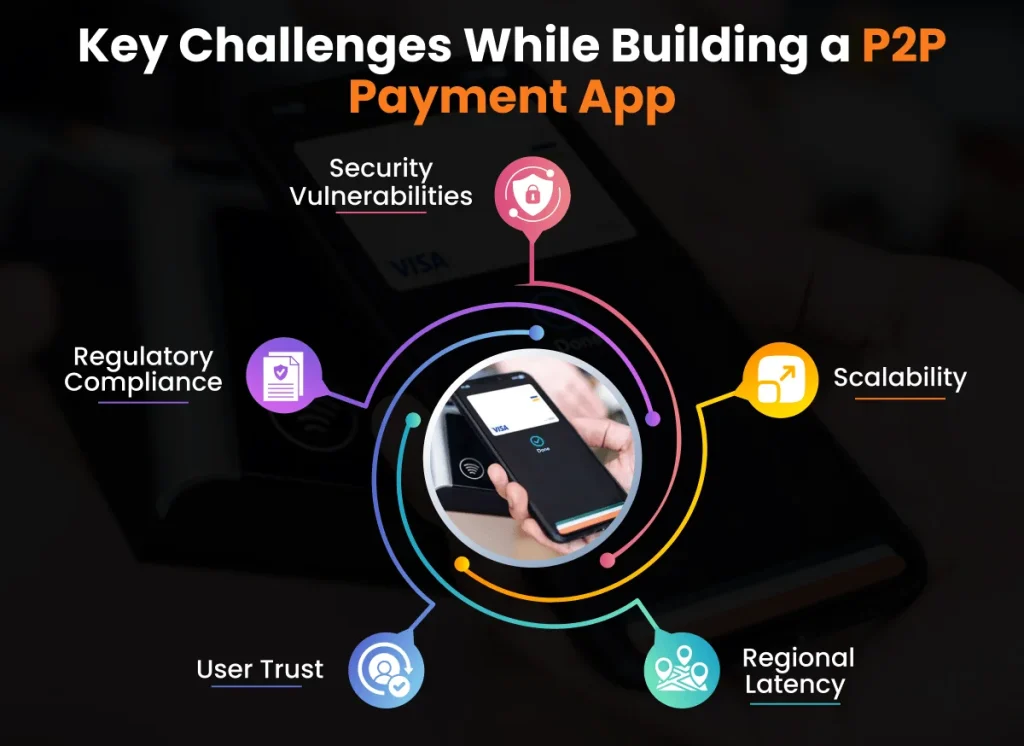
1. Security Vulnerabilities
Real-time payments are a primary target for hackers. Payment software development requires the implementation of a Zero Trust security architecture.
2. Regulatory Compliance
The process of complying with PCI DSS, GDPR, and local money transmitter licenses requires organizations to spend both time and money.
3. User Trust
A user needs to see complete brand trustworthiness before they will permit their main banking account to connect with a new application.
4. Regional Latency
The server distribution needs to be optimized because instant transfer between London and New York depends on this requirement.
5. Scalability
Fintech p2p mobile app development service providers face significant technical difficulties when they need to manage 10,000 simultaneous transactions during the holiday shopping period.
Also Read: How to Build a Finance App like Empower?
P2P Payment App Monetization Strategies
How will your app generate revenue while providing its fundamental service to users at no cost?
1. Transaction Fees
The service charges customers a minor percentage fee for “Instant” transfers, but provides “Standard” transfers, which take 1-3 days at no cost.
2. Premium Subscription Plans
It provides a “Pro” subscription that enables users to access greater limits and receive personal cards and cashback benefits.
3. B2B Merchant Services
Your application functions as a payout solution for developers because it enables small businesses to process P2P payments through a paid service.
4. Advertising & Affiliate Marketing
The company collaborates with retailers to provide customers with special discounts appearing in the app’s activity feed.
Check these use cases of Payment Solutions: One-click payment solutions
Future Trends in P2P Payment Apps
Stay ahead of the curve by considering these latest trends in p2p payment app development:
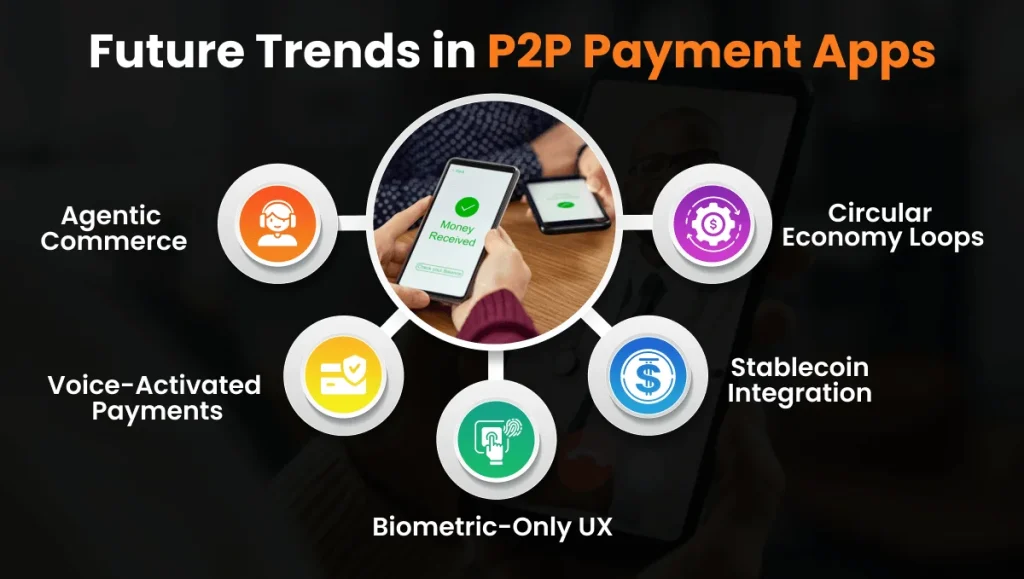
1. Agentic Commerce
AI “agents” that can negotiate and pay for services on your behalf (e.g., booking a flight and paying automatically).
2. Voice-Activated Payments
“Siri, send $20 to Mike” is developing into a standard secure method of interacting with others.
3. Biometric-Only UX
The authentication process will evolve from using passwords to employing “Face-to-Pay” systems utilizing liveness detection technology.
4. Stablecoin Integration
People use government-pegged tokens to make immediate international money transfers at low-cost.
5. Circular Economy Loops
The system provides integrated P2P payment solutions that enable customers to buy second-hand goods through in-app purchases for resale and repair markets.
Security & Compliance Requirements in P2P App Development
Enterprise payment application development needs security as its primary component because security functions as the fundamental element for building payment applications.
Compliance
You must adhere to PCI DSS (for card data), GDPR (for user privacy), and AML (Anti-Money Laundering) protocols to avoid massive fines.
Security Layers
The system needs to use Biometric 2FA and JWT Tokenization to prevent data storage on servers and needs End-to-End Encryption to secure all communication between the application and backend system.
Why Choose Octal IT Solution for P2P Payment App Development?
At Octal IT Solution, we don’t just build apps; we engineer financial ecosystems. We assist startups and enterprises with our expertise as the leading fintech app development company USA to navigate through financial sector challenges. Our financial application development specialists possess deep knowledge about real-time rails, high-concurrency backends, and regulatory compliance requirements.
We as an on-demand app development company, help you protect your users while achieving business returns. Our finance app development company delivers comprehensive support from initial discovery until post-launch maintenance to develop your P2P application into a successful product that competes with other market offerings.
Concluding Words
The future of finance is peer-to-peer. The success of creating a payment application like PayPal and Venmo or a crypto-based payment system depends on execution. You can create a platform that earns user trust and expands worldwide by implementing a Security-First strategy, developing important AI fraud detection features, and selecting trustworthy payment application development services. Do you need assistance to start your path? You should hire mobile app developer now who will develop your concept into a complete digital platform.
 By
By July 10, 2026


 Latest Stories
 Get in Touch