


Key Takeaways
- The NFT marketplace development cost in 2026 can range from $25,000 for a white-label MVP to more than $500,000 for a fully customized enterprise platform.
- The degree of UI/UX design, security auditing, blockchain selection, and smart contract complexity are the core value elements.
- Your development price can increase by 30–40% due to hidden costs, maintenance, compliance, and fuel optimization.
- When groups are properly vetted, NFT marketplace development outsourcing can reduce costs by 40–60% without adequate compromise.
- 2026 is a reasonable year to construct because NFT use cases have spread far beyond art to include gaming, real-world asset (RWA) tokenization, and digital identification.
Introduction
A few years ago, cartoon monkeys were boasting hundreds of thousands of dollars; no one believed traditional ownership would stop, NFTs looked like a fever dream, and success was quiet. Real utility, which is far more valuable, has taken its place.
Building an NFT marketplace is a significant commercial discussion in 2026. Brands, game studios, financial institutions, and independent creators are all launching or scaling platforms. With about 11.87 million active users globally, Statista projects that the global NFT market will bring in $501.3 million in revenue in 2026 and expand to $3.37 billion by 2028.
The problem most founders have is that they view the cost of NFT marketplace development as a single figure. It’s not. – your blockchain, your operations, your cluster version, your security audit – makes a huge difference.
This guide describes everything in detail. By the conclusion of this blog, you will know exactly what to spend, what to attend to, and where you can take small cuts and save out, regardless of whether you are a startup proving a concept or a commercial enterprise developing a full-scale platform.
What is an NFT & Why Does It Matter in 2026?
The incredible virtual certificate held on the blockchain is called an NFT, or non-fungible token. Each NFT is unique, considering Bitcoin and Ethereum, which are interchangeable. Digital images, tones, in-game items, real estate documents, or perhaps concert price tickets can be represented through it.
Why does it matter in 2026? Because of the digital profession, the fundamental problem addressed by NFTs does exist. In fact, it’s far more relevant now.
Now the market is more developed. Speculative flipping has replaced utility-driven NFT adoption. NFTs are used by manufacturers for loyalty programs. In-game merchandise forms the basis of entire economies created by game developers. Real international goods, such as real assets and commodities, are tokenized through financial institutions. By 2026, there will be 15.97 million NFT users worldwide, and by 2030, the industry will be worth $152.54 billion at a compound annual growth rate (CAGR) of 34.2%.
That’s the idea. Now let’s look at the places where all this is bought and offered.
Different NFT Marketplace Types
NFT marketplaces are built differently. Your NFT platform development cost and availability architecture are determined by the way you build it.
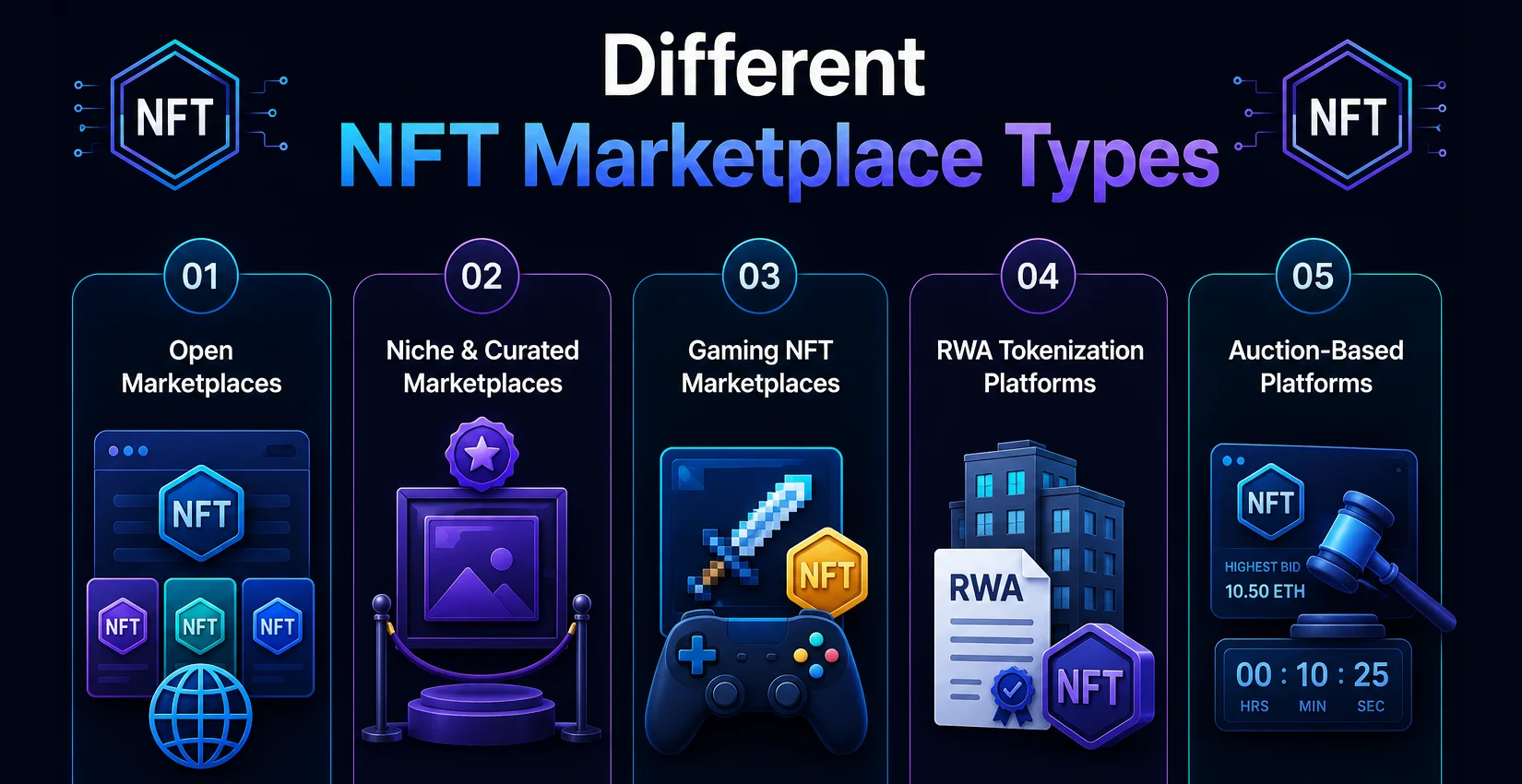
Open Marketplaces (OpenSea)
Mints, catalogs, and shops are open to the public. It requires remarkably scalable infrastructure, sophisticated restraint, and insight. The cost range is $50,000 to $150,000.
Niche & Curated Marketplaces (SuperRare)
Artists need to apply or pass. Reduced width, better feel, forward, and handles nicely. The cost varies from 80,000 to $200,000.
Gaming NFT Marketplaces
Based primarily on the play-to-earn economy and assets within entertainment. It needs to integrate with the entertainment engine. The typical NFT gaming marketplace development cost ranges from $100,000 to $300,000+.
RWA Tokenization Platforms
For fractional ownership of precise assets, such as raw materials, real estate, and high-end assets. Strict standards for compliance. Price change: $150,000 to $500,000 or more.
Auction-Based Platforms
Reserve rates, live-drop capabilities, and timed bidding. Depending on real-time infrastructure needs, the NFT auction marketplace development cost can range from $60,000 to $180,000.
Your NFT platform development cost is directly determined by the type you choose, making it more than just a business decision.
Visit: Top 15 Software Development Outsourcing Companies for Startups & Enterprises
Top NFT Marketplace Examples & What We Can Learn From Them
OpenSea
2017 brought the largest NFT market in the international arena. OpenSea uses a 2.5% flat commission model to manipulate multi-chain assets on Ethereum, Solana, and Polygon. If you look at the OpenSea clone development cost, a feature-like custom build should cost between $80,000 and $2 100,000 or more.
Lesson Learned: Multi-wallet support and scalable infrastructure are critical from the start.
Rarible
Users now have a say in platform choices to come up with Rarible’s regime token (RARI), which has grown in popularity. Producers seeking greater power were drawn to its decentralized NFT marketplace model.
Lesson Learned: While community ownership elements increase development complexity, they also foster loyalty.
SuperRare
A well-chosen platform for virtual art in a limited edition. SuperRare’s invite-best method limits quantity while maintaining excellent quality. It gets 3% from secondary revenue and 15% from primary sales.
Lesson Learned: Strong artist authentication and content material handling systems should be integrated into curated NFT platform models.
Decentralized Marketplace
Decentraland operates within the metaverse, where users can buy, trade, and create durable virtual parcels of land (LAND).
Lesson Learned: Growing the Metaverse NFT marketplace requires specific images of deep integration with 3-D environments and game engines.
NBA Top Shot
Topped with over a million registered customers, NBA Top Shot, which was transformed into an embedded form on the Flow blockchain, delivered NFTs to mainstream sports target markets. This removed cryptocurrency friction for newbies using a custodial wallet architecture.
Lesson Learned: The NFT user onboarding structure is only as important as the underlying smart contracts.
The Evolution of NFT Marketplaces: From CryptoKitties to $69 M Sale
Essentially, the story of NFT marketplaces is that of individuals discovering what they can accomplish with a proven virtual scarcity.
It all started in 2017 with the blockchain entertainment CryptoKitties, which had customers trading and fostering digital cats. This may also seem trivial; however, it confirmed that people can spend real money on extraordinary digital goods and shut down the entire Ethereum network.
Then 2021 came along. When Beeple bought “Everydays: The First 5000 Days” at Christie’s for 69.3 million dollars, it became the third-most expensive work of art ever sold through a living artist, more expensive than just selling art. It turned into a signal for all industries that ownership of virtual content was becoming the norm.
Only speculative plays ended with the 2022 crash. Platforms built primarily on real utility, such as gaming economies, innovative royalties, RWA tokenization, and token-gated communities, are firmly established and flourishing in 2026. The market has grown vibrantly.
How NFT Marketplaces Work?
You can get a higher understanding of why building an NFT marketplace can involve such great mechanics.
The basic process is as follows: The author uploads virtual assets, mints them as NFTs, and links their cryptocurrency wallets to the platform. Mint uses smart contract development services, part of auto-executing code that specifies ownership policies, royalty distribution, and transfer conditions, to write the NFT metachain into the blockchain, an important factor in participating in contract development proposals.
Customers use cryptocurrencies to pay by browsing the market, bidding, and buying for a fixed fee. With a smart contract, the Switch is robotically owned. Every transaction is permanently, transparently, and opaquely recorded on the blockchain.
The platform requires blockchain indexing, wallet authentication, decentralized storage (like IPFS or Filecoin), and finally a robust API layer. Custom NFT development is a huge investment instead of rapid construction due to its complexity.
Is It Worth Investing in NFT Marketplace Development in 2026
In a nutshell, if you develop for practical purposes instead of guessing, the answer is yes.
According to Statista, the NFT market is expected to grow at a compound annual growth rate (CAGR) of 34.2%, from $501.3 million in sales in 2026 to $3.37 billion in 2028. 12,000 NFT revenues eclipse territory.
One more telling sign of where stock money is being moved. Brand loyalty packages, RWA tokenization schemes, and gaming NFT economies are all attracting full-scale investment. What separates structures that are stagnant from those that are developed is the choice of a trusted NFT development companies with long-term NFT history.
Founders who prioritize building over acquiring individuals are the ones who go through trouble. When you build with a well-defined target audience and a clear use case, the investment feels right.
Essential Features Every Successful NFT Marketplace Must Have
These are not perfect assets. Before the first transaction, customers will be lost if any of them are neglected. These are also the key features affecting NFT marketplace development cost; Each will increase the complexity and duration of your work.
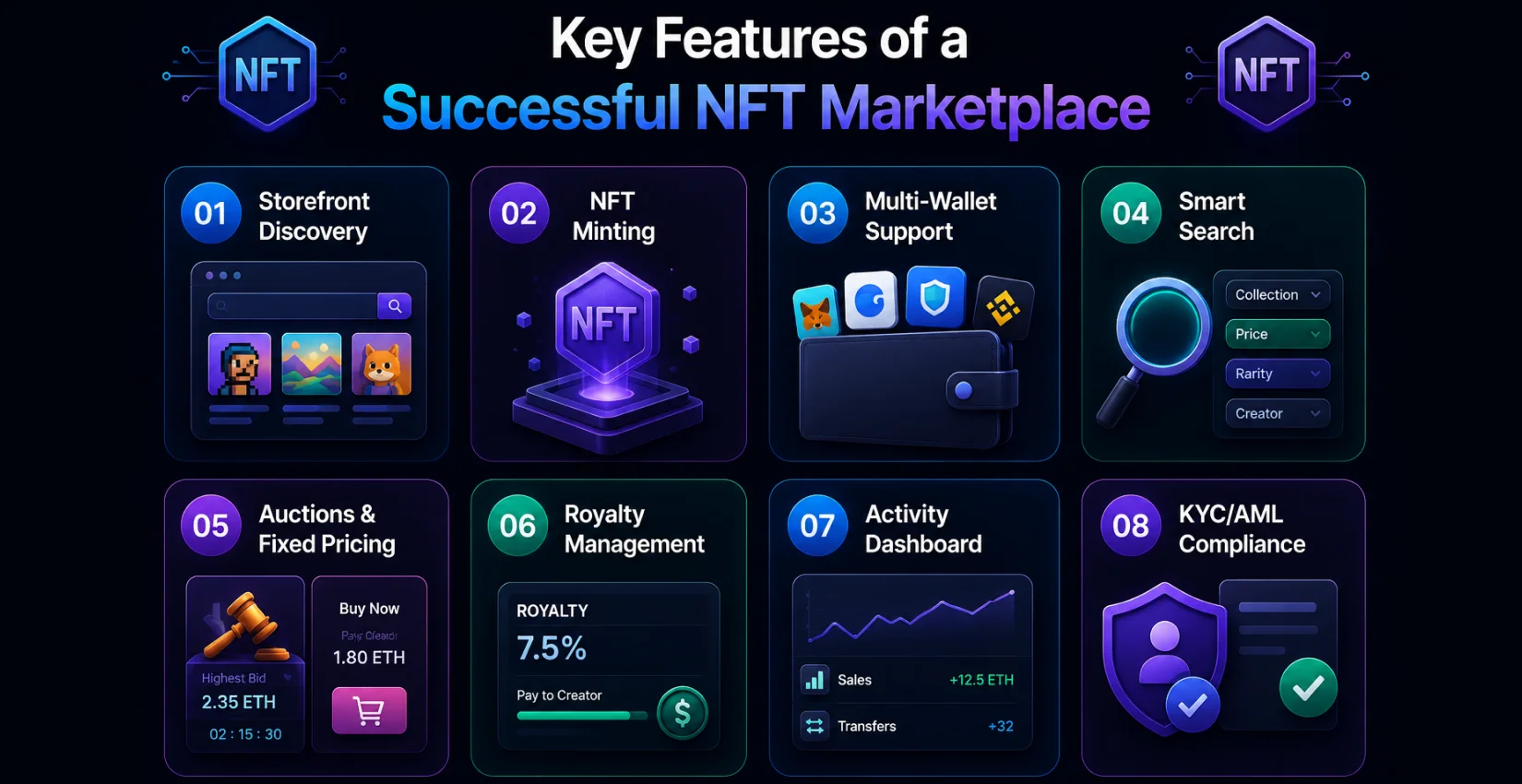
Storefronts & Asset Discovery
Clear product pages showing relevant items, price history, ownership history, and ownership information.
Minting Tool
Allows authors to mint NFTs and upload documents without adding any code. Support for mass minting, limited drops, and single releases.
Multi Wallet Support
Phantom, Wallet Connect, Coinbase Wallet, and Metamask. By 2026, account abstraction (email/social login) may become the norm for Web3 onboarding.
Smart Filtering & Search
Price levels, row filters, quadratic filters, and rare syndromes. Users won’t find what they’re looking for without this.
Fixed Price Listings & Auctions
Both models are important. Add down payments, buy-now options, and offer reporting.
Royalty Management
EIP-2981 is used to include computerized accounting royalties of secondary sales at the smart contract level.
Activity Dashboard
Real-time feed of the latest moves, offers, and deposits. It is important to have a consumer perspective.
KYC and AML Integration
Regulators want more in 2026, especially for RWA tokenization schemes and high-value assets.
Blockchain & Tech Stack: The Foundation That Drives Your Cost
The most crucial technology choice that you will make is which blockchain to pick. The long-term scalability of your user experience and NFT marketplace software development cost are all directly affected.
The most tested blockchain for NFTs is still Ethereum. Gas rates may increase at some level during intervals of heavy traffic, yet the developing environment is unprecedented. Due to the need for fuel optimization, Ethereum NFT marketplace development costs are generally higher than layer-2 alternatives, but you get the best level of security and trust.
By 2026, most critical systems will use Layer-2 networks like Polygon or Base to build Ethereum. With a transaction fee below $0.01, according to Mint, the Polygon NFT marketplace development cost is typically 20–30% lower than the main network designs, making it best for high-volume designs.
By 2026, Solana will have emerged as the desired chain of mobile-first structures and gaming NFTs. Transactions are confirmed in milliseconds, fractions of value, and fractions of a penny. While its smaller developer pool may additionally result in higher trading costs, the Solana NFT marketplace development pricing is competitive.
Solidity (Ethereum/L2) or Rust (Solana) for smart contracts, IPFS or Filecoin for decentralized storage, Node.js or Python for backend, and React.js or Vue.js for front-end search functionality rely on the Graph protocol for indexing blockchain information.
NFT Marketplace Development: White-Label vs. Custom Solutions
Every founder must make this genuine cost decision the first time.
White label NFT marketplace development uses pre-made templates that you could modify and relabel. Cost: $10,000 to $50,000. Time body: 4 to 12 weeks. Speed to market is a bonus. The downside is that there isn’t always a huge difference between your platform and dozens of others.
Building from the ground up for your unique use case is called a custom enhancement. The NFT marketplace creation cost for a completely customized platform ranges from $80,000 to $500,000+, and takes 4 to 18 months. The benefit is control over your entire architecture, features, and brand.
Most of the founders support white-label authentication. Get real users, real transactions, and real records. After perfecting the invocation, reconstruct the practice with evidence of each identifiable need. It’s significantly less dangerous compared to investing $300,000 before deciding if you fit the market.
NFT Marketplace Development Process: Step-by-Step Breakdown
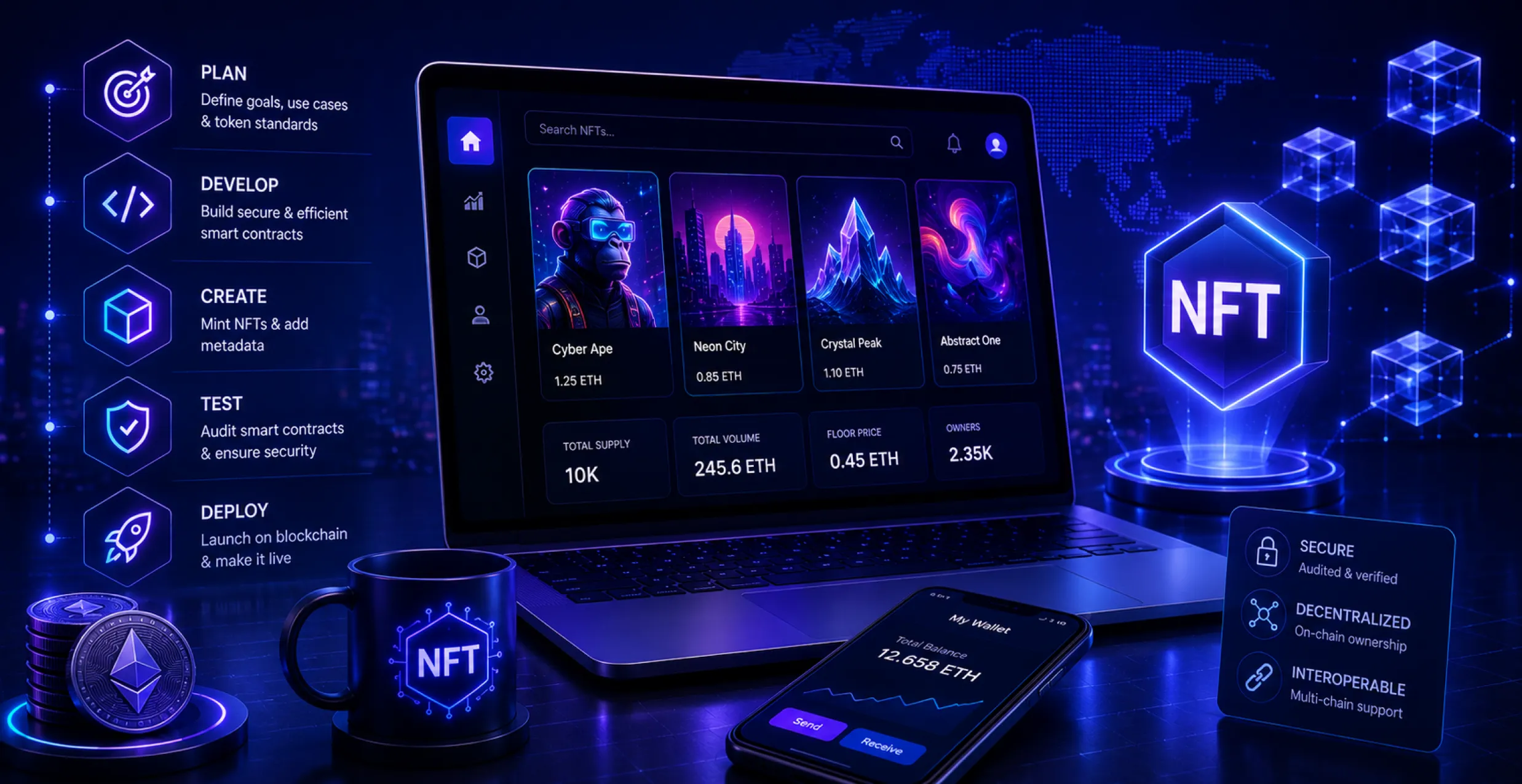
The actual course of a professional on-demand NFT marketplace development engagement is as follows:
Phase 1: Planning and Discovery (2-4 weeks)
Describe your target blockchain, feature set, monetization method, and niche. When this section applies, your technical specification file is created.
Phase 2: UI/UX Design (3-6 weeks)
High-fidelity prototypes, user flows, and wireframes. In 2026, customers envision Web3 platforms for Web2-level individuals to experience. Most founders underestimate the importance of this stage.
Phase 3: Create a Smart Contract (4–8 weeks)
Arrival, monitoring, and enforcement of the NFT agreement. Technically, the most sensitive step is that it is. Make sure to clearly check the smart contracts portfolio when you hire dedicated NFT marketplace developers.
Phase 4: Frontend and Backend Development (6–12 weeks)
After creating a smart contract, the development phase comes. This phase creates database infrastructure, wallet integration, API layer, and marketplace interface.
Phase 5: Safety Audit (2 to 4 weeks)
Non-negotiable. While they could save tens of millions in losses, an audit activated through CertiK or Halborn typically costs between $15,000 and $50,000.
Phase 6: QA Test & Launch (2 to 4 weeks)
This is the final phase, which includes performance testing, troubleshooting, testnet deployment, and mainnet release.
The Complete Cost Breakdown of NFT Marketplace Development
This is a complete cost breakdown for NFT marketplace development in 2026 based on the market pricing of the 3 team areas. Offshore groups typically operate 40–60% lower than US/Western European values.
| Development Component | US / W. Europe | Eastern Europe | India / SE Asia |
| UI/UX Design | $15,000–$25,000 | $8,000–$14,000 | $5,000–$9,000 |
| Frontend Development | $25,000–$40,000 | $12,000–$22,000 | $8,000–$15,000 |
| Backend Development | $35,000–$60,000 | $18,000–$32,000 | $10,000–$20,000 |
| Smart Contract Development | $25,000–$80,000 | $12,000–$45,000 | $8,000–$28,000 |
| Security Audit | $20,000–$50,000 | $12,000–$28,000 | $8,000–$18,000 |
| Wallet Integration | $8,000–$15,000 | $4,000–$9,000 | $2,500–$6,000 |
| Decentralized Storage Setup | $5,000–$10,000 | $2,500–$6,000 | $1,500–$4,000 |
| QA & Testing | $12,000–$20,000 | $6,000–$12,000 | $3,500–$7,000 |
| Post-Launch Maintenance (Yr 1) | $36,000–$60,000 | $18,000–$36,000 | $10,000–$20,000 |
| Estimated Total | $130,000–$360,000 | $92,500–$204,000 | $56,500–$127,000 |
Note: The starting price for the White Label MVP is $25,000. The NFT marketplace website development cost for an organization-grade platform, multi-chain architecture, and RWA compliance can be more than $500,000.
Key Factors Affecting the NFT Marketplace Development Cost
Your NFT marketplace development cost estimate will vary greatly depending on a variety of factors, as well as issuance costs:
Feature Complexity
Development hours are significantly increased with fragile NFTs, cross-chain transfer, dynamic NFTs, and AI driven recommandations. This has an immediate impact on the responsibility of the NFT marketplace app development cost.
Blockchain Selection
Since each additional chain requires separate settlement planning, testing, and wallet support, the multi-chain NFT marketplace development cost is more than single-chain developments.
Team Location
Senior blockchain creators in the United States are priced between 150 dollars, equivalent to $300 per hour. Eastern European teams cost between $50 and $10 per hour. Indian teams earn between $30 and $60, depending on the hour.
Customization Depth
The cost of creation increases with each unique feature absent in the out-of-the-box response. Your NFT marketplace development pricing is just this.
Compliance Requirements
Development costs and continued legal costs are compounded by KYC/AML integration, GDPR compliance, and securities regulatory issues.
Smart Contract Development & Security Audit Cost
This is where the deficit is most volatile and where budget overruns occur most regularly. The quality of funding goes back to hiring a respected auditor and a qualified smart contract development proposal. Once you move beyond a simple ERC-721 contract, costs rise quickly. The following contract series in 2026 are likely to be resolved:
| Smart Contract Type | Complexity | Dev Cost Range | Audit Cost Range |
| Basic ERC-721 (standard NFT) | Low | $8,000–$15,000 | $8,000–$15,000 |
| ERC-1155 Multi-Token Standard | Medium | $12,000–$25,000 | $10,000–$20,000 |
| Royalty Logic (EIP-2981) + Auction | Medium-High | $20,000–$40,000 | $15,000–$28,000 |
| Staking + Governance Token | High | $30,000–$55,000 | $20,000–$35,000 |
| Cross-Chain Bridge Integration | Very High | $45,000–$80,000 | $30,000–$50,000 |
| Dynamic NFTs with Oracle Data | Very High | $40,000–$75,000 | $25,000–$45,000 |
| RWA Tokenization (compliance logic) | Enterprise | $60,000–$120,000 | $40,000–$70,000 |
CertiK, Halborn, and Trail of Bits are respected audit firms. The liquidity of an entire platform can be eroded in minutes through an unpatched vulnerability; This has moved on a large scale to huge platforms. After release, allocate funds to a bug bounty program, which is common for already trusted NFT systems.
Hidden Costs You Must Budget For
Most pricing guides leave out this part. The annual cost of server infrastructure, contract updates, security patches, and NFT marketplace maintenance costs alone can range from $20,000 to $60,000. Don’t be surprised by these extras:
Legal and Compliance
IP registration and entity creation: about $ 8,000 one time. Continued penalty recommendation: Over $3,000 per month. In 2026, it is non-negotiable.
Gas Fee Optimization
During intervals of heavy traffic, gas surges on the Ethereum mainnet can also render your platform inactive. Gas optimization and Layer-2 routing are really expensive, though.
Infrastructure Scaling
User choice will increase server costs. Many founders are best counting on release-day infrastructure, so their CDN, load balancing, and database scaling can have a cost range.
Content Moderation
Open structures each require human moderators and machine hashing strategies to prevent IP theft, fraud, and explicit content.
Marketing & Community Building
For a new NFT platform, reasonable year 1 advertising funding ranges from $50,000 to $300,000; Startups are often underfunded when growing their initial market.
Third-Party APIs
Email services, payment oracles, analytics gear, and KYC companies all have recurring costs that cycle quickly.
In-House vs. Freelancer vs. Agency: Which Team Model Fits Your Budget
One of the main elements that affects the overall pricing manual for NFT Marketplace app development is the size of your team. Here’s an NFT marketplace app development pricing guide with a clean comparison side by side:
| Criteria | In-House Team | Freelancers | Development Agency |
| Cost | $400K–$700K+/yr in salaries | $30–$200/hr per person | $30–$300/hr (varies by region) |
| Quality Control | Highest — direct daily oversight | Variable — hard to enforce standards | High — structured QA & PM process |
| Speed to Start | Slow — 3–6 months to hire | Fast — start in days | Fast — typically 1–2 weeks |
| Accountability | The full team is inside your org | Low — fragmented, no single owner | High — contracts & milestones |
| NFT Expertise | Depends on who you hire | Varies widely by individual | Proven portfolio — verify first |
| Best For | Well-funded startups & enterprises | Specific one-off tasks only | Most founders — best cost-quality ratio |
| Risk Level | Low (if budget allows) | High for full builds | Low-Medium (vet carefully) |
For most founders, the right combination of time, cost, and responsibility is provided through a specific NFT marketplace development company, especially always requesting audited code bases from previous NFT features of a strong blockchain department offshore firm, no longer actually designing screenshots.
How to Reduce NFT Marketplace Development Cost Without Cutting Corners
Setting smart priorities is key to cutting costs. Here’s a way to reduce the cost to build an NFT marketplace without compromising on what actually counts:
Start With an MVP
Start by facing your five defining tendencies. For the NFT marketplace MVP development cost, growth is a small part of the whole build; Validate first, then rely on real user information to increase complexity.
Use Audited Open-Source Contracts
OpenZeppelin provides tested smart invoice templates. Imagine again what has proven to be safe.
Choose the Ideal Blockchain
While your use case may not require it, building to the Ethereum mainnet adds unnecessary complexity and price.
Hire Mobile App Developers
With Web3 knowledge, if you prioritize mobility and strengthen the platform, Cross-platform frameworks like React Native can reduce mobile development costs by spending 30–40% compared to native ones if you need to hire mobile app developers.
Join a DeFi-Experienced Agency
Weeks of development time can be saved by using pre-built modules and layout styles from Defi development agency, which also develops NFT platforms.
Offshore Development
Without sacrificing quality, a reliable offshore team can reduce your development costs by 40–60%. Examine them very carefully.
How to Make Money With Your NFT Marketplace
It is imperative that you build your commercial venture model before construction, rather than incorporating it after the fact. Understanding the Cost to develop an NFT marketplace like OpenSea is additionally understood, followed by a refinement of OpenSea’s business methodology. The input modes examined are as follows.
Transaction Fees
the typical model. 2.5% is the fee for each sale on OpenSea. The majority of platforms fall between 1 and 5%. nicely adjusts to volume.
Minting Fees
Hard and fast quantity or percentage of this is estimated by the manufacturers. Extensive on carefully selected websites.
Listing Costs
A small initial percentage per listing. It filters out less-unique items and makes money rather than selling them.
Membership Tiers
Fees, analysis, and sales space are all reduced with top-class manufacturer loans.
Launchpad Fees
In exchange for a portion of revenue derived from primary revenue, many platforms currently offer NFT minting, smart contract management, whitelists, advertising, and marketing assistance.
Promotion and Distinctive Placement
Sponsored drops, class descriptions, and website highlights.
Future Trends in NFT Marketplace
Real-World Assets Tokenization Goes Mainstream
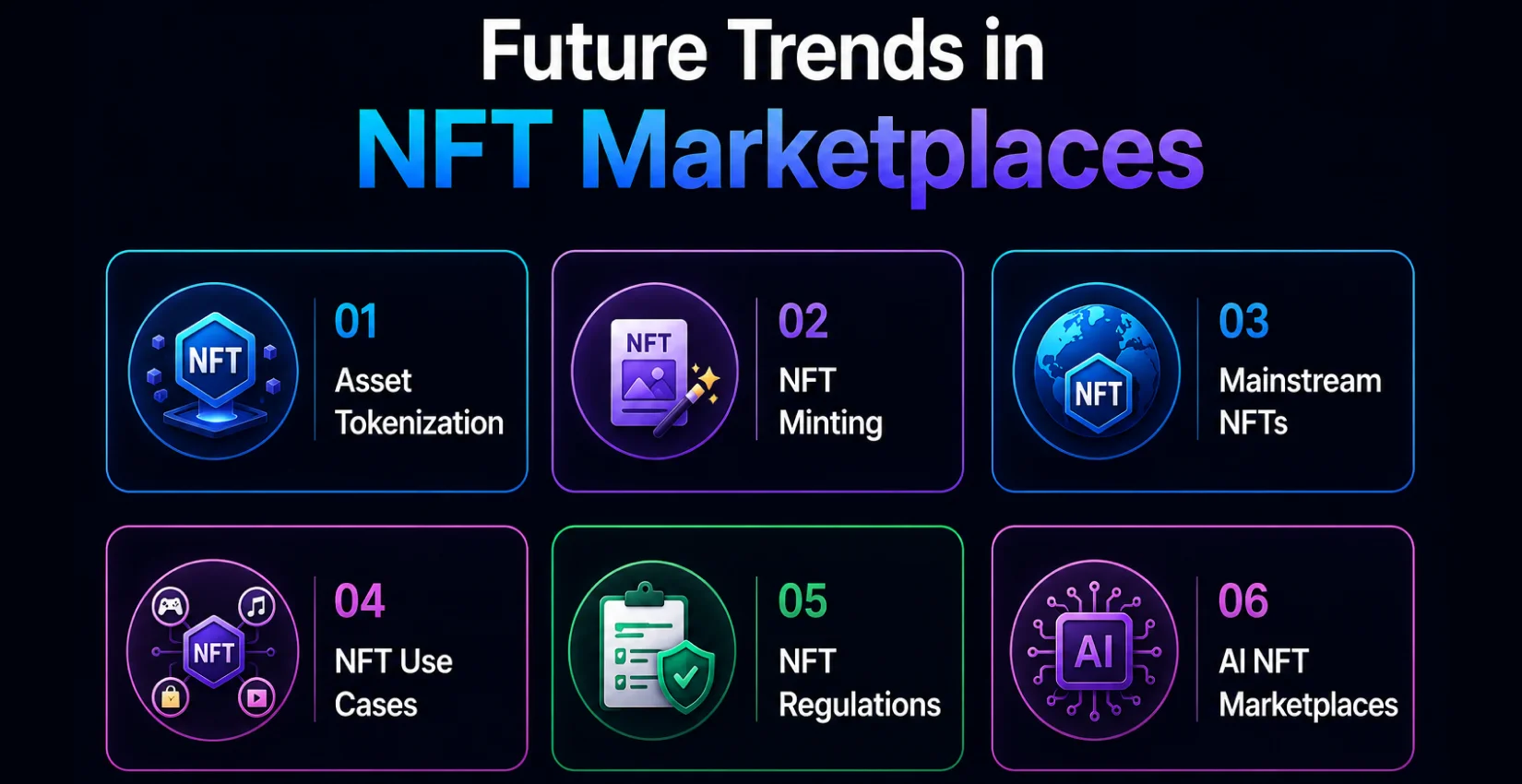
The fastest-growing category is precision asset tokenization, which includes bonds, real estate, commodities, and fine art. For most merchants, fractional ownership of previously unavailable items is made viable through RWA tokenization. $1 million of commercial assets can be broken down into 10,000 tokens, each worth $1,000. This is no longer theoretical; Currently, tokenization efforts are underway at major firms such as JPMorgan and BlackRock. Growing platforms in this regard need a solid compliance architecture and a crypto wallet development company.
How NFT Values Change Based on Use Cases
The cost to develop an NFT marketplace varies greatly by category as NFTs grow into tangible assets. Each physical item that is digitized (photography, 3D scanning, legal paperwork) costs between $500 and $5,000. From $50–$200 per mint on the Ethereum mainnet to less than $1 on Polygon or Base, mining expenses have significantly decreased on Layer-2 networks. The crypto wallet development cost also plays a role: an account abstraction for email-based onboarding adds $8,000–$20,000 to a build, while a self-custody wallet integration adds $5,000–$15,000. Gas optimization, contract maintenance, and IPFS pinning fees are examples of ongoing ownership expenses.
Will NFTs Go Mainstream?
Because NFTs have an absolutely wonderful feature, they do not replace foreign currency. NFTs are valuable because of their strong point, while currency is fungible (exchangeable). NFT will likely be an invisible infrastructure like HTTPS. Within ten years, many of those things-including digital certificates, sports tickets, concert tickets, luggage cards-could be NFTs without user expertise. Account abstraction (email access, no cryptocurrency wallet needed) and cell-first structures masquerading at the blockchain level are already branching widely.
NFT Use Cases Expanding Across Industries
Digital and physical artifacts (author royalties, origin tracking), games (commercial game assets, moving game object transport), real global assets (assets, items, bonds), and virtual identities (credentials, event access, using club tokens) in 2026 are several live NFT2xi. 12 million identity NFTs (Decentralized IDs) have been released, which are compatible with Fortunly. Each vertical has unique development cost implications and technical requirements.
The Legal Environment
Each country has quite different NFT regulations. Frameworks about digital asset classification, KYC/AML standards, and securities law are being actively developed by the US, EU, and UK. While some jurisdictions function in a legal limbo, others have well-defined regulations. Building with a compliance-ready design now reduces the cost of retrofits in the future. Over the next five to ten years, there will probably be a global standardization, and the platforms that develop clean today will have the lowest transition costs.
AI-Powered Marketplaces & Dynamic NFTs
By 2026, AI recommendation systems will be commonplace. Rapidly growing class of dynamic NFTs (dNFTs) requires chainlink oracle integrations that handle in response to real global opportunities (gaming locations, market costs, weather). Although these characteristics make improvement extra difficult, they allow completely new product experiences that are not possible with static structured NFTs.
How a Development Partner Can Support NFT Marketplace Development ?
Before NFTs became popular, Octal IT Solution developed blockchain-powered solutions. The company has completed projects in the fields of art, gaming, RWA tokenization, and commercial enterprise blockchain, combining extensive expertise in smart contracts with tried and tested marketplace configurations.
We connect the real scale of your business, with security as the top problem, and guide you through and past launch, whether you need an NFT marketplace development company to quickly validate your MVP or a unique platform built from the ground up. We provide pure, milestone-first-based pricing for NFT Marketplace development that is customized to your market agenda.
The services we provide include: UI/UX design, wallet integration, decentralized storage, multi-chain market creation, smart contract management and auditing, and post-launch maintenance.
Get the right, no-duty offer in your specific use case with the help of a thorough conversation with our team now.
Wrapping It Up
The development of the NFT market in 2026 will require a broader economic commitment, but it will have a well-established market. Successful organizations do not depend on hype. They fuel in-game economies, present author royalties, assert ownership, and provide fractional access to valuable tools.
Your choices about blockchain, feature set, team model, and custom education will determine how much of a good deal it will cost to build an NFT marketplace. Make an honest budget, account for unexpected fees, and choose a blockchain development partner with experience in this area.
The fate of the NFT market is not in question. That’s clear from the statistics that assume $152.54 billion by 2030. Whether your platform will be sufficiently developed to gain a spot in it is the question.


 Get in Touch
 By
By August 7, 2026