



The cryptocurrency market has developed rapidly. Buyers and sellers don’t need banks, agents, or centralized platforms to trade digital assets. They have complete control over their money and can do it directly, on their own terms and at their own pace. A peer-to-peer cryptocurrency exchange makes this possible.
This change presents a huge opportunity for organizations. Investing in a p2p crypto exchange development puts you at the forefront of one of the fastest-growing industries in global finance. This applies whether you are a fintech startup, a blockchain company, or a business looking to move into the crypto market.
This blog covers everything about P2P cryptocurrency exchange development. You’ll learn how P2P exchanges work, key features, development costs, technology stack, guidelines, and effective ways to get started.
- What is a P2P Crypto Exchange & How Does It Work?
- P2P Exchange vs. Centralized Exchange:
- Types of P2P Crypto Exchange Models
- Top Crypto Exchange Mobile Apps to Inspire You to Build One
- 1. Coinbase
- 2. Binance
- 3. Crypto.com
- P2P Crypto Exchange Market Overview (2026)
- Legal & Licensing Requirements for a P2P Exchange
- Key Features for a Competitive P2P Crypto Exchange
- How to Build a P2P Crypto Exchange: A Step-By-Step Process
- Tech Stack for P2P Crypto Exchange Development
- How to Monetize Your P2P Crypto Exchange
- How Much Does It Cost to Build a P2P Crypto Exchange
- Security Best Practices for P2P Crypto Exchanges
- Business Benefits of Building a P2P Crypto Exchange
- Common Challenges & Solutions in P2P Exchange Development
- Future Trends of P2P Crypto Exchanges
- Build Your P2P Exchange Software With Octal IT Solution
- Final Thoughts
- FAQs
What is a P2P Crypto Exchange & How Does It Work?
A peer-to-peer (P2P) crypto exchange lets customers trade cryptocurrency directly with one another. This happens without any banks, brokers, or middlemen involved. The platform itself acts as a facilitator rather than a custodian.
Here’s how the process works in P2P crypto exchange apps. A seller shares an offer. It includes details about cryptocurrency, the price, and payment methods. After discovering the offer, the buyer initiates the transaction. This program automatically holds the funds until both parties fulfill their obligations. The smart contract verifies the payment, then it sends the cryptocurrency to the customer’s wallet. The platform steps in to resolve disputes.
Users have complete control over their money and data with this strategy. Because no central authority holds the funds, counterparty risk is removed. The escrow-plus-smart-contract structure is both the foundation and differentiator of a specific function of a robust P2P platform. It is also what separates serious fintech makers and blockchain app development company partners from the rest.
P2P Exchange vs. Centralized Exchange:
For years, the market has been dominated by centralized exchanges (CEXs) such as Binance and Coinbase. However, they came with real drawbacks, such as severe geographical restrictions, higher costs, multiple factors of failure, and custodial control of user funds.
Most of these problems are solved through P2P exchanges. This is a specific comparison:
| Feature | P2P Exchange | Centralized Exchange |
| Fund Custody | User holds own funds | Exchange holds funds |
| Privacy | High – minimal KYC options | Low – full KYC required |
| Fees | Lower, peer-set | Platform-controlled, higher |
| Downtime Risk | Lower – decentralized | High – single point of failure |
| Geographic Access | Global, borderless | Often restricted by region |
| Payment Methods | Flexible – bank, UPI, PayPal | Limited – often crypto only |
Businesses are switching to the P2P model. This is due to lower costs, more users, and a global reach. The P2P structure provides revenue opportunities that a decentralized exchange development company can access more easily than a CEX.
Types of P2P Crypto Exchange Models
In crypto app development, P2P exchanges are designed differently. Depending on their target market and business goals, companies can choose from four main models:
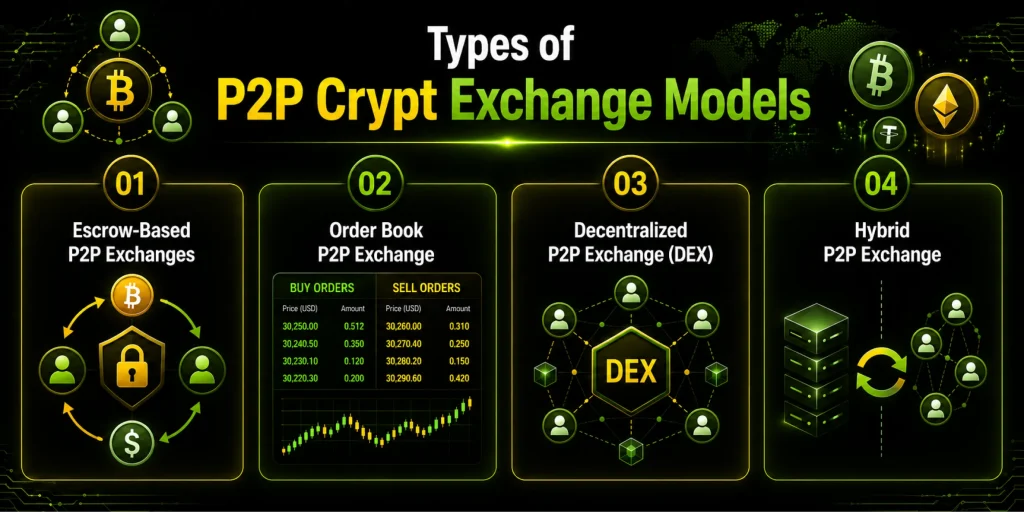
Escrow-Based P2P Exchanges
This is the most commonly used model. During the trade, cash is placed in escrow and released only when certain requirements are met. LocalBitcoins and Paxful-style structures are examples.
Order Book P2P Exchange
Orders are placed through buyers, and the platform matches them. Through trades that happen peer-to-peer, an automated order book handles the matching.
Decentralized P2P Exchange (DEX)
This model is completely decentralized and on-chain. Everything is controlled entirely through smart contracts. Variations of this version are used by dYdX and Uniswap.
Hybrid P2P Exchange
Combines centralized matching speed with decentralized custody. The best of both worlds provides platforms aimed at expansion and privacy.
Selection of an accurate model is an essential priority. You can explore what best suits your user base, business goals, and regulatory environment with the help of a pro cryptocurrency exchange development company.
Top Crypto Exchange Mobile Apps to Inspire You to Build One
1. Coinbase
Coinbase, founded in June 2012, is a widely used cryptocurrency exchange platform with a user-friendly mobile app available on both iOS and Android. The app has garnered millions of downloads, offering a seamless interface for users to buy, sell, and manage various cryptocurrencies. Headquartered in San Francisco, California, Coinbase provides a secure environment for trading digital assets and has become a popular choice for both beginners and experienced crypto enthusiasts.
2. Binance
Launched in July 2017, Binance, a major player in the cryptocurrency space, provides a robust mobile app compatible with iOS and Android devices. Known for its global presence, Binance’s app has witnessed millions of downloads, allowing users to trade an extensive range of cryptocurrencies. Originally founded in China and later relocating to Malta, Binance offers a diverse range of features, including spot and futures trading, making it a go-to platform for those seeking a comprehensive crypto trading experience.
3. Crypto.com
Established in 2016, Crypto.com has gained popularity with its mobile app, catering to various financial services beyond traditional cryptocurrency trading. Available on both iOS and Android, the app has seen millions of downloads. Based in Hong Kong and operated by Foris Inc. (formerly Monaco Technology GmbH), Crypto.com, led by CEO Kris Marszalek, offers features such as crypto payments, a Visa card, and a diverse range of financial products, making it a versatile platform for users looking to engage in both crypto trading and broader financial services.
P2P Crypto Exchange Market Overview (2026)
The global crypto market will likely grow at a CAGR of 19.29%, increasing from $24.75 billion in 2024 to $71.94 billion by 2029. Similarly, the exchange platform market will likely expand from $50.95 billion in 2024 to $150.1 billion by 2029.
P2P crypto exchange software is growing fastest in emerging regions. By 2025, APAC crypto volume will reach $2.36 trillion, growing at a 69% annual rate. Latin America observed a gain of 63%. P2P volume in Kenya hit $49 million in Q2 2025. This led to a 52% boom in sub-Saharan Africa.
Active exchange users are projected to grow from 18.9 million in 2024 to 53.56 million by 2025. Mobile-first P2P systems will drive much of this growth.
The market for P2P cryptocurrency exchange development is large. It is growing rapidly and remains underpenetrated, especially in large KY trading areas.
Legal & Licensing Requirements for a P2P Exchange
You need to know the legal environment before you write a line of code. Countries have strict policies on cryptocurrency exchange. Errors can prevent your platform from launching.
The following requirements for most countries are:
1. AML/KYC Compliance
At most, face-to-face interviews with customers are required in regulated markets. They also demand control over money laundering. Verify the identity of customers on your platform. Flag any suspicious behavior.
2. Money Services Business (MSB) License
Essential for any forum on cryptocurrency-to-fiat transactions within the United States and Canada.
3. Virtual Asset Service Provider (VASP)
Required under FATF guidelines in the EU, UK, UAE, and many other jurisdictions.
4. MiCA Compliance (EU)
The market regulation for crypto-assets came into full effect in 2024. P2P exchanges based entirely in the EU are required to comply with their policies on custody, customer security, and disclosure.
5. Data Privacy Laws
The user data processing is governed by the GDPR in Europe, the PDPA in Southeast Asia, and comparable legislation.
Partnering with a p2p cryptocurrency business development agency is wise, preferably if they have a regulatory understanding. It is less costly to build compatibility within the platform than to add it later.
Key Features for a Competitive P2P Crypto Exchange
Users’ trust and loyalty towards your platform are decided through the features you provide. For any major cryptocurrency exchange platform development initiative, the following features must be included:
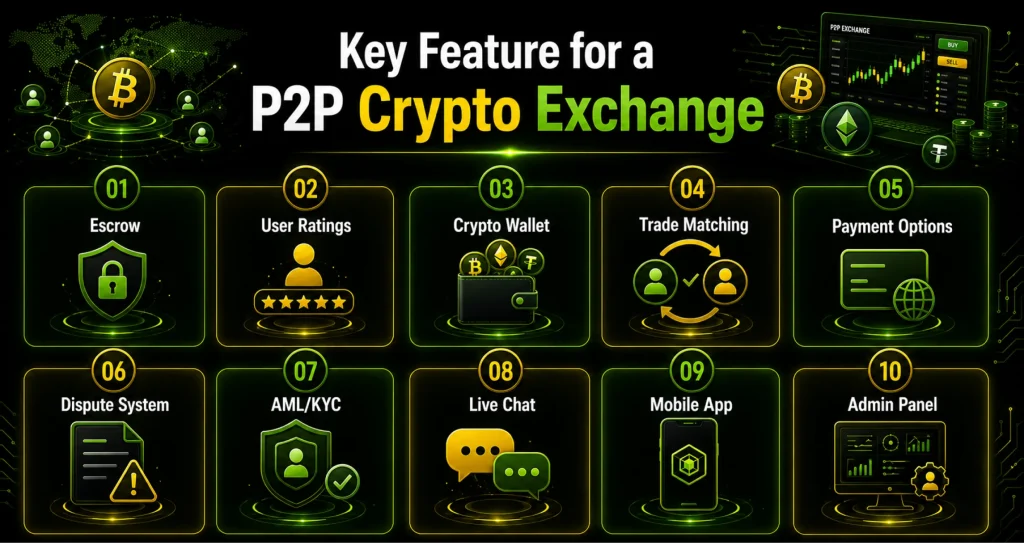
Escrow Smart Contracts
Hold and release cash automatically depending on the terms of the change. The foundation of all safe peer-to-peer transactions.
User Reputation & Rating System
Let buyers and sellers build a trust score based on feedback and completed transactions.
Multi-Currency Wallet Integration
Use a non-custodial wallet for Bitcoin, Ethereum, USDT, and other major cryptocurrencies. You can also work with a crypto wallet development company.
Advanced Trade Matching Engine
Connect buyers and sellers fast. Use filters for price, payment methods, and location.
Different Payment Options
More payment options mean better chances for worldwide adoption. This includes bank transfers, UPI, PayPal, mobile money, and more.
Dispute Resolution System
A well-defined escalation procedure with administrative arbitration for failed trades.
AML/KYC Verification Module
Built identity verification with third-party tools, such as Jumio or Sumsub.
Real-Time Chat
During live trading, buyers and sellers can communicate through encrypted text messages.
Mobile App Support
In 2026, a fully responsive crypto exchange app for both iOS and Android is essential.
Admin Dashboard
Complete insight into user behavior, platform performance, conflicts, and trades.
These features serve as a cornerstone. You can make your platform stand out with premium features. Consider adding DeFi yield integration, cross-chain swap support, and AI-based fraud detection.
How to Build a P2P Crypto Exchange: A Step-By-Step Process
From concept to launch, the development process of P2P crypto exchange software uses a methodical approach. This is how it works:
Market Research
Determine the geographic area, supported currencies, payment methods, and target user base. Research your competitors and find your point of differentiation.
Define Business Model
A successful cryptocurrency exchange software project starts with defining key features, user flow, and the revenue model. Then, you can move on to the design phase.
UI/UX Design
Emphasize simplicity and create an ideal structure and wireframe. The interface needs to accommodate every new and experienced P2P client.
Smart Contracts Development
Write, test, and audit escrow contracts. Knowledge of smart contract development services is critical in this situation.
Backend Development
Create an order eBook, a user management tool, a trade matching engine, and an API layer.
Wallet Integration
Integrate non-custodial wallets for safe asset management or connect with a provider of digital wallet app development.
Payment Gateway Integration
Use a payment gateway development services partner to connect fiat on/off ramps. Encourage your target market to use local payment methods.
Security Assessment
Perform code reviews, smart contract audits, and penetration testing before launch.
Testing
Check functionality, load, and security. Simulate high-volume trading situations.
Launch & Scale
During the first 90 days, you will set up on the main network, register initial users, and monitor performance closely.
Tech Stack for P2P Crypto Exchange Development
The platform’s overall performance, scalability, and long-term maintainability are all impacted by the ideal technology stacks you select for crypto exchange software development. Here are the top technologies that P2P systems will use in 2026:
| Layer | Recommended Technologies |
| Frontend | React.js, Next.js, Vue.js |
| Backend | Node.js, Python (Django/FastAPI), Go |
| Blockchain | Ethereum, Solana, BNB Chain, Polygon |
| Smart Contracts | Solidity, Rust (for Solana) |
| Database | PostgreSQL, MongoDB, Redis (caching) |
| Cloud Infra | AWS, Google Cloud, Azure |
| Security | SSL/TLS, 2FA (Google Authenticator), HSM |
| Mobile | React Native, Flutter |
| API Layer | REST, GraphQL, WebSocket (real-time) |
White label crypto exchange software development is a great option if you want speed to the market. White-labeled responses save 40–60% of development time. You can tweak the tested hub instead of starting from scratch.
How to Monetize Your P2P Crypto Exchange
A well-considered P2P crypto exchange development revenue model plan can start delivering from day one. The models tested are as follows.
Trading Fees
A small share (0.1%–1%) shall be taken for each completed trade. For most P2P platforms, this is their fundamental source of profit.
Escrow Costs
Charge a flat or percentage fee for using the platform’s escrow service.
Premium Listings
Allow suppliers to pay for better exposure or top ratings in search results.
Membership Plans
Offer monthly or yearly subscriptions with expanded capabilities, multiple change limits, faster matching, and dedicated assistance.
Fiat On/Off Ramp Fees
Profit margin on fiat-to-crypto conversion. Collaborate with the fintech app development company to incorporate split-fee supporting payment channels.
P2P Lending Integration
P2P lending app development that offers cryptocurrency-backed loans and earns interest spreads from your user base.
API Access
Pay third-party businesses or developers to use trading data and corresponding engines on your platform.
How Much Does It Cost to Build a P2P Crypto Exchange
Scope, features, operations, tech stack, and whether you’re starting from scratch or using a white-label foundation all have an impact on the final price. Partner with a reliable development partner who provides a clear p2p cryptocurrency exchange development cost. Here’s the reality breakdown to get the idea:
| Development Type | Timeline | Estimated Cost |
| White Label Solution | 4–8 weeks | $15,000 – $40,000 |
| MVP (Core Features) | 3–5 months | $40,000 – $80,000 |
| Full Custom Platform | 6–12 months | $80,000 – $200,000+ |
| Enterprise-Grade Platform | 9–12 months | $200,000 – $500,000+ |
Smart contracts are complex. The types of blockchains supported matter, too. Mobile operations and security checks play a role. Also, licensing costs are key factors.
The choice between custom development and white-label cryptocurrency exchange software development also significantly impacts the overall budget.
Every year, ongoing costs, web hosting, maintenance, compliance, and customer service usually account for 20-30% of the development cost.
You can save money and time without losing quality. Work with a solid p2p crypto exchange software development company. They should provide milestone-based delivery and clear pricing.
Security Best Practices for P2P Crypto Exchanges
Security is the cornerstone, not the feature. P2P platforms are valuable targets for attackers when you consider that they handle real cash and real user data. Strong P2P crypto exchange software development security looks like this:
Multi-Signature Wallets
Multiple approvals are required for overvalued transactions. Reduces the risk of single-point theft.
Two-Factor Authentication (2FA)
Required for every user account. The prototype is TOTP-based (Google authentication).
End-to-End Encrypted Communication
All conversations between investors should be encrypted to protect your messages from being intercepted.
Smart Contract Audits
Before going live, each escrow contract should be independently audited. There are no exceptions.
DDoS Protection
To prevent traffic flood attacks that can take your platform offline, use AWS Shield or Cloudflare.
IP Whitelisting & Rate Limiting
Stop unauthorized API access and brute-force login attempts.
Cold Storage for Reserves
If your platform holds any funds, keep the majority in cold storage. Your wallet structure can be secure from the start if you work with a crypto wallet development company.
Regular Penetration Testing
To identify and fix vulnerabilities early, use external security companies to conduct quarterly pen tests.
Read Also: Decentralized Exchange Development: Complete Guide
Business Benefits of Building a P2P Crypto Exchange
Investing in cryptocurrency exchange software development services is a profitable long-term scheme. Businesses are building P2P platforms in 2026 for the following reasons.
Global Market Access
Reaching customers across Latin America, Africa, Southeast Asia, and underbanked regions where peer-to-peer cryptocurrency is often the main financial tool.
Lower Operating Cost
There is no need for large liquidity reserves and protective infrastructure. The P2P approach is leaner in nature.
Recurring Revenue
Transaction fees and subscriptions create predictable, compounding income streams through your cryptocurrency exchange app development investment.
Brand Trust
Compared to custodial CEX options, a non-custodial model where customers hold their own keys builds stronger user trust and loyalty.
Regulatory Flexibility
In certain jurisdictions, P2P platforms using the facilitation-only model are subject to less stringent regulations than custodial exchanges.
White Labeling Opportunity
Once built, your crypto exchange white label software development can be licensed to other businesses as a SaaS product.
Bonus Read: How much does it cost to develop an ICO in 2026?
Common Challenges & Solutions in P2P Exchange Development
There are challenges in developing a peer-to-peer cryptocurrency exchange. Here’s what to expect and ways to solve.
Challenge: Fraud & Scams
Solution: Use reputation systems, trade limits for new users, and AI-based anomaly detection to catch fraud early.
Challenge: Liquidity Bootstrapping
Solution: Early-stage structures are killed through low liquidity. Run incentive programs, referral rewards, and partnerships with market makers to build liquidity fast.
Challenge: Regulatory Uncertainty
Solution: Partner with legal experts for each target market. Include compliance features in the platform so you can quickly adjust if policies change.
Challenge: Dispute Management At Scale
Solution: Manual dispute resolution doesn’t scale. Only complex issues should be escalated to a human mediator; The first level triage should be automated.
Challenge: Smart Contracts Vulnerabilities
Solution: Get every escrow contract written, audited, and stress-tested through expert smart contract development services before you go live.
Challenge: Cross-chain Complexity
Solution: There is additional technical overhead that supports multiple blockchains. Use the existing bridge protocol and test the optimal size before launching any new chain.
Future Trends of P2P Crypto Exchanges
The market for p2p exchange development is growing rather than contracting. The following patterns will shape the next phase of growth through 2026 and beyond:
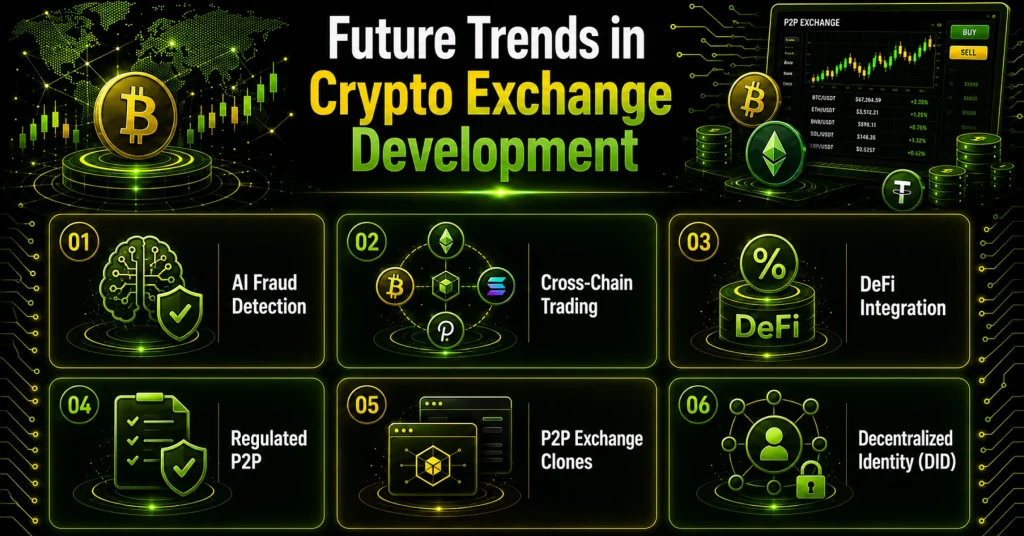
AI-Powered Fraud Detection
Machine learning models will soon flag suspicious trade patterns in real time. This will be standard on major P2P platforms.
Cross-Chain Trading
Customers can rely on easy transfers between Ethereum, Solana, Bitcoin, and more. No need to manually bridge or wrap tokens.
DeFi Integration
P2P systems are now linking with DeFi protocols. This helps create hybrid CeFi/DeFi products. These products aim to reach a wider audience. They provide yield, credit, and liquidity.
Regulated P2P in Developing Markets
Governments in Africa, the Middle East, and Southeast Asia are creating licensing systems tailored to cryptocurrencies. Early-mover P2P platforms with clean compliance records will have a major advantage.
P2P Crypto Clones
As commercial business owners look for faster routes to market, the market for P2P Crypto Exchange Clones – quick launch white-labeled platforms based on Paxful or LocalBitcoins – is growing.
Decentralized Identification (DID)
To reduce KYC friction while staying compliant, customers will soon self-authenticate. They will use blockchain-based credentials for their identity across multiple systems.
Build Your P2P Exchange Software With Octal IT Solution
Octal IT Solution has deep experience in blockchain, fintech, and exchange platform development. This makes them a top choice for p2p crypto exchange development. We’ve helped companies in the US, UAE, UK, and Southeast Asia build secure, scalable, compliant systems. Our services cover everything from smart contracts to post-launch support, and our in-house team means you won’t need to juggle multiple vendors.
We deliver on time and under budget, Whether you need a full custom build, a white-label launch, or an MVP to test your idea, we’ve got you covered.
Smart contract creation, escrow system design, KYC/AML integration, mobile app development, security audits, and post-launch support are all included in our comprehensive p2p crypto exchange development services.
We bring together blockchain engineers, security experts, and compliance professionals under one roof as a top cryptocurrency exchange development company, eliminating the need for you to manage many vendors.
Ready to launch? Talk to our team today and get a free consultation tailored to your business goals and budget.
Final Thoughts
P2P cryptocurrency exchanges allow customers to exchange digital assets, and businesses that move early will capture more value. The growing p2p crypto market presents a strong opportunity for long-term business growth.
Every choice you make in the planning phase helps you at launch and beyond. These decisions include determining the best model and features, navigating regulatory requirements, and selecting your cryptocurrency trading software development partner.
Octal IT Solution is right here to help you make smarter choices. Connect with our team, and build a quality product with us.
Read More : cryptocurrency exchange development companies

 By
By August 7, 2026





 Latest Stories
 Get in Touch