


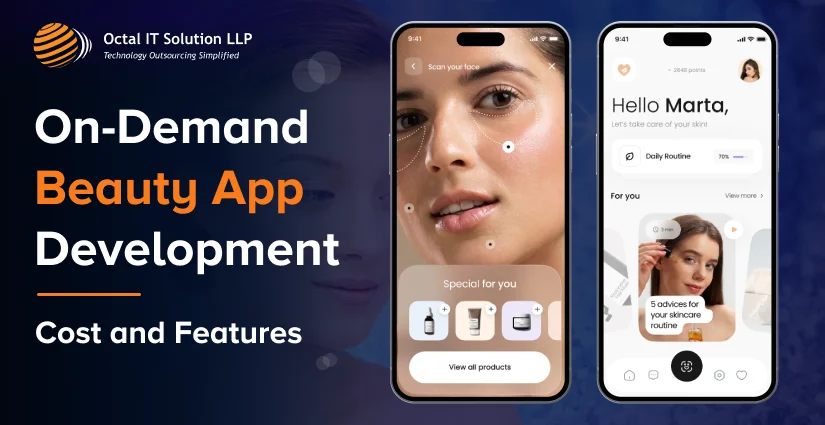
We live in a time where a book is always judged by its cover. Social media has made it so significant for everyone to look good that people can invest much of their earnings in their looks. Be it dressing in a particular manner, putting up makeup, or trying various accessories, it is all for some good pictures that go to the internet.
Many business owners have monetized the trend with on-demand beauty app development where the end-user can select any particular type of beauty service, and the beautician goes home to offer these services.
Sounds like an ideal plan!
Suppose you are heading toward the on-demand beauty mobile app development services for your new startup and are afraid of missing the crucial points. This post will guide you through the whole process.
In this scenario, the businesses can either link to the professional stylist or with the salon owners, or they can tie up with both and can serve users with the beauty services offered at the users’ location or at the salon itself.
Now, when you are developing an on-demand beauty service mobile app, you will have all the reliable beauty solutions accumulated under a single roof with the best price and variety of features.
So, in this post, you will find out all the features of the on-demand beauty service mobile app associated with any of the business models to cater an amusing styling approach to your users.
Why Invest in Beauty Service Mobile App Development?

According to Verified Market Reports, Beauty Application Market size was valued at USD 557.24 Billion in 2023 and is expected to reach USD 878.4 Billion by 2030 with a CAGR of 7.7% during the forecast period 2024-2030.
- In 2023, the beauty care industry is expected to generate US$45.68 billion in revenue.
- It is anticipated that revenue will expand at a 9.84% annual rate (CAGR 2023–2027), translating into a projected market volume of US$66.50 billion by 2027.
- With a market volume expected to reach US$10,980.00 million in 2023, the US accounts for the majority of revenue.
- By 2027, there will likely be 1.6 billion people in the beauty care industry.
- By 2027, user penetration is predicted to reach 20.8%, up from 16.8% in 2023.
- It is anticipated that the average revenue per user (ARPU) will be $35.46 USD.
Features of On-Demand Beauty Service App
So, what are the key features to consider during the development of a beauty services mobile app?
The beauty app development team finishes the complete beauty on-demand application in four different phases. The on-demand beautician software would be used by end-users, salon owners, beauticians, and the admin. So, the on-demand beauty service app needs to integrate features that make it easier for all of them to interact with the app to find beauty services.
Let’s talk about each of the aspects one at a time.
User Panel Features – Beauty Services Mobile App Development
In the beauty app development process, it is the user panel that gets the most attention. It would be the end-users only who would define the success or failure of an application and what it would bring to the market.
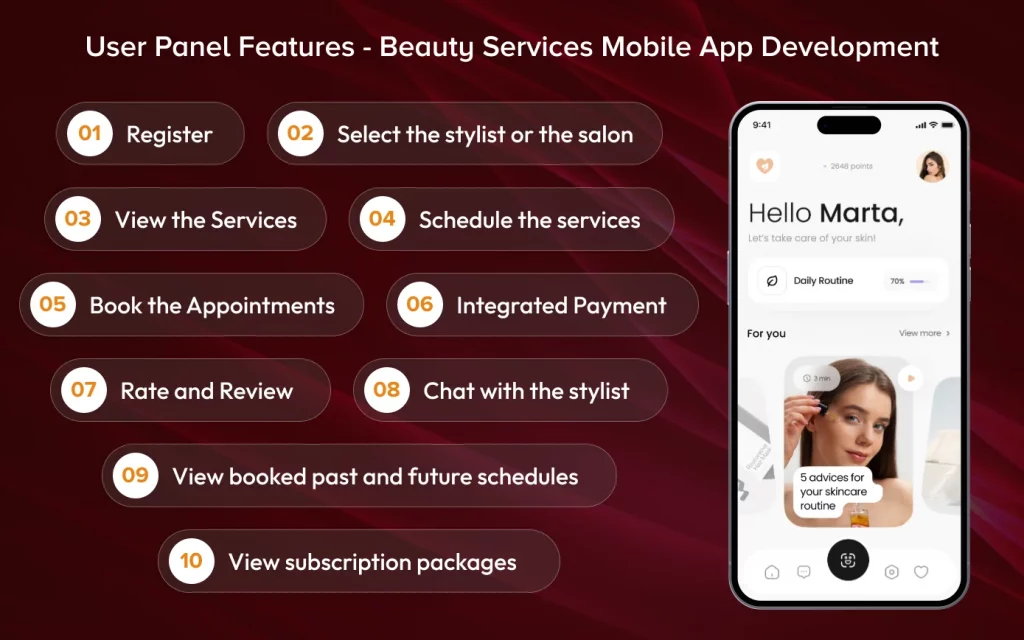
Register
This is the introductory section of the app where the user will land. They can sign in with the help of social networking or email account credentials.
Select the stylist or the salon
Under this section, the user can select from any of the options:
- The users can select a professional beautician and can send the request
- In this case, users can select a particular salon. According to their request, a stylist is assigned to the users.
View the Services
The users can view the services delivered by the beautician and can send them the request as required.
Schedule the services
Once done, the users can then send the request to the considered beautician or the salon owners.
Book the Appointments
The users then can assign them the date on which they want to avail of the beauty on-demand services. They can set the time and hours for the make-up and styling activities.
Integrated Payment
Users can pay the concerned beautician or the salon owner via integrated payment models such as Credit/Debit cards, net banking, etc.
Rate and Review
The users can check the ratings and reviews for each of the salons and beauticians. This helps users book the stylist conveniently.
View booked past and future schedules
Under this section, users can check their past bookings and schedule future dates to book beauty services with just a single tap.
View subscription packages
Under this section, the users can check the beauty packages related to different services, such as facials and cleaning, manicures and pedicures, hair styling, etc, along with the price charts.
Chat with the stylist
The users can communicate with their respective beautician or the salon owner to discuss the various services.
Since we are talking about both salon owners and professional beauticians, the on-demand beauty service app will contain a separate panel for both modules. However, the app owner can select any of the business models as required before processing for On-demand beauty app development.
Salon Owner Panel – On-demand Beauty Service App Development
The next panel in beauty salon app design that we are talking about is service providers, the salon owners. On-demand beauty app development experts must include features in the application that would make it easier for the app users to confirm and decline the orders as per the availability of the beauticians.

- Register: This will remain similar to the user panel. The salon owner can register with the help of a social network or email account credentials.
- View user request: The salon owner can view the user’s request. Depending on the type of services users seek to avail of, the owner can assign the stylist to a particular user.
- Manage their catalog: Under this section, the salon owner can manage their catalog and showcase different hairstyles, facials, etc.
- Manage the services: The owner can manage their services as well. They can add or delete the services as per the user’s requirements and stylist expertise.
- Schedule the stylist for the users: Under this section, the salon owner can check the booking appointments for every stylist. And as per their expertise, the owner can assign them the user request.
- Accept/decline the user’s request: Depending on the user’s request and the stylist’s availability, the owner can accept or decline the user’s request.
- Add the cost of services and sub-services: The salon owner can modify the price of different services as per the market trends.
Individual Beauty Expert Panel Features
- Register: Again, this is similar to both the user and the salon panel. The professionals can log in with the help of email or social network account credentials.
- View bookings: The stylist can check the users’ requests and the type of services they seek to avail themselves of.
- Manage calendar: Under this feature, the stylist can manage their booking calendar. They can schedule the appointments for a particular date and time before confirming the user’s request.
- Accept/Reject/Reschedule user request: As per the number of bookings aligned, the stylist can accept, reject, or reschedule the services to meet the user’s requirements.
- List services and prices: Under this module, all the benefits and the prices that the beautician delivers.
- Payments: Professional stylists can receive payments from their clients within the On-demand beauty mobile app.
- Manage their catalog: Under this section, the stylist can manage their catalog and showcase different hairstyles, facials, and other beautifying tips to attract users.
Admin Panel Features – Beauty App Development
On-demand beauty app development experts develop the admin panel with features where the admin can explore the backend of the application and explore all the information stored with the app, but they cannot infringe on the privacy of the app users. We offer secure and safe solutions that let you earn a great name in the market with the launch itself.
Approve or reject stylist registration request: The users reserve all the right to approve or reject the registration request of the stylist or the owner.
Customer Management:
User profiles and customer information.
Customer support and communication tools.
Customer reviews and feedback management.
Service Management:
Service categories and subcategories management.
Pricing and commission management.
Service availability and scheduling.
Service request handling and assignment.
Booking and Appointment Management:
Booking and appointment scheduling.
Real-time appointment tracking.
Cancellation and rescheduling management.
Automated reminders and notifications.
Payment and Billing:
Payment gateway integration (credit card, PayPal, etc.).
Commission management for service providers.
Invoice generation and transaction history.
Dashboard and Analytics:
Real-time dashboard for tracking key metrics.
Performance analytics for service providers.
Customer behavior and trends analysis.
Revenue and earnings reports.
Other than the user panels, there are a lot more features that need to be integrated with your beauty on-demand application for better results. These are the real USPs of your application that would make your application stand out from the crowd.
Advanced Features to Develop Outstanding On-demand Beauty Services App
Our experts study your salon services app in detail to ensure that you don’t enter the market with the same loopholes as your competition. We make it a point to study your competition and other top applications of the industry before we lay the road map for the beauty app development of your application.

1. Live styling and facial videos
With the aid of the stated feature, the users can view live hairstyling and facial videos posted by different salons and stylists. This helps a lot in delivering the exact idea about the styling, plus it also helps in keeping the users attuned to your app for at-home beauty services.
2. Toggle beauticians’ availability
With this feature, users can toggle the availability of salons or beauticians within their defined radius. They can track the nearby salons and professional beauticians and can identify the associated beauty services to make themselves conveniently available.
3. Blogging and research
All styling research and blogs can be published by different stylists and professionals. This way, users will be able to view all the trending make-up and beautifying options and can remain updated with all the beauty and make-up tips.
4. Subscription packages
Subscription packages allow the users to avail themselves of more than one service at a time. In the beauty app development, subscription packages play a major role, and many salons prescribe them to allow users to avail themselves of maximum services at a cost-effective price.
5. Social media integration
Your on-demand beauty service mobile app must allow users to share their experiences on social media. In today’s scenario, users love to share images over social media, and if they are styled by professionals and reputed salons, posting the images becomes necessary.
6. E-commerce
The E-commerce option of the beauty salon app design allows the users to buy the beauty products that are used or recommended by their stylist and salon. Moreover, they can verify the product details and thus can order within the On-demand beauty service mobile app. This is an excellent feature that keeps users glued to the app.
7. Push notifications
With the help of push notifications, users can be kept updated with different make-up tips, facial options, and much more. All the messages related to the payment, order confirmation, new users’ requests, etc., can be sent to the users, stylists, and salon owners to keep them attentive.
These features would find extensive application in your product, making it one of the most popular applications in the market. The team that works for your project uses cutting-edge technology that affirms that your product is future-ready and highly rewarding. Sounds like a good option? Surely it is!
Read More: How to Develop Apps Like TaskRabbit – Cost and Key Features
Top On-Demand Beauty Service at Home for Inspiration
1. Treatwell

Hair & Beauty (Country: United Kingdom): Treatwell is a beauty and wellness booking platform that originated in the United Kingdom. Treatwell allows customers to discover and book various hair and beauty services from local salons and spas. Users can choose from various services, including haircuts, manicures, massages, and more, and make appointments at their preferred salons and spas.
2. Soothe
Wellness On Demand (Country: United States): Soothe is a wellness on-demand app that was founded in the United States. Soothe offers customers the convenience of booking professional massage therapy services to their homes or locations of their choice. Soothe connects users with licensed massage therapists for relaxation and stress relief.
3. YesMadam
Beauty Service at Home (Country: India): YesMadam is an Indian beauty service at home app that connects customers with beauty professionals who offer various beauty services, including facials, waxing, and makeup, right at the customer’s doorstep. YesMadam is designed to cater to the beauty and grooming needs of customers in India.
4. Urban Company

Urban Company, originating in India, is a comprehensive home services platform that includes beauty services, home cleaning, repair, and more. Customers can book a wide range of beauty services, such as salon treatments, makeup, and hairstyling, all in the comfort of their homes.
Business Model for Beauty Services at Home Apps
1. Dedicated/Self-Owned Model
The dedicated or self-owned model in on-demand beauty services involves individual beauty salons or service providers operating their own branded mobile applications or websites. Customers use these dedicated apps to book appointments directly with the salon’s stylists and technicians for various services.
The salon sets service pricing and maintains full control over its operations, ensuring quality and consistency in the services offered. At the same time, it offers a personalized experience and fosters customer loyalty.
2. Aggregator Beauty Service App
Aggregator apps act as intermediaries, connecting customers with a diverse network of beauty service providers, including salons, freelance stylists, and spa professionals. Customers can access various services, read reviews, and book appointments with their preferred providers.
Aggregator platforms often standardize pricing for some services, charge a commission to providers, and implement quality control measures. Aggregator Beauty Service App offers providers greater visibility and access to a larger customer base, leveraging marketing and technology support, but service quality may vary among providers.
How On-Demand Beauty Service Mobile Apps Make Money?
On-demand beauty service mobile apps can generate revenue through various monetization strategies. Here are some common ways these apps make money:
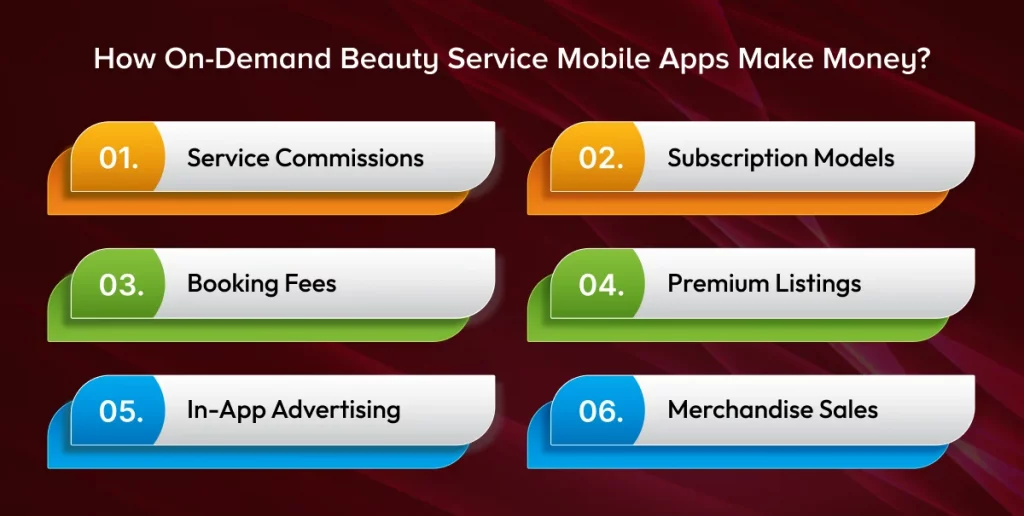
Service Commissions: The primary revenue source for many on-demand beauty service apps is service commissions. Beauty service at-home apps charge a percentage of the total service cost as a commission from the beauty professionals or salons listed on their platform. This percentage can vary, but it’s a straightforward way to generate income for the app.
Subscription Models: Some beauty service mobile apps offer subscription plans to customers, which typically provide benefits such as discounts on services, priority booking, or exclusive access to premium beauty professionals. Customers pay a monthly or yearly fee for these subscription benefits.
Booking Fees: On-demand beauty services Apps may charge customers a small booking fee for each appointment scheduled through their platform. This fee can cover the cost of app maintenance and development.
Premium Listings: Beauty professionals or salons may have the option to pay for premium listings, making their services more visible and prominent on the app. These paid listings can help them attract more customers.
In-App Advertising: Beauty service mobile Apps can monetize through in-app advertising by partnering with beauty and wellness brands or related businesses. They can display targeted ads or sponsored content within the app, generating revenue from advertising deals.
Merchandise Sales: Some beauty service apps sell beauty products, tools, or merchandise directly through their platform. They may take a percentage of the sales as a commission.
Learn More: 15 Best Hair Color Try On Apps in 2025
Technology Stack for Beauty App Development
To develop the best-in-class On-demand beauty service mobile app, you need to select the sound technological stack. An app that delivers optimized performance and adheres to all the quality standards certainly conserves a seat ahead of its competitors.
Therefore, carry out extensive technical research to craft the featured rich On-demand beauty service mobile app.
| Component | Technology/Tool |
| Frontend Development | React Native / Flutter |
| Backend Development | Node.js / Django |
| Database | MySQL / MongoDB |
| Cloud Hosting | AWS / Google Cloud / Azure |
| Payment Gateway | Stripe / PayPal / Razorpay |
| Push Notifications | Firebase Cloud Messaging (FCM) |
| Authentication | Firebase Authentication / OAuth |
| Maps and Geolocation | Google Maps API |
| Real-Time Chat | Socket.io / Twilio |
| Analytics | Google Analytics / Mixpanel |
With such advanced technology put to use, we make it a point that the app for at-home beauty services delivered to you is unique and interesting. We have been working in the industry for over a decade and have earned industry experience to make sure that your product turns out to be your identity on the internet.
Note: To enhance the user experience in on-demand beauty app development, integrating advanced technologies like VR app development can allow users to virtually try on makeup, hairstyles, or other beauty services, offering a more immersive and personalized experience.
How to Develop a Quality On-demand Beauty Service Mobile App?
Developing a mobile application is quite a complicated task, and the experts need enough time to research the details that are to be worked on. They study the latest technology, what is trending, and what is the reason for your competition’s failure.
Before the beauty app development process starts, these things are considered.
1.) Recognize your user requirement
Needless to say, this is very important. Perform intensive research on the user requirements, their likes, the most frequently used beauty services, the beauty products they are looking for, how often they visit the salon or book the services, and everything associated. View their comments and communicate with them to garner a brief understanding of their interests and preferences.
2.) Analyze
Your competitors always look for the beauty salon app design solution provided by the key players and consider all the attributes and the benefits that the competitors are delivering.
3.) Right mobile app development company
Certainly, finding a beauty app development company is a must for developing superior quality on-demand mobile apps for beauty services. It is extremely important to identify all the skilled project managers, astute iOS App developers, Android App Developers, UI/UX designers, and testers who can engineer quality mobile apps in the industrial niche.
4.) Implement the app development cycle in the right way
While initiating the development of the app to find beauty services, it must hit upon the right development procedure and the stages (Planning, analysis, design, development, quality assurance, and launch) for crafting out the best mobile app.
The development process is quite simple and doesn’t need a lot of energy from an experienced beauty app development company. Many business owners who come to us often question the cost of developing a salon marketplace platform.
The cost of developing any mobile application is defined by the features and details that are used. Here, we share the most influential factors that define the sum of your investment.
Cost of Developing an On-demand Beauty Service Mobile App
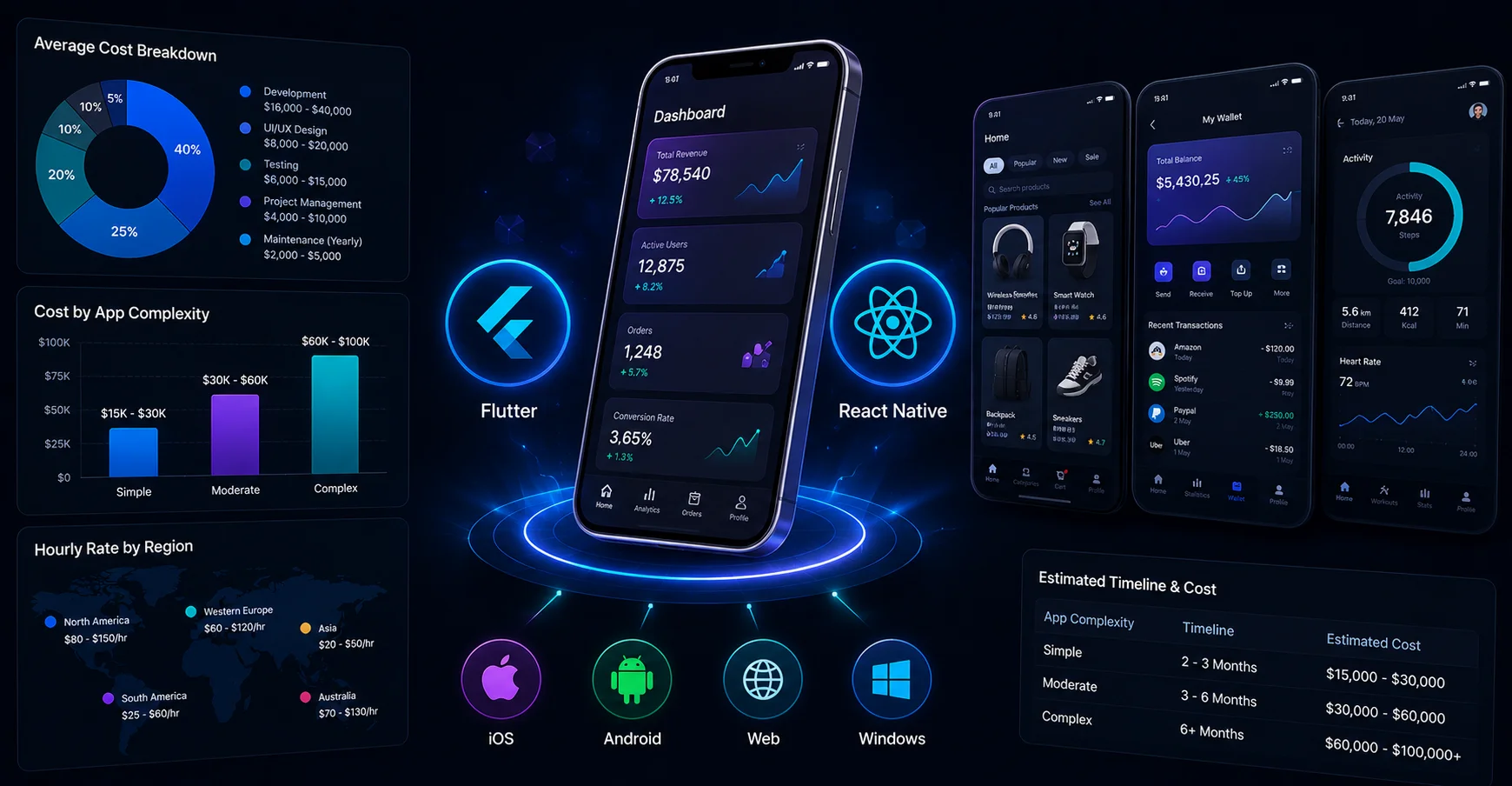
The finalized mobile app development cost entirely depends on the apps’ functionalities, size, and rates that are laid by the different salon services app developers coming from different physical locations. So, here is a breakdown of the development costs for on-demand beauty service apps based on complexity, including developer roles and estimated expenses.
| Developer Role | Basic App (Approx. $20,000) | Advanced App (Approx. $40,000) | Complex App (Approx. $80,000) |
| Project Manager | $2,000 – $3,000 | $4,000 – $5,000 | $7,000 – $9,000 |
| UI/UX Designer | $3,000 – $4,000 | $5,000 – $6,000 | $8,000 – $10,000 |
| Frontend Developer | $4,000 – $5,000 | $8,000 – $10,000 | $15,000 – $18,000 |
| Backend Developer | $5,000 – $6,000 | $10,000 – $12,000 | $18,000 – $22,000 |
| Mobile App Developers | $4,000 – $5,000 | $8,000 – $10,000 | $15,000 – $20,000 |
| QA Engineer | $1,000 – $2,000 | $3,000 – $4,000 | $5,000 – $6,000 |
| Other Specialists (AR/AI, integrations, etc.) | N/A | $2,000 – $3,000 | $10,000 – $15,000 |
So, if you have your project documentation ready, developers at Octal IT Solution can convert it into reality with the accurate development and cost of a sound technological framework.
Final Words!
It is quite evident now how important it is for the millennials to care for their looks. If you want to monetize this generation’s need, reach out to the experts at Octal IT Solution and get your app to find beauty services developed for the best results. We make it a point that the results we share are one of a kind and stand out from the rest of the market.
Frequently Asked Question


 Get in Touch
 By
By September 10, 2026