


In 2026, companies will not compete only based on the price or the quality of the product; they will compete based on the customer experience.
With the increased digitalization of customer journeys, which have turned into multi-channel and data-driven, the relationship management should depend on robust technology to serve the organization. This is the place where contemporary CRM platforms are instrumental.
Customer relationship platforms are no longer simple contact management tools. In modern times, businesses demand intelligent automation, predictive analytics, real-time insights, and integrations.
Learning the key features of a CRM system can be crucial to companies that intend to grow and implement long-term plans to expand and digitalize their operations and keep customers.
This blog will discuss the most vital CRM capabilities that any business should adopt in 2026 in order to stay competitive and customer-focused.
Why CRM Software Matters More Than Ever in 2026?
The digital customers are demanding personalization, speed in their reactions, and similar experiences across all platforms.
As per the reports, the global customer relationship management (CRM) market was valued at USD 73.40 billion in 2024 and is expected to grow to USD 163.16 billion by 2030, registering a CAGR of 14.6% between 2025 and 2030.
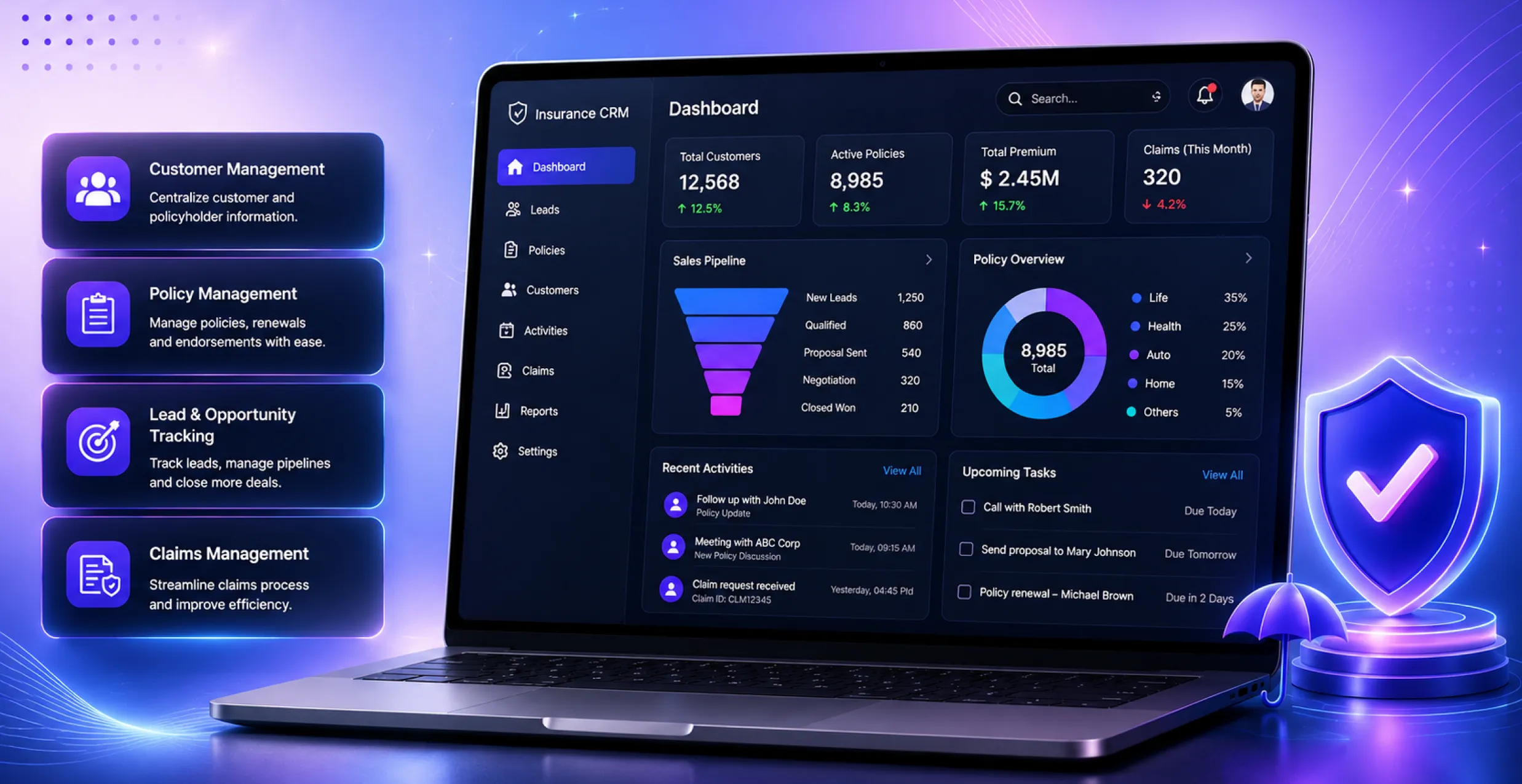
An effective CRM helps companies to centralize data, improve communication, and translate insights into action. Contemporary CRM tools are also highly connected with AI, cloud computing, and mobile technologies.
The increase in the use of CRM software with AI features has enabled companies to control the workflow and predict sales, as well as interact with customers on a large scale. These systems do not represent optional tools anymore; they are core business infrastructure.
Also Read : Microsoft Sitecore CRM Development
Core Features of CRM Software for Modern Enterprises
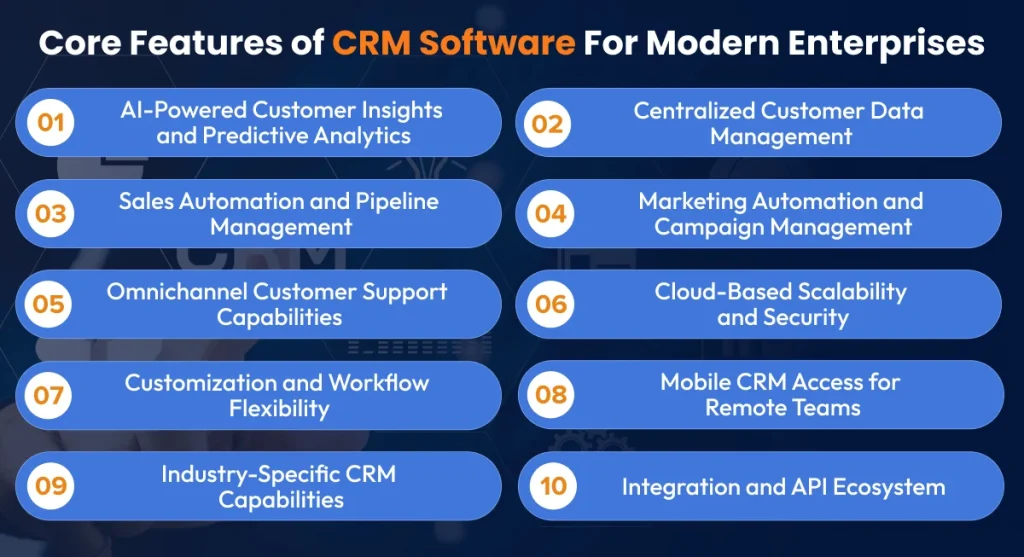
The knowledge of the features of crm software assists decision-makers in selecting solutions that suit both operational and strategic objectives. The capabilities that define CRM adoption in 2026 are the most crucial, as enumerated below. Let us go through the main features of CRM.
1. AI-Powered Customer Insights and Predictive Analytics
CRM innovation has become artificial intelligence. Using AI, it is possible to analyze the behavior of customers, predict buying behavior, and suggest the next-best action to the sales and support staff.
The emergence of crm software that contains AI capabilities will mean that companies will be able to predict the needs of their customers instead of addressing them. It is now expected to predict lead, churn, and sentiment analysis.
The developments are a great boost to the general CRM software with AI features, which make CRMs more proactive and intelligent.
2. Centralized Customer Data Management
A CRM system features one of the most valuable essential features in the centralization of information across departments in real time to be available to teams; in other words, this is a centralized system. A common database can enable sales, marketing, and support teams to work in unison, which is why businesses treat their CRM as the backbone of their broader data management systems rather than a standalone sales tool.
Sales automation does away with manual activities, including data entry, follow-ups, and tracking of deals. Automated pipelines will assist sales teams to emphasize deal closure as opposed to dealing with spreadsheets.
3. Sales Automation and Pipeline Management
These are critical CRM software with AI features, which enable an organization to see the stages of sales, predict the revenues, and/or track the performance measurements instantly.
CRM in the modern world includes marketing automation CRM functionality, which enables companies to design, implement, and assess multi-channel campaigns. It is possible to control email marketing, SMS, social media, and push notifications using a single dashboard.
4. Marketing Automation and Campaign Management
These are marketing-related capabilities of crm software that enhance the interaction with the customers, as well as provide a constant message of the buyer journey.
The customer support should be quick in 2026, personalized, and omnichannel. CRMs are currently compatible with live chat, email, voice, social media, and chatbots.
5. Omnichannel Customer Support Capabilities
These are regarded as belonging to the core capabilities of CRM that guarantee that customer problems are monitored, escalated, and processed effectively via the channels.
Cloud computing allows business organizations to expand the use of CRM without significant investments in infrastructure. The cloud-based solutions are easy to access, perform, and are cost-effective.
6. Cloud-Based Scalability and Security
Popular websites display the capabilities of Zoho CRM cloud computing software features, including the ability to access it remotely, automatic backups, and security on the enterprise level. One of the CRM software with AI features is the cloud deployment.
There are no two businesses that are run the same way. CRMs today have customizable workflows, dashboards, and reports that can be adapted to meet the needs of a particular operation.
7. Customization and Workflow Flexibility
Such flexible capabilities of a CRM system enable organizations to customize processes without needing heavy coding, which facilitates quick adoption and enhances ROI.
Mobile access is now a necessity with remote and hybrid work models becoming the rule. CRM platforms have mobile applications that are fully functional.
8. Mobile CRM Access for Remote Teams
The trend has enhanced the speed of the Mobile CRM app development, whereby teams are able to manage leads, update records, and respond to customers simultaneously by leveraging CRM application Features. The mobile-first access enhances crm as a whole. Industry-specific CRMs are becoming popular as companies require specialized workflows. To take one example, a hotel crm is centered around guest profiles, booking history, and loyalty management.
9. Industry-Specific CRM Capabilities
On the same note, Healthcare CRM Software Development is useful in healthcare organizations and helps them to engage with patients, comply, and handle data in a safe manner.
Businesses would tend to compare an example of crm software in the market. Enterprise solutions are more sophisticated in analytics, whereas an SMB-oriented platform is easier to use and more affordable.
10. Integration and API Ecosystem
Modern CRM systems are no longer standalone platforms; they act as a hub within a larger digital ecosystem. One of the most important emerging features is seamless integration with third-party applications such as ERP systems, accounting software, e-commerce platforms, customer support tools, and collaboration apps.
Through robust APIs and pre-built integrations, businesses can ensure real-time data synchronization across tools, eliminating data silos and improving operational efficiency. This capability allows organizations to extend CRM functionality, automate cross-platform workflows, and create a unified customer experience across all touchpoints.
Integration-driven CRM software with AI features enables smarter insights, better decision-making, and greater scalability as businesses grow and adopt new technologies.
Key CRM System Features Comparison Table
| Feature Category | Business Benefit | Typical Users |
| AI Analytics | Predictive insights and automation | Sales & Marketing |
| Cloud Access | Scalability and remote operations | All Teams |
| Omnichannel Support | Improved customer satisfaction | Support Teams |
| Workflow Automation | Operational efficiency | Operations |
| Custom Dashboards | Better decision-making | Management |
Feature vs Cost Table
The Feature vs Cost Table below helps businesses understand how different CRM features impact overall investment. The cost of each feature can vary based on whether you choose an off-the-shelf solution or opt for a tailored approach, where the custom CRM development cost is influenced by functionality, integrations, and scalability requirements. This comparison makes it easier to evaluate value versus budget before making a decision.
| CRM Feature | Estimated Cost (USD) | Notes |
| AI Lead Scoring | $20–$50/user/month | Advanced analytics |
| Sales Automation | $15–$40/user/month | Pipeline optimization |
| Marketing Automation | $30–$70/user/month | Campaign tools |
| Mobile CRM Access | $10–$25/user/month | Remote teams |
| Custom Integrations | $5,000–$25,000 | One-time cost |
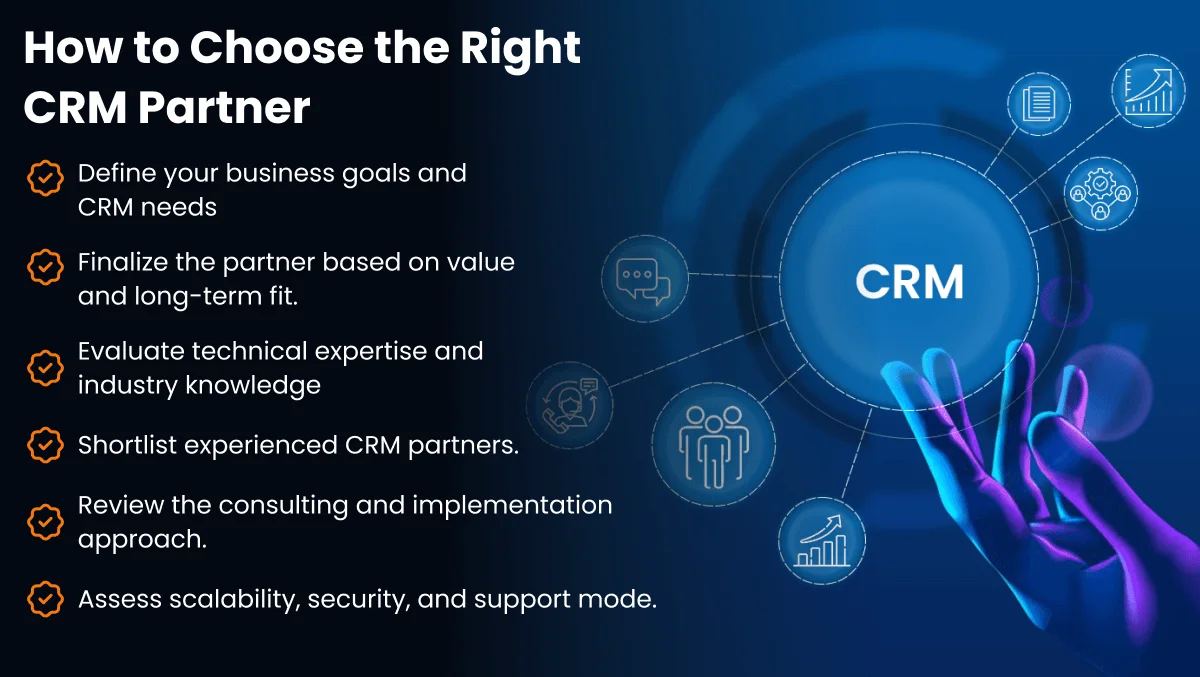
How to Choose the Right CRM Partner?
Popular CRM apps showcase salesforce crm features, which include advanced reporting, AI-related insights, and ecosystem integrations. On the same note, the features of Zoho CRM cloud computing software are stable in terms of affordability, flexibility, and cloud scaling.
The selection of an appropriate CRM partner is a business decision that will determine customer engagement, sales, and the scalability of the business in the long term. The correct partner must not just sell software, but can also serve as a technology consultant who can know your business objectives, business challenges, and growth strategy.
By partnering with a custom crm software development company you will be able to create a CRM Solution for your Business that aligns with your workflows and compliance requirements, data security requirements, and future expansion plans.
In deciding on potential partners, experience, technical expertise, and a successful track record of delivery should be the priority. Major crm software development firms have end-to-end solutions, including requirement analysis to after-sales services.
Their CRM Consulting Services will assist in defining the CRM strategy and highlighting the existing system gaps, as well as considering the most efficient features and integrations.
Moreover, Leading CRM Implementation Services guarantee smooth implementation, proper data migration, and user onboarding without causing operational discontinuity.
Also Read: 7 Ways Microsoft Dynamics CRM Can Assist Your Business
CRM and Digital Transformation Services
Octal is one of the best crm software development companies because of its comprehensive knowledge in its domain, customer-oriented attitude, and emphasis on scalable digital solutions. Having a long history of providing enterprise-grade CRM solutions, Octal can design solutions that meet the business requirements without compromising flexibility and the ability to grow in the future.
Long-term support, quality technical team, and consultative approach make Octal a trusted provider of total CRM Solution for your Business and contribute to the growth of sales, retaining customers, and achieving operational excellence.
CRM systems tend to be connected with wider digital systems. Most organisations outsource CRM alongside the SaaS development services, enterprise software development, and solutions provided by a Mobile App Development company.
CRMs are made the key centers of the digital customer interaction process across platforms when paired with modern Web Development.
Conclusion
With the shift of businesses to a deeper level of customer-centric digital economy, CRM software is now an enabler of strategic growth, as opposed to an operational tool.
By 2026, those organizations investing in future-ready CRM platforms will be in a better position to establish a stronger relationship, enhance efficiency, and generate long-term revenue.
The automation of customer behavior prediction, sales pipeline optimization, and decreased manual workloads are changing the ways teams operate, informed by AI. Hyper-personalization is facilitating brands to offer personalized experiences at all points of contact that make them more engaged and loyal.
Simultaneously, industry-specific CRMs are aiding companies to meet the needs of specific workflows, compliance requirements, and customer demands with more accuracy. The CRM is designed to be mobile-first, which means that real-time data access is not disrupted and that remote and on-the-go teams can remain productive and responsive.
A combination of these Top CRM Trends is transforming the way companies choose and adopt CRM solutions, and these three concepts of adaptability, intelligence, and customer-centricity are the pillars of successful CRM adoption in 2026 and beyond.


 Get in Touch
 By
By July 13, 2026