



What if your business could turn loyalty points, investment rights, in-app assets, or even community voting power into programmable digital units? The main goal of ERC20 token development exists as its fundamental promise. Users can trade ERC20 tokens as Ethereum-based assets because these tokens maintain value when you swap them for other tokens that are supported by various wallets and exchange platforms and DeFi apps and decentralized applications.
According to Dimension Market Research, the tokenization market continues to expand, as one forecast shows its value will rise from USD 3.9 billion in 2025 to USD 18.8 billion by 2034, which indicates a 19.0% CAGR. Organizations should treat market signals as indicators because different estimation approaches can produce varying results in their calculations.
You can hire a dedicated ERC20 token development company to help your business idea develop into a protected token system.
What Is an ERC20 Token? Understanding the Basics
An ERC20 token is a fungible digital asset that gets created through an Ethereum smart contract. “Fungible” means every unit is the same value and has the same set of traits as any other unit of the same token.
The ERC20 standard was put forward by Fabian Vogelsteller in November 2015. Additionally, it defines a shared API so tokens can operate smoothly within smart contracts. Ethereum still stays popular because its token standard is widely understood. And it’s supported by wallets, exchanges, development tools, DeFi protocols, and auditing frameworks.
Businesses can build an ERC20 token without needing to build a new blockchain. Yet they still benefit from Ethereum’s already existing infrastructure. And if you hire an ERC20 token development agency, they can tune parameters such as total supply, permissions, practical utility, and distribution plans. As well as the integrations around whatever business model.
Basic Structure for ERC20 Tokens: Core Components Explained
The base setup behind ERC20 tokens appears to be built from balances and supply constraints. A small set of transfer-related methods and approve-style permissions. Moreover, there are events that other apps can latch onto in a consistent way.
1. Mandatory Functions
- totalSupply() – Returns total tokens in circulation
- balanceOf(account) – Returns how many tokens an account holds
- transfer(to, amount) – Sender transfers tokens to recipient
- approve(spender, amount) – Owner grants spending permission to spender
- allowance(owner, spender) – Checks remaining approved amount
- transferFrom(owner, recipient, amount) – Spender transfers on owner’s behalf
2. Optional Functions and Extensions
name(), symbol(), and decimals() make things way easier for humans and UIs, because they expose the token’s identity and how its denomination is presented.
Furthermore, OpenZeppelin typically includes plenty of add-ons too, like minting, burning, pausing, permit-based approvals, snapshots, and capped supplies.
3. Events
The transfer event records token movements, and it can reflect minting or burning when that scenario shows up. The approval event captures updates to spending permissions.
Wallets, explorers, analytics systems, and dApps rely on these signals to track activity. Rather than trying to decode every internal transaction behavior all by themselves.
Why Businesses Need Custom ERC20 Token Development?
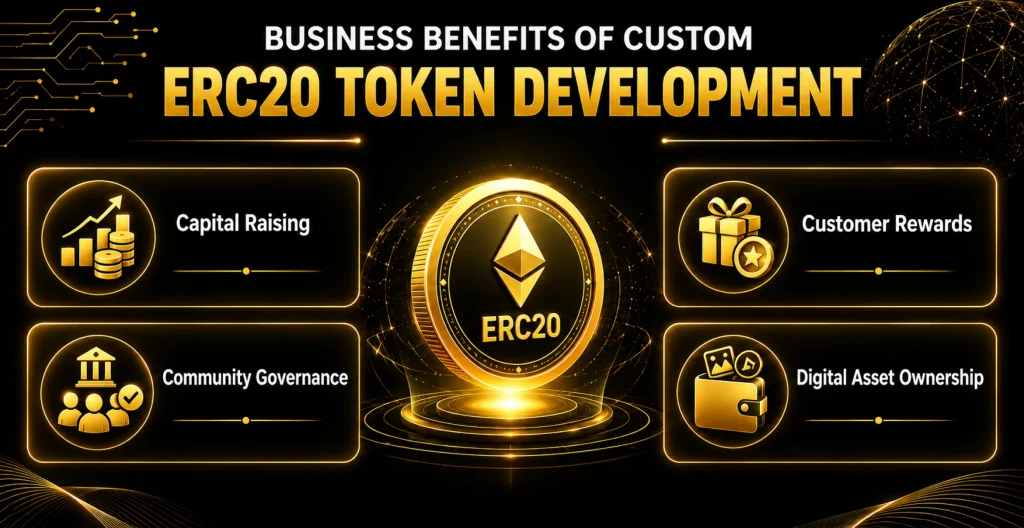
Custom ERC20 tokens can tie together digital ownership, user incentives, and fundraising. Moreover, governance is inside one programmable business ecosystem, and that’s the point; everything stays connected. Their real worth depends on authentic utility, sensible tokenomics, solid technical security, and applicable legal compliance.
1. Fundraising
Companies might use tokens for ICOs, IDOs, private allocations, or community fundraising campaigns. In some cases, a token acts like access, usage rights, rewards, or even participation signals. However, the design still needs careful review, because financial and securities rules can kick in.
So ICO development shouldn’t just be “code it and ship it. It has to include legal analysis, clear investor disclosures, allocation logic, and a secure distribution smart contract.
2. Loyalty and Rewards
Retailers, marketplaces, and various platforms can issue tokens as loyalty rewards. Customers can redeem them for discounts, memberships, products, or premium services. But unlike scattered points that live in one app only, blockchain-based rewards can be threaded into wallets. Along with partner applications, as long as the business handles user experience properly and keeps transaction costs effective.
3. Governance and DAOs
Users receive voting rights through token ownership, which lets them decide on proposal choices and treasury resource distribution, product modification decisions, and community rule selection. The process of DAOs development needs to establish specific rules that define the number of voters needed to proceed, the voting system, representative choices, and proposal deadline requirements. The system includes emergency stop mechanisms that maintain open governance but keep the system free from control by any single dominant group.
4. Asset Tokenization
Asset tokenization, which is straightforward, means tokenizing real estate, invoices, commodities, and memberships. Furthermore, other assets are represented using tokenized units in a way that can be traded and verified.
In practice, an asset tokenization development service provider has to link the token to enforceable ownership records and set transfer limits. And define custody arrangements and compliance procedures.
Step-by-Step ERC20 Token Development Process
A successful ERC20 token development roadmap starts from business utility, not from code. The team defines what the token is for, then builds the smart contract safely and validates everything properly. Furthermore, it prepares the surrounding product pieces along with the compliance framework.
1. Requirement gathering and tokenomics design
First, the team figures out the intended users, the token’s practical utility, and the total supply. How allocation works, vesting rules, a liquidity approach, decimals, the launch method, and the governance model. When there’s a clear tokenomics document, it reduces later redesign work. Additionally, it helps investors understand how the supply actually reaches the market.
2. Smart Contract Architecture Planning
The developers need to select essential ERC20 modules for their project while establishing appropriate access control settings. The upgrade strategy requires planning together with the creation of an administration system and the development of integration system maps. The team evaluates gas efficiency together with emergency response protocols and multisignature wallet management, and they determine which between fixed and upgradable smart contract structures functions best.
3. Writing the ERC20 Token Contract Code
The developers who work with Solidity code their planned logic through pre-existing libraries while following development practices that provide enough security protection. The contract should not get too tangled, and it should say plainly who can mint, burn, pause, upgrade, or even transfer tokens.
4. Testing on a Testnet
The contract gets pushed to a test network like Sepolia. Developers try out transfers and approvals and the stuff that breaks: failed transactions, supply ceilings, access control checks, edge cases, real integrations, and normal user journeys before any real funds are involved.
5. Security Audit
A mix of automated scanners, unit tests, and static analysis. Additionally, an independent manual look helps spot reentrancy concerns, access-control mistakes, accounting errors, unsafe upgrade paths, and logic weaknesses. An audit definitely boosts confidence but does not guarantee complete security.
6. Mainnet Deployment
After approval, the team deploys the contract to Ethereum mainnet or another chosen EVM network. They should verify the source code on a public block explorer. Where it makes sense, transfer deployment ownership to a managed multisignature wallet where appropriate.
7. Post-launch Monitoring and Support
After release, the team keeps an eye on contract events, liquidity levels, odd activity, failed transactions, and also integration health. Support afterward can mean upgrades, fast incident response, deeper analytics, exchange integration, and plain user assistance too. In many cases, these things sit inside wider blockchain development services.
ERC20 Token Contract Code: Key Elements Explained
A real ERC20 token contract codebase should not be too large but also flexible enough so the project can actually use it. OpenZeppelin’s setup is commonly used because it brings in reviewed contracts and extensions for common token functions.
1. Token Metadata
The contract sets the token name, symbol, and decimal precision. This metadata influences how wallets and exchanges show the asset. But it doesn’t decide the market value.
2. Supply Management
Supply might be fixed when the contract is deployed, or it can be managed with a restricted minting function. If minting is allowed, the contract should spell out the authorized role, maximum supply, event behavior, and operational approval process.
3. Transfer Accounting
The token transfer mechanism removes tokens from the sender’s wallet while it creates new tokens, which move to the recipient’s wallet. The system needs to block unauthorized addresses and transactions with insufficient balance while producing accurate transfer events.
4. Approval Logic
The approval functions in DeFi protocols and exchanges enable these applications to spend tokens on behalf of their users. Organizations need to track permission risks as they establish methods to verify personnel authorization. The system should support signature types, which include permit-based signatures for appropriate situations.
5. Security and Administration
The system should only display role-based access control and cap burning, pause, and upgradeability features when users have valid reasons to do so. A smart contract development company needs to create documentation for each privileged function while conducting tests that verify both proper and improper access attempts.
A conceptual structure is
contract BusinessToken inherit standard ERC20 module define administrator roles initialize token metadata create initial supply or controlled minting apply transfer restrictions only when required emit standard transfer and approval events |
This is a conceptual walkthrough, not production code. Developers should rely on current audited libraries and the right compiler versions. As well as reliable testing frameworks, and still get an independent review before deployment.
How to Create an ERC20 Token: Available Methods Compared
Businesses can create an ERC20 token using a no-code generator, a semi-custom implementation, or fully custom development. The better option depends on budget, risk level, compliance needs, integrations, and the importance of long-term control.
1. No-code or Free Token Generators
A generator can create a basic token quickly, sometimes for a small platform fee plus blockchain gas. This route is useful for experimentation and learning.
But it often gives you limited control over permissions, safety controls, future upgrades, and branding details. Along with the whole legal paperwork trail. Also, “free” means no deployment fees; it still doesn’t remove technical risk.
2. Semi-custom Development
A developer takes a standard template and tweaks things like metadata, total supply, and minting. As well as burning rules, tax logic, or access-control settings. It’s quicker than building every module from scratch, but the template still needs testing and review. This fits small projects with a fairly straightforward utility.
3. Fully Custom Development with an Agency
A professional team designs tokenomics, contract architecture, product integrations, dashboard UI, wallet journeys, launch tooling, the audit process, and even the support model. For many businesses, this is the best option when you’re aiming for a long-term ecosystem. A complicated distribution setup, or something that looks more like a regulated asset. It is also the most expensive method of building an ERC20 token.
Cost to Create an ERC20 Token: Complete Pricing Breakdown
The cost to create ERC20 token can go from a few hundred dollars for a pretty basic DIY launch up to tens of thousands for something customized, audited, and integrated as a business solution. The numbers below are more like planning ranges than fixed quotations.
| Development approach | Typical scope | Indicative cost |
| Free or no-code generator | Basic metadata, supply, and deployment support | USD 50–500 plus gas |
| DIY standard contract | Developer-led implementation using a library | USD 500–5,000 |
| Semi-custom token | Custom supply rules, access control, and testing | USD 4,000–15,000 |
| Fully custom token | Advanced features, integrations, dashboard, and QA | USD 15,000–50,000+ |
| Enterprise token ecosystem | Token, wallet, exchange, DeFi, compliance, and support | USD 50,000–150,000+ |
Published estimates also vary considerably. One development provider mentions something like USD 2,000–10,000 for ERC20 design. While another 2025 estimate suggests feature-rich development at USD 10,000–50,000 or even more.
Main cost-affecting factors
- Contract complexity, including minting, burning, vesting, snapshots, taxes, and different restrictions.
- How many security audits there are, and how deep those reviews go.
- Wallet, exchange, DEX, website, dashboard, and dApp integrations.
- Legal work, compliance steps, token-sale planning, and jurisdictional requirements.
- Developer location, timeline for the project, documentation quality, and post-launch support.
- Ethereum gas fees, liquidity provisioning, marketing activity, and listing-related expenses.
The “ERC20 token price” is not the same thing as development cost. Token market price depends much more on utility, supply and demand, liquidity, distribution approach, reputation, and broader market conditions.
ERC20 Token Development Company Costs: USA vs. UK vs. UAE
An ERC20 token development company USA may end up charging more. Since the engineering effort and compliance workload tend to be higher. In the UK and UAE, the pricing can look competitive. But in reality, things like capability, security practices, communication, and regulatory experience matter more than geography alone.
| Region | Typical hourly rate | Basic token project | Custom business token | Enterprise solution |
| USA | USD 120–250 | USD 15,000–35,000 | USD 35,000–90,000 | USD 90,000–200,000+ |
| UK | USD 90–180 | USD 12,000–30,000 | USD 30,000–75,000 | USD 75,000–170,000+ |
| UAE | USD 70–160 | USD 10,000–25,000 | USD 25,000–65,000 | USD 65,000–150,000+ |
These are only rough market-planning ranges. A quote from an ERC20 token development company in the UK should spell out separate line items for development, audit, deployment, integrations, legal services, and also ongoing maintenance.
Must-Have Features in Custom ERC20 Token Development
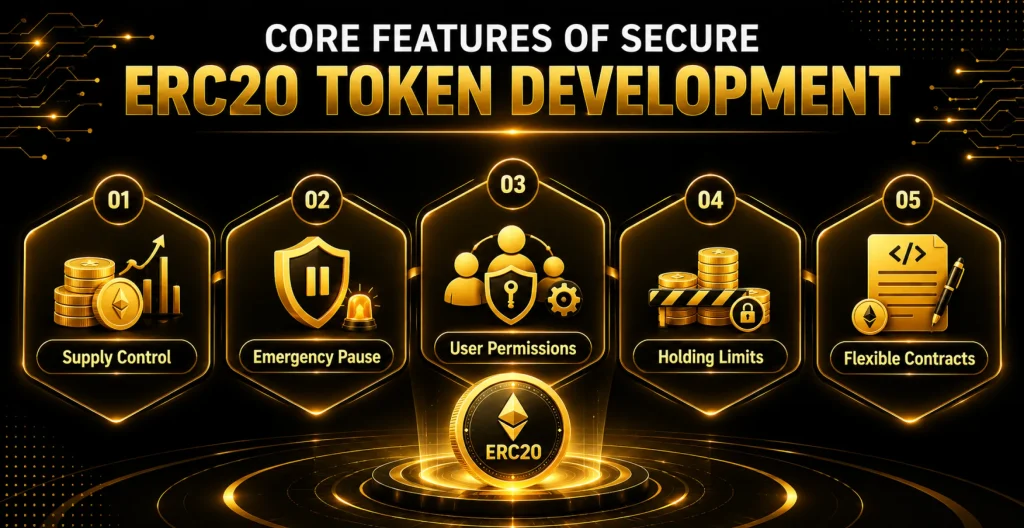
The right features make a token manageable and useful, but every additional permission can increase risk. Custom ERC20 token development should include only functions that support a documented business requirement.
1. Mintable and Burnable Supply
Minting helps support controlled issuance, while burning permanently removes tokens from circulation. Still, both functions have to rely on strict role restrictions, complete event logging, and supply limits. Along with a documented set of operating procedures.
2. Pausable Functions
A pause mechanism can halt transfers during an incident or during a security investigation. It should be controlled by a secured role, ideally protected by multisignature approval. This makes sense and is backed by a clear policy for how the contract restarts afterward.
3. Access Control and Role Management
Separate roles can be set up to handle minting, pausing, upgrading, and the admin side too. When roles are split like that, damage stays smaller if one key is compromised. Furthermore, day-to-day responsibility becomes easier to audit.
4. Anti-whale Mechanisms
Transfer limits, together with wallet caps, vesting schedules, and time-based restrictions, work to decrease market concentration while safeguarding new token launches. The established guardrails have effects on decentralization systems, while they create problems for exchange compatibility, and they also reduce user trust levels. Organizations must present their information in a direct manner.
5. Upgradeable Contracts
The upgrade system lets authorized users update the logic, but it creates security risks for governance systems and key management operations. Things like the proxy pattern, the upgrade authority, the storage layout, and a timelock. The organization needs to create an emergency process, which should undergo proper documentation and testing procedures.
The features that the project needs require DeFi development services to build staking functionality, liquidity management, lending systems, and other yield-related operations.
ERC20 Token Development Company: What to Look for Before Hiring
The process of selecting an ERC20 token development company requires more than just finding the cheapest service provider. You need to assess their technical abilities, security measures, communication methods, documentation quality, legal understanding, and their ability to support after product launch.
1. Technical Expertise and Audit Practices
First, ask if the developers understand Solidity, EVM behavior, gas economy, access control, upgradeability, and testing, and how they use the current OpenZeppelin libraries. Then confirm a few more messy but important points: are the audits done independently? Are findings fixed? Is the final report available?
2. Portfolio and Case Studies
Review verifiable examples rather than relying only on screenshots or marketing claims. Ask about the project’s real scope, which contracts were deployed, what integrations existed, and how the security process ran during development. I’d also ask about the team contribution and post-launch performance.
3. Post-launch Support
The agreement should explain monitoring, bug fixes, emergency response, key management, upgrade paths, documentation, and how quickly they respond. A dependable ERC20 token development agency should also spell out what is excluded from the quoted price.
The company should be able to coordinate with a blockchain consulting services team or give similar guidance themselves around architecture, compliance, and launch planning.
Industry Use Cases and Examples of ERC20 Tokens
ERC20 tokens are able to back a lot of business models. But the token has to fix something real in day-to-day operational problems rather than exist only as a speculative asset. Utility, user protection, and compliance should drive implementation.
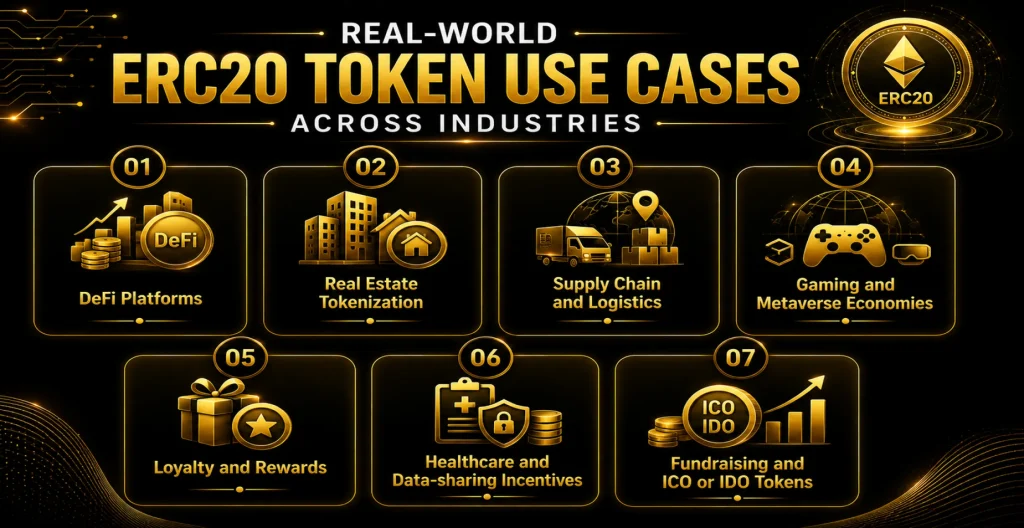
1. DeFi Platforms
Lending, staking, governance, and liquidity protocols use fungible tokens to represent deposits, rewards, voting power, or liquidity positions. Smart-contract risk and economic design need careful attention.
2. Real Estate Tokenization
A token can stand for a fractional interest, membership, or revenue right. Or even an access credential tied to real estate. But legal ownership, transfer restrictions, and custody. Furthermore, who is eligible as an investor has to be defined outside the token code too.
3. Supply Chain and Logistics
Utility or tracking tokens can help with supplier incentives, shipment milestones, data permissions, and settlement steps. Still, reliable off-chain data feeds are essential because a token cannot independently confirm a physical delivery.
4. Gaming and Metaverse Economies
Players might use ERC20 assets for rewards, purchases, crafting, or marketplace settlement. Developers then have to manage earning opportunities, inflation control, user safety, and the overall game design.
5. Loyalty and Rewards
Brands can issue redeemable tokens for purchases, referrals, memberships, or partner benefits. Wallet recovery that is simple and redemption that feels familiar matter a lot for mainstream customers.
6. Healthcare and Data-sharing Incentives
Tokens may reward consented data sharing, research participation, or verified contributions. But privacy, patient consent, data minimization, and healthcare regulations should stay right at the center.
7. Fundraising and ICO or IDO Tokens
Tokens can support a project launch, but fundraising structures can create regulatory obligations, so it’s not “just” technical. A proper legal review, transparent allocation, vesting, and investor communication are all essential.
A project may mix these capabilities with crypto token development and dApp development services.
Ethereum Token Development Company: Beyond ERC20
An Ethereum token development company can assist teams in choosing standards. Other than ERC20, especially when an asset needs its own identity, partial substitutability is important. Or some more specialized behavior. Ethereum’s broader ecosystem supports multiple established token models.
| Standard | Asset type | Typical use |
| ERC20 | Fungible | Currency, rewards, governance, utility, staking |
| ERC721 | Non-fungible | Individual collectibles, certificates, unique assets |
| ERC1155 | Fungible and non-fungible | Games, batches, mixed asset collections |
Five practical differences
- Interchangeability: ERC20 “units” are interchangeable, while ERC721 tokens are individually distinguishable. ERC1155 bridges both directions, letting you treat some things as a substitute. And other things as distinct, depending on how you design the IDs.
- Metadata: The complete token information becomes available through metadata when users operate with ERC20. The ERC721 standard requires developers to create individual metadata files that store information about each collectible token that exists on the blockchain. The ERC1155 standard enables the storage of metadata information, which becomes accessible through token ID numbers.
- Transfer efficiency: The system enables users to send various asset types through single batch transactions, which proves beneficial for game operations and for users who possess extensive token collections.
- Business utility: The ERC20 system functions optimally to manage currency operations and reward distribution, and other value-based transaction systems. ERC721 fits more naturally for unique ownership. ERC1155 fits inventories of mixed digital goods.
- Development choice: The standard should follow the asset model and the real user journey. As well as marketplace expectations and any compliance-minded requirements and compliance design, not marketing preference.
How to Convert ERC20 Tokens to ETH: A Quick Guide
To turn ERC20 tokens into ETH, most people swap the tokens via a decentralized exchange, or they just sell them on a centralized exchange. The ERC20 token needs enough liquidity, and the user also has to have ETH for network gas.
Using DEXs
First, connect a compatible wallet to something like Uniswap. Then select the ERC20 token and either ETH directly or a very liquid middle asset. After that, look at slippage and price impact.
Before you hit swap, you’ll also need to approve the token. Also check the token contract address very carefully, and steer clear of unknown links or imitation tokens.
Using CEXs
Deposit the ERC20 token that matches the exact asset and network. Then you sell it for ETH, or you sell for fiat and later convert, depending on what the platform offers. While doing this, confirm deposit networks, withdrawal fees, and minimum withdrawal amounts. Along with any account verification requirements and exchange custody risks.
The phrase “how to convert ERC20 tokens to ETH” is about a normal market transaction, not about changing the token contract itself. Taxes and reporting obligations might also come up depending on the user’s jurisdiction.
Best ERC20 Token Wallets to Store and Manage Your Tokens
The “best” ERC20 token wallet depends on your security needs, how often you plan to move funds, and your device habits. Furthermore, can you protect recovery credentials? Never share a seed phrase, and don’t approve unknown contracts. Even if they’re promoted by random pages that seem polished.
| Wallet type | Advantages | Limitations | Suitable for |
| Hardware wallet | Private keys remain isolated from everyday software use | Costs money and requires careful backup | Long-term or high-value storage |
| Mobile or browser wallet | Convenient for dApps, swaps, and routine use | More exposed to phishing and device compromise | Active users |
| Multisignature wallet | Multiple approvals reduce single-point risk | More complex to operate | Teams and treasuries |
| Exchange wallet | Easy trading and recovery processes | You do not fully control the private keys | Short-term trading |
When you’re recommending the best ERC20 token wallet for a business. You should think about transaction policies, clear role separation, strong backup procedures, phishing training, and multisignature controls.
Why Choose Octal IT Solution as Your ERC20 Token Development Company?
If a business is comparing custom ERC20 token development companies, it wants to line up the delivery approach, engineering transparency, security procedures, documentation quality, and long-term support. Octal IT Solution can frame the engagement around business-friendly capabilities that are confirmed during scope review and project verification.
- The planning of tokenomics according to requirements follows the established utility and distribution, and governance goals.
- The development of Solidity and EVM smart contracts occurs through established standards that incorporate reusable security libraries.
- The process includes contract testing, testnet deployment, code review, and independent auditor coordination.
- The system provides integration support that connects wallets to exchanges and dashboards, DEXs, dApps, and various business systems.
- The documentation needs to support three different user groups, which include administrator users, token holders, and support teams.
- The process requires continuous monitoring after launch while performing maintenance tasks and handling problems, and planning system upgrades.
- The estimates need to show clear breakdowns that separate development expenses from audit fees, deployment costs, legal charges, liquidity expenses, and marketing expenditures.
Before hiring, request verifiable case studies, deployed contract addresses, team profiles, audit evidence, concrete deliverables, ownership terms, and support service commitments. This tends to separate a capable ERC20 token development company from a vendor offering only a template.
Final Words
Custom ERC20 token development can help organizations make programmable benefits, decision-making mechanisms, fundraising instruments, DeFi utilities, and even tokenized ownership arrangements. You’ll still have to look at tokenomics, smart contract security, legal assessment, user experience, liquidity, wallet integration, and long-term monitoring; all matter.
So whether you’re aiming to launch an ERC20 token for a startup or for a wider enterprise ecosystem. Start with a clean business goal and a measurable utility. Connect with Octal IT Solution, share your needs, outline the development approach, and confirm the estimated budget.
Also review the launch roadmap. When strong cryptocurrency development services are paired with careful, responsible planning, your token idea can become a usable digital product.

 By
By September 8, 2026




 Get in Touch