



Have you ever thought about the reason why some construction companies are more successful in their bids and projects while others are always behind? The difference is sometimes simply in the effective handling of client relationships and project data. In 2026, the international construction CRM software market is expected to exceed USD 2.87 billion, and it is likely to continue growing through 2032 and beyond as companies increasingly rely on digital tools for efficiency and collaboration.
That is why construction CRM software has become a must rather than a nice-to-have or optional add-on; it matters whether it is CRM for general contractors or specialized tools for small construction businesses and residential builders. The adoption of these systems in the industry allows the companies to manage their sales pipelines, communication, and project workflow all in one place, thus increasing their productivity and at the same time cutting down on costs in a very competitive industry.
What Is CRM Software for the Construction Industry?
CRM software for construction industry is a centralized digital solution intended to control customer relations, sales pipelines, projects, and communications all in one place. Generic tools are not able to serve the specific workflow of construction, as the construction CRM software is made to accommodate lengthy sales cycles, different parties involved, and on-site coordination.
A good CRM tool for construction companies will give you a single view of leads, bids, contracts, and project updates. It does not matter if it is a CRM for general contractors, CRM for residential builders, or best CRM for small construction business; these platforms are going to enhance collaboration, visibility, and decision-making throughout the whole construction process.
Key Benefits of the Best CRM Software for Construction Companies
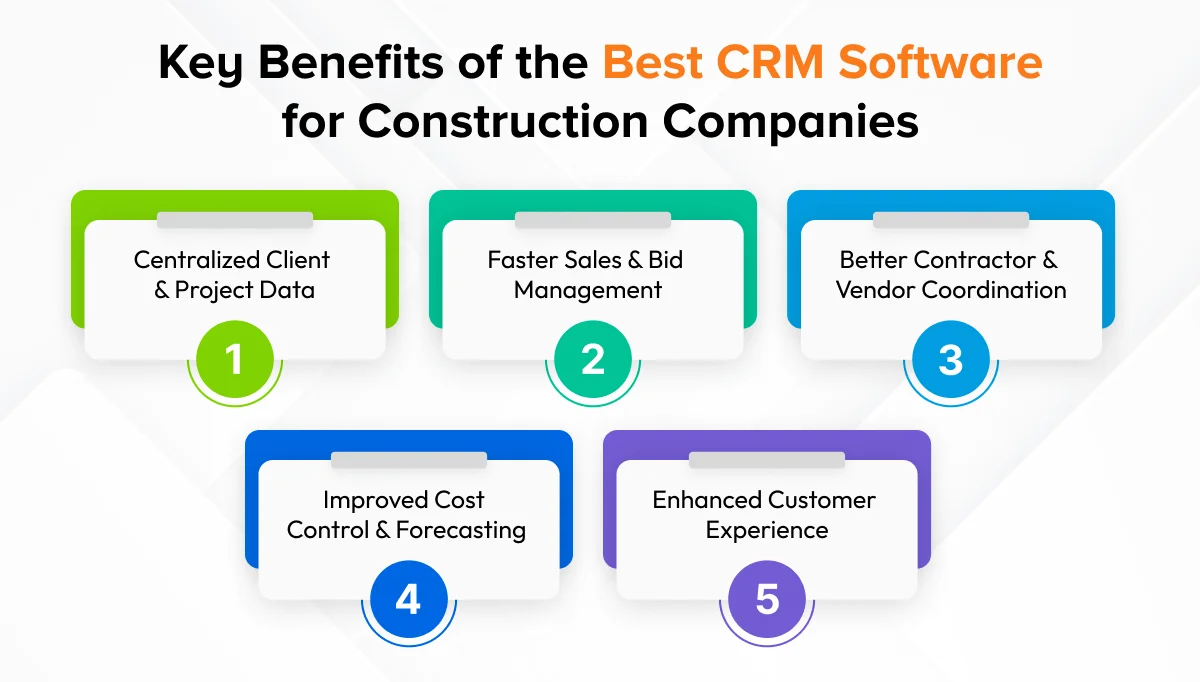
The best CRM for construction companies not only makes the entire process easier but also drives more sales and improves client relations by saving contractor time and managing project costs effectively.
1. Centralized Client & Project Data
CRM would be the controlling system the construction company would use, which would consist of client details, project records, contracts, and communication, thus getting rid of data silos and manual tracking errors.
2. Faster Sales & Bid Management
Construction CRM captures leads, manages bids, and tracks sales transparently. Faster closing of deals is a result of the higher visibility of sales activities.
3. Better Contractor & Vendor Coordination
The introduction of CRM for construction has brought a complete twist in the process, and it is now all about collaboration among the different players in a project that is backed up by the sharing of schedules, tasks, and real-time updates.
4. Improved Cost Control & Forecasting
Construction-focused customer relationship management systems provide accurate cost awareness, budget monitoring, and predictive analytics to avoid overruns, which would otherwise result in losses and reduce profits.
5. Enhanced Customer Experience
With the help of the CRM system, the contractor will not only keep clients updated but also respond to their questions in a friendly way, establishing trust and developing long-term relationships.
Note: The benefits of CRM for small business include streamlined sales, better client management, improved communication, and increased efficiency for growth.
CRM Software Features That Matter Most in Construction
The feature selection can support sales, project tracking, collaboration, and the length of construction cycles effectively, which is a major factor in the success of best CRM software for construction companies.
1. Lead & Opportunity Management
This particular feature of the best CRM for contractors aids in capturing, tracking, and nurturing leads in an efficient manner, thus improving the conversion rates and making sure that no sales opportunity is lost.
2. Bid & Proposal Tracking
An effective CRM software for construction industry streamlines the process of creating bids, tracking the submission of the bids, and following up, which leads to faster responses from the teams and winning of more projects.
3. Project Pipeline Visibility
A construction CRM program allows managers to get a real-time view of the project pipeline, which in turn helps them to monitor the progress, resources, and timing of the project from pre-construction to completion.
4. Contract & Document Management
CRM software for builder not only provides centralized storage but also takes care of the management of contracts, drawings, and approvals in a secure manner, thus minimizing the problems related to paperwork and version control.
5. Reporting & Cost Analytics
Sales performance, project costs, and future revenue forecasts are some of the areas where the advanced analytics of a CRM system for construction company yield actionable insights.

Best CRM Software for Construction: Popular Options
The selection of the best CRM software for construction will ensure that sales are made smoothly, client management is done more effectively, and project workflows are made better using the tools that are specifically designed for contractors, builders, and construction companies of all sizes.
A. Salesforce for Construction
Salesforce for construction provides the flexibility of customizing the applications, the dashboards that are specific to the industry, and the comprehensive analytics, the major attributes for the large contractors who intend to use a scalable construction CRM software with the automation and integration features that are really strong.
B. HubSpot CRM Pricing Overview
The HubSpot CRM pricing starts from a free tier and then increases according to features, which makes it appealing to small and medium-sized businesses looking for a simple-to-use CRM for contractors with no complex setup involved.
Other Popular CRM Software for Construction
1. Procore CRM
Procore CRM fuses together the processes of project management and customer data, thereby providing a contractor with a single platform for making bids, communicating with clients, and back-office workflows that are tailored to the CRM software for construction industry.
2. Buildertrend CRM
Buildertrend CRM caters to the needs of house builders, providing the tools for lead tracking, scheduling, and client portals that ease the management of sales and projects for small and mid-sized construction businesses.
3. Zoho CRM
Zoho CRM offers affordable, flexible automation and custom pipelines for a small CRM system for construction company and for general contracting teams as well.
Pre-Construction Software vs CRM System for Construction
First of all, if a construction company understands the distinction between pre-construction software and a CRM system, it could be easier for the company to select the proper tool for planning, estimating, sales tracking, and customer management.
| Aspect | Pre-Construction Software | CRM System for Construction |
| Primary Purpose | Estimating, budgeting, planning | Managing leads, clients, sales |
| Focus Area | Project cost & schedules | Customer relationships & pipelines |
| Best For | Pre-construction teams | Sales & client service teams |
| Key Benefit | Accurate cost forecasts | Improved lead tracking |
| Communication Support | Limited | Strong collaboration and follow-ups |
| Contract Management | Basic contract integration | End-to-end contract tracking |
| Data Centralization | Project data | Client + project data |
| Industry Fit | Construction planning | Construction CRM software |
| For Small Business | Helpful for budgeting | Best CRM for small construction business |
| Customization | Moderate | High with CRM development companies options |
Role of AI in CRM for Construction Companies
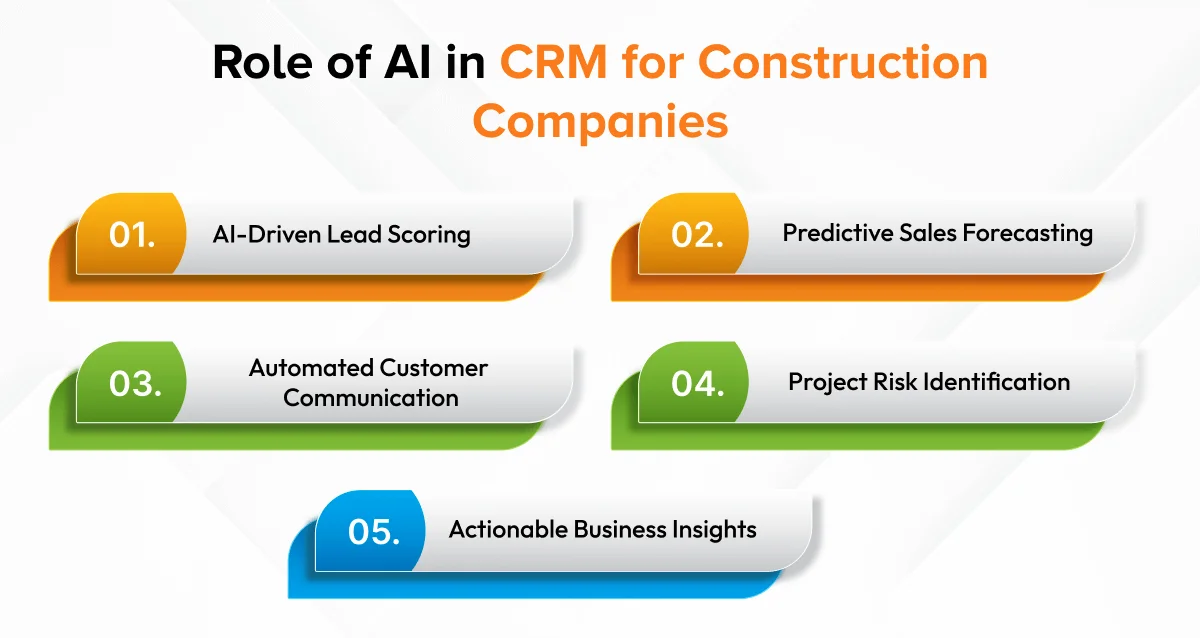
The increased use of AI in construction is one of the ways in which the construction industry is changing, and it is one of the areas where the transformation is most significant in terms of lead management, project outcome prediction, and decision-making across sales and customer engagement.
1. AI-Driven Lead Scoring
One of the benefits of using AI-powered construction CRM software is that it analyzes data from the past and provides the necessary information to prioritize and, on high-quality leads, thus allowing the contractors to be more selective and focus on those opportunities that have a better conversion potential.
2. Predictive Sales Forecasting
The construction smart CRM system can work on an AI basis to predict sales pipelines, which in turn allows accurate revenue predictions and better planning of future projects.
3. Automated Customer Communication
AI has made it possible for CRM for construction companies to do follow-ups, reminders, and responses automatically, and also ensure that the communication is done on time without increasing the manual workload.
4. Project Risk Identification
Breakable detection of builders’ AI-enhanced CRM software that signals possible delays or risks through the detection of patterns is capable of allowing teams to take proactive corrective actions early on.
5. Actionable Business Insights
CRM systems for construction companies equipped with AI-powered analytics have the capability to transform raw data into insights that can support smart decisions and company growth in the long run.
Custom CRM Development Cost: What to Expect
Building a custom Customer Relationship Management (CRM) system that fits your construction CRM software specifications involves different levels of investment. The Custom CRM Development Cost varies based on the required features, integrations, and overall system complexity.
Custom-made systems are thus different from commercially available ones in the sense that their cost reflects the value of such a system, fully supporting your distinct business operations and being aligned with your strategic business goals for the long run.
Average costs in 2026 will include everything from basic MVP traffic to complete solutions with powerful analytics and automation capable of serving an entire enterprise.
| CRM Type / Role | Estimated Cost (USD) |
| Basic CRM | $20,000 – $40,000 |
| Mid-Level CRM | $50,000 – $100,000 |
| Enterprise CRM | $120,000 – $250,000+ |
| AI-Enhanced Modules | +$20,000 – $150,000 |
| Third-Party Integrations | $5,000 – $30,000+ |
| UI/UX Design | $10,000 – $50,000 |
Top CRM Trends Impacting the Construction Industry
The top CRM trends are affecting the ways construction companies handle customer relations, sales funnels, and projects. They are doing it with the help of more intelligent and associated CRM systems.
1. AI-Powered CRM Automation
The use of AI in CRM for construction firms translates into the automation of lead scoring, predictions, and insights, thus the overall improvement of sales efficiency and decision-making correctness.
2. Mobile-First CRM Systems
Today’s construction CRM software is mobile-ready; professionals in the CRM software for construction industry can instantly connect to the client database, tasks, and updates directly from the construction site.
3. Industry-Specific CRM Customization
Rather than using a one-size-fits-all approach, companies choose industry-specific, customized CRM solutions that cater to their particular workflow, bidding, and project lifecycle needs.
4. Deeper System Integrations
CRM now has the ability to connect with accounting, ERP, and pre-construction software effortlessly which results in a data flow that is smooth all over the construction operations.
5. Data-Driven Customer Insights
The construction industry that employs advanced analytics in CRM software becomes familiar with its customers and can thus gradually build strong client relationships.
How to Choose the Best CRM Software for Construction?
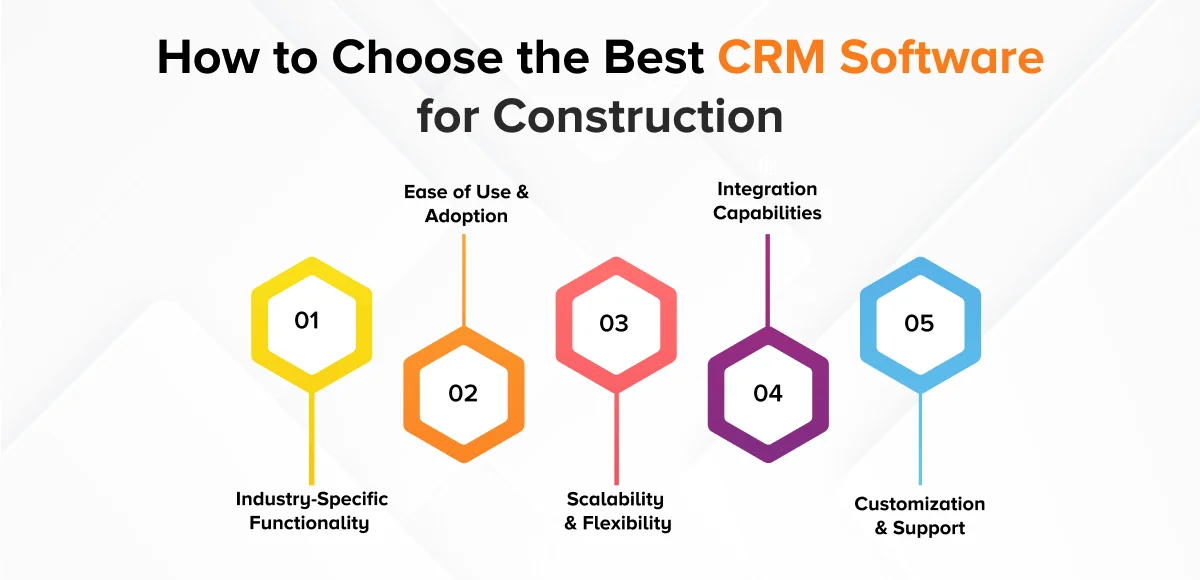
The process of selecting the most suitable CRM software for construction involves the assessment of the alignment with industry requirements, the capacity to grow, and the characteristics that facilitate the management of sales, projects, and the establishment of long-term client relationships.
1. Industry-Specific Functionality
A construction-specific CRM solution should be opted for that would help in managing bids, long sales cycles, and numerous stakeholders in projects without the necessity of complicated workarounds.
2. Ease of Use & Adoption
Having a construction-friendly CRM system would allow the whole team to adopt it very quickly, hence reducing the training time and, at the same time, making the daily productivity better.
3. Scalability & Flexibility
The best CRM for contractors should be able to grow along with the increasing number of projects, users, and integrations as the construction firms broaden their activities.
4. Integration Capabilities
The best construction CRM software is one that connects effortlessly with the accounting tools, project platforms, and pre-construction software for the sake of the whole workflow being unified.
5. Customization & Support
Custom CRM for construction company ensures that the businesses get the features that are idiosyncratic to their requirements, support them constantly, and offer to enhance the system with the inventiveness of the future that is in line with the business objectives.
Why Work With a Custom CRM Development Company?
A construction company can rely on a custom CRM development company to create a solution that is perfectly suited to its operational, sales, and project workflows. The customized CRM system for construction companies, on the other hand, corresponds to CRM development process, contractor coordination, and long sales cycles very well when compared to the generic tools.
An experienced provider of CRM software development services ensures the perfect integration, scalability, and, of course, security of data for the long run. The consultation with a reliable Software development consulting company empowers businesses with better control, flexibility, and ROI.
Working alongside a firm that specializes in the industry, like Octal IT Solution, can enable the construction companies to have their future-ready construction CRM software that not only supports but also is in line with their expansion, efficiency, and ever-growing digital demands.
Final Thoughts
Definitely, the construction companies’ CRM software is to be considered as a worthwhile investment. The more complicated the construction projects, the more inefficient and expensive the manual work to manage clients, bids, contractors, and data will be. The right construction CRM software will not only increase sales visibility but also optimize communication and improve decision-making across the organization.
Irrespective of whether you pick the very best CRM software for construction, adopt a general contractor CRM, or have a custom-made CRM system for construction company, the long-term advantages always surpass the initial expense. The rapidly developing technologies like AI in CRM, plus expandable development options, have made CRM a tactical need for construction companies targeting efficiency, profit, and continuous growth.


 Get in Touch
 By
By July 13, 2026