


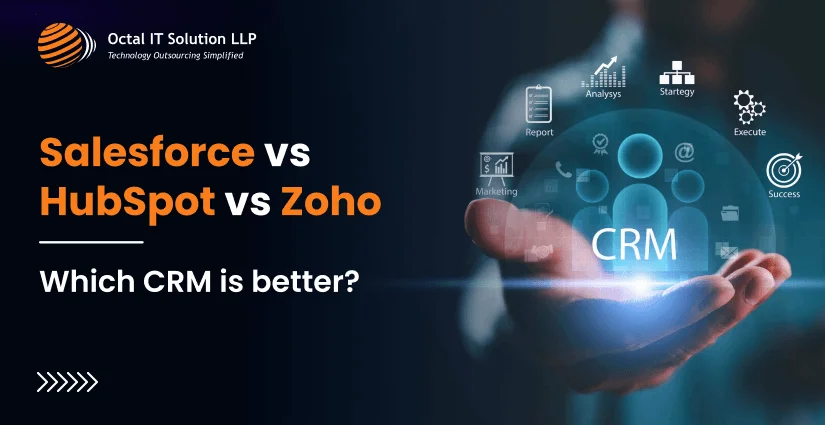
As technology continues to evolve, the choice of a proper CRM system will always be an integral business decision. This single choice directly affects revenue, productivity, and ultimately the trust of customers. With an increased number of customers, businesses will have to efficiently manage customer data, conversations, and sales pipelines. This CRM comparison guide allows businesses to compare leading platforms in detail in order to see all of the pros and cons before making a long-term investment in either platform. So, let’s compare and contrast Salesforce, HubSpot, and Zoho, the three most prominent CRMs of today.
What is CRM and Why Does it Matter?
CRM, or Customer Relationship Management, refers to a software solution that helps you to centrally manage all of the data and interactions of your customers. CRM for businesses will allow you to keep track of leads, sales activities, support tickets, and communication history, as well as any sales activity and interactions. CRM Matters for businesses as it helps:
- Utilizing a CRM solution for your business enables an organization to centralize its customer data. Therefore, it improves visibility into customer activity, whilst reducing data silos between departments.
- Automating processes & enables organizations to track customer sales funnels, which can enhance sales productivity.
- Personalizing communication with customers. This improves both timely and consistent responses to customer inquiries.
- Providing tools for organizations to use data to make decisions through various forms of predictive analysis, performance reporting, etc.
- Tracking customer engagement, customer satisfaction, and issues raised by customers. It helps organizations improve their customer retention rates.
Thus, CRM not only focuses on sales, but it also assists businesses in creating better ties with their customers by aligning Marketing, Sales, and Service under one umbrella. Thus, creating a better collaborative partnership with CRM software development companies is definitely necessary today.
A Quick Overview of the Leading CRMs
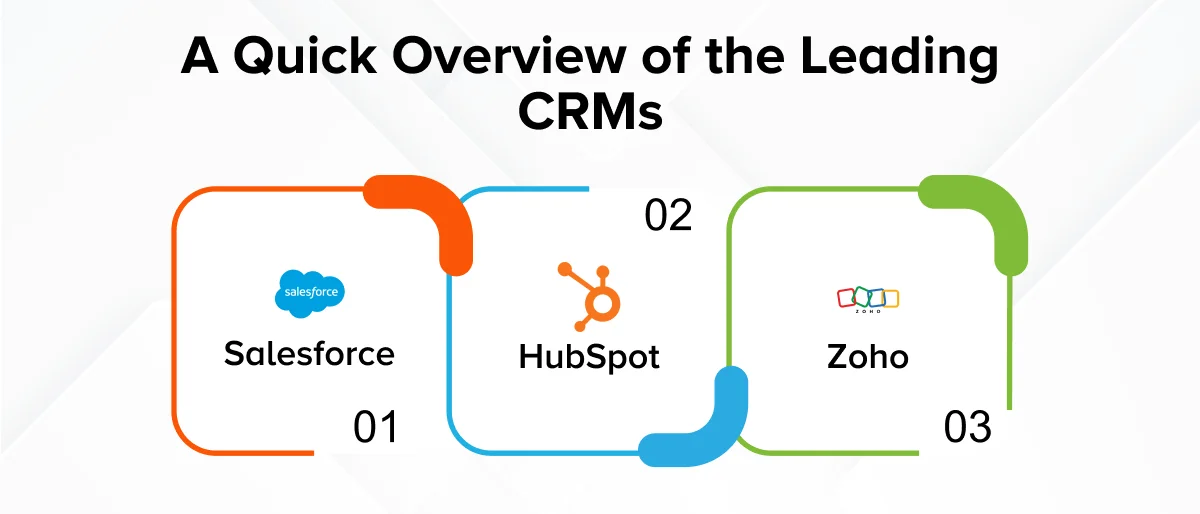
When organizations compare the top CRM platforms, they can make informed decisions based on the unique benefits of CRM for small businesses. If one asks about the best CRM for small business in 2026, three names come in the front: Salesforce, HubSpot, and Zoho. So, take a quick understanding of these three contenders before delving deeply into their comparisons.
Salesforce
Salesforce is considered one of the best CRM software for large businesses providing enterprise-level CRM solutions. It is characterized by its high level of Custom CRM solutions and an extensive selection of third-party applications. As of 2025, Salesforce has a market share of approximately 20.93% of the global CRM marketplace and is the largest player in this market.
It contains a range of analytical tools, AI capabilities, and extensive automation Salesforce CRM features. Salesforce is designed to help organizations with complex sales processes and with several countries operating out of one location. In addition to this, it provides access to thousands of applications through its AppExchange and developer community.
HubSpot
HubSpot has gained traction because of its highly intuitive interface and its ability to provide all-in-one marketing solutions. It seems to be targeting primarily mid-sized organizations and rapidly growing start-ups. The CRM consulting services market is expected to grow by at least 14.6% CAGR up until 2030.
That growth is expected partly because of how many businesses want platforms like HubSpot to be as easy to use as possible. The HubSpot platform combines not only sales but also marketing and customer service within one package, with clearly defined dashboards. Plus, the free version allows small teams to get started without any initial investment and then upgrade with additional custom CRM development costs when necessary.
Zoho
On the other end of the spectrum, Zoho provides users with an affordable, flexible alternative to their CRM needs. It also includes AI-Enhanced Data Analytics, Automated Workflows, and Advanced Communication Tools, and is very easy to integrate with other business products offered by Zoho.
Zoho’s pricing structure makes it ideal for small businesses and money-sensitive sales teams. When making a comparison between Salesforce vs Zoho CRM or HubSpot, it is crucial to determine what capabilities a given business needs for each functional department.
Hire Zoho Developers from Octal IT Solution.
Reviewing all the capabilities of each of the CRMs can quickly reveal where they fall short or excel relative to your needs. This will help you create your own application from mobile app development services with greater insight.
Comparison of Salesforce vs HubSpot vs Zoho
The features of Salesforce, HubSpot, and Zoho represent key aspects of the CRM development process as they apply to sales and marketing strategies. Side-by-side reviewing of each CRM platform comparison highlights their strengths and weaknesses, enhancing the effectiveness of team-based decision-making throughout the evaluation process.
| Feature | Salesforce | HubSpot | Zoho |
| Contact Management | Advanced | Strong | Good |
| Lead Scoring | Customizable | Built-in | Basic |
| Workflow Automation | Powerful | Easy Setup | Flexible |
| Reporting and Dashboards | Real-time | Visual | Custom |
| Email Integration | Seamless | Native | Integrated |
This comparison of CRM systems will help to guide the team in determining which tool is best for their specific needs. It provides an informed base for making decisions after a thorough CRM software review.
Overview of Salesforce, HubSpot, and Zoho CRM Comparison
Selecting the right CRM should be based on its usability, cost, scalability, and your long-term goals. When you start to compare HubSpot CRM vs Salesforce CRM and Zoho, you will quickly find that your choices are much easier to determine. See below for a complete side-by-side breakdown to get your suitable CRM.
User Experience
From the usability standpoint, when comparing Salesforce vs HubSpot and Zoho, there is a clear result. Starting with the HubSpot Salesforce comparison, Salesforce offers businesses an extensive list of customizable features. But it does so with a steep learning curve. Whereas, HubSpot provides an easy-to-follow and user-friendly interface, making it easier for users to adopt quickly. Zoho combines the ability to streamline the complexity of multiple business processes with easy configuration options. This makes Zoho a good fit for a team wanting the best of both worlds.
Key Advantages
When looking at comparing Salesforce vs Zoho CRM for strengths, the discussion usually centres around Scalability versus Price. A CRM software price comparison will indicate Salesforce to be costly with enterprise-level customizations and integration facilities with other business systems. Zoho provides a very cost-effective solution, providing businesses with an all-inclusive software package to run and manage their business. And lastly, HubSpot provides an easy-to-use platform that aligns your marketing and sales teams in one system, as you choose a software development company to design a CRM.
Pipeline Tracking
Pipeline tracking is very different in HubSpot vs Zoho CRM. HubSpot provides Sales teams with an easy visual tracking pipeline that can be used by small to medium-sized businesses. Zoho provides Sales teams with a pipeline that allows for customizable stages and automations. In addition to the above, Salesforce provides advanced capabilities in deal scoring, sales operations, and forecasting. Additionally, Salesforce provides all clients with the ability to create Multi-Pipeline Management capabilities.
Pricing
Price is one of the main factors that influences what type of CRM to buy. HubSpot CRM pricing is flexible as it offers its product free to begin with, but it will later charge for features beyond the base product. While comparing Zoho CRM versus Salesforce, Zoho has budget-friendly and predictable pricing tiers. Whereas Salesforce is typically higher priced than other CRM options. However, it can justify the higher cost with its advanced capabilities and enterprise-level scalability, along with extensive third-party integrations.
Customer Support
Customer support is another area that varies greatly among the different CRMs available today. While many providers offer an extensive amount of customer support, Zoho CRM benefits your business with a very responsive support team.
The difference between Salesforce and HubSpot is that HubSpot has robust onboarding support as well as a community support system. Whereas Salesforce provides several premium options for customer support. But it only offers premium technical support when you subscribe to a higher-level service.
Which CRM Will Work Best For You?
After comparing Zoho vs HubSpot vs Salesforce, the decision is up to you now. What CRM works best for you is based on how large your company is, what your budget is, and what your long-term goals are. If you’re a larger company with a growing customer base, then Salesforce would likely be the best option for you.
You can hire dedicated developers to build your custom CRM strategy on Salesforce. It has the most advanced features and capabilities to support the complexities of larger businesses. Moreover, it offers the ability to automate the processes needed for managing growth.
Whereas nimble and growing teams will find that HubSpot’s greater ease of use and speed serve their needs. Budget-conscious companies will find that Zoho offers an affordable option. Whatever your choice is, with the help of some best CRM software developers, you can soon get the strategic growth you want.
This Salesforce HubSpot Zoho comparison can help you align your business goals with the selection of the right CRM. While features are important, ultimately, the successful adoption of a CRM depends upon the preparedness of your organization and the plans for long-term scalability.
Conclusion
Choosing CRM implementation services is a strategic investment, not just a choice of software packages. Aligning a platform’s strengths with the goals and objectives of your business is key to the ongoing success of your partnership with the vendor. This CRM platform comparison will thus give you the ability to see at a glance how these products stack up regarding customer support and pricing.


 Get in Touch
 By
By July 13, 2026