


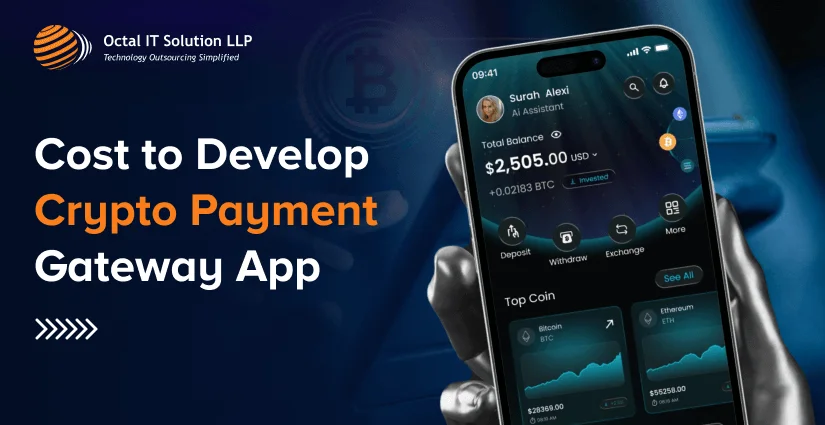
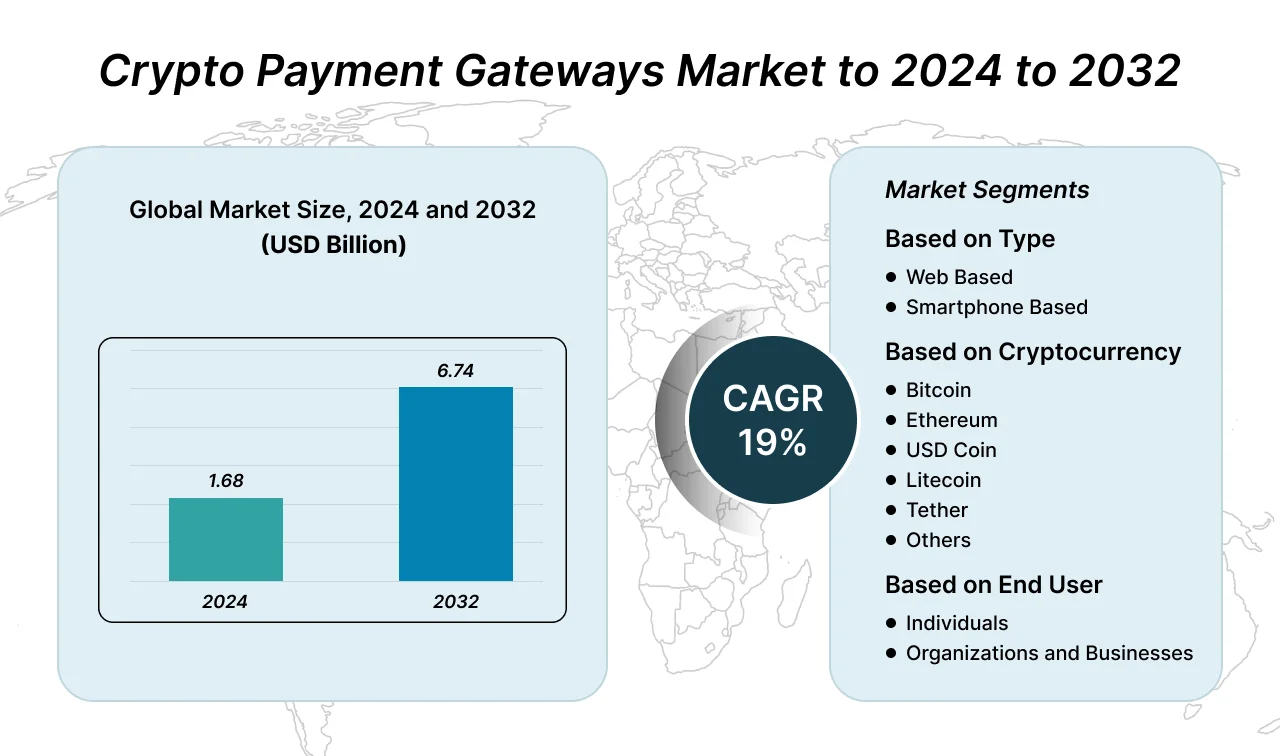
The trend toward decentralized finance and the growing use of digital transactions on an international scale have increased the adoption of cryptocurrency payments across industries. With the use of blockchain-based financial services by businesses, the need to develop crypto payment gateways is ever-increasing. The global market for crypto payment gateways was worth about USD 1.2 billion in 2023 and is projected to grow at a CAGR of more than 15% from 2024 to 2032.
A crypto payment gateway enables merchants to receive digital currencies in a reliable, immediate, and worldwide manner without making use of conventional financial institutions or high-rate exchange gatekeepers.
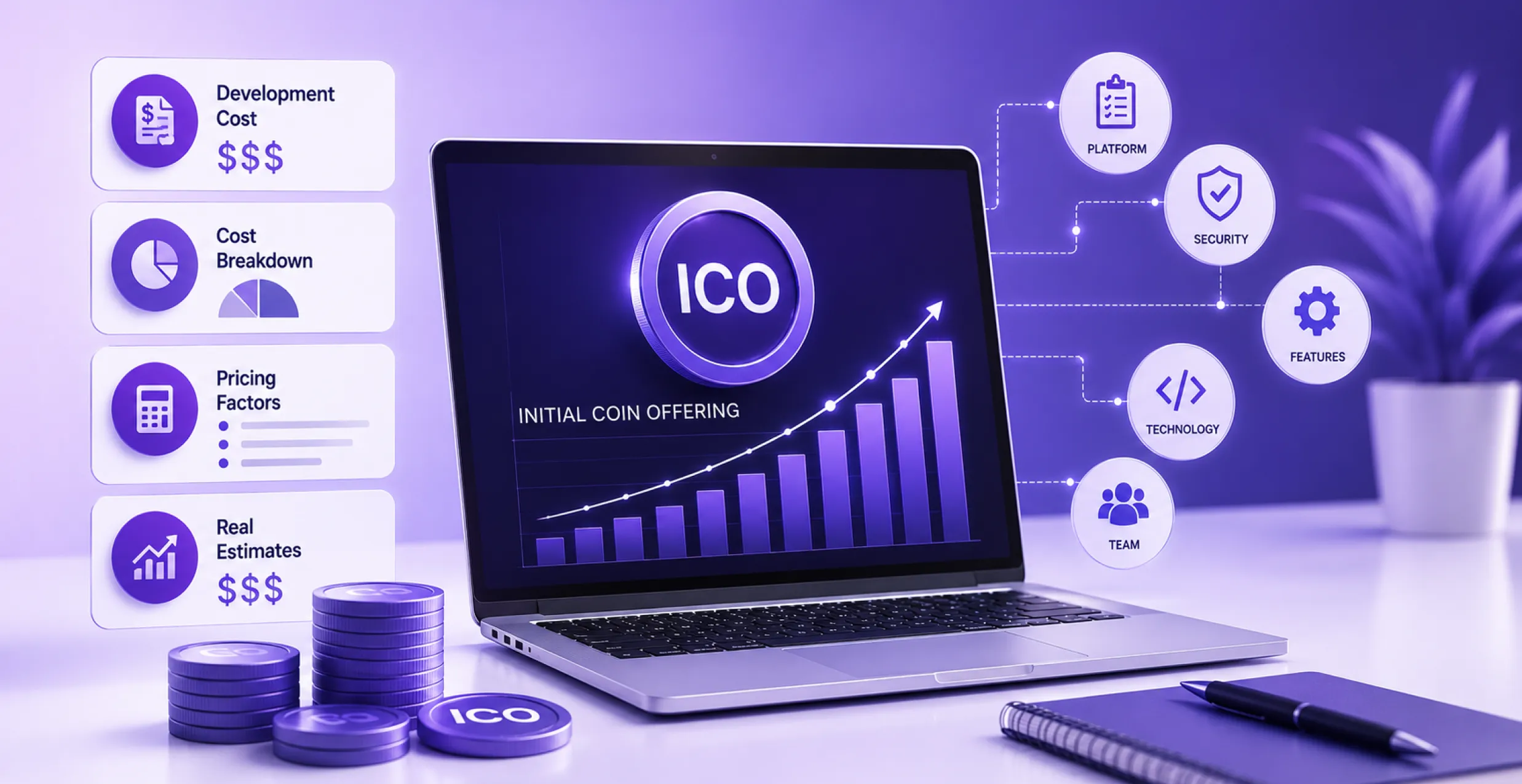
The question that is frequently posed by organizations that look into the development of payment gateways using cryptocurrencies is the cost to develop crypto payment gateway app.
The solution will be based on features, security needs, blockchain integrations, third-party services, and compliance standards.
This guideline splits the cost of building the crypto payment gateway application, its key features, considerations in price, technology stack, security layers, and advice from a professional software developer to the business that wishes to develop a scalable and enterprise-grade crypto payment provider.
- Key Features of Crypto Payment Gateway App
- Factors Impacting Crypto Payment Gateway App Development Cost
- Crypto Payment Gateway App Development Cost Breakdown
- How Much Does It Cost to Develop Crypto Payment Gateway in 2026?
- Technology, Security & Compliance in Crypto Payment Gateway App Development
- Compliance Frameworks During Crypto Payment Gateway App Development
- Final Thoughts
- FAQs
Key Features of Crypto Payment Gateway App
The present crypto gateways should provide flawless performance, an easy-to-use interface, and sophisticated security. These are the key characteristics below.
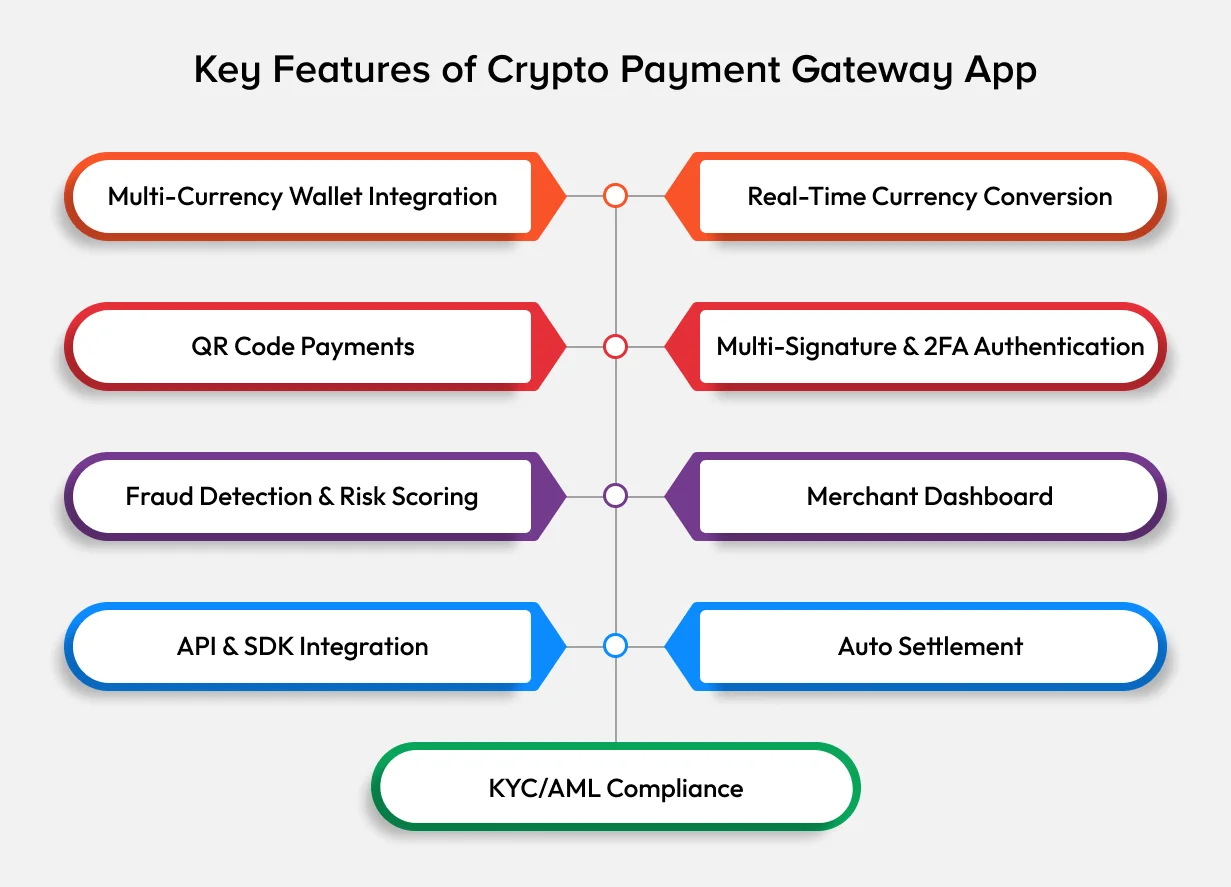
Multi-Currency Wallet Integration
Enables traders and customers to save, manage, and transact with various cryptocurrencies via a single interface. It helps to send, receive, and track asset balances, as well as provides flexibility and interoperability with key blockchain networks and other digital currencies.
Real-Time Currency Conversion
Offers real-time exchange rates between cryptocurrencies and bank currencies. This assists merchants in avoiding volatility, ensuring fair pricing, and making it easy to settle transactions without the need to use manual interventions and external exchange platforms.
QR Code Payments
Makes it easy to make a payment using scannable QR codes that enable one-tap transfers. This characteristic facilitates online and offline purchases, which increases the checkout experience and user experience with minimal friction.
Multi-Signature & 2FA Authentication
Adds protection by adding a layer of protection with numerous authorized keys of access, as well as two-factor authentication. It minimizes the risks of unauthorized access and enhances the security of wallets, as well as providing secure and validated crypto transactions to merchants and shoppers.
Fraud Detection & Risk Scoring
Applies analysis algorithms with machine learning to detect suspicious activities and stop money laundering. This option helps merchants reduce risks, preserve transaction integrity, and enhance confidence by automatically tracking potentially malicious activity.
Merchant Dashboard
Provides detailed information on payments, revenues, settlements, and trends in transactions. A properly created merchant dashboard will enable the business to measure performance and customer behavior and get control over operations through data that is organized visually.
API & SDK Integration
Helps dedicated developers to quickly add crypto transactions to websites, mobile apps, and point-of-sale systems. APIs and SDKs are ready to use, which minimizes the time of development, but maintains cross-platform compatibility and functionality.
Auto Settlement
Motorized conversion of received crypto into desirable fiat currencies or stablecoins. This helps businesses to avoid fluctuating prices and also to have reliable revenue without the need to convert them manually or involve external exchange rates.
KYC/AML Compliance
Secures identity checks, anti-money laundering, and compliance. These elements prevent fraud, enhance platform integrity, and ensure the payment gateway complies with the laws of different jurisdictions.
Factors Impacting Crypto Payment Gateway App Development Cost
Multiple elements influence the cost of building a crypto payment gateway app, especially when designing enterprise-grade platforms.
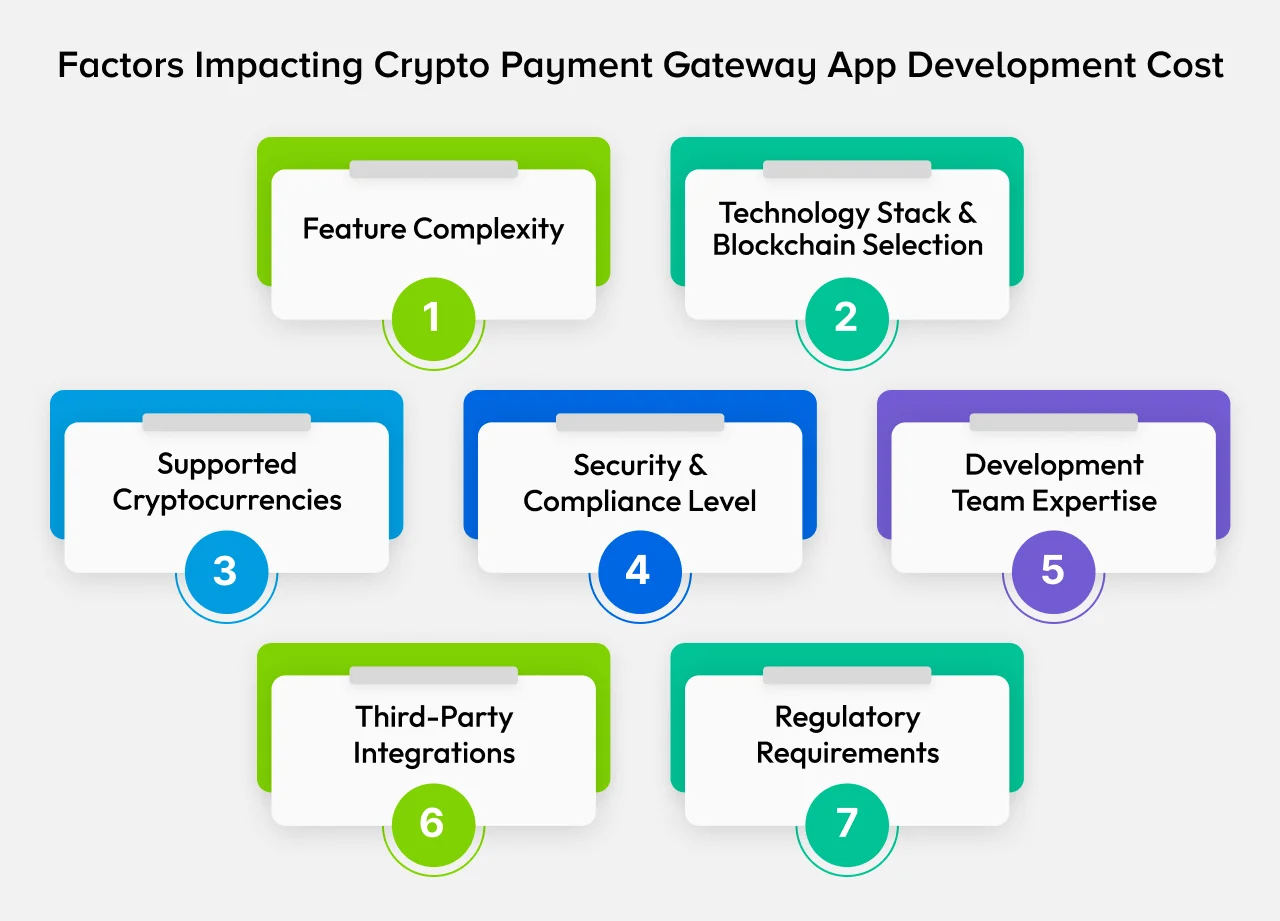
Feature Complexity
Advanced systems with multi-chain support, real-time conversions, dashboards, and smart contracts cost significantly more than basic gateways. More features increase development time, security requirements, and architectural planning, directly affecting overall cost.
Technology Stack & Blockchain Selection
Using advanced frameworks, smart contracts, and multi-node blockchain integrations increases costs. The more sophisticated the technology stack, the more resources required for development, testing, and maintenance.
Also, Read: How Blockchain App Development Is Revolutionizing Business Operations?
Supported Cryptocurrencies
Adding support for Bitcoin only is simple, but integrating multiple blockchains such as Ethereum, Solana, Polygon, or BNB Chain requires more engineering work. Each blockchain includes unique protocols, increasing development complexity and cost.
Security & Compliance Level
Building enterprise-grade security with encryption, multi-signature wallets, KYC, AML, and audits increases cost but ensures maximum protection. Higher compliance and regulatory requirements increase development time and technical investment.
Development Team Expertise
Experienced blockchain engineers, competent contract developers, and security specialists typically charge higher rates. Their expertise ensures a safer, more reliable platform. Team location US, Europe, or Asia, also affects the final development cost.
Third-Party Integrations
Integrating blockchain nodes, exchange APIs, liquidity systems, and compliance services increases costs. Each integration requires careful testing and configuration to maintain reliability and scalability.
Regulatory Requirements
Different regions require specific compliance frameworks and licensing. Meeting these requirements involves additional development, legal review, and verification processes, increasing cost but ensuring long-term operational legality.
Crypto Payment Gateway App Development Cost Breakdown
Below is a structured cost estimate for different project scales in crypto payment gateway app development:
| Project Type | Description | Estimated Cost |
| Basic | Essential wallet + payments | $25,000 – $40,000 |
| Mid-Level | Multi-chain + dashboards + APIs | $40,000 – $70,000 |
| Advanced | Smart contracts + DeFi support | $70,000 – $150,000+ |
| Enterprise | Custom, compliance-heavy | $150,000 – $300,000+ |
How Much Does It Cost to Develop Crypto Payment Gateway in 2026?
Average crypto payment gateway app development cost ranges from $40,000 to $150,000. Enterprise systems may exceed $250,000 depending on customization, security, and feature load.
A professional payment gateway app development company can significantly reduce risks, ensure faster deployment, and deliver enterprise-grade crypto solutions. Experienced developers understand blockchain infrastructure, regulatory requirements, private key management, and scalability, providing secure and efficient payment processing.
Technology, Security & Compliance in Crypto Payment Gateway App Development
A crypto gateway must be built on strong technological foundations and advanced security measures to ensure reliable operations.
Data Encryption
Protects sensitive data from unauthorized access through strong cryptographic methods. Encryption ensures transactional safety, prevents data leaks, and safeguards users from cyber threats.
Multi-Signature Wallets
Requires multiple approvals for transactions, enhancing security for high-value transfers. It’s essential for institutions managing user assets or treasury wallets.
Real-Time Monitoring
Tracks transactions continuously to flag suspicious activities, prevent fraud, and ensure seamless processing. This boosts platform reliability and integrity.
Cold Storage & Key Protection
Securely stores private keys offline to prevent hacking and unauthorized access. This is vital for long-term asset protection.
DDoS Protection
Prevents server overload during cyberattacks, ensuring uninterrupted operations and secure transactions even under high-traffic threats.
Compliance Frameworks During Crypto Payment Gateway App Development
Ensures adherence to AML, KYC, GDPR, and other global standards. Compliance protects businesses from legal complications and enhances user trust.
An expert ewallet app development company enhances crypto payment gateways by integrating secure wallets, private key management, biometric authentication, and multi-chain compatibility. Their specialized expertise builds strong user experiences and stable wallet infrastructure.
Advanced payment processing software development ensures optimized transaction routing, real-time validation, fraud prevention, and improved settlement accuracy. These systems support large-scale operations and enterprise performance needs.
Professional software consulting services help businesses choose the right blockchain, define technical requirements, ensure compliance, and plan architecture. Their guidance eliminates risks and supports successful implementation.
Specialized financial software development enhances transaction security, ensures auditability, and improves settlement processes. This expertise helps crypto platforms maintain financial-grade reliability.
Final Thoughts
The cost to build crypto payment gateway app depends on feature requirements, blockchain integrations, security standards, and customization levels. A professionally designed gateway delivers global scalability, low transaction fees, fast settlements, and strong user trust.
Businesses aiming to build crypto payment gateway app should partner with experienced blockchain developers to ensure secure architecture, compliance, and long-term performance.
If you want to develop such an app, hire Octal IT Solution as the leading cryptocurrency payment gateway development company. We have a team of experienced developers who can create apps as per your requirements to assist you in getting a competitive advantage in your business domain.
So, connect with our professionals today and turn your app idea into reality!
Get our services : Crypto Exchange Development Company
FAQs
The development cost is determined by multiple factors, including the complexity of features, the chosen technology stack, the number of supported cryptocurrencies, the required level of security and compliance, and the expertise of the development team.
More advanced features like multi-chain support, smart contracts, and real-time conversions increase development time and cost. Additionally, integrating third-party services, ensuring regulatory compliance, and implementing enterprise-grade security can also drive up the price.
KYC (Know Your Customer) and AML (Anti-Money Laundering) compliance are crucial for ensuring that the crypto payment gateway adheres to global legal and regulatory standards. This process helps prevent illegal activities such as money laundering and fraud, and it protects both businesses and customers.
Implementing KYC/AML procedures requires additional development work, such as identity verification systems and audit trails, which can significantly increase the cost of building the platform.
Integrating multiple blockchains such as Bitcoin, Ethereum, Solana, or BNB Chain requires more extensive engineering due to the unique protocols and features of each blockchain. This increases both the development timeline and the cost.
For instance, adding multi-chain support involves designing a system that can handle different transaction types, scalability issues, and security concerns across various blockchains, which can make the development process more complex and resource-intensive.
A crypto payment gateway must incorporate several layers of security to ensure the protection of user funds and transaction integrity. Key measures include data encryption to safeguard sensitive information, multi-signature wallets for high-value transactions, real-time monitoring to detect suspicious activities, and cold storage for offline private key management.
Implementing DDoS protection and compliance with global standards like GDPR, KYC, and AML further fortifies the platform against cyber threats and regulatory violations, though these measures can add to the overall development cost.


 Get in Touch
 By
By August 7, 2026