




Key Takeaways
- The global cryptocurrency trading bot market reached $47.43 billion in 2025. It could grow to $200.1 billion by 2035, at a CAGR of 14%.
- AI-powered bots analyze market data, optimize strategies, and predict trading opportunities.
- It offers strategic flexibility, security, and scalability. It also provides a wide range of ready-to-use features.
- The cost of crypto trading bot development depends on its complexity and workload. It typically ranges from $20,000 to $150,000 or more.
- Backtesting and paper trading are not negotiable before any live capital is committed.
- A strong regulatory framework is important for crypto trading bots. It is as important as security and risk management.
The Market Never Sleeps – And Neither Should Your Market Strategy
The cryptocurrency market runs 24/7. Human traders eventually get tired and make emotional decisions.
AI-powered crypto trading bot development is growing rapidly. Corporations, hedge funds, fintech startups, and individual investors now use automated trading bots. These bots make trading smarter, more efficient, and more reliable.
However, not all bots are the same. An AI-driven system is much more advanced than a simple rule-based script. Whether you’re a startup or an established business, this guide covers everything you need. It explains what a trading bot is. And it also covers how to build one, how much it costs, and how to make it successful. So, let us get into it.
- Key Takeaways
- The Market Never Sleeps – And Neither Should Your Market Strategy
- What is an AI Crypto Trading Bot & How Does It Work?
- Bot, AI-Enhanced Bot, Or Autonomous Agent: What is the Difference
- The Crypto Trading Bot Market In 2026 & Beyond
- Why Are Smart Businesses Investing in Crypto Trading Bot Development?
- Not All Bots Are Built the Same – A Clear Breakdown of Every Type
- Real World Use Cases That Prove It Works
- The Brain Behind the Bot – AI Model, Algorithms & Right Tech Stack
- What AI Trading Bots Can Actually Do And Where the Hype Takes Over
- Build vs. Buy: Custom Development or Ready-Made Solution?
- How to Build an AI Crypto Trading Bot – A Step-By-Step Process
- Why Back Testing & Paper Trading Are Non-Negotiable
- Real Challenges, Real Solutions – What Can Go Wrong & How to Stay Ahead
- Security & Governance Considerations
- Crypto Trading Bot Development Cost
- How Octal IT Solution Helps You Build A Crypto Trading Bot
- Wrapping It Up
- FAQs
What is an AI Crypto Trading Bot & How Does It Work?
An AI cryptocurrency trading bot uses data-driven signals to execute trades automatically. This reduces the need for human involvement in every trade. Many crypto wallet app development companies now integrate AI trading bots. This helps them deliver smarter and more automated crypto experiences.
AI-powered bots use machine learning models to recognize patterns and adapt to changing market conditions. Unlike traditional bots, they improve over time instead of following fixed “if-then” rules.
Here is how it works in simple terms:
- Data Collection: It collects real-time data from news, social sentiment, behavior, and chain analysis.
- Signals Generation: This data is analyzed using an AI/ML model to detect trading opportunities.
- Decision Making: The bot evaluates the signal using redefined risk parameters.
- Trade Execution: It uses an API to connect to exchanges and automatically places orders.
- Feedback Loop: The bot tracks results and uses them to improve future predictions.
The biggest difference is how these systems work. They analyze market conditions instead of simply reacting to them. AI-powered bots offer a higher level of predictability. That is what sets them apart from basic automation.
Bot, AI-Enhanced Bot, Or Autonomous Agent: What is the Difference
Not every “AI trading bot” works the same way. Three different systems are often grouped under the same name.
Traditional Bots
Follow established guidelines. “If prices are less than 5%, keep buying.” It does not learn from past market data.
AI-Enhanced Bots
These bots follow predefined rules. AI models adjust those parameters over time. The AI adjusts the order size or execution time based on the trading signal.
Autonomous Agents
Autonomous agents plan and execute multi-step tasks. Choose your own process, not just your own inputs.
The difference also affects risks. A bot’s mistakes usually trace back to the person who created the rules. An agent’s mistakes are harder to track. It makes its own decisions during execution.
In simple terms, a bot executes a strategy, while an AI agent decides which strategy to use. The agent decides which approach to use.
The Crypto Trading Bot Market In 2026 & Beyond
These market figures highlight the industry’s rapid growth.
The cryptocurrency trading bot market was worth 47.43 billion in 2025. It is expected to grow from $54.07 billion in 2026 to $200.1 billion in 2035.
The AI cryptocurrency trading bot market is expected to grow at a CAGR of 32.4% from 2024 to 2030. This growth is driven by wider crypto adoption and rising demand for automated trading.
In 2023, North America held the largest market share at 40%. Asia Pacific followed with 35% and recorded the fastest growth at a 20% CAGR.
Recently, 33% of trading companies adopted AI to improve execution. Another 29% integrated directly with exchanges.
Key Trends Shaping The Market Right Now
The following trends are shaping the market.
- Adoption of DeFi Bots
Developers now build bots specifically for DEX arbitrage, yield farming, and liquidity mining.
- Institutional Participants
Market makers and hedge funds are adopting AI-powered automated trading. Many now use it on a large scale.
- Regulatory Pressure
Regulations are becoming stricter around the world. That makes a compliance-ready bot architecture essential.
- Multi-Exchange Crypto Trading Bots.
Investors now prefer a single platform for trading across Binance, OKX, Coinbase, and Kraken. As a result, multi-exchange support has become a standard feature.
- SaaS Cryptocurrency Trading Platforms Development
SaaS crypto trading platforms are becoming more popular. Many companies now build and white-label their own trading bots.
- Machine-to-Machine Payment Rails
New payment protocols are emerging just for AI agents. They allow agents to pay each other directly, without human involvement. It’s early, but the market is changing quickly. It indicates where autonomous trading is heading next.
The early adopter phase is over. Businesses that delay automation risk falling behind.
Why Are Smart Businesses Investing in Crypto Trading Bot Development?
Businesses are investing rapidly in this space. They see clear opportunities for growth and profit. Here is what is driving the investments.
- 24/7 Market Coverage
Cryptocurrency markets never close. A trading bot helps capture opportunities around the clock. It also reduces the need for constant human monitoring.
- Speed and Accuracy
Trading bots execute trades in milliseconds. That speed gives traders an advantage during volatile markets.
- Emotionless Trading
Fear and greed often affect human decisions. Automated systems follow predefined strategies instead of emotions.
- Scalability
A human team cannot monitor multiple portfolios at once. It also cannot manage several trading strategies simultaneously.
- Competitive Advantage
Enterprise crypto trading bot solutions give businesses a competitive edge. They also help buyers choose faster and more efficient trading systems.
- Revenue Diversification
SaaS crypto trading platform development is creating new revenue opportunities. Fintech app development companies now offer trading bots as a service to their customers.
- Cost-Effectiveness
Automating business processes reduces operating costs. It also removes the need to maintain large trading teams.
- Advanced Risk Monitoring
Circuit breakers, position sizing, and built-in stop-losses protect capital. They reduce risk during volatile market conditions.
- Backtested Decision Making
Each strategy is tested before live trading begins. This reduces guesswork and improves confidence.
- Multi-Asset Portfolio Management
Businesses can manage multiple cryptocurrency holdings more efficiently. A crypto portfolio management bot helps automate the process.
- Lower Slippage
Smart order routing reduces the gap between expected and actual execution costs.
- Regular Performance Monitoring
AI bots track every trade automatically. They also report key metrics like win rate, drawdown, and Sharpe ratio.
Not All Bots Are Built the Same – A Clear Breakdown of Every Type
Choosing the right type of bot is important. It should match your trading strategy. Here’s a quick summary:
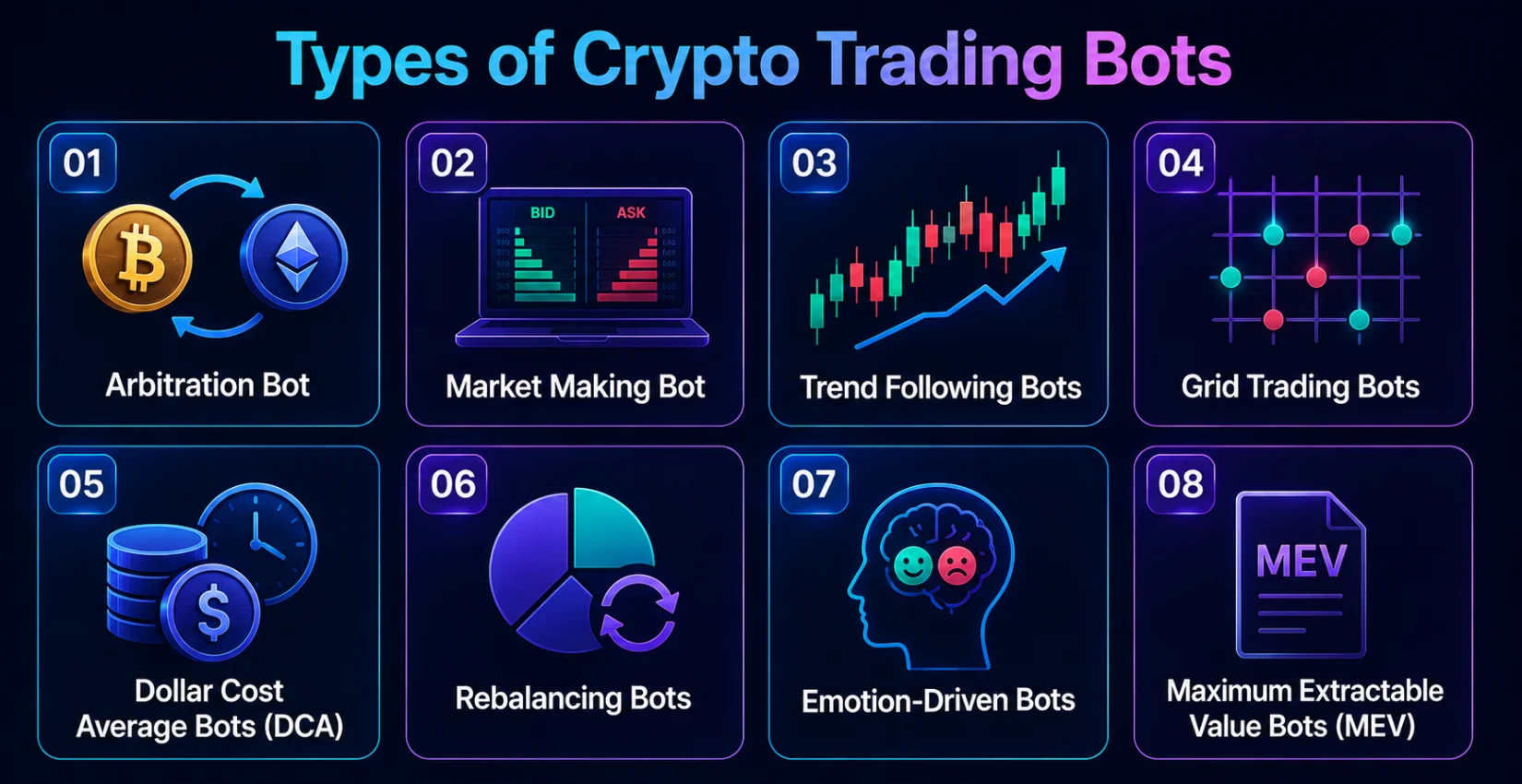
Arbitrage Bot
These bots compare prices of the same asset across multiple markets. Crypto arbitrage bot development is popular for low-risk and high-frequency trading.
Trading firms widely use these solutions in crypto arbitrage trading bot development. For example, a bot can buy Bitcoin for $60,000 on Exchange A. It can instantly sell it for $60,200 on Exchange B to earn the price difference.
Market Making Bot
Limit orders are placed by these bots based on the current market price. They benefit from bid-ask spreads as a result. These bots are often used by exchanges and liquidity providers.
Trend Following Bots
Indicators like moving averages, RSI, and MACD are used by these bots. They recognize and track trends in the market. They function best in marketplaces with strong trends.
Grid Trading Bots
At predetermined price intervals above and below a base price, these bots make trade orders. They do well in erratic or sideways markets.
Dollar Cost Average Bots (DCA)
These bots buy a fixed amount of an asset at regular intervals. This helps reduce long-term investment risks.
Rebalancing Bots
When allocations shift, these bots rebalance the portfolio. For instance, they may stick to a goal mix of 20% SOL, 30% ETH, and 50% BTC.
Emotion-Driven Bots
These bots use AI and NLP to analyze information headlines, Reddit discussions, and Twitter statistics to take action based on crowd psychology cues.
Maximum Extractable Value Bots (MEV)
Use the DeFi protocol and blockchain to create value through front-running on-chain and transaction ordering.
Real World Use Cases That Prove It Works
AI cryptocurrency bots are no longer just a concept. They solve real business problems across many industries:
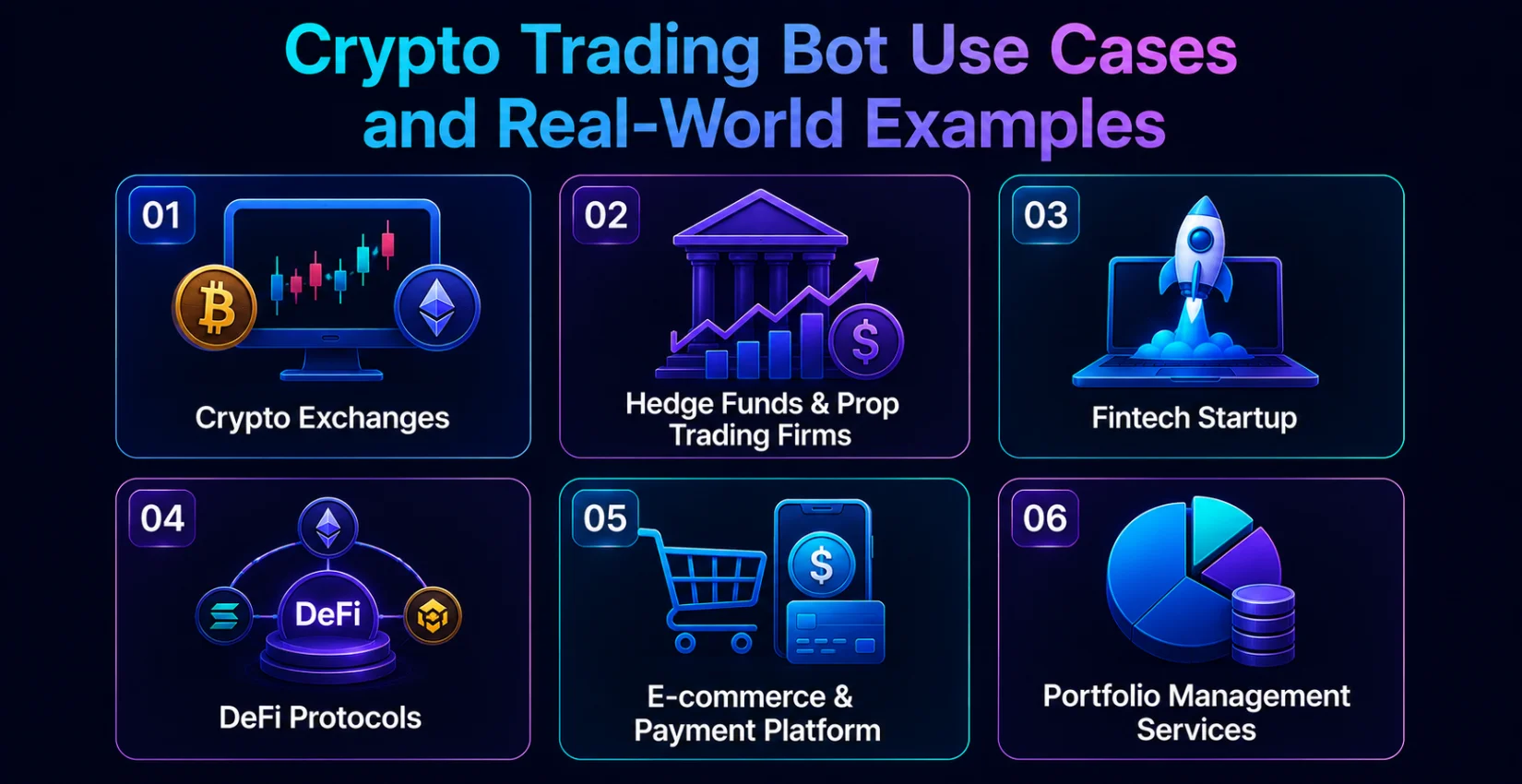
Crypto Exchanges
Crypto exchanges use trading bot solutions to improve liquidity and automate trading. They also offer these tools as value-added services to their users.
Hedge Funds & Prop Trading Firms
Firms like Jump Trading use algorithmic bots for MEV strategies and high-frequency trading in DeFi. Automation gives these firms a strong competitive advantage.
Fintech Startup
Many startups build crypto trading bots as their core products. These bots offer yield optimization tools, copy trading, and automated portfolio management.
DeFi Protocols
Bots automate yield farming, cross-pool arbitrage, and liquidity management. This reduces costs across the DeFi ecosystem. They have become essential for exchanges and decentralized trading platforms.
E-commerce & Payment Platform
Companies that accept cryptocurrency payments use trading bots to reduce the impact of price volatility. These bots can also integrate with crypto payment software development.
Portfolio Management Services
Wealth management platforms use AI-powered crypto portfolio management bots. These bots automatically adjust portfolios based on each client’s investment profiles.
The Brain Behind the Bot – AI Model, Algorithms & Right Tech Stack
This is where real intelligence comes in. The AI layer is what separates an advanced bot from a simple script.
Common AI/ML Models Used:
- LSTM Networks (Long Short-Term Memory)
LSTM models are excellent for short-term forecasting. They predict market volatility by analyzing sequential historical data.
- Reinforced Learning (RL)
The bot learns by interacting with the market data. It also improves its strategy by optimizing a reward function based on risk-adjusted returns. It determines what works; There is no set regulation.
- Gradient Boosting / XGBoost
Gradient Boosting and XGBoost perform well in classification tasks. They predict price movement using technical indicators.
- LLM and Transformer Models
LLM and Transformer models generate trading signals. They analyze news, SEC filings, social media, and market sentiment.
- Random Forests
Random Forests combine multiple decision trees and are used in the clustering process to create a reliable prediction.
What AI Trading Bots Can Actually Do And Where the Hype Takes Over
Not every AI CLAIM in this space is accurate. Here’s a realistic breakdown.
- RL Parameter Tuning
Real: AI adjusts quote spreads and order size as market conditions change.
Hype: Claims that AI “learns to be profitable” are exaggerated. It performs well only under specific conditions. It can overfit to backtest data.
- Sentiment and Signaling Models
Real: AI analyzes news, social media, and text data over time. It uses this information to generate trading signals.
Hype: saying AI “reads the market” is misleading. It identifies patterns and correlations, but they can’t fade quickly.
- Anomaly Detection
Real: AI Flags unusual order flow or misbehaving strategy in real time. Often omitted yet clearly useful.
Hype: It is rarely discounted, making it one of the more expensive options in this category.
- Predictive Routing
Real: Artificial intelligence anticipates fill quality across exchanges to route trades better.
Hype: Claims that AI can accurately predict prices are often misleading. Route optimization focused on execution quality, not future prices.
- Autonomous Agents
Real: Autonomous agents can plan and execute multi-step actions across multiple blockchain networks.
Hype: “Set it and forget it” is a risky mindset. Autonomous systems still need limits, monitoring, and human oversight.
- Natural Language Trading
Real: Allows users to describe intent instead of code rules. Lowers the barrier to entry.
Hype: The risk shifts to how the system interprets instructions. A misread instruction or a malicious command can still execute instantly.
AI is a real capability layer for execution, risk, and routing. It is not a money-printing oracle.
Recommended Tech Stack for Crypto Bot Development
| Layer | Tools / Technologies |
| Language | Python (primary), Rust (for low-latency execution) |
| ML Libraries | TensorFlow, PyTorch, Scikit-learn, XGBoost |
| Data Pipeline | Apache Kafka, Redis, TimescaleDB |
| Exchange Connectivity | CCXT (unified crypto exchange library), REST + WebSocket APIs |
| Backtesting | Backtrader, QuantConnect, Zipline |
| Infrastructure | AWS / GCP (cloud-based crypto trading bot), Docker, Kubernetes |
| Monitoring | Grafana, Prometheus |
| Security | Vault (secrets management), 2FA, encrypted API keys |
The data layer, signal layer, risk layer, and execution layer are all independently scalable and auditable in a well-designed, automated crypto trading system architecture.
Build vs. Buy: Custom Development or Ready-Made Solution?
Every company asks this question at the beginning. Here is a straightforward, honest comparison:
| Factor | Ready-Made (e.g., 3Commas, Cryptohopper) | Custom Development |
| Time to Launch | Days | Weeks to months |
| Upfront Cost | Low (subscription) | Higher initial investment |
| Strategy Flexibility | Limited to built-in options | Fully customizable |
| Scalability | Restricted by platform limits | Designed for your scale |
| Security | Shared infrastructure risk | Full ownership & control |
| IP Ownership | None – you’re renting | 100% yours |
| Integration | Basic API connections | Deep integration with your stack |
| Competitive Moat | Zero (competitors use the same tools) | High (unique system = unique edge) |
The Verdict:
Pre-made structures are useful for testing ideas or applying tangible methods to individual investors. Custom crypto trading bot development is the best choice for businesses that need a competitive solution. It also supports custom integration or unique product requirements.
If you need a white label crypto trading bot or a complete crypto trading automation platform, choose a custom development partner. They can build a solution that matches your business goals.
Custom Binance trading bot development gives you greater flexibility. Multi-exchange integration also helps you meet your specific business needs.
How to Build an AI Crypto Trading Bot – A Step-By-Step Process
The entire professional crypto trading bot development process looks like this:
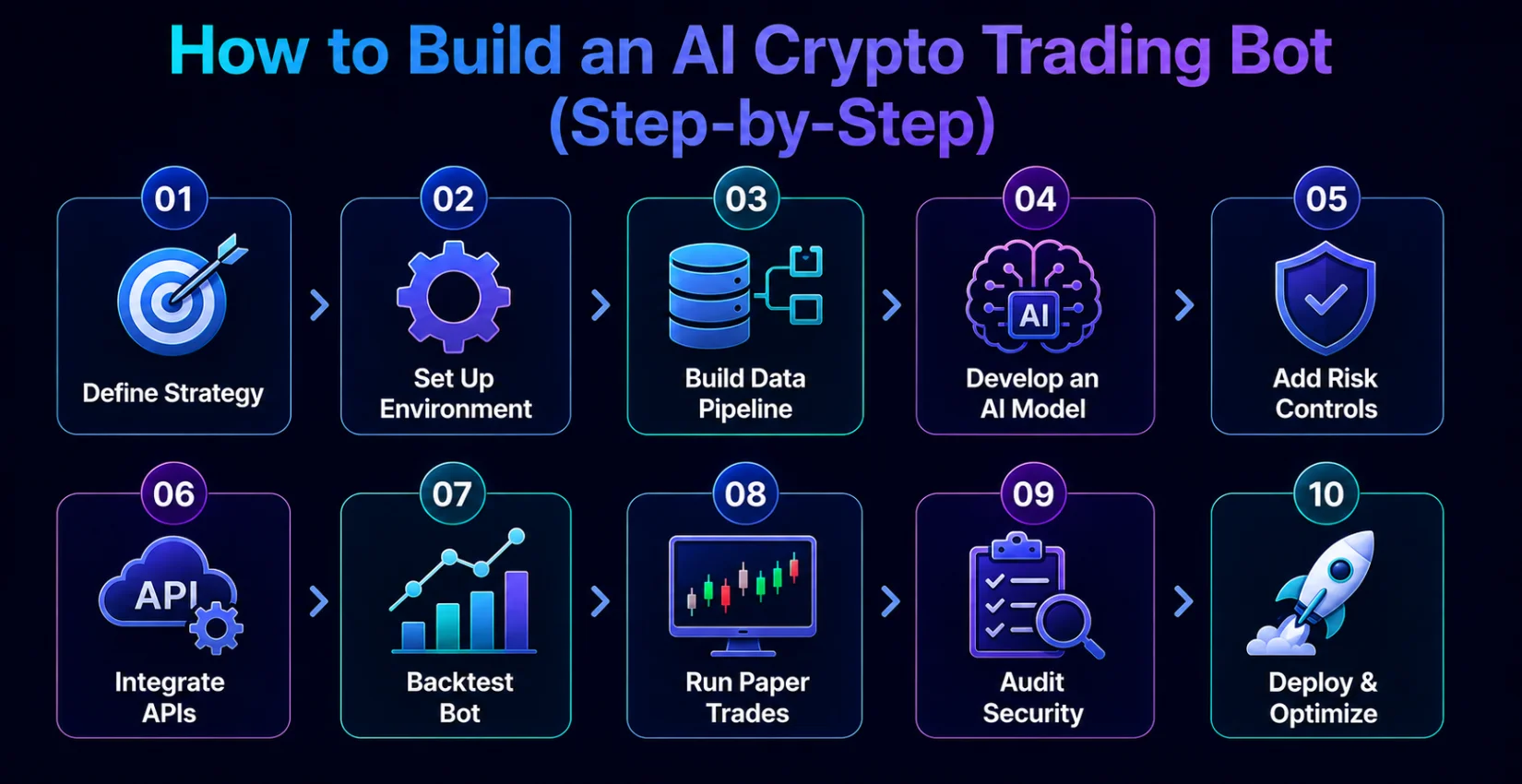
Define Your Trading Strategy
Before writing any code, define exactly what the bot needs to do. Including the assets, alerts, risk limits, and exchanges it will support. An unclear strategy often leads to a failed bot.
Set Up Your Development Environment
Configure your Python environment first. Then connect to sandbox APIs like Binance and Kraken, and set up your development tools. This is a good testing ground for you.
Build the Data Pipeline
Connect the bot to sentiment feeds, trading APIs, and real-time market data sources. The system cleans and normalizes the data. It then stores the data in a time-series database. Poor quality data can ruin even the best AI models. That is why accurate data is important.
Develop the AI/ML Model
Choose the right AI model based on your trading strategy. Common options include LSTM, XGBoost, and Reinforcement Learning. Use historical data AND engineered features like RSI and order book imbalances. Validate the model properly to avoid overfitting.
Implement the Risk Management Layer
Build the risk management layer before enabling live trading. Add circuit breakers, drawdown limits, position sizing, and stop-loss rules. Keep the strategy layer separate from the risk management layer.
Integrate Exchange APIs
Connect your bot to the target exchange using WebSocket and REST APIs. Use a library like CCXT to support multiple exchanges. Build custom integration if you need faster execution.
Backtest the Strategy
Use tools like Backtrader or QuantConnect to test your strategy with historical data. Test the strategy under real market conditions. Include slippage, order delays, and actual trading costs.
Paper Trade (Dry Run)
Trade with simulated funds in a live market environment. Backtest gaps, API freezes, incomplete completions, and connectivity issues that paper trading helps identify. Keep the bot in paper trading mode for at least two to four weeks before live deployment.
Compliance Review & Security Audit
Perform a thorough security audit of data encryption, access controls, and manage API keys before going live. Check applicable cryptocurrency trading laws when running a business venture in regulated markets.
Implement, Monitor, and Iterate
Deploy the bot on your cloud infrastructure. Create a real-time monitoring dashboard and configure anomaly alerts. Markets change over time. Retrain and evaluate your models regularly.
Why Back Testing & Paper Trading Are Non-Negotiable
Backtesting cannot be compromised. Skipping backtesting is one of the most expensive mistakes you can make. It is the foundation of reliable algorithmic crypto trading software.
Backtesting measures your strategy using historical market data. It helps you identify problems before risking real capital.
Important Pitfalls to Stay Away From:
- Overfitting: This technique fails on recent statistics due to being miles overmatched by historical statistics. Always validate at off-sample intervals.
- Lookahead Bias: It inadvertently feeds future records to try from the past. This destruction is all over the monitor and blows up the spine test results.
- Unrealistic Assumptions: Ignore partial fill, slippage, and trading costs. Model practical execution instead of perfect examples.
Important Performance Indicators to Highlight:
- Sharpe Ratio: Risk-adjusted return (higher = better)
- Maximum Drawdown: Worst peak-to-trough loss
- Win Rate: Percentage of profitable trades
- Profit Factor: Gross profit ÷ gross loss
Paper Trading
Adheres to retrospective and live market simulations of the use of fictitious money. It looks at practical aspects that backtesting ignores, with execution flow, change functions, and API latency. Your method is not always ready for live capital if it does not do well in paper trading.
Backtesting, QuantConnect, Freqtrade (open-bid), and the changing sandbox environment are examples of popular technologies.
Real Challenges, Real Solutions – What Can Go Wrong & How to Stay Ahead
Challenge 1: Market Volatility Breaking Strategies
Cryptocurrency markets can move 20–30% in a single day. Strategies must adapt to changing market conditions.
Solution: Create position sizing. This is a volatility warning and reduces exposure during periods of high volatility. Using governance identification models to modify the process according to market conditions.
Challenge 2: Downtime and API Price Limits
Exchanges often apply rate limits during periods of high volatility. They can delay order execution when timings matter most.
Solution: Create failover, exponential backoff, and retry logic for backup exchange connections. Use local order queuing to prevent your trades from being lost during short power outages.
Challenge 3: Model Decay & Overfitting
A model that performs well in backtesting may fail when market conditions change. Retrain it regularly to maintain accuracy.
Solution: Use walk-forward validation to test your model. Retrain it regularly and compare latency against benchmark results each week. Set automatic alerts when performance falls below a certain level.
Challenge 4: Security Weaknesses
The industry suffered heavy losses due to the risk of third-party risk, unsecured storage, and API key leaks.
Solution: Use read-only or limited API permissions whenever possible. Enable 2FA, store API keys in an encrypted vault, and perform regular access reviews. Choose a secure crypto trading bot development technique right now.
Challenge 5: Latency & Execution Slippage
Even a 100ms delay can cause your order to be executed for a fee that is worse than you expected in fast-moving markets.
Solution: Install infrastructure in proximity to exchange servers. Use WebSocket connections over REST for real-time data. And use auto-cancel logic to determine the maximum allowable slippage limit.
Challenge 6: Regulatory Compliance
Cryptocurrency policies are becoming stricter worldwide. Businesses are facing more compliance requirements as the market continues to evolve.
Solution: Create an architecture that makes it a good fit with AML/KYC right away. Partner with legal experts in your target markets. Establish proper audit trails and change sheets. Make sure your blockchain app development partner is familiar with both national and global frameworks if you want someone with compliance information.
Challenge 7: Prompt Injection Attacks
AI agents can be fooled by malicious instructions. These are hidden inside a data feed or social media post.
Solution: Give agents the scoped permissions only. Set a spending limit. Require human approval for anything beyond routine actions. Never allow an agent to have unlimited wallet access.
Security & Governance Considerations
In AI crypto trading bot development, security is critical, not optional. A single security breach can drain user accounts.
- API Key Hygiene
Only use exchange API keys; do not grant withdrawal permission in any way. Never place them in plain text files or accessible environment variables; Keep them securely stored.
- Isolated Infrastructure
Run robots in cloud environments that may be remote and have strict network access policies. Reduce the variety of incoming and outgoing connections.
- Encrypted Communication
TLS 1.3 is used for all records in transit. All data collected at rest is anonymized.
- Circuit Breaker
Automated circuit breakers eliminate any indulgence and notify your team if the bot is known for unusual behavior (unusual losses, sudden trading frequency)
- Regular Audits
Specifically perform regular security assessments and penetration assessments before quantitative planning.
- Governance & Access Control
Only legal people can toggle strategy settings or check execution logs thanks to role-based access control (RBAC).
- Session Keys & Scoped Permission
Give agents time-limited scoped access, instead of complete wallet control. This limits the damage if something goes wrong.
- Smart Account Permissions: (ERC-4337)
Use programmable permission systems. Set spending caps and session limits at the account level, and not just at the application level.
- Kill Switch
Every autonomous system needs a manual stop. If the circumstances are unusual, someone can return them immediately.
- Blast Radius Awareness
Know the maximum damage a compromised agent could do. Design permissions so the number stays small.
Crypto Trading Bot Development Cost
One of the most common questions from companies preparing to develop a crypto trading bot is: what is the cost to develop a crypto trading bot?
This is a practical breakdown:
Cost & Time Breakdown
| Bot Type / Scope | Estimated Cost | Timeline |
| Basic Rule-Based Bot (single exchange, simple strategy) | $10,000 – $25,000 | 4–8 weeks |
| Mid-Level AI Bot (ML model, 2–3 exchanges, standard risk mgmt) | $30,000 – $70,000 | 2–4 months |
| Advanced AI Bot (deep learning, multi-exchange, custom backtesting, full risk layer) | $70,000 – $150,000 | 4–7 months |
| Enterprise Platform (white label, SaaS, multi-tenant, compliance-ready) | $150,000 – $400,000+ | 6–12 months |
| Ongoing Maintenance (model retraining, security patches, feature updates) | $3,000 – $10,000/month | Ongoing |
Key Cost Drivers
- Complexity of the AI Model: advanced deep learning models versus easy rule-based whole.
- Number of Exchanges: The time and complexity multiply with each exchange API integration.
- Security & Compliance Requirements: Although it costs more, enterprise-grade security is important.
- Back Testing Infrastructure: Historical datasets and individual statistical pipelines.
- Team Composition: DevOps, QA, ML engineers, and blockchain developers all have different billing rates.
Look for agencies that can show back-tested performance data, security audit practices, and exchange API expertise. Choose a team with software development experience when you hire developers with proven experience.

Understanding factors like crypto wallet app cost help businesses estimate their investment. It also helps them plan secure and scalable crypto ecosystems.
How Octal IT Solution Helps You Build A Crypto Trading Bot
Building a production-optimized AI cryptocurrency trading bot definitely requires more than coding expertise. Additionally, it requires a deeper understanding of blockchain, machine learning, conversion APIs, and financial security. As a trusted crypto trading bot development company, Octal IT Solution serves as the ideal technology partner for the following reasons.
- Complete Crypto Trading Bot Development Services
With our AI-powered crypto trading bot development services, we manage the entire development lifecycle. From strategy and AI model selection to deployment and post-launch monitoring. Instead of fragmented components, you get a fully integrated and cohesive trading system.
- Development of Custom AI Models
As a leading AI crypto trading bot development company associate, our ML engineers do not rely on generic models. We build AI models that match your trading strategy. They support NLP-based sentiment analysis, pattern recognition, and LSTM-based price prediction.
- Multi-Exchange Architecture
Multi-exchange cryptocurrency trading bots use a unified API. They also include smart routing, failover mechanisms, and exchange-specific optimization. Our expertise in cryptocurrency exchange development helps your bot run seamlessly across Coinbase, OKX, Kraken, Binance, and other major trading platforms.
- SaaS-Ready & white-Label Builds
Our white-label crypto trading bot deployment approach gives you a fully branded, scalable platform ready for commercial launch. AI app development adds advanced trading capabilities to crypto products. Businesses can build intelligent crypto products tailored for modern traders and investors.
- Security-First Development
As an experienced AI crypto trading bot development company, we build every bot with strong security measures. We include security architecture assessments, isolated infrastructure, rate-limit protection, encrypted key storage, and circuit breaker implementation. Stability and security are built into the cryptocurrency trading bot from day one, not added at the end.
- Compliance Aware Engineering
Our builds include audit logging, AML-compliant configuration, and reporting features. They help you stay ready as global regulations become stricter.
- Blockchain and Web3 Integration
Do you need information feeds, wallet integration, or DeFi bot capabilities from the chain? We connect every layer of your cryptocurrency stack. Our proficiency in blockchain application development and crypto wallet app development services ensures smooth integrations.
- Full Stack Fintech Capabilities
Payment gateway development services support your entire cryptocurrency product ecosystem. They complement your trading bots with secure payment functionality.
- Efficient Bot Development Team
Our team consists of professionals who can hire crypto trading bot developers all at once. Those people know about the underlying trading system and market strategies.
- Ongoing Support and Ideal Model Retraining
Your bot should change as markets do. Trading bot software development includes ongoing support after launch. Regular upgrades, performance evaluations, and planned model retraining help you keep your system competitive.
Our company also lets you hire mobile app developers to create dashboard companion apps in your buying and selling facilities.
Wrapping It Up
The advent of AI-powered cryptocurrency trading bots has evolved from a specialized endeavor to an essential enterprise tool. As the market evolves and grows rapidly, smart automation has a significant and quantifiable competitive advantage.
A successful trading bot depends on good design, a reliable model, and strong risk management. Thorough backtesting and secure infrastructure also play a critical role.
You must collaborate with a team that is knowledgeable about the trading enterprise and technology. If you are serious about developing a cloud-based crypto trading bot solution that works. We offer both at Octal IT Solution.
Read More : cryptocurrency exchange development companies

 By
By September 25, 2026





 Get in Touch