


Key Takeaways
- The cost to develop a crypto trading app like CoinSwitch Kuber can range between $30,000 and $300,000+. The development cost depends on many factors, such as complexity, features, and team location.
- The timeline for the crypto trading app development for MVP basically takes 3-5 months, and a full-fledged platform can take 8-14 months.
- CoinSwitch trending in the market, but it still has real gaps reported by users. Your platform can fill those gaps and build to do better.
- Development cost includes post-launch maintenance, compliance, and security audits, which can run 15-20% of your initial cost annually.
- In 2026, the cryptocurrency exchange platform market is valued at $68.85 billion and is expected to reach $173.92 billion by 2030. The market is growing at a CAGR of 26.1%.
- Centralized crypto exchange development needs a robust infrastructure, trading engine, KYC/AML integration, hot/cold wallet management, and real-time data feeds.
CoinSwitch Kuber came in 2017, and since then, it has changed how businesses trade crypto. This platform made buying and selling digital currencies as easy as ordering food online. Over 2.5 crore users trust this platform, and this supports 400+ cryptocurrencies.
- Key Takeaways
- CoinSwitch Kuber vs. Custom Crypto App: Features, Gaps & What to Build Better
- CoinSwitch Kuber Like App Development: Market Analysis
- Core Features of a Crypto Trading App Like CoinSwitch Kuber
- MVP vs. Full-Scale Build: What Should You Launch First?
- Choosing the Right Technology Stack for Crypto App Development
- How Long Does it Take to Build A Crypto Trading App Like CoinSwitch Kuber?
- Cryptocurrency Exchange Development Cost Breakdown
- Key Factors Affecting Crypto Trading App Development Cost
- Hidden Costs in Building A Crypto Trading App
- Post-Launch Cost: Maintaining and Scaling Your Trading App
- How to Monetize a Crypto Trading App Like Coin Switch Kuber
- Security Architecture for Crypto Trading App
- Legal & Compliance Considerations in Crypto Trading App Development
- Case Study: KCrypto – A Crypto Trading App We Built
- Future Trends in Crypto Trading App Development
- Build Your Crypto Trading App With Octal IT Solution
- Conclusion
- FAQs
As we all know, nothing is perfect, and everything comes with flaws, and so is CoinSwitch Kuber. The platform is trending, and people trust it, but it has also been reported to have multiple issues. Users reported several issues with the platform, including withdrawal delays during peak times, sudden coin delistings, and slow customer support. Your business can take this gap as an opportunity and build better than this.
If you are planning but still wondering how to develop a crypto exchange app, then you are at the right place. We have compiled this guide that includes everything you need to know. From features, tech stack, timelines, to crypto trading app development cost, compliance, and monetization strategies, this includes everything. We will also show you where CoinSwitch falls short so you can build better.
This guide gives you a clear picture of what it takes to build a competitive Crypto trading app in 2026. Whether you are a small business exploring a crypto exchange development for startups or you are an experienced enterprise finding a custom crypto exchange development, stay tuned, and you will get everything about the crypto trading app development.
CoinSwitch Kuber vs. Custom Crypto App: Features, Gaps & What to Build Better
You must be searching for how to develop a crypto exchange app like CoinSwitch Kuber. And many blogs will surely tell you how. But we will say that why build something that already exists, be useful and build smarter than that.
CoinSwitch Kuber is strong in many areas, but if you read the user reviews, it will tell you a different story. So when it comes to reliability, it fails. Here is a clear breakdown to help you make a smarter choice.
| What CoinSwitch Does Well | Where It Falls Short | What You Can Build Better |
| Simple, beginner-friendly UI | Withdrawal is disabled during market peaks | Guaranteed withdrawal availability with load balancing |
| 400+ crypto listings | Sudden coin delistings without warning | Transparent delisting policy with advance notice |
| UPI & bank transfer support | Slow or unresponsive customer support | 24/7 live chat + automated support tickets |
| Low entry point | Price discrepancies between app views | Single real-time price engine across all screens |
| FIU-IND registered & KYC-compliant | Limited advanced trading tools for pros | Pro trading dashboard with TradingView charts |
| Crypto SIP & passive income features | No web3 wallet or DeFi integration | Web3 coin support and DeFi earning features |
This comparison helps you understand where the CoinSwitch application falls short and where you can do better to fill the gap. If your business chooses to develop a custom crypto trading app solution with reliability, you can stand out with a strong user base.
Now the real question is not how to develop a crypto exchange app like CoinSwitch Kuber, it is how you build one that users really prefer.
CoinSwitch Kuber Like App Development: Market Analysis
Before you invest in a crypto exchange platform development, you must understand the market and how large it has become.
According to The Business Research Company, the cryptocurrency exchange platform market was expected to reach a value of 54.8 billion dollars in 2025. Analysts expect the market to reach 68.85 billion dollars in 2026. And it will reach 173.92 billion by 2032.
Globally, the cryptocurrency exchange market is valued at approximately 170.52 billion USD in 2026 and is projected to reach USD 1,550 billion by 2035, growing at a CAGR of 27.8%.
But what are the forces that are driving this?
- Institutional traders are entering the crypto space in droves. Over 68% increased their crypto holdings in 2025.
- Trading participation is growing, especially in the Asia Pacific, the fastest-growing region in the world.
- Over 45% of retail and institutional traders actively trade cryptocurrencies.
- About 32% of the main exchanges use AI-driven trading tools.
- Regulatory clarity in markets such as the US and EU is removing barriers that companies have closed in the past.
Digital payment transactions reached 13 billion per month by 2024 – up from just 2.5 billion in 2018. More than 20 million customers already invest in crypto through regulated exchanges. This is the same target audience that CoinSwitch Kuber built its business on.
The market is growing constantly, and frameworks are maturing. Even user comfort with crypto is at an all-time high. Therefore, the year 2026 is the right time if your business wants to explore what cryptocurrency app development services are available.
Core Features of a Crypto Trading App Like CoinSwitch Kuber
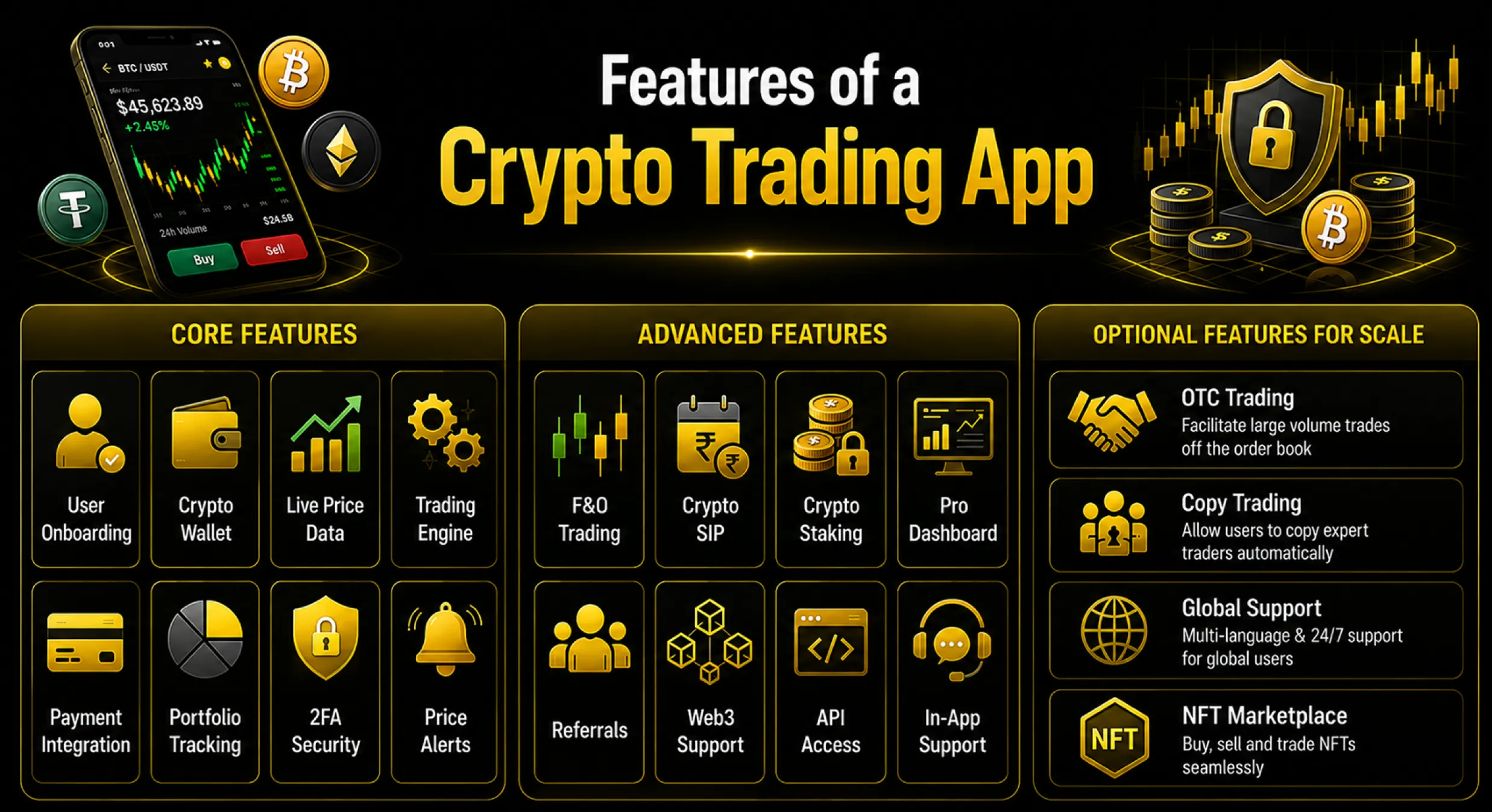
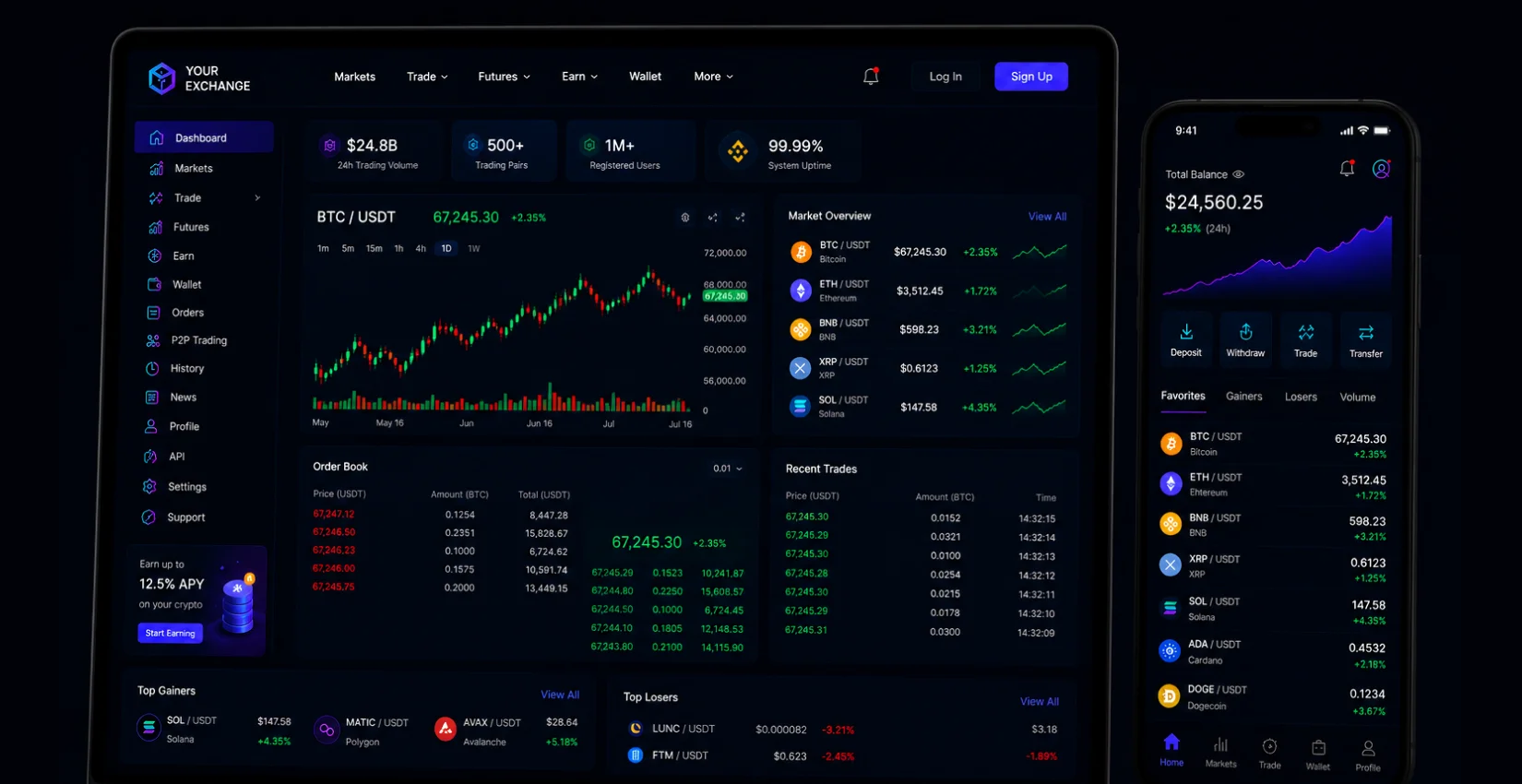
Features serve as the foundation when you build a crypto trading app that competes in the leading market. Here are some essential and advanced features that will definitely make your app more feature-rich than CoinSwitch.
Core Features
- User Registration & KYC: Email & phone signup, document verification, PAN/Aadhaar integration for Indian users.
- Crypto Wallet Integration: Hot/Cold wallet support, ability to deposit, withdraw, and hold assets.
- Real-Time Price Feeds: Live charts, order books, price tickers across 400+ coins.
- Buy/sell/ Trading Engine: Market orders, limit orders, instant trading with INR support.
- Payment Gateway Integration: UPI, NEFT, IMPS, and bank transfer support.
- Portfolio Dashboard: Holdings overview, profit/loss tracker, transaction history.
- Two-Factor Authentication (2FA): mandatory security layer for all accounts.
- Push Notification & Price Alerts: Real-time alerts for price movements.
Advanced Features (Differentiators)
- Futures and Options Trading: Leveraged futures contracts, multi-leg basket orders.
- Crypto SIP: Systematic Investment Plan for recurring crypto purchases
- Staking & Passive Earning: Allow users to earn on idle holdings.
- Pro Trader Dashboard: TradingView chart integration, market depth, advanced analytics.
- Referral Program: Tiered commission structure on friends’ trading fees.
- Web3 Coin Support: Access to DeFi tokens and tokenized stocks.
- API Trading: Allow power users and bots to trade programmatically.
- In-App Customer Support: Live chat, support ticket, help center.
Optional Features for Scale
- OTC Trading Desk: High-volume trades off the main order book.
- Copy Trading / Social Trading: Follow and mirror expert traders.
- Multi-Language & Multi-Currency Support: For global expansion.
- NFT Marketplace Integration: For Web3 forward integration.
Your app can be more advanced than CoinSwitch Kuber from a feature perspective. These features give your app capabilities that CoinSwitch Kuber currently does not offer. But again, features alone do not make your platform better overall; it takes a lot more than that. Let us discuss it further.
MVP vs. Full-Scale Build: What Should You Launch First?
When you start your crypto exchange MVP development, then you surely get this question in mind: Do I need to build everything now?
The answer to your question is No. In fact, building everything at once can be very risky.
| Factor | MVP Build | Full-Scale Build |
| Timeline | 3–5 months | 8–14 months |
| Cost | $30,000 – $80,000 | $150,000 – $300,000+ |
| Features | Core trading, KYC, wallet, basic dashboard | All features, including futures, staking, API trading, and pro tools |
| Best For | Startups validating product-market fit | Funded businesses ready for full launch |
| Risk | Lower – test before scaling | Higher – large upfront investment |
When you start with MVP development, it reduces your crypto exchange app development pricing by 40-60%. It will help you understand the market and your user base as well, so that you can deliver accordingly next time. Even your inspiration, the CoinSwitch app, itself started lean, and then added features later. Less risk and more understanding.
For startups, the path is simple: start with an MVP with core trading features, KYC wallet, INR support, etc. Then, for the next 3-6 months, analyze and validate user behaviour. Once you understand the actual demand, then build futures, staking, and advanced tools.
If you have made up your mind about the development and need a crypto exchange development cost estimate, then this is the right time to start. Contact a crypto app development company that has a track record of delivering similar products. Their team will give you a realistic estimate and help you build a strong product.
Choosing the Right Technology Stack for Crypto App Development
Like features, the tech stack is also a very strong foundation for your platform. The technology you use affects the performance of your app and influences the security, scalability, and long-term maintenance cost as well. Here is the list of modern tech stacks for secure crypto exchange app development.
| Layer | Technology Options | Recommended For |
| Frontend (Mobile) | React Native, Flutter | Cross-platform apps (reduce cost by 30–40%) |
| Frontend (Web) | React.js, Next.js | Pro trading dashboards, admin panels |
| Backend | Node.js, Go, Python | High-frequency trading logic and API layers |
| Database | PostgreSQL, MongoDB, Redis | Order books, user data, and caching |
| Blockchain | Ethereum, Solana, Polygon, BNB Chain | Smart contracts, token handling |
| Trading Engine | Custom HFT engine or open-source fork | Order matching at <10ms latency |
| KYC/AML | Onfido, Jumio, DigiLocker (India) | Regulatory compliance |
| Payment Gateway | Razorpay, Cashfree, PayU (India) | INR deposits and withdrawals |
| Infrastructure | AWS, Google Cloud, Azure | Design for high availability |
| Security | HSM, MultiSig, MPC wallets | Hot/cold wallet management |
If you are developing a platform for Indian market deployment specifically, Aadhaar-based KYC DigiLocker integration is important. And for Exchange APIs, you can make use of CoinGecko and CoinMarketCap as they provide reliable real-time market data feeds.
These technologies give your business the flexibility to launch faster and scale better. You can easily evaluate crypto exchange software development options. Working with a trusted blockchain app development company will allow you to choose the best combination of tech stack based on your business model.
How Long Does it Take to Build A Crypto Trading App Like CoinSwitch Kuber?
Timeline is one of the most important factors of your business planning, along with the cost. Here we are presenting a realistic phase-by-phase time breakdown for your cryptocurrency exchange app development.
| Phase | Duration | Key Activities |
| Discovery & Planning | 2–3 weeks | Requirements, scope, and architecture decisions |
| UI/UX Design | 3–5 weeks | Wireframes, prototypes, and user flow design |
| Backend Development | 8–14 weeks | Trading engine, wallet, API, database, KYC |
| Frontend Development | 6–10 weeks | Mobile app (iOS + Android), web platform |
| Security & QA Testing | 3–5 weeks | Penetration testing, bug fixes, load testing |
| Compliance & Legal | Parallel (4–6 weeks) | FIU-IND registration, KYC policy, TDS integration |
| Deployment & Launch | 1–2 weeks | App store submission, server setup, go-live |
Crypto exchange MVP development typically takes 3-5 months, whereas a full-scale CoinSwitch Kuber-like platform can take 8-14 months based on requirements.
Also, remember that security and compliance should run in parallel because these are mandatory requirements, not an afterthought.
A little tip for businesses: starting your legal preparation early can save you a lot of time (4-6 weeks).
Cryptocurrency Exchange Development Cost Breakdown
If you are wondering how much does it cost to develop a crypto trading app like CoinSwitch Kuber, well, the answer is: It depends on your scope. Here, we made a realistic cost breakdown, which will tell you how much to budget for each phase.
| Development Component | MVP Cost | Full-Scale Cost | Notes |
| Discovery & Planning | $2,000 – $5,000 | $5,000 – $15,000 | Scope, architecture |
| UI/UX Design | $3,000 – $8,000 | $10,000 – $25,000 | Wireframes + UI |
| Backend Development | $10,000 – $25,000 | $40,000 – $100,000 | APIs, DB, engine |
| Frontend / Mobile App (iOS + Android) | $8,000 – $20,000 | $30,000 – $70,000 | React Native / Flutter |
| Trading Engine & Wallet Integration | $5,000 – $15,000 | $50,000 – $200,000 | HFT engine is custom |
| KYC/AML Integration | $3,000 – $8,000 | $10,000 – $30,000 | Onfido / Jumio |
| Security Architecture | $5,000 – $10,000 | $30,000 – $80,000 | HSM, MPC, audits |
| QA & Testing | $3,000 – $8,000 | $15,000 – $30,000 | Pen testing + load |
| Deployment & Infrastructure | $1,000 – $3,000 | $5,000 – $15,000 | AWS / GCP setup |
| TOTAL ESTIMATED COST | $30,000 – $80,000 | $150,000 – $300,000+ | – |
Note: These cost ranges apply to an Indian development team. Any crypto wallet development company USA and a development team in Europe can charge 2-3x higher. Therefore, we recommend that you hire crypto exchange developers from an Indian development team.
If you are wondering how can I hire crypto exchange developers? Then you can simply connect with the development team of Octal IT Solution. Working with a reliable crypto exchange development company will get you quality and clear pricing.
Key Factors Affecting Crypto Trading App Development Cost
Well, as we already know, the cost depends on your scope, so the cryptocurrency exchange platform development cost is not fixed. These are a few factors that influence the development cost.
Development Team Location
This is one of the biggest variables that move the cost up or down. US-based developers charge typically $100-$200 per hour, which is significantly higher than developers from India. The hourly rate for Indian developers ranges from $25 to $75. The difference in cost could exceed $100,000 for a full-scale project with a comparable scope of work.
Feature Complexity
A simple buy/sell app can be far less than an app with more complex features. Such as futures, staking, options trading, and HFT engines. Every time you add complex features like these or real-time data features, it increases the backend complexity and the final cost.
Platform Choice
The platform you choose also affects the cost, as building with iOS and Android costs more. Use cross-platform with React Native and Flutter, it will reduce the cost by 40%. Most businesses that are launching an MVP in 2026 prefer cross-platform as their default approach.
Centralized vs. Decentralized Architecture
The centralized crypto exchange development cost is less as it does not require any smart contract audits. Whereas DEX development is far more expensive, as it requires Solidity expertise and multiple security audits. So, the purchasing cost is much higher.
KYC/AML Provider
After the integration of third-party KYC tools (Onfido, Jumio), it costs $1–$5 per verification. High user volume makes this one of the highest ongoing costs.
Security Level
Crypto exchange app development solutions are more expensive in 2026 because of AI -powered attack vectors. Additions like the MPC wallet, signature setups, and penetration testing increase the cost and add more $30,000-$80,000 to a full build.
Regulatory Jurisdiction
Different regulatory compliance requirements for different nations. Your business needs FIU-IND registration if you are building for India. Building for the US requires FinCEN compliance and potentially a state-level money transmitter license. Compliance with many jurisdictions increases legal expenses.
White-Label vs. Custom Build
White label crypto exchange development is cost-effective and can be launched for $25,000-$80,000, but again comes with limited customization. Working with custom crypto exchange software development services allows you to have full control over the development. This takes longer and costs more.
Hidden Costs in Building A Crypto Trading App
Most businesses plan for the initial cost of crypto trading platform development, but are surprised when they encounter hidden costs. Here, get to know what to budget for.
App Store Fees
Apple costs $90/year; Google Play costs a $25 one-time fee. Both have evaluation methods that can delay the launch.
Exchange API Cost
Real-time market reports from providers like CoinGecko Pro, CoinMarketCap, or Kaiko can cost $500 – $5,000/month, depending on the plan.
Liquidity Provider Fees
You want liquidity allocation to make sure smooth trading, especially in low-volume pairs. The cost varies by volume.
Smart Contract Audits
If your platform uses any smart contracts, a third-party security audit requires $5.000–$50.000, depending on the complexity of the code.
Legal & Compliance Fees
FIU-IND registration, legal documentation, and ongoing compliance review cost $10,000-$50,000.
Insurance for Hot Wallets
Industry best practice calls for securing at least 10% of total hot wallet assets. The cost depends on the total asset value.
Marketing & User Acquisition
The new exchange without any marketing plan is not going anywhere. Budget $10,000–$50,000 for launch campaigns.
Third-Party Integration
Payment gateways (Razorpay, Cashfree), SMS companies, email services, and push notification tools are all added to invoices.
Post-Launch Cost: Maintaining and Scaling Your Trading App
The cost to build a crypto exchange app in 2026 doesn’t stop once you launch your platform. In fact, poor planning about post-launch can cost you more than you thought. This is also one of the reasons why most exchanges fail in their initial year of launch.
Here, get the idea of what you need to budget for annually.
| Post-Launch Cost Item | Estimated Annual Cost |
| Server & Cloud Infrastructure (AWS/GCP) | $12,000 – $60,000/year |
| Security Audits (quarterly recommended) | $10,000 – $40,000/year |
| Market Data API Subscriptions | $6,000 – $60,000/year |
| KYC/AML Verification (per user) | $1 – $5 per verification |
| App Updates & Bug Fixes | 15–20% of dev cost/year |
| Compliance & Legal Updates | $5,000 – $20,000/year |
| Customer Support Tools & Staff | $10,000 – $30,000/year |
When you plan for these costs up front, you can clearly see the difference between the platform that grows and the platform that fails quickly after launch.
How to Monetize a Crypto Trading App Like Coin Switch Kuber
What we are going to tell you is that no custom crypto trading app development company will ever tell you. Remember that knowing the revenue model before building will shape every feature decision you make.
Here are the main ways a crypto trading platform makes money:
Trading Fees (Maker/Taker)
Primary revenue stream. CoinSwitch charges 0.04%–0.4% per spot exchange. Even at low volumes, this scales quickly.
Futures & Options Fees
Maker/Taker fees on derivatives (CoinSwitch costs 0.02%/0.05% on futures). High-volume traders generate extensive, recurring revenue here.
Withdrawal Fees
A small flat fee for crypto withdrawals. It is simple, low-friction, and adds up over time.
Premium Tier/ Pro Subscription
Charge to access advanced mapping, low cost, API access, and priority support.
Referral Program Commissions
Referral programs help platforms acquire users at a lower cost and improve retention. Referral program helps increase user acquisition and retention.
Staking & Earn Products
Earn a percentage of the yield generated through staking and earn products. Users make deposits; You keep returns by investing assets with yield companies.
Listing Fees
Pay crypto companies to have their tokens registered against your exchange. Common at scale.
Crypto SIP Fees
Charge a small service fee on systematic investment plans. This creates a regular sale for long-term buyers.
A fintech app development company that knows crypto will help design your revenue model into the app structure from day one – not as an afterthought.
Security Architecture for Crypto Trading App
Security is not a feature that you can add anytime; it is the foundation of your platform. You can clearly see the difference in developing a crypto exchange app in 2026 from the last two years. The basic security is not sufficient for an AI-powered attack vector. Here, see how production-grade security looks:
Wallet Security
- Hot/Cold Wallet Split
Keep 90–95% of your funds in cold storage. Only the minimum required for trading each day sits in hot wallets.
- Multi Signature (MultiSig)
Multiple personal key holders are required to allow large withdrawals.
- MPC Wallets
Multi-party computation splits the private key into multiple locations. In 2026, well known for its non-custodial key management.
- HSM (Hardware Security Module)
Physical devices that generate and project cryptographic keys.
Platform Security
- Two-Factor Authentication
It is a must for all accounts. Not optional.
- Biometric Authentication
Facial recognition and fingerprint login as default login methods.
- DDoS Protection
Cloud-based mitigation to handle traffic flooding at some point during the market peak.
- AI Threat Detection
Real-time anomaly detection for unusual trading styles and login attempts.
- Penetration Testing
Quarterly third-party pen checks are now the minimum standard.
Compliance Security
- OFAC & Sanction Screening
KYC/AML systems must be tested against global sanctions in real time.
- Audit Trails
The system logs and stores every transaction, login, and withdrawal for future audits.
- Proof of Reserves
Quarterly audits that verify your platform holds the assets it claims to hold, helping build user trust, especially after the FTX collapse.
Working with competent blockchain consulting services will help you avoid security flaws that aren’t obvious until it’s too late.
Legal & Compliance Considerations in Crypto Trading App Development
Here are a few compliances for 2026 if you want to develop a crypto exchange app.
Indian Specific Requirements
- FIU-IND Registration
All crypto exchanges operating in India register with FIU-IND before launch.
- KYC/AML Policy
Collect PAN, Aadhaar, and bank account details. Verification of identity before allowing transactions.
- TDS Compliance
1% TDS on crypto transactions above a threshold, deducted at source and filed with the authorities.
- 30% Tax on Crypto Gains
Notify users of each transaction factor. Create tax reporting widgets in the dashboard.
- PMLA Compliance
Crypto exchanges fall under the Prevention of Money Laundering Act. Suspected interest should report to FIU-IND.
Global Compliance
- FinCEN (USA)
Money service business registration and reporting requirements.
- MiCA (EU)
The EU’s MiCA framework regulates crypto asset providers. Documentation and transparency are a must.
- VASP Licensing
Many jurisdictions now require licenses for digital asset service providers.
Budget $10,000–$50,000 for legal setup. Ongoing monitoring (renewals, reports, legal updates) costs $ 5,000–$ 20,000 per year.
A cryptocurrency development company that has experience in regulated markets will have already prepared a legal template and compliance framework. It will save money and time.
Case Study: KCrypto – A Crypto Trading App We Built
We’re not just talking about a crypto exchange app development solution anymore; we’ve delivered one. KCrypto is a production-grade, integrated CEX + DEX platform built by Octal IT Solution. It is live, audited, and runs at scale.
The Problem
The client wanted a platform where users would trade, exchange, store, and convert crypto, without switching between multiple applications. The real enterprise is about bringing a centralized exchange (CEX), a decentralized exchange (DEX), a non-custodial wallet, and fiat conversion all under one roof, across 5 blockchain networks, while maintaining complete KYC compliance on the CEX side and complete security on the DEX side
What We Built
- CEX: Spot trading, P2P with escrow, OTC desk for institutional volume, and converted modules.
- DEX: AMM-based exchange engine with liquidity pool management on Ethereum, Polygon, BNB chain, Arbitrum, and TRON.
- Non-Custodial Wallets: Full self-custody, seed phrase backup, multi-chain support, and biometric access.
- Fiat Ramp Engine: 7+ vendors aggregated (Transak, Banxa, Razorpay, Stripe, and extra) with live offer comparisons.
- Mobile-app + Chrome-Extension: React Native app for iOS and Android, plus Web3 browser extension.
Key Challenges We Solved
- CEX + DEX in One UI
We built a modular architecture with a common API gateway, so customers can move between centralized and decentralized businesses without any friction.
- Multi-Chain Deployment
Solidity contracts are employed across 5 chains using Hardhat with chain-specific configs and a centralized contract registry.
- KYC Without Breaking DEX Privacy
The scope of KYC is on the CEX side. DEX clients interact only through wallet address – no PII stored, no overlap.
Tech Stack
Solidity, Hardhat, OpenZeppelin, Next.js 14, React Native, Node.js, PostgreSQL, MongoDB, Redis, AWS EKS, Kubernetes, AES-256-GCM, Multi-Sig, Prometheus, Grafana.
Outcomes
- Zero security breaches since launch.
- Installed 3,000+ TPS sustained under stress testing
- 98% of DEX exchange within five basis points of the quote price;
- Delivered a full platform in 12 sprints
- White-labeled multi-tenant structure ready for partner deployment
If you need to hire crypto app developers who have already solved those problems in production, then you are in the right place.
Future Trends in Crypto Trading App Development
Work with a crypto trading platform development company in 2026, and know these trends that will shape your platform for the next 2-3 years.
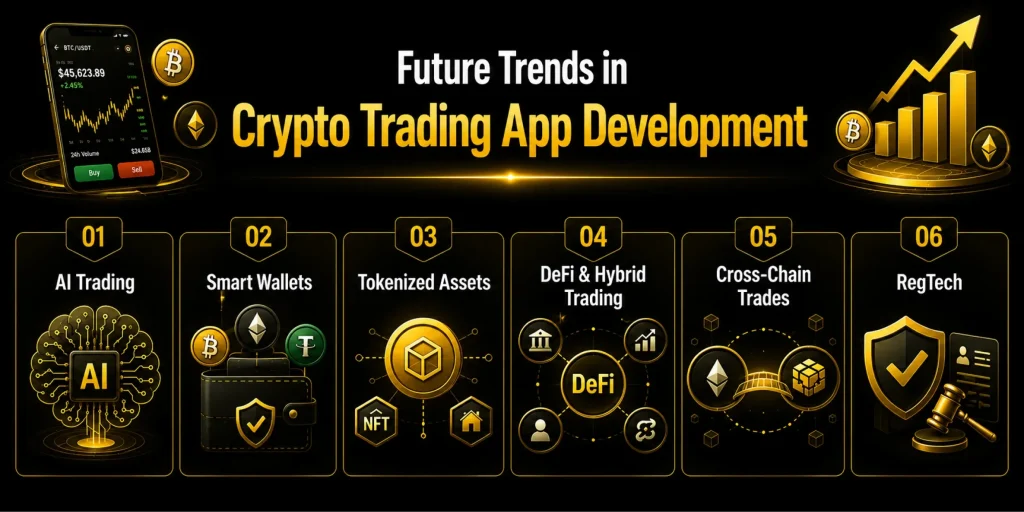
AI-Powered Trading Tools
About 32% of major exchanges have already started integrating AI for automated trading, fraud detection, and market analysis. AI trade alerts, risk scoring, and smart order routing are becoming popular features.
Agentic Wallets
The next frontier in crypto UX is wallets that can execute trades and manage portfolios autonomously based entirely on uniquely defined rules. Agent-AI wallets are rapidly improving cutting-edge systems that facilitate agent-to-agent transactions.
Tokenized Stocks & Real-World Assets
CoinSwitch already supports tokenized stocks like Tesla xStock and Apple xStock. This category is growing rapidly. Exchanges that offer access to global assets can attract a broader user base beyond traditional crypto investors.
DeFi and Hybrid Exchange Models
Pure centralized exchanges are losing ground to hybrid models that offer customers the control of DeFi with the ease of CEX. Building a DeFi integration into your roadmap from the start makes sense.
Cross-Chain Trading
Users want to trade assets between Ethereum, Solana, Polygon, and BNB Chain without switching wallets. Cross-chain management is a baseline expectation, not a differentiator.
Regulatory Technology (RegTech)
As regulations evolve globally, exchanges are investing in automated compliance tools. RegTech integrations that manage real-time sanction screening, transaction tracking, and reporting will reduce manual compliance costs.
Build Your Crypto Trading App With Octal IT Solution
If you’re asking yourself how I can develop a crypto trading app without starting from scratch or without paying extra for it, Octal IT Solution is the answer.
We are a crypto exchange development company with a long history of delivering production-grade blockchain fintech platforms to clients across India, the US, the UK, and beyond.
What We Bring to Your Project?
- Providing end-to-end crypto exchange software development services from architecture to deployment.
- Proven experience with centralized crypto exchange development, DEX platforms, and hybrid models.
- In-house team of blockchain developers, fintech experts, and compliance consultants.
- Deep expertise in enterprise crypto exchange development services, scalable to millions of users.
- Transparent cost to develop a cryptocurrency exchange platform with milestone-based full pricing schemes.
- Post-launch support, security audits, and ongoing platform maintenance.
Our Development Process
- Discovery: We consider your business model, target market, and feature selection in the initial phase.
- Architecture: After that, we outline your technology stack, security model, and scalability plan.
- Design: Once we’ve done with the outlining, our design team builds an intuitive UI/UX that makes crypto accessible to your customers.
- Development: As the design phase is complete, developers start building in sprints with weekly demos and milestone reviews.
- Testing: Once the development ends, testing starts. This includes Penetration Testing, Load Testing, and Pre-Publication Conformance Audit.
- Launch & Support: After all the testing is done, we deploy, monitor performance, and maintain.
If you want to develop a crypto trading app from scratch, then hire crypto app developers on a project basis. Get in touch with our development team at Octal IT Solution for building a full-fledged crypto trading platform.
Conclusion
CoinSwitch Kuber has proven that an easy, properly designed crypto trading app can attract millions of users in a very short time. But as its own review shows, there’s still plenty of room for improvement.
In 2026, the crypto trading platform development market is more competitive than ever, yet also more mature. The regulatory framework is clearer. Technology stacks are validated. And consumers understand what it looks like.
The goal isn’t to clone CoinSwitch or match its cost – it’s to build something users prefer. It’s about creating what CoinSwitch users want that your platform can provide.
If you are serious about creating your crypto trading app, the process is clear. Start with a nicely scoped MVP, choose the right technology stack, lock yourself to compliance quickly, and contact a development partner to know the crypto wallet app development cost. Work with a reliable development partner that has experience with smart contract development or DeFi app development.
Octal IT Solution has already done that. Our development team built KCrypto and various crypto trading solutions that live, comply, and evolve. We can help you build and scale it successfully.
Read More : cryptocurrency development companies

 By
By August 7, 2026



 Get in Touch