




In the digital economy that is perennially in a rush, innovation is contingent upon trust. The organizations, while competing against each other, are going to change their entire business functions, and among all the technologies, the development of Blockchain applications has become a principal driving force for change.
Blockchain technology, once synonymous with digital currencies, has become a vital force in the broader business transformation by providing alternative means of engaging in transactions, sharing valuables, and maintaining a company’s righteous conduct.
Blockchain app development is not only working in the direction of creating an entirely new ecosystem by giving birth to various traces in the chains, such as supply tracing, but also setting the bar high for future by coming up with digital identity systems that are secure, efficient, and traceable, thus declaring a future filled with smart, safe, and transparent business operations.
The Rising Wave of Blockchain Adoption (2025–2030)
According to finance.yahoo, a phenomenal rise in the use of Blockchain has come to the forefront of the business world. The global Blockchain market size is projected to witness a massive jump from about USD 33 billion in 2025 to almost USD 393 billion by 2030, meaning it would have a compound annual growth rate (CAGR) of more than 64% during the period.
One study even goes so far as to say that the rise in the technology’s application in public and private sectors will be so rapid that it will reach USD 1.4 trillion by 2030, which primarily will be driven by the soaring demand for strict security, automated, and crystal-clear solutions all over the industries. (Source – Grand View Research)
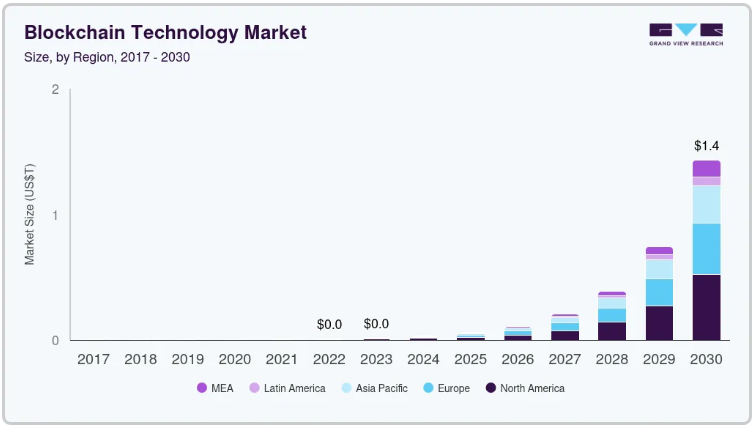
This phenomenon is a clear indicator of the fact that corporations are realizing that Blockchain is not just an advanced technology amongst the rest; it is a revolution in operations that facilitates trust, efficiency, and collaboration in the digital landscape.
Understanding Blockchain’s Role in Modern Business
At its most basic level, Blockchain is a distributed ledger technology (DLT) that keeps track of all the transactions in a secure way through the computers that are part of the network. The process of each transaction involves encryption, validation by the other participants in the network (known as nodes), and finally, incorporation into a chain of previously verified records – this way, a permanent record is created that cannot be changed retroactively.
In contrast to traditional centralized systems, which have a single vulnerable point for data storage, Blockchain decentralizes the entire data storage process. Thus, it brings about transparency and security against unauthorized alterations, and intermediaries are no longer needed.
Companies are taking advantage of the technology behind Blockchain application development to make their operations more efficient, discriminating, and collaborative in the following sectors:
- Finance: By providing quicker settlement and lower transaction costs.
- Healthcare: By enabling data sharing among patients that is secure and interoperable.
- Retail: By ensuring the integrity of products and their being sourced ethically.
- Logistics: By having real-time visibility of goods throughout the global supply chain.
In short, the technology associated with Blockchain will end up bringing trust and accountability to all transactions, and it will alter how organizations interact.
Explore Article: Carbon Credit Platform Development Companies
Key Advantages of Blockchain App Development for Businesses
Blockchain technology in business is designed to address some of the major challenges associated with traditional operations. Let’s take a closer look at the main advantages that the companies will get from the use of this technology.
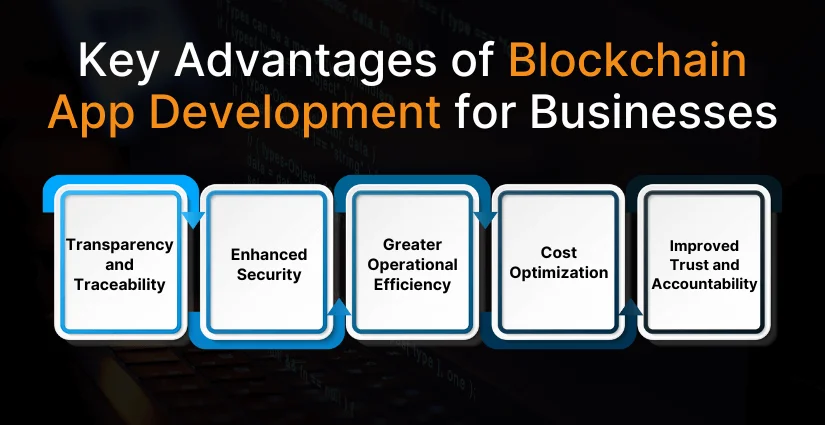
1. Transparency and Traceability
The private ledger of Blockchain guarantees that all parties concerned are provided with the same information. A time stamp is given to each transaction, and it is recorded in such a manner that no one can erase it, making it possible to easily follow the path of any asset or confirm its source.
The openness created in this manner among stakeholders, suppliers, and customers will especially benefit markets that deal with food safety, luxury items, and pharmaceuticals, where traceability is an essential factor.
2. Enhanced Security
Blockchain technology employs the most sophisticated cryptography to secure data transmission. Once the data block is verified, it becomes immovable; that is, it becomes impossible to change or erase it. Such an inability to change the data reduces the risk of data fraud, hacking, or unauthorized access.
Sensitive data business firms, such as the finance sector and healthcare industry, are discovering Blockchain technology to be a necessity in the safeguarding of both customer and operational information.
3. Greater Operational Efficiency
The use of smart contracts, self-executing programs stored on the blockchain, allows companies to automate complex processes. The process of automation does away with human handling, cuts down on mistakes, and gives a guarantee that agreements will be enforced automatically as soon as the conditions are met.
What’s more? Quicker transactions, less paperwork, and more synchronized teamwork among different departments and firms.
4. Cost Optimization
The deployment of Blockchain is a major factor that leads to a significant cut in the administrative costs through the elimination of intermediaries and the automation of processes. The data verification, reconciliation, and auditing have all become smooth and cost-effective despite the fact that these activities are normally time-consuming and labor-intensive.
Firms that have adopted Blockchain technology in business operations are enjoying a drop in transaction costs, processing times, and compliance costs.
5. Improved Trust and Accountability
Blockchain’s transparency and verifiability of data form the foundation of trust and accountability. The involvement of all parties leads to the exposure of transaction trails, and the partners, therefore, assume a lesser role in not only information sharing but also in dispute resolution, which in turn results in strengthening the partnership.
Read More: Blockchain Identity Management Guide

Real-World Applications: Blockchain in Action
There is an ongoing process of organizations across the globe that are developing powerful blockchain-based solutions, which, in turn, are changing the practices in the business.
1. Supply Chain Management
Companies such as IBM and Maersk have been using Blockchain technology for tracking shipments from their sources to the final destinations, thus eliminating delays and verifying the quality of the products.
2. Healthcare
Hospitals and medical facilities are relying on Blockchain for the generation of patient records that cannot be altered, hence ensuring the correctness of medical diagnoses and safeguarding the confidentiality of the patients.
3. Banking and Finance
The use of Decentralized finance (DeFi) applications enables direct transactions between parties without involving any intermediaries, thus cutting down costs and promoting wider access to services.
4. Retail
Retailers utilize QR codes based on Blockchain technology to allow their customers to confirm the genuineness of the products and learn the history of the products.
5. Government and Public Sector
Not only digital identity verification but also e-governance and voting systems are among the many areas of application for Blockchain technology in business that countries like Estonia and the UAE are currently researching and testing.
The above-mentioned Blockchain use cases validate the claim that Blockchain technology is a must-have for any business enterprise aiming to stay updated, as it is the one factor that determines the modernity of the whole enterprise.
The Power of AI and Blockchain Integration
Whereas Blockchain brings in security and transparency as its main features, Artificial Intelligence (AI) brings in its main feature of intelligence and adaptability. The AI in Blockchain merger is the one that leads to the new era of automated processes, insights, and accurate predictions, with the main benefits.
Let’s take a look at the main ways through which AI enhances the power of blockchain:
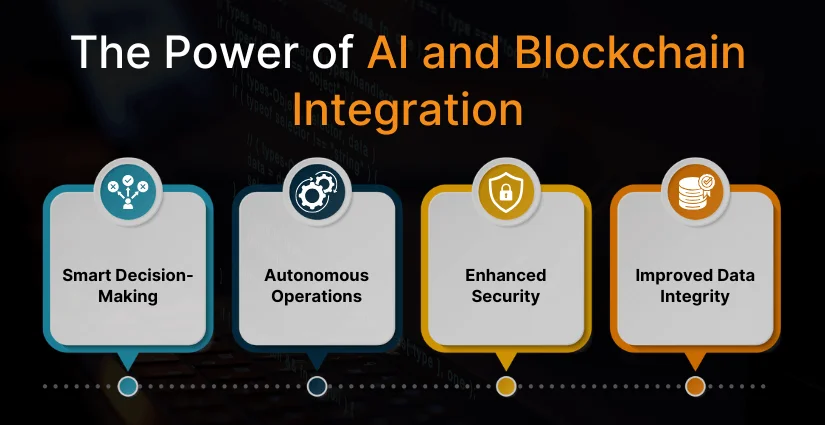
1. Smart Decision-Making
Assisting the organizations in making smart decisions, this method first processes the Blockchain data through AI algorithms to spot the overall trends, make the supply chains more efficient, and even predict the occurrence of fraud.
2. Autonomous Operations
Organizations may build smart contracts driven by AI that are executed automatically when predefined criteria are met, thus eradicating the need for manual overseers.
3. Enhanced Security
Intrusion detection and prevention systems that are based on machine learning may be able to monitor the Blockchain networks for detecting abnormal behavior or cyber threats in real-time.
4. Improved Data Integrity
The introduction of AI technology in the Blockchain space guarantees that data input will undergo the process of verification, maintaining consistency and ensuring that no duplicate entries are made throughout the process.
With the fusion of AI and blockchain, the scenario of AI being a digital ecosystem that can learn, adapt, and upgrade is realized.

Choosing the Right Blockchain Development Platform
The best Blockchain app development platforms to be employed will be dictated by the organization’s own objectives, the ability to scale, and the speed of transactions. An example of some widely-used Blockchain software includes:
- Ethereum: Leading Blockchain for the development of decentralized apps (dapps) and smart contracts.
- Hyperledger Fabric: A permissioned Blockchain technology in business-level solutions.
- Solana: Associated with phenomenal transactions per second and scalability.
- Polygon (MATIC): A solution that is both scalable for Ethereum and cost-effective.
Every one of these platforms has its own advantages and disadvantages, and finally, it all comes down to whether the organization is looking for decentralization, privacy, performance, or interoperability.
Blockchain Development Costs: What to Expect
The Blockchain app development cost can be extremely different depending on a lot of factors: the complexity of the project, the required features, the integration, and development platform. Below is a typical example of costs for Enterprise development:
| Role | Average Hourly Rate (USD) |
| Blockchain Developer | $60 – $120 |
| Frontend Developer | $40 – $90 |
| Backend Developer | $50 – $100 |
| UI/UX Designer | $35 – $80 |
| QA Engineer | $30 – $70 |
| Project Manager | $50 – $110 |
| Security Specialist | $70 – $130 |
A Minimum Viable Product would probably be in the range of $30,000-60,000, while the enterprise mobile Blockchain solution could go beyond $150,000.
Whatever the scenario, always go for the investment in Blockchain Development companies that can support your project in terms of scalability, compliance, and return on investment in a manner that is sustainable.
Partnering with Expert Blockchain Development Companies
To develop a trustworthy Blockchain application, a good grasp of both tech and business logic is necessary. Top Blockchain development companies are to be relied upon to facilitate a seamless end-to-end process, from the idea stage to deployment and ongoing maintenance.
The professionals not only do the coding and set the framework, but also help with:
- Regulatory compliance along with data privacy.
- Security audits coupled with encryption standards.
- Smart contract development and testing.
- Long-term scalability and integration with existing systems.
Getting in partnership from the start comes with a lot of benefits, such as lowering the risks, speeding up the process, and the final product being exactly what the business wants.
How Blockchain is Disrupting Traditional Business Models?
The most revolutionary characteristic of Blockchain technology in business is its ability to change business models completely.
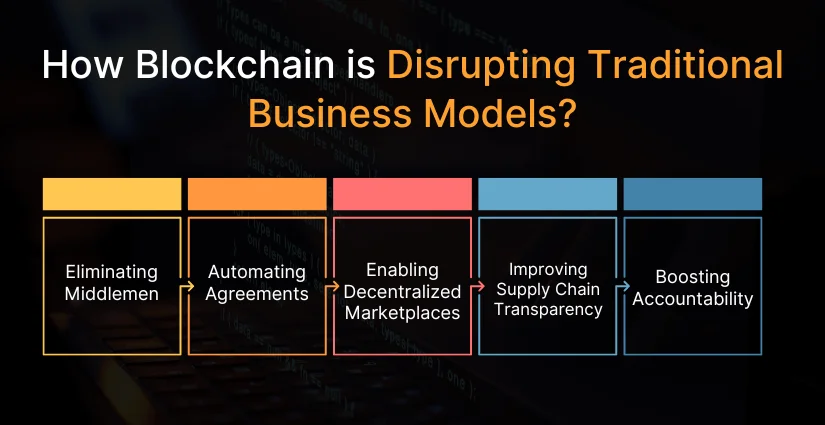
1. Eliminating Middlemen
With the help of blockchain, the transfer of money and assets can happen directly between the parties involved, and thus it eliminates intermediaries like brokers, banks, or notaries, thereby cutting down costs and time for transactions.
2. Automating Agreements
It is the smart contracts that carry out the terms of agreements automatically when the pre-condition is met, and so there will be no manual supervision or disputes.
3. Enabling Decentralized Marketplaces
The technology makes it possible for people and businesses to sell and buy directly, thus giving rise to new business environments without the need for a central authority.
4. Improving Supply Chain Transparency
The path of each product can be tracked, which guarantees that it is ethically sourced and that counterfeit risks are minimized.
5. Boosting Accountability
All transactions are recorded in a way that only the concerned parties can see, hence a trust and mutual reliability situation is created.
All the above-mentioned changes are leading industries in the direction of a more open and collaborative way of working; therefore, sales and innovation are being made easier.
The Future of Blockchain App Development
The introduction of Blockchain technology has already placed its footprint on some industries. Over the years, its usage roadmap includes:
- Decentralized Finance (DeFi): More people are using global financial services.
- Digital Identity Management: Citizens receive a high level of security over their personal data.
- Smart Asset Tracking: Digital and physical assets monitoring and managing activities in real time.
- AI-Powered Automation: Enabling operating systems with human-like skills in thinking, making decisions, and performing tasks.
Notably, the digital realm’s future will be to a great extent underpinned by the superior and transformative technologies of AI, IoT, and quantum computing that will eventually break through and continuously lift Blockchain to the top within the digital economies.
Conclusion
Blockchain development is no longer a dream for the upcoming years; it is a reality that has come to mark the beginning of an era with business innovation. Organizations will be able to build and rely on each other through the introduction of Blockchain technology in business , which offers them benefits like Transparency, Efficiency, and Security.
The synergy of AI and Blockchain technologies promises to be so powerful that companies will be able to create unprecedentedly large windows of opportunity for automation, accountability, and growth. Investing in Blockchain application development does not mean just following Blockchain trends, but rather, it means being part of a future where the competitive advantages are trust, data integrity, and decentralization.
All things considered, Blockchain is not only transforming the business landscape in terms of operations but also in terms of the way the world does business.


 By
By September 8, 2026




 Latest Stories
 Get in Touch