


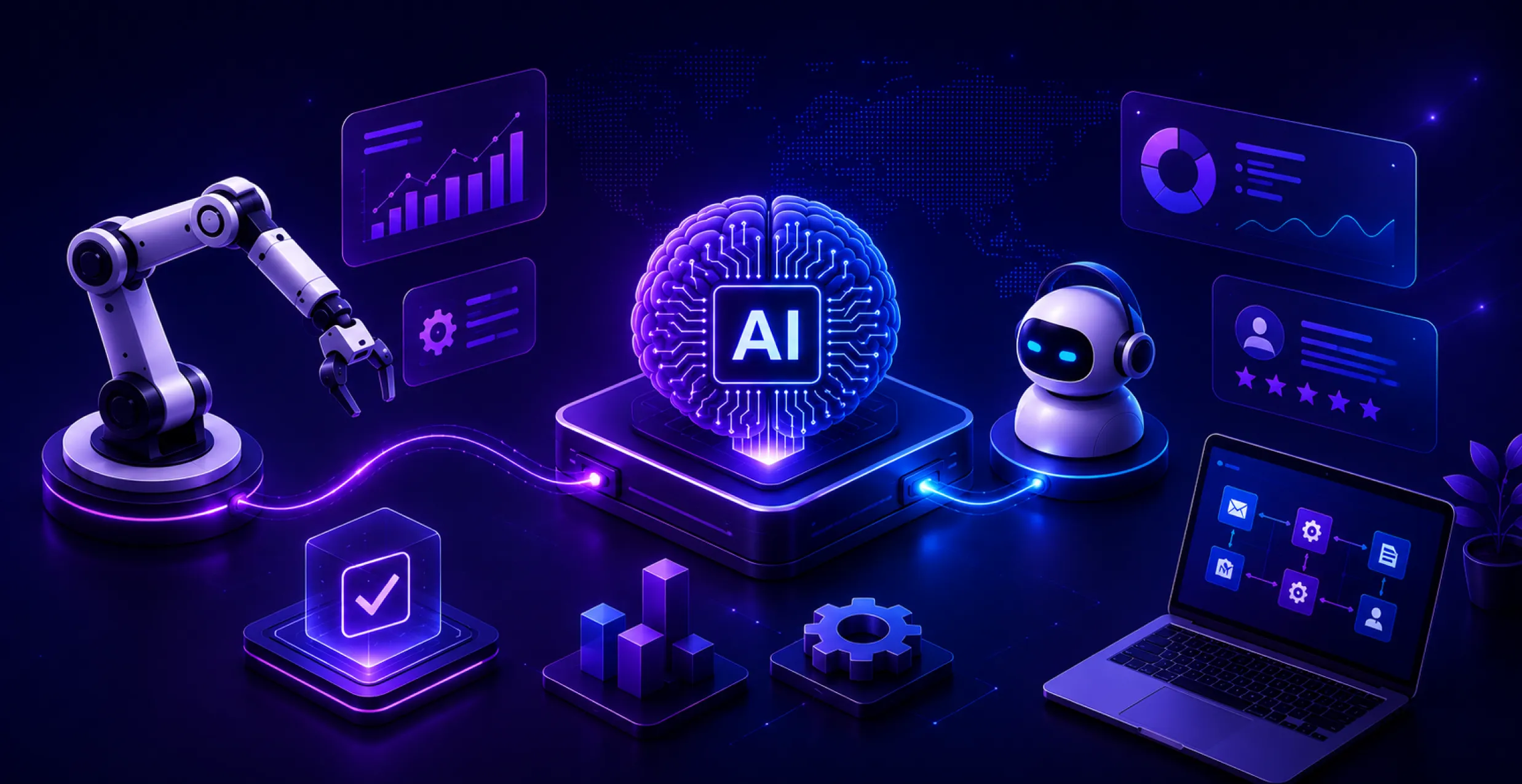
Key Takeaways
- AI is being voraciously used by small businesses and is not restricted to enterprises.
- This technology is not just used for cutting down business expenses but also to offload, make faster decisions, and channelize operational efficiency 24*7.
- Generative AI for business automation goes beyond rule-based triggers, enabling contextual responses, document summarization, and predictive workflow management.
- The use of AI automation tools for businesses allows even lean teams to connect fragmented software and eliminate repetitive manual tasks.
- Small businesses can identify high return on investment by making use of AI automation for custom app development.
- Choosing the right AI for business automation agency over in-house development often delivers faster results, lower upfront risk, and ongoing system maintenance.
When businesses try to work faster, under tremendous pressure to generate sales, to get their AI automation services for business and products to the market, they outsource some subtasks to AI. They delegate what is redundant, what requires minimal human intervention, and what does not need to be monitored over and over again. Almost every business vertical is making use of AI automation these days. These include
- Healthcare & Life Sciences
- Finance & Banking
- Manufacturing & Logistics
- Hospitality & Restaurants
- Sales & Marketing.
Is AI Automation for Enterprises only, or can Small Businesses also implement it? Earlier, large companies were the only ones to implement AI automation for business processes. Now, even mid-sized startups are imbibing it into their day-to-day operations. Now the idea has shifted from experimental to essential.
It leverages this innovation due to the emergence of modular, API-first AI automation tools for the purely commercial enterprise that do not require a dedicated engineering team to deploy or maintain.
A small retail operation can now automate stock indicators, customer follow-ups, and supplier communications with the same built-in intelligence used by a large logistics company. The difference is configuration, not capability anymore.
How Does AI Automation Work for Small Businesses?
Businesses make use of AI to anticipate any delays that might occur during step-wise processing of a task. AI not just speeds up a task, but also removes redundancy. It changes the unstructured historical data into searchable logic. Routine responsibilities like chatbots answering customer questions, if achieved with the help of AI, can relieve employees for more valuable tasks. As an example, PayPal used AI chatbots to deal with 65% of customer messages.
AI automation for business makes it easier for businesses to reduce errors, improve user experience, and make smarter choices. An AI automation agency facilitates the creation of custom AI structures such as chatbots, fact parsers, and self-sustaining agents to remove repetitive responsibilities and reduce mentor labor.
AI reads messy, unstructured data (emails, documents, alerts), parses it,, and streamlines it into structured, filtered data.
This technology can help fill the gap, missing information, make an answer comprehensive, include or remove redundant details, add use cases, add anecdotes and relevant examples, to make the result unique and more result-oriented.
Smart bots perform responsibilities more naturally, almost like virtual workers, and can simulate movements to solve problems before they show up. The system continuously learns and improves, shifting from reacting to problems to anticipating and fixing them.
Why Do Businesses Need AI Automation?
Businesses that ignore the onset of the internet or artificial intelligence, for that matter, struggle to compete. We can see the same shift with AI automation.
So now, AI is no longer a futuristic concept; it is happening right now. It is gradually becoming a practical business tool that is helping organizations of all sizes reduce costs, improve efficiency, increase revenue, and deliver better customer experiences.
Every business faces repetitive tasks, redundant information, limited time and resources, increasing customer expectations, growing competition, and rising operational costs.
Employees spend hours performing their routine activities, which can easily be optimized and automated by using relevant AI tools.
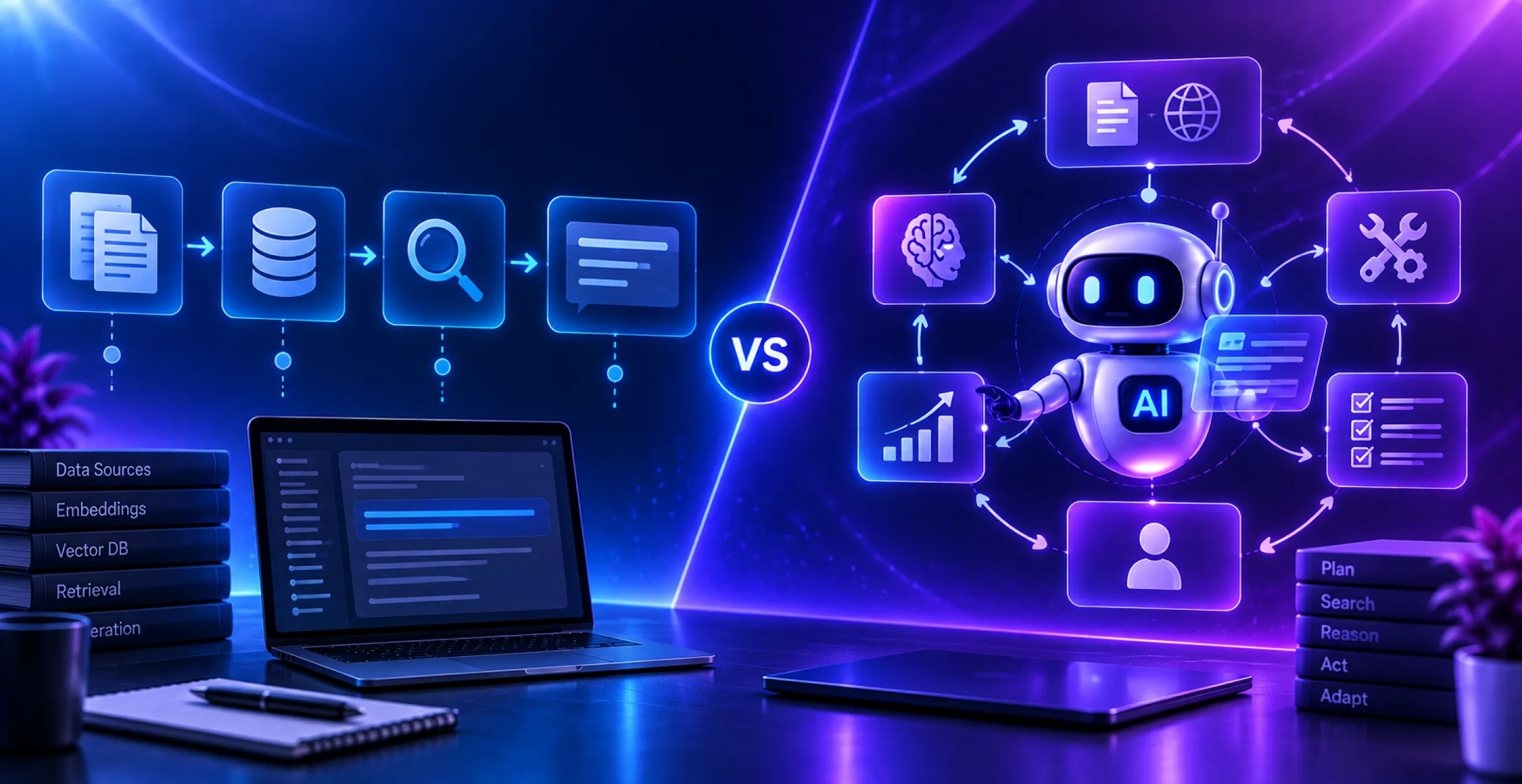
AI Automation vs. Traditional Automation: Which is Right for Your Business?
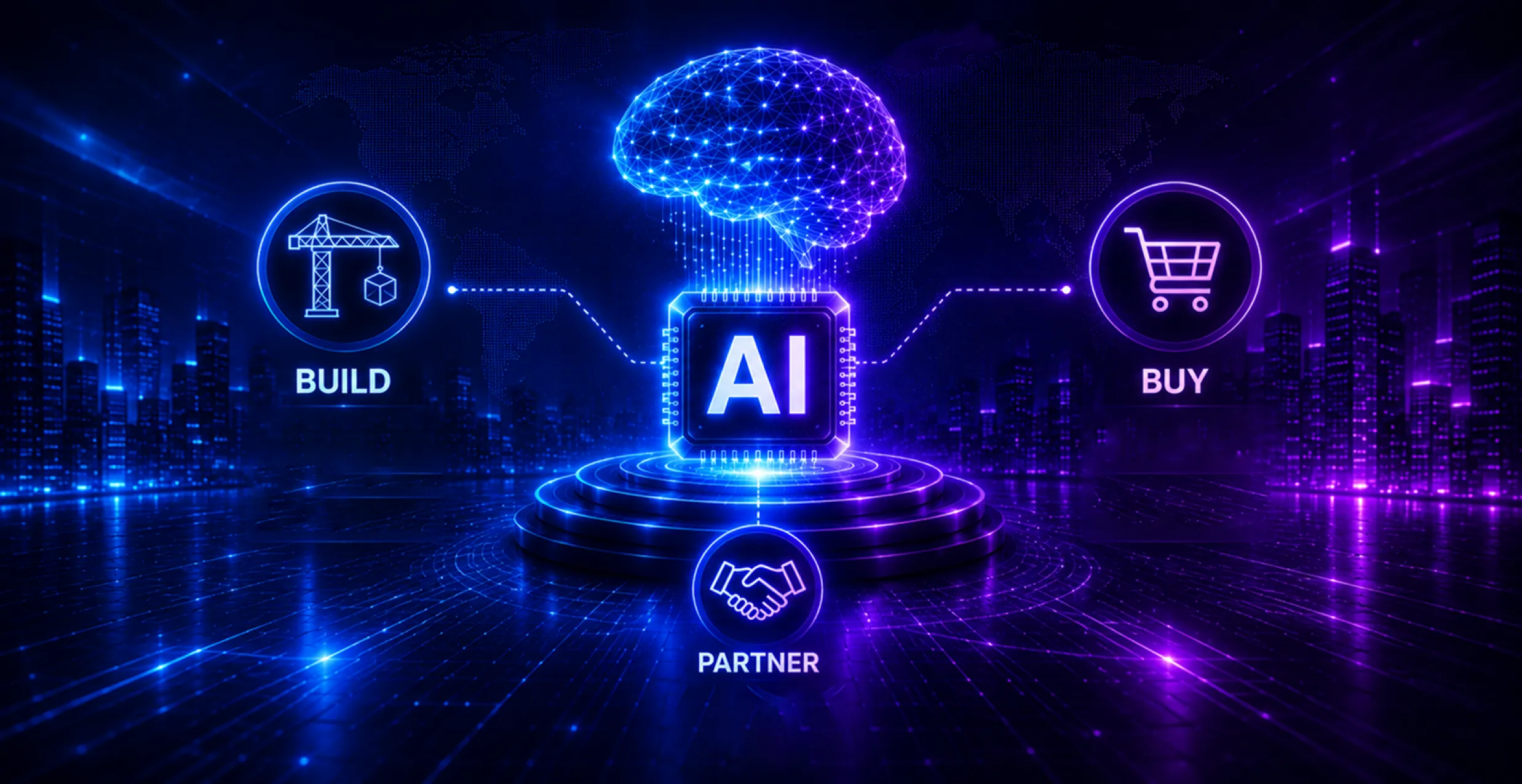
Options range from enterprise subscriptions, hiring an AI automation company for a small business, or investing in custom solutions built specifically around your operational stack, with each path having a specific cost-benefit profile.
The AI development cost of custom builds varies on the basis of complexity, integrations, and ongoing support requirements. And if a business is not ready for that commitment, it is often smarter to engage consulting services.
A good consultant will audit existing workflows, identify the three or four highest-ROI automation opportunities, and help determine whether you need a custom generative AI development solution or simply a better-configured existing tool.
| AI Automation | Traditional Development/Automation | |
| Decision Making | It can handle uncertainty, and self-corrects when it confronts edge cases | If data structure changes, the workflow crashes and requires manual reprogramming |
| Data Handling | Can act on unstructured data irrespective of layout changes | This development process requires structured data formats which can be predicted in advance |
| AI Automation | AI models can analyze historical outcomes, improve performance, and adapt to new scenarios | The system performs the exact same way indefinitely unless human operators update the rules. |
| Implementation | It is suitable for complex processes that require judgment, like in lead qualification, sentiment-driven customer support | It is ideal for routine tasks like invoice routing, or fixed-sequence data entry. |
AI automation is pioneering the transformation of industries through advanced automation solutions. Consider Octal IT Solution if you wish to hire AI developers for custom development.
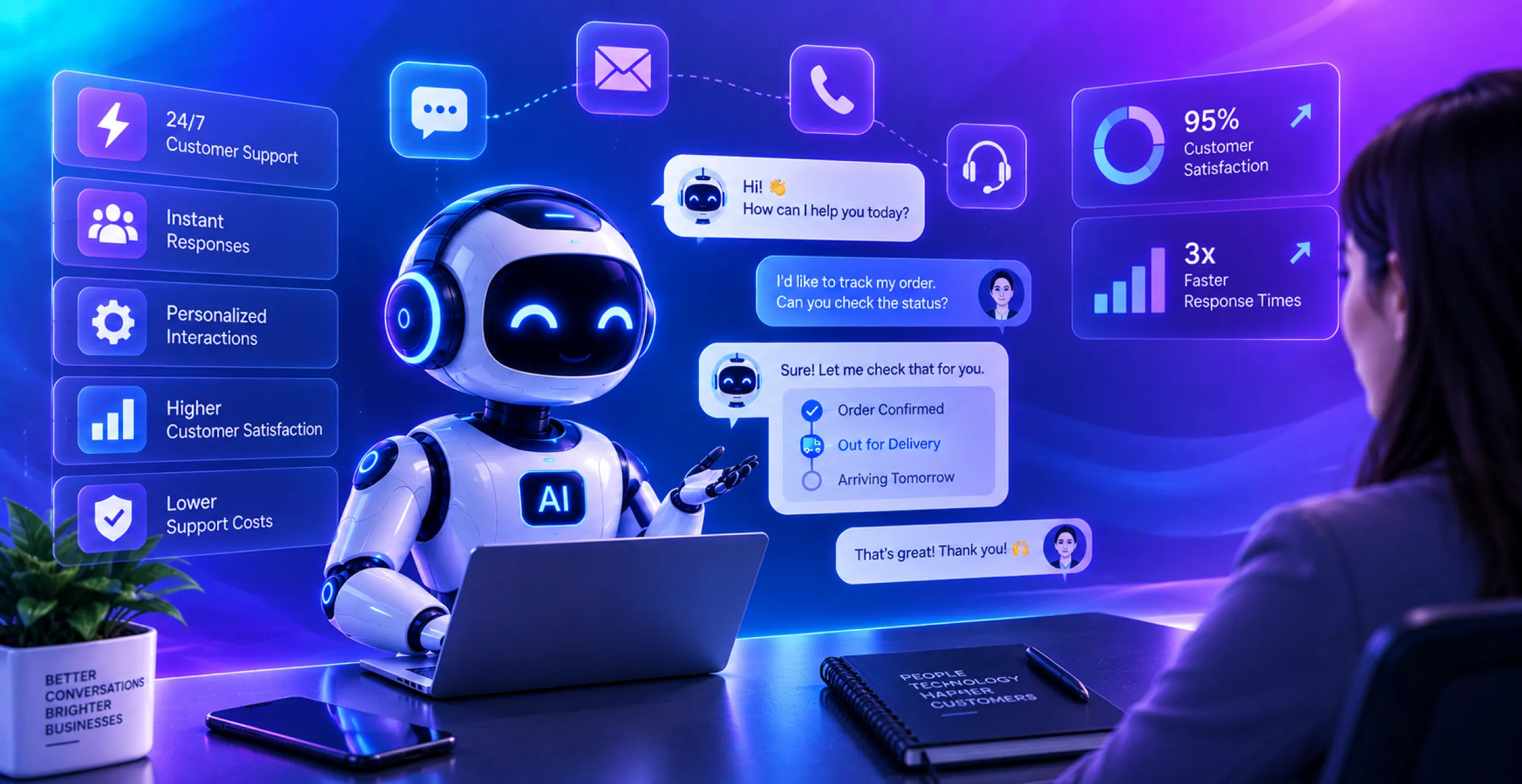
Intercom and Zendesk are leaders in customer support automation. Intercom’s Fin AI chatbot alone resolves less than half of client questions immediately, in line with the agency’s own custom statistics.
Zendesk’s AI agents take a similar approach, autonomously resolving customer inquiries across email, chat, and social channels while routing complex cases to human agents with full conversation context. This is a strong selection for all people comparing the best AI automation solutions for businesses 2026 within the assistance category.
Benefits of AI Automation for Businesses
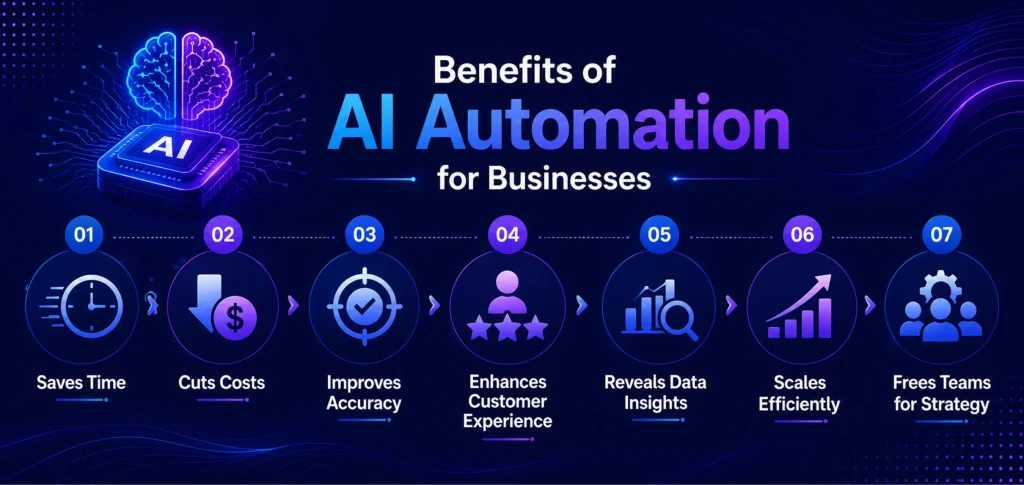
AI automation solutions for businesses are helpful across: Email responses, Data entry, Report Generation, Customer Support, Lead qualification, Content creation, Document management, and Appointment scheduling. Do you know why this is possible? This is because AI can work 24*7 without a break. AI can handle thousands of tasks simultaneously. Here are a few more benefits of AI automation.
Saves Time on Repetitive Work
Tasks like entering information, invoicing, and picking up leads now take minutes instead of hours, freeing up your team for higher priorities.
Cuts Operational Costs
Owners exploring AI automation for small business options typically see lower staffing costs, given that a machine can handle images that previously required extra hires.
Improves Accuracy
Machines do not get tired or fail. They effectively repeat the same steps each time, as this leads to fewer billing errors and cleaner information.
Boosts Customer Experience
Chatbots and automated responses work outside of business hours. No customer waits until 9 a.m. For a simple solution.
Uncovers Useful Data Patterns
AI automation solutions for business often follow revenue and customer trends that spreadsheets can hide, helping owners make faster choices.
Scales Without Extra Headcount
Accurate AI for business automation solution grows with your workload, so that you don’t need to hire every time demand increases.
Frees Up Mental Space for Strategy
When busy tasks are computerized, owners spend more time thinking ahead rather than just keeping them. This is the real long-term value of an AI-based automation services for businesses.
Steps to Implement AI Automation in Your Business
Getting started doesn’t have to be complicated. A clear, step-by-step plan makes the system much smoother.
Step 1: Identify Repetitive Tasks
List the tasks that the team repeats day in and day out. Data access, scheduling, and email responses are often the best wins.
Step 2: Set Clear Goals
Decide what achievement looks like. Is it hours saved, faster responses, or fewer errors? A clear purpose keeps the work focused.
Step 3: Choose the Right Tool
Not every tool is right for every business. Someone searching for AI automation for my business should first match tools to their actual daily tasks, and not just popular names.
Step 4: Start Small
Automate one workflow first. A digitally implemented guide to adopting AI for small businesses recommends choosing a high-impact discipline, visiting a pilot company, and measuring results before escalating further. This does not overwhelm your team.
Step 5: Train Your Team
Even simple tools require a quick learning curve. Give the team time to run into problems before more automation is incorporated.
Step 6: Connect Your System
AI works best when it speaks for your various tools, your CRM, your calendar, and your invoicing software. This is where AI adds real value to enterprise automation solution platforms. In that, they connect devices as opposed to running in isolation.
Step 7: Measure & Adjust
Look at the time saved and the errors reduced. If something doesn’t work, fix it rather than abandoning the whole project.
Step 8: Scale Gradually
Once one workflow is successful, move on to the next. Businesses that grow incrementally stay away from the illusion of price increases that include acceleration.
Explore the Top AI Automation Companies in 2026
AI Automation Use Cases for Businesses
Where is AI helpful?
- Marketers: It channels its energies to generate marketing content, predict purchasing patterns, create personalized campaigns, analyze customer behaviour, and optimize ad performance. AI handles execution and optimization while marketers focus on strategy.Beyond traditional campaign metrics, marketers can pair that automation with the best AI sov tool to track brand visibility across AI-generated search results and answer engines.
- Sales Automation: AI helps find qualified leads, score prospects, automate follow-ups, update CRM systems, and forecast sales trends so that the sales team spends more time closing deals.
- Customer Support: AI Agents for Customer Service can answer common questions, handle support tickets, resolve routine tasks, and route complex cases to human agents.
- Human Resources: AI streamlines employee onboarding, performance tracking, interview scheduling, candidate evaluation, and resume screening.
- Finance and Accounting: Organizations take the help of AI for processing invoices, detecting fraud, forecasting finance, and monitoring compliance.
- Healthcare: AI assists in predicting disease risk, automating appointment scheduling, analyzing diagnostic images, and streamlining clinical documentation so that medical staff spend more time on patient care.
- Supply Chain and Logistics: With the help of AI, delivery routes can be optimized; it also helps in forecasting demand, automating warehouse inventory, tracking shipments in real time, and predicting equipment maintenance needs.
Challenges & Their Solutions in AI Automation Adoption
Challenge: Many owners think AI doesn’t apply to their business
Solution: Start with a small AI business ideas, such as sorting emails and showing the time accumulated. Once you see the owners doing that work, doubt usually disappears quickly.
Challenge: Old systems don’t connect easily with new AI tools.
Solution: Choose AI automation services for business processes built for easy integration. Most modern platforms now offer plug-and-play connectivity for common software.
Challenge: The advertised price rarely covers the real cost.
Solution: Budget for training time, not just membership fees. Industry information shows that the sticker rate often covers the best half of the true adoption fee.
Challenge: Employees fear automation will replace their jobs.
Solution: Realistically define which tasks will be managed by AI and which will remain human. Most AI automation services for small business 2026 succeed as soon as the workforce experience is stable.
Challenge: Poor data quality leads to poor automation results.
Solution: Clear spreadsheets and information before automating. AI tools are most effective when they are reliable because you feed them data.
Challenge: Rushed rollouts skip proper oversight.
Solution: Add a simple approval step before scaling evenly. Gartner predicts that many accelerating AI efforts could close by 2027 due to poor governance, so slower deployment pays off.
Also Read: How AI Automation Consulting Is Transforming Business Operations?
Cost of AI Automation Services for Small Businesses
The cost of automating a business via AI depends upon specific business processes, software systems, and tools, making use of no-code platforms, connecting with old, legacy, on-premise databases, and regulatory compliance.
AI automation services for small businesses typically cost between $500 and $15,000 upfront for initial setup and development, paired with ongoing operational or retainer fees ranging from $100 to $2,000+ per month.
Newer entrants among the best AI customer service agents push resolution rates further by letting teams train the agent directly on their own content, rather than relying on a fixed knowledge base structure. This is a strong selection for all people comparing the best AI automation solutions for businesses 2026 within the assistance category.
AI Automation Cost Breakdown for Small Businesses
| Deployment Type | Upfront Setup Cost | Monthly Cost | What It Covers |
| Native SaaS tools (Zapier, HubSpot, ChatGPT, etc.) | $500 – $2,000 | $2,000$100 – $300 | Ready-made automation with minimal customization |
| No-code custom workflows | $1,500 – $6,000 | $6,000$300 – $800 | Connecting multiple tools into tailored, multi-step workflows |
| AI automation agency (fully custom build) | $6,000 – $15,000 | $800 – $2,000+ | Complex processes, legacy system integration, compliance-heavy industries |
Key Cost Drivers That Affects the Price
| Cost Driver | How It Affects Price |
| Number of processes automated | More workflows increase both setup and monthly costs |
| Legacy or on-premise system integration | Adds development time due to compatibility work |
| Regulatory compliance needs | Raises cost in industries like finance and healthcare |
| Tool choice (SaaS vs. no-code vs. custom) | SaaS is cheapest upfront; custom builds cost more but scale further |
| Ongoing support and maintenance | Adds monthly cost but reduces long-term risk of breakdowns |
The overall investment depends entirely on whether you deploy native Software-as-a-Service (SaaS) tools, configure custom workflows using no-code integration software, or contract an AI automation agency.
Top AI automation Tools & Platforms in 2026
Choosing the right platform can feel overwhelming. This is where the tool businesses are really using this year.
Zapier
Zapier continues to be a favorite for connecting apps. It now allows you to describe automation in plain English, and its AI layer generates workflow steps for you based on that description. It’s a strong entry factor for anyone who is new to automation.
HubSpot
It mixes CRM and ad automation on the same premises. The AI features now distill content into email assistants, lead scoring, and prediction that are directly built into the CRM. This makes it familiar among companies already trying to find AI automation services for small businesses. Businesses can also pair these AI capabilities with content workflow software to streamline content planning, collaboration, and campaign execution across marketing and sales teams.
Microsoft Copilot
The co-pilot naturally fits into everyday work. Because it sits internally in Word, Excel, and Outlook, it respects the permissions and fact settings that exist in a Microsoft 365 environment. Teams are already using Microsoft tools adopt it with almost no learning curve.
ChatGPT Enterprise
ChatGPT Enterprise and Cloud now go beyond chat. Businesses use them as study assistants, contract reviewers, and internal expert tools. They pair well with a task-specific platform against change.
Intercom & Zendesk
Intercom and Zendesk are leaders in customer support automation. Intercom’s Fin AI chatbot alone resolves less than half of client questions immediately, in line with the agency’s own custom statistics. This is a strong selection for all people comparing the best AI automation solutions for businesses 2026 within the assistance category.
ClickUp & Notion AI
ClickUp and Notion AI cover project management and internal documentation. They impose automation and force teams to leave those already using it every day.
For businesses with specific workflows that tools can’t cover, custom builds are still worth considering. A tailored setup usually solves problems; generic AI tools for business automation can’t handle them out of the box.
Indzu Social fits naturally into everyday social media marketing and content creation. It brings essential tools together in one simple platform, helping businesses, creators, and marketers create engaging social media posts more efficiently. From generating post ideas and captions to designing attractive content, Indzu Social reduces the time and effort required for regular social media management.
Future Trends in AI Automation
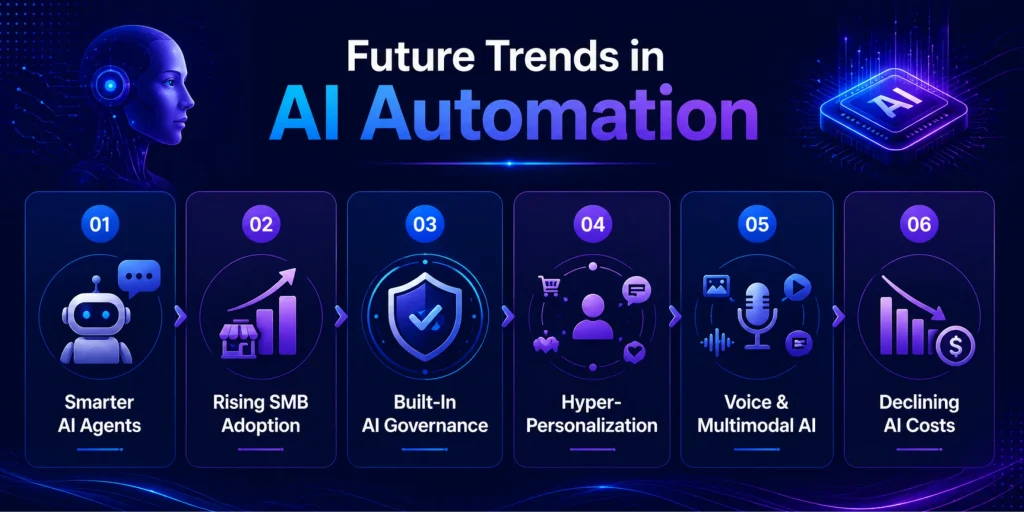
Agent AI takes over multi-step tasks
Instead of just answering questions, AI agents will complete the entire workflow automatically, making human assessment with key steps the simplest. Businesses can explore an online plateform to discover AI-powered solutions designed to automate tasks and improve workflow efficiency.
Small business adoption keeps accelerating
Small business adoption has nearly tripled over the years, and AI automation for small businesses 2026 is expected to grow even faster through the rest of the year.
Governance becomes standard, not optional
Expect more built-in approval steps and audit trails as organizations realize that unattended automation carries real risks.
Personalization goes deeper
The tools will tailor responses to each client’s records instead of using a generic script, making AI-driven automation solutions for businesses feel less robotic.
Voice & Multi model automation expand
Automation is not yet constrained by textual content. Expect multiple tools to manage calls, images, and documents in a single workflow.
Costs keep dropping
What a few years ago required a large budget now starts at under $100 per month, pushing AI automation services for small businesses 2026 further into reach for smaller teams.
Why Choose Octal IT Solution for AI Automation?
At Octal IT Solution, we don’t build artificial intelligence models from scratch. We act as integrators, leveraging existing AI APIs and no-code tools to solve specific business problems:
- Lead qualification and booking, fully computerized. We build AI chatbots that qualify leads, book appointments, and around-the-clock follow-ups with prospects.
- Instant, context-aware customer support. Octal IT Solution deploys smart helpdesk salespeople who ask for context and artificial Intelligence development solutions immediately rather than unusual.
- Data mining that truly saves hours. We build structures that pull scanned PDF, invoice, and email, then feed straight into your CRM or ERP.
- Each device linked, acts as a system. The Octal IT solution connects structures such as Salesforce, Slack, and Gmail through workflow developers that perform AI actions automatically.
- Engineering depth, not just no-code shortcuts. Our team provide AI consulting services that can help you understand and build advanced AI from scratch, while off-the-shelf tools fall apart quickly.
- Proven across company sizes. We have brought automated campaigns to startups and large enterprises, and have adapted the process to each size.
- Built around your results, not our tools. We measure fulfillment using time raised and money earned, not features delivered. One client, for example, delivered applications 20% faster after we computerized their success workflow.
Conclusion
AI automation can quickly take on repetitive tasks, allowing humans to be recognized for creative and strategic enthusiasm. Businesses use this to save time and reduce errors. Consider the following brief examples: Chatbots for customer service, software applications that copy billing systems for computerized statistical reporting, and scheduling user conferences through smart scheduling .
The shift toward automation is accelerating rapidly across all industries. Recent data shows a massive surge in small businesses adopting machine learning tools. Companies are prioritizing software that integrates smoothly into their existing workflows. By implementing these smart tools, your business can stay highly competitive.


 Get in Touch
 By
By September 25, 2026