


Duolingo has changed how people approach language learning by combining short lessons with gamification, streaks, rewards, and personalized learning. Its success has also created opportunities for businesses looking to build engaging education apps for language learning and other skill-based education.
But building an app like Duolingo involves more than copying its visible features. Businesses need to consider learning content, user experience, AI capabilities, gamification, backend infrastructure, subscriptions, and ongoing maintenance.
If you plan to build an education app like Duolingo, understanding development costs and the factors behind them can help you plan your budget more effectively. This guide covers the key features, technology stack, development process, cost factors, hidden expenses, and emerging trends to consider in 2026.
How Much Does It Cost to Build an Education App Like Duolingo in 2026?
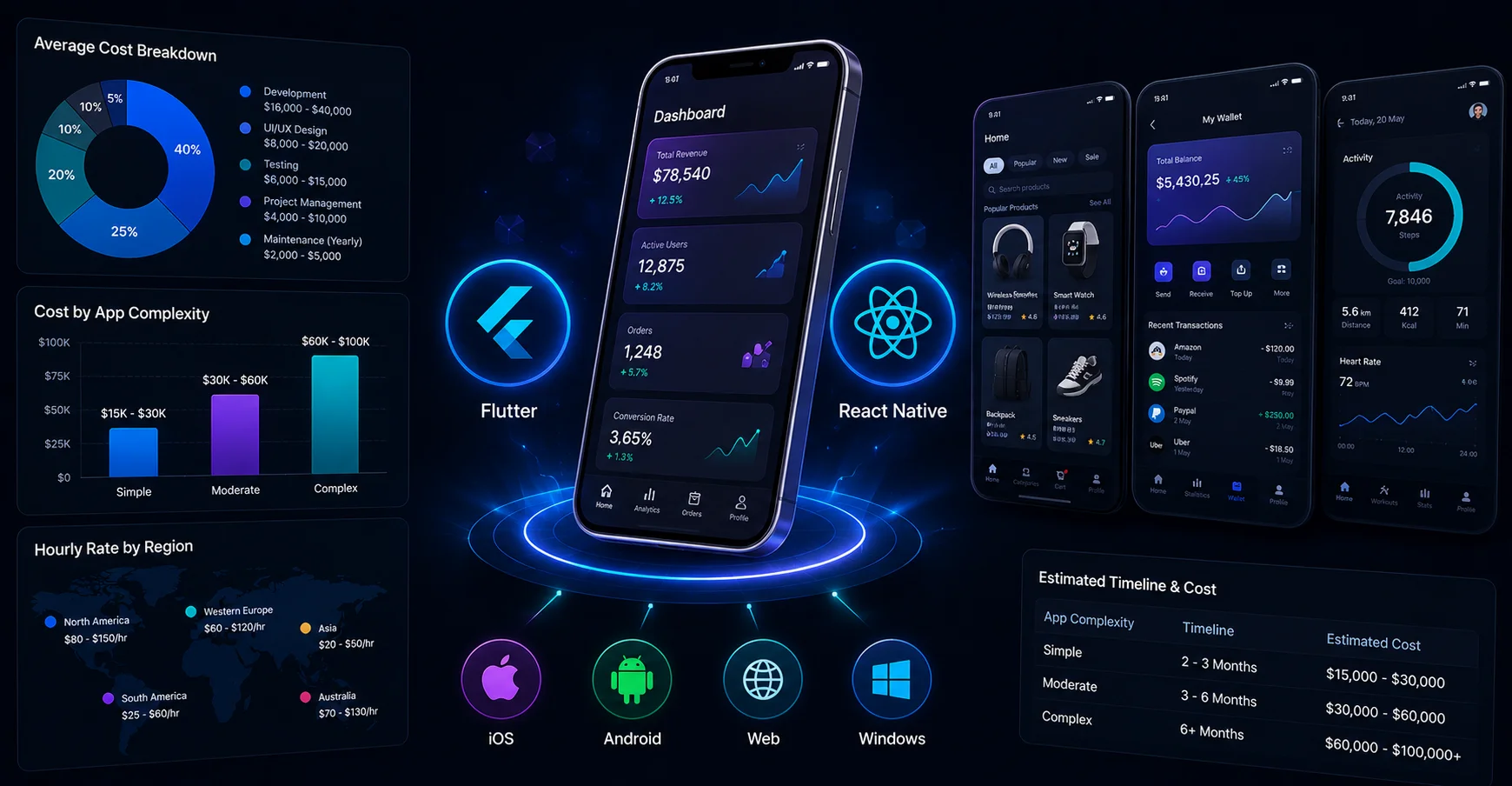
Let’s address the big question first: How much does it cost to develop an education app like Duolingo? The honest answer is, it depends. But here is a realistic breakdown based on app complexity, team location, and feature set.
| App Type | Estimated Cost | Timeline |
| Basic MVP (core features only) | $20,000 – $40,000 | 3–5 months |
| Mid-Level App (gamification + AI) | $50,000 – $100,000 | 6–9 months |
| Full-Scale App (Duolingo-level) | $120,000 – $300,000+ | 12–18 months |
- Developing an AI-powered language learning app with features like real-time speech recognition, content management systems, and advanced analytics can significantly increase the education app development cost, pushing it toward the higher end of the budget.
- These figures are approximations, and the overall cost of developing an education app depends on multiple factors, such as the size of your development team, whether you hire offshore or onshore, the number of platforms (iOS, Android, Web), and the level of AI integration required.
- Before moving forward, it is important to understand the different types of educational apps available in the market, including language learning apps, skill-based training platforms, K-12 education apps, and corporate eLearning solutions, as each category has a different scope, feature set, and budget.
- Identifying your app category early helps in better planning and provides a more accurate estimate of the cost to build an education app like Duolingo.
- The Duolingo app development cost is mainly driven by four key pillars: UI/UX design complexity, backend architecture, third-party integrations, and quality assurance.
Hidden Costs to Consider When Building an App Like Duolingo
The majority of education app development services briefs focus on the more apparent cost items, including design, development, and testing. However, there exist a few unknown expenses that can slowly creep into your budget without you being ready.
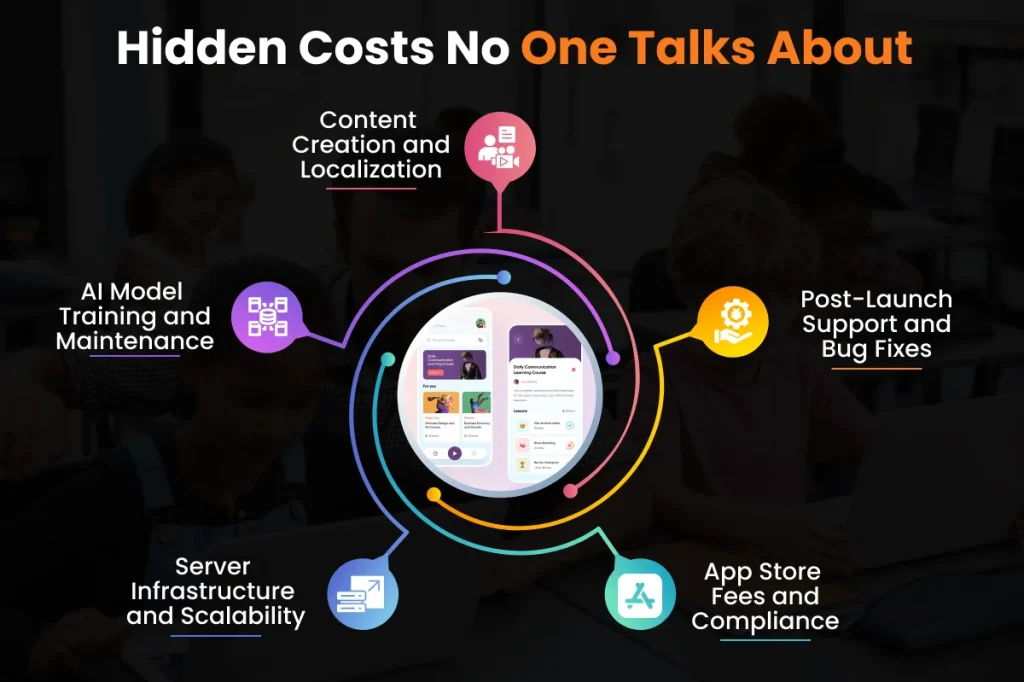
1. Content Creation and Localization
Compared to a generic application, a language-learning app needs well-structured, professionally edited material- vocabulary banks, grammar principles, sound samples by native speakers, and culturally-adapted examples. The cost of developing an education app with multilingual content of even five languages can range between $10,000 and $50,000, depending on the intensity and quality.
2. AI Model Training and Maintenance
Trained machine learning models are required in case you wish to build a language learning app with advanced features such as speech recognition, personalized learning, or real-time feedback. The cost of implementing AI-powered learning platforms starts high at the training stage, and the expense of retraining as your user base increases is an addition to the long-term cost. Anticipate the expenditure of between $5,000–$20,000 in the maintenance of AI per year.
3. Server Infrastructure and Scalability
Duolingo has hundreds of millions of users, and its infrastructure is designed to handle it. At a smaller scale, a solid cloud infrastructure (AWS, GCP, or Azure) to support an eLearning app development company can be as pricey as $500–$5,000/month, depending on traffic.
4. App Store Fees and Compliance
Both Google Play and the Apple App Store have annual fees, and compliance (COPPA, GDPR, data privacy legislations) may necessitate legal advice, particularly in cases where your application is aimed at minors. Estimate compliance groundwork between $3,000 and $8,000.
5. Post-Launch Support and Bug Fixes
A common mistake founders make is thinking the budget ends at launch. Expect to allocate 15–20% of your initial development cost annually for maintenance, updates, and security patches.
Essential Features of an Education App Like Duolingo
To build education app like Duolingo, you must consider features at three levels: core learning mechanics, user engagement systems, and administrative/back-end tools. Understanding Duolingo App Features in detail is equally important, from its streak-based motivation system and heart life mechanism to its XP leaderboards and personalized learning paths, as these directly inspire what makes a language learning app sticky and successful. The following are what each feature contributes to your development cost:
| Feature | Description | Estimated Cost |
| User Onboarding & Proficiency Test | Skill assessment quiz for new users | $3,000 – $6,000 |
| Gamified Lessons | XP points, streaks, leaderboards | $8,000 – $15,000 |
| Speech Recognition (AI) | Pronunciation feedback using NLP | $12,000 – $25,000 |
| Adaptive Learning Engine | Personalized lesson paths via ML | $15,000 – $30,000 |
| Push Notifications & Reminders | Smart nudge system for daily goals | $2,000 – $4,000 |
| Multi-Language Support | Content + UI in multiple languages | $5,000 – $15,000 |
| Admin Dashboard / CMS | Lesson management, analytics | $8,000 – $18,000 |
| Social & Community Features | Forums, friend challenges, groups | $5,000 – $12,000 |
| In-App Purchases & Subscriptions | Payment gateway, premium tiers | $4,000 – $8,000 |
| Offline Mode | Download lessons for offline use | $3,000 – $7,000 |
The education app development features, such as AI-based speech recognition and adaptive learning, take the biggest portion of your funding. But these are the features that distinguish a mediocre app and a market leader as well. Beyond the standard list, there are several forward-thinking educational app ideas worth exploring, such as AR-based vocabulary challenges, AI conversation roleplay, or social accountability circles, that can set your product apart in a crowded market.
These are also the Essential Language App Features that learners expect in any competitive product today: daily goal tracking, pronunciation coaching, spaced repetition, and progress visualization. Getting these right from the start will define your product’s stickiness and long-term retention.
Should You Start With an MVP or Build a Full-Scale App?
You do not have to make a Duolingo-style platform on day one. If you are starting a new company or an education business, an MVP is often a solid first step. It lets you check if the idea holds up, watch how people use it, and keep early spending in check.
Start With an MVP If:
- You want to validate your education app idea.
- Your initial budget is limited.
- You are targeting a specific learner group.
- You want to launch quickly and collect user feedback.
- You plan to add advanced AI features in later phases.
Consider a Full-Scale App If:
- You already have an established user base.
- Your platform requires advanced personalization.
- You plan to support multiple languages from launch.
- AI-powered learning is central to your product.
- You need advanced analytics, subscriptions, and community features.
A step-by-step plan can work best. Start with the key features. Then grow the product based on what users actually do and ask for.
Technology Stack for Building an App Like Duolingo
The selection of the appropriate technology stack to build a Duolingo-like app is not just a technical decision, but also a strategic business choice. An appropriate stack minimizes the development time, enhances scalability, and minimizes long-term maintenance expenses. Understanding the technical architecture behind language learning apps is equally critical, from how lesson content is served and cached, to how user progress is stored and synced across devices in real time. The architectural decisions made early on will impact performance at scale.
A typical production-grade language learning system would look like this:
| Layer | Technology Options |
| Frontend (Mobile) | React Native, Flutter (cross-platform); Swift (iOS); Kotlin (Android) |
| Frontend (Web) | React.js, Next.js |
| Backend | Node.js, Python (Django/FastAPI), Ruby on Rails |
| Database | PostgreSQL, MongoDB, Redis (for caching) |
| AI / ML | TensorFlow, PyTorch, Google Speech-to-Text API, OpenAI APIs |
| Cloud Infrastructure | AWS, Google Cloud Platform (GCP), Azure |
| Push Notifications | Firebase Cloud Messaging (FCM) |
| Payment Gateway | Stripe, Braintree, Razorpay |
| Analytics | Mixpanel, Firebase Analytics, Amplitude |
For a mobile learning app development project of this scale, React Native or Flutter are the most cost-effective choices for mobile, as they allow a single codebase to run on both iOS and Android. Python-based backends with FastAPI are increasingly popular for AI-heavy applications due to their performance and ML library ecosystem.
Step-by-Step Process to Develop an Education App Like Duolingo
Building an app like Duolingo is not a straight line from idea to launch. It involves conscious planning in six stages. The following is the way a professional education app development company would go about it:
Phase 1: Discovery and Market Research (2–4 Weeks)
Know your target audience, compete with rivals (Duolingo, Babbel, Rosetta Stone), and sketch your differentiated value proposition. Part of this stage also involves learning how to make an app like Duolingo structurally, studying its lesson loop design, onboarding flow, and monetization model. Wireframing and initial user journey mapping are also included in this stage.
Phase 2: UI/UX Design (4–8 Weeks)
This is the place where your eLearning Software Development vision becomes graphic. Design teams build prototypes with high fidelity, define the design system (colors, typography, components library), and perform user testing rounds. A polished product will require the design as a single expense of between $8,000 and $20,000.
Phase 3: Backend and API Development (8–16 Weeks)
The engine of your platform is the backend. Developers create user authentication, lesson management APIs, progress tracking databases, real-time scoring logic, and the notification engine. Choices of scalable architecture made now will save you thousands later. For teams seeking comprehensive elearning solutions, this phase is where the real product differentiation gets built.
Phase 4: Frontend and Mobile Development (10–20 Weeks)
This is generally the most time-consuming stage. The designers create screen-by-screen based on the design specifications, developers add third-party APIs (speech recognition, payments), and deal with iOS and Android platform-specifics. Thus, one can coordinate with top developers from a leading mobile app development company to ensure platform-specific performance and native-level polish.
Phase 5: QA Testing and Performance Optimization (4–8 Weeks)
Extensive testing, including functional, regression, performance, and accessibility, makes sure that your app does not fail when it is under heavy load. Speech recognition accuracy testing is particularly necessary in the case of a language app. Partnering with experienced education software development companies at this stage ensures that domain-specific edge cases, like varied accent handling or offline sync conflicts, are caught before they reach end users.
Phase 6: Launch, Marketing, and Iteration
The introduction of a mobile learning app is not a finish line. After launch, teams use user behavior data to analyze, fix bugs, deploy features, and invest in user acquisition. The most effective EdTech apps do not stop at launch day but consider it mile one.
What Factors Affect the Cost of a Duolingo-Like Education App?
Below are the key factors that significantly influence the cost of education app development, from technical complexity to strategic business decisions.
Development Model Selection
Choosing between in-house development, outsourcing, or a hybrid model directly impacts overall cost, resource availability, and project timelines.
Geographic Location of Development Team
Hiring developers from different regions (e.g., North America vs. Asia) can significantly vary your development budget due to hourly rate differences.
Target Platforms
Building for multiple platforms such as iOS, Android, and web increases development time, complexity, and cost compared to a single-platform approach.
AI & ML Integration Level
Advanced features like personalized learning, speech recognition, and recommendation engines increase both development and maintenance costs.
Content Volume & Complexity
The size and quality of your educational content library (videos, quizzes, multilingual content) play a major role in overall project cost.
LMS Development Approach
Deciding whether to build a custom Learning Management System (LMS) or integrate an existing solution can significantly affect budget and scalability.
Scalability & Architecture Decisions
Planning for future user growth requires robust backend architecture, which may increase initial costs but saves money long-term.
Duolingo-Like App Development Cost by Feature
The total cost of an education app depends heavily on the features you plan to include. A basic learning platform may only need user registration, lessons, quizzes, progress tracking, and notifications. More advanced products require AI, gamification, speech recognition, and personalized learning.
Here is a general cost distribution to consider:
| Development Area | Estimated Cost |
| UI/UX Design | $4,000 – $10,000 |
| User & Profile Management | $3,000 – $7,000 |
| Learning Modules & Quizzes | $6,000 – $15,000 |
| Gamification Features | $8,000 – $15,000 |
| AI & Speech Recognition | $12,000 – $30,000+ |
| Admin Panel & CMS | $8,000 – $18,000 |
| Payment & Subscription | $4,000 – $8,000 |
| Testing & Deployment | $5,000 – $12,000 |
These are indicative figures rather than fixed prices. Your actual budget will depend on the number of platforms, feature complexity, content volume, integrations, and development team.
Emerging Trends in Education App Development for 2026
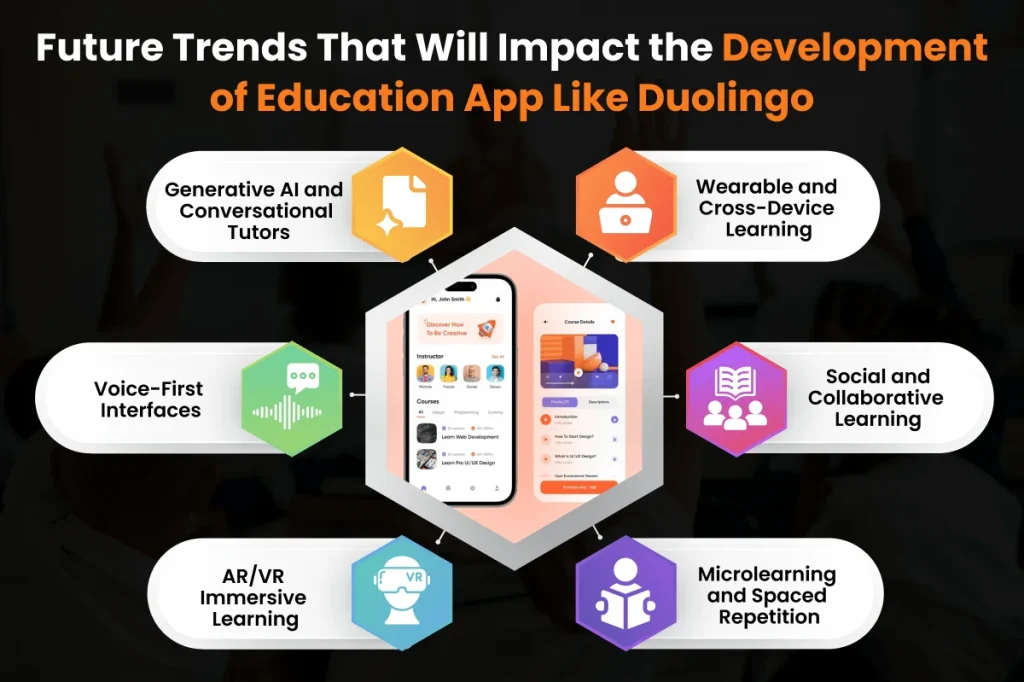
The EdTech environment is changing at a high rate. When you invest in an education app today, you have to invest today with the future in mind. The following trends for eLearning app development are determining the future of building language learning apps:
1. Generative AI and Conversational Tutors
With large language models (LLMs) such as GPT-4, fully conversational AI tutors capable of simulating natural-language practice are becoming a possibility. The inclusion of AI in education apps is no longer a choice; it is part of the competitive need. The market will be dominated by apps that rely on AI to customize the learning process and imitate the dialogue with a human.
2. Voice-First Interfaces
With the maturity of speech recognition technology, people now anticipate speaking to their apps more than tapping and typing. Speech-first will be the focus of language learning UX. When you evaluate the language learning software company Duolingo on learning styles, it becomes clear that auditory and kinesthetic learners benefit significantly from voice-interactive features, a strong signal for where the industry is heading.
3. Video-Based Learning
The rise of the video-based eLearning platform model is reshaping how learners engage with content. Short-form explainer videos, tutor-led lesson walkthroughs, and video-based conversation practice modules are increasingly popular additions to language learning apps and can meaningfully improve comprehension and retention.
4. AR/VR Immersive Learning
AR and VR worlds that replicate the real-world setting, such as ordering food in Paris and riding a subway in Tokyo, are becoming strong instruments of immersive learning. AR/VR capabilities remain expensive, but they are entering mainstream EdTech.
5. Microlearning and Spaced Repetition
Algorithms that involve short, intensive lessons followed by spaced repetition (algorithms scheduled review) prove to be a dramatic increase in long-term retention. These are all table stakes of any serious online education platform in the future.
6. Social and Collaborative Learning
Social aspects, such as language exchange partners, group challenges, and live conversation sessions, are now being part of retention approaches. Users can learn better when they are socially accountable.
7. Wearable and Cross-Device Learning
Education apps are going outside of the smartphone, and we can see them in Apple Watch alerts, smart TV integrations, and so on. The cross-device-first mindset will be built to open new user engagement opportunities.
Why Choose Octal IT Solution as Your Education App Development Company?
Building an app like Duolingo requires more than just coding; it demands expertise in EdTech strategy, user psychology, AI integration, and scalable architecture. That’s where Octal IT Solution comes in.
Octal IT Solution is a full-service education app development company known for delivering feature-rich, scalable solutions globally. Whether you need to hire dedicated eduvation app developers or a complete product team, ensure reliable and efficient execution.
Why choose Octal IT Solution:
- End-to-end development from ideation to post-launch support
- Strong expertise in AI/ML for personalization and speech recognition
- Cost-effective cross-platform development using React Native and Flutter
- Scalable cloud architecture for growing user bases
- Transparent project management with real-time updates
- Competitive pricing with high-quality delivery standards
- Built-in GDPR and COPPA compliance
From MVPs to enterprise-grade learning platforms, Octal IT Solution delivers high-performance solutions tailored to your goals. With experience across global markets and diverse EdTech products, the team ensures your app is engaging, scalable, and built for long-term success.
Final Thoughts: Planning Your Duolingo-Like Education App
Development of an education application such as Duolingo is a huge investment with huge payoffs in the market that is not showing any indication of decelerating. The cost to develop an educational app ranges from $20,000 for a focused MVP to $300,000 and more for a full-scale, AI-powered platform with all the bells and whistles.
It is all about beginning with a clear vision, focusing on the features that your target learners care about most, and collaborating with a team of developers that not only know the tech but also the business of EdTech. Understanding the cost of developing an educational app upfront, including hidden expenses like content creation, AI training, and compliance, is what separates projects that launch successfully from those that run out of runway.
In case you are willing to bring your idea to life, then the company to rely on is Octal IT Solution, which will provide you with world-class education app development services that are not only interesting but also can be remembered and enjoyed by learners all around the globe. Get in touch with our team and start moving the first steps to create the next big thing in language learning.


 Get in Touch
 By
By September 30, 2026