


Today’s businesses are under pressure to create higher digital experiences, move faster, and spend smarter. It will become more difficult to handle that load if your apps are still on outdated infrastructure. Companies can not put off the cloud app development and modernization plan for the next 12 months; those trends are already underway, and people who take the lead are making the way.
What is Cloud Application Modernization
The act of updating, recreating, or shifting legacy apps to operate on modern cloud infrastructure is known as cloud app modernization. This is a way more complicated than a straightforward raise-and-shift. It includes reconsidering the creation, deployment, and maintenance of applications as well as imposing cloud-native designs, modern mobile app development methodologies, and scalable infrastructure that were not meant for legacy structures.
Consider this: while your old app may still be around and functioning, it would be similar to coping with a logistics business with paper maps. It completes the task, but it is more expensive, breaks more often, and is unable to keep up with industry improvements.
Cloud-Native Architecture vs. Legacy Systems: The Widening Gap
It is tough to replace, scale, or restore legacy applications without inflicting system disruptions because they’re typically monolithic, with the whole thing tightly packed together. Conversely, cloud-native apps are designed as separate services that may be upgraded without bringing down the entire system, scale independently, and communicate with one another.
Every year, the difference between these two strategies widens. While cloud-native competitors deliver improvements in days rather than months, businesses that need to maintain legacy stacks should take care of increasing maintenance costs, lengthier release cycles, and security issues.
The Significance of Cloud Modernization in 2026
Every year, the difference between these two strategies widens. While cloud-native competitors deliver improvements in days rather than months, businesses that rely on outdated systems and delay working with legacy app modernization companies should take care of increasing maintenance costs, lengthier release cycles, and security issues
State of Cloud Application Modernization in 2026
Market Size, Growth, And Key Statistics
The numbers make a strong case on their own:
- At a 14.6% CAGR, the Application Modernization Services marketplace is predicted to attain $51.45 billion by 2031 from its expected $22.67 billion in 2025. Source
- In 2025, 62% of corporations will be actively moving their legacy workloads to the cloud. Source
- Businesses that update their apps for the duration of migration, instead of simply rehosting them, see a 40% leading to improved ROI. Source
- Businesses transferring to the cloud report 20–30% financial savings on infrastructure expenses on average. Source
Why Modernization Is So Important in 2026?
Three factors are compelling businesses to take immediate action. First, on-premise solutions are not able to continually offer the flexibility and scalable infrastructure needed for AI and system learning workloads. Second, utility performance and availability are becoming non-negotiable due to the increase in distributed workforces. Third, many legacy vendors are ending support for older platforms, leaving organizations vulnerable in terms of both value and security. This is also where cloud platforms play a defining role in data center modernization, replacing aging on-premise infrastructure with scalable, managed cloud environments that are easier to secure and maintain.
Top Trends in Cloud Application Modernization (2026)
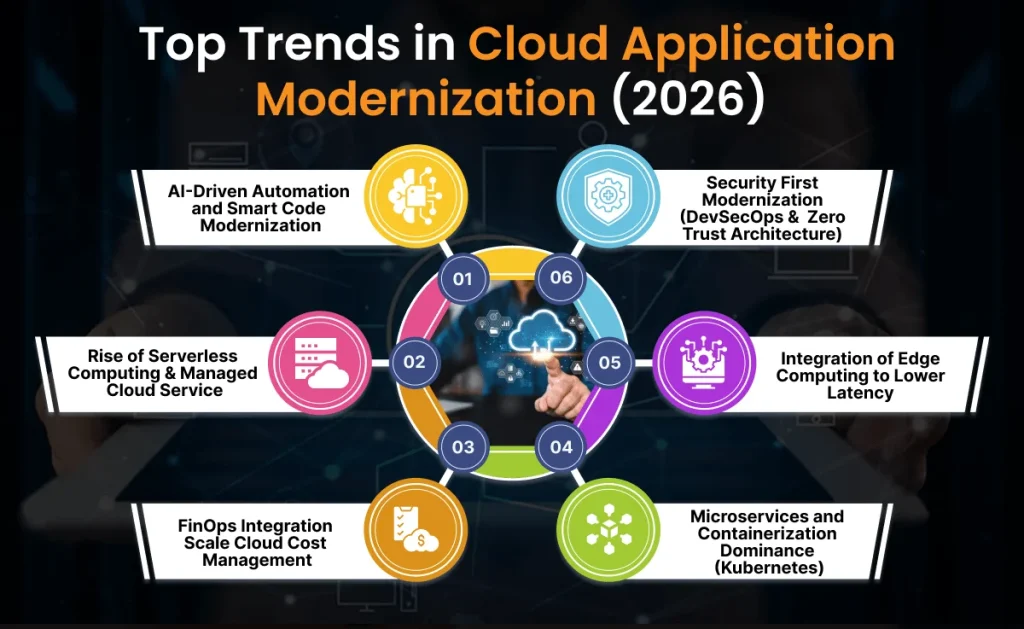
- AI-Driven Automation and Smart Code Modernization
AI and automation in modernization are changing how the process itself gets done. These days, machine learning-powered tools can experiment with legacy codebases, find technical debt, advise remodeling tactics, and, in such situations, robotically convert code to modern languages. The time and cost of application modernization solutions, which previously required months of manual developer work, have appreciably decreased as a result.
- Rise of Serverless Computing & Managed Cloud Service
Because serverless design eliminates the need to manage the underlying infrastructure, developers may focus completely on writing code. Scaling, availability, and maintenance are automatically managed by using vendors, including AWS Lambda, Azure Functions, and Google Cloud Run. Faster deployment timelines and decreased operational overhead are vital components of any smart legacy application modernization strategy for organizations.
- Microservices and Containerization Dominance (Kubernetes)
The main modernization method now entails dividing monolithic apps into microservices and containerizing them with the use of Docker and Kubernetes. Teams can release, scale, and upgrade specific additives in their own way. This is mainly useful for corporations using state-of-the-art, multifunctional applications in which a single update is used to necessitate complete system outages.
- FinOps Integration: Scale Cloud Cost Management
Without adequate supervision, cloud spending can increase out of control. Mature cloud application modernization solutions increasingly include FinOps, the technique of coordinating financial responsibility with cloud intake. The “bill shock” that has burned many early cloud adopters is avoided by businesses that have expense visibility from the outset.
Once a team has that visibility, the next discipline is putting it to work through structured cloud cost management practices that flag anomalies the moment spend drifts from forecast.
- Integration of Edge Computing to Lower Latency
Edge computing is evolving from a catchphrase to a useful tool as programs serve users throughout more regions and devices. Processing records towards the source lowers latency, complements real-time performance, and supports cloud infrastructure modernization tasks, particularly in sectors like production, healthcare, and retail.
- Security First Modernization (DevSecOps & Zero-Trust Architecture)
Bolting on security at the end is not an option. While a Zero-Trust layout ensures that no person or system is routinely depended on, even within the network, DevSecOps integrates security tests immediately into the development and deployment workflow. These are critical components of any enormous attempt to cloud native application modernization; they’re no longer non-obligatory extras.
Key Benefits of Cloud Application Modernization
Understanding the benefits of app modernization facilitates justifying the funding internally and setting the proper expectations with stakeholders.
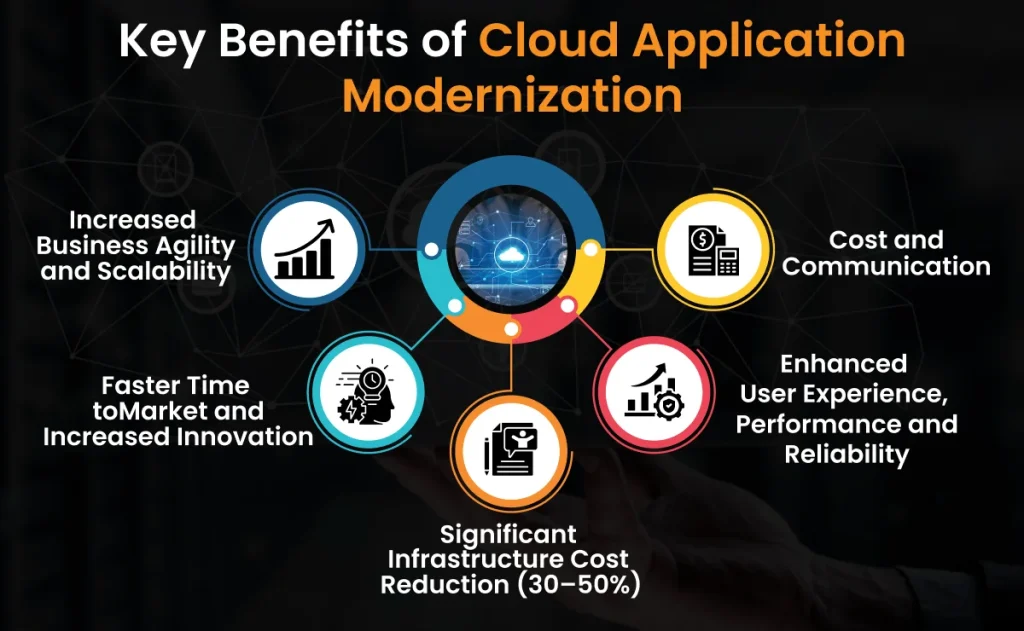
- Increased Business Agility and Scalability
Depending on real demand, cloud-native apps can scale up or down. Hardware isn’t being overprovisioned for twice-yearly peak loads. This flexibility allows organizations to manage expansion, introduce new products, and react to shifts in the market without constantly rebuilding their infrastructure.
- Faster Time-to-Market and Increased Innovation
Your development team can deal with creating after they aren’t scuffling with old structures. Features that used to take months can now be released in weeks thanks to modern CI/CD pipelines, application modernization platform technologies, and microservices layout. Over time, that pace will become a massive, competitive benefit.
- Significant Infrastructure Cost Reduction (30–50%)
One of the most considerable results is this. Organizations can save between 30 and 50 percent on infrastructure expenses by switching from on-premise hardware to cloud-managed services. Projects related to the business application modernization that include appropriate FinOps governance usually end up at the upper end of these financial savings.
- Enhanced User Experience, Performance, and Reliability
Global content delivery, automobile-failover, and redundancy are included in contemporary cloud infrastructure. Faster load times, fewer outages, and a visibly advanced user experience are the outcomes, often achieved through UI/UX modernization services, which have a direct influence on consumer-facing applications’ revenue and retention.
- Increased Regulatory Compliance and Security
Due to a huge component of their trouble in patching and monitoring, legacy structures are disproportionately focused on data breaches. The majority of on-premise systems just can’t fit the centralized security controls, automated compliance reporting, and real-time threat detection that current cloud environments offer.
Roadmap for Implementing Cloud Application Modernization
Defining the right cloud modernization implementation strategies is where method and execution come together. Successful cloud migration and modernization projects are prominent from costly, protracted ones through a methodical approach.
Phase 1: Evaluation and Portfolio Analysis
Recognizing “Zombie” Apps and Technical Debt: Knowing what you’re working with is vital before modernizing something. A comprehensive portfolio audit reveals technical debt, out-of-date code, redundant systems, insufficient documentation, and “zombie” apps, packages that can be in use but do not serve a commercial reason. Instead of being moved, those should be decommissioned.
The 7 R Strategy: Definition For each app to your portfolio, the 7 Rs provide a framework for decision-making: Rehost (carry-and-shift), Replatform (minor optimization), Refactor (code adjustments for cloud optimization), Rearchitect (structural redesign), Repurchase (transfer to SaaS), Retire (decommission), or Retain (leave as-is in the intervening time). A practical cloud modernization strategy consultation service begins with mapping every app to the right sort of paths.
Phase 2: Planning and Modernization Strategy
Value vs. Risk Prioritization: It isn’t important to replace all applications at once, and this is where expert cloud consulting services help define the right modernization roadmap. Set priorities in line with migration risk and enterprise effect. Early stages are best suited for high-cost, low-danger applications that produce fast outcomes and foster internal trust.
Establishing Performance Standards and Success Measures: Before you begin, outline what success looks like. Benchmarks such as response times, uptime goals, deployment frequency, and cost are consistent with transaction permits for the validation of results and early course correction while something isn’t functioning.
Phase 3: Cloud Migration and Execution
Croservices decomposition. Applications are divided into services, deployed on orchestration systems such as Kubernetes.
Containerization & Microservices Decomposition: The essential technological duties are containerization systems such as Kubernetes, often supported by reliable cloud migration services, and containerization. When finished effectively, this allows for the flexibility and scalability that make investing in cloud application development software worthwhile.
Implementing DevOps & CI/CD Pipelines: Using DevOps and CI/CD pipeline automation is essential to the long-term viability of updated apps. By automating the process of testing, integration, and deployment, CI/CD pipelines lower human errors and considerably speed up delivery.
Database Modernization and Migration: Compatibility, downtime periods, and data integrity must be carefully planned for database migration, which is occasionally the most difficult part of cloud migration and modernization. Using managed database services, performing real-time data replication during transition, and adopting NoSQL are core strategies. For cloud data modernization for large businesses, this also means migrating data warehouses, restructuring pipelines, and ensuring data governance doesn’t break during the transition.
Phase 4: Optimization After Modernization
Continuous Monitoring & Performance Tuning: Modernization of continuous monitoring and performance tuning doesn’t always end with go-live. Continuous monitoring with technology like Datadog, New Relic, or cloud-native solutions guarantees that overall performance remains stable and issues are recognized before they impact purchasers.
Verifying Security Controls and ROI: Return to the Phase 2 benchmarks you installed. Are costs lower? Is it quicker to install? Do fewer safety incidents occur? The inner justification for ongoing investment in cloud modernization solutions is built through this validation loop.
Key Challenges in Cloud Application Modernization and Ways to Overcome Them
- Controlling Data Migration & Interoperability Risks
The majority of initiatives encounter challenges while moving data between structures. Integration mistakes, record loss, and format incompatibilities are common. Particularly for cloud analytics modernization use cases in which data pipelines are complicated, the answer is a phased migration method with robust rollback plans and comprehensive testing at each stage.
- Preventing Vendor Lock-In with Multi-Cloud Techniques
Risks to price and flexibility rise while a cloud issuer is over-reliant on. Whenever feasible, businesses can negotiate and regulate by using provider-agnostic tools, containerized workloads, and open standards. This is a fundamental concept of modern cloud application modernization consulting engagements for transformation.
- Resolving Cloud-Native Technology Skill Gaps
Simply stated, many businesses lack in-depth knowledge of DevSecOps, serverless, and Kubernetes. Targeted education through a cloud computing course, smart hiring, and collaboration with experienced application modernization consulting partners can help upskill internal teams while the project is underway.
- Maintaining Business Continuity During Cloud Migration
Without making the right plans, zero-downtime migration is not often a reality. Teams may additionally migrate progressively, keeping the modern system operational even as the new one receives verification concurrently, thanks to blue-green deployments, feature flags, and canary releases.
Top Cloud Application Modernization Techniques for 2026
1. Begin Small: Test a Low-Risk, Non-Critical Application
Don’t begin with the device that is most complicated. Select an inner, smaller application to update first. This allows your team of workers to grow familiar with the procedure and tools before taking on workloads, which can be crucial to the objective.
2. Adopt a Cloud-Native Mindset, Not Just Cloud Migration
Rehosting isn’t the same as modernization, while an app is genuinely moved to the cloud without being redesigned. Rethinking the structure with controlled services, event-driven patterns, and cloud-native design principles yields the real price. This difference is important in distinguishing successful application modernization software program outputs from unsatisfactory ones.
Integrate Security From Day 1 (Shift-Left Security)
It is just too late and too expensive to implement security checks near the conclusion of development. Shift-left refers to incorporating security checks, static code analysis, dependency scanning, and secret discovery right from the beginning of the development process.
Align Core Business KPIs with Your Modernization Roadmap
Every modernization choice should be connected to an enterprise purpose. Leadership is inquisitive about measures such as increased uptime, reduced costs, and faster time-to-market. Maintaining the roadmap’s link to KPIs ensures ongoing financing and organizational support.
Use Automation Tools to Quicken the Modernization Process
Automation greatly lessens the effort of modernization, from AI-assisted refactoring platforms to infrastructure-as-code solutions like Terraform. This is especially important for huge agencies, as application development for the cloud at scale requires reliable, repeatable tactics.
Continue to Track, Evaluate, and Improve Post-Migration
Through ongoing improvement, the cloud migration maturity model continues to broaden after migration. Consider post-migration monitoring as a non-stop exercise rather than a one-time checklist.
Future of Modernization of Cloud Applications
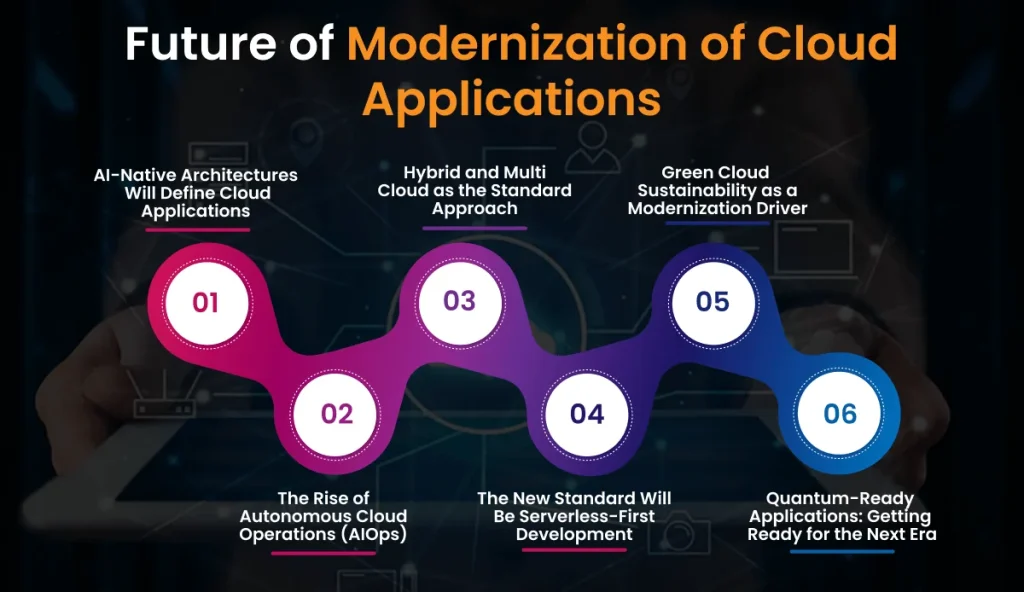
- AI-Native Architectures Will Define Cloud Applications
The next phase of cloud app modernization involves growing programs with artificial intelligence at their core rather than simply relocating existing ones. Real-time inference, smart automation, and included device mastering models become regular capabilities rather than extras in programs.
- The Rise of Autonomous Cloud Operations (AIOps)
Machine learning is used by AIOps structures to automate root cause research, remediation, and difficulty detection. AIOps is a logical progression for any established cloud modernization consulting business because guided monitoring becomes unfeasible in increasingly more complicated cloud structures.
- Hybrid and Multi-Cloud as the Standard Approach
Few organizations will perform entirely on one cloud. For resilience, compliance, and cost optimization, multi-cloud and hybrid strategies, which integrate public and private clouds with on-premise infrastructure, are quickly taking the lead in structure.
- The New Standard Will Be Serverless-First Development
More businesses are embracing a serverless-first method as serverless tools advance, choosing controlled, event-driven computation over server provisioning. This is in line with the best cloud modernization strategies for businesses in 2026 that placed an emphasis on operational effectiveness.
- Green Cloud: Sustainability as a Modernization Driver
Businesses are considering sustainability while selecting carriers, and cloud vendors are dealing with growing stress to decrease their carbon footprints. Planning for responsible cloud infrastructure modernization is increasingly incorporating green cloud principles, workload scheduling, region selection based on renewable strength, and rightsizing.
- Quantum-Ready Applications: Getting Ready for the Next Era
Although still in its infancy, quantum computing is developing more quickly than anticipated. Particularly in the finance, medical, and defense industries, forward-thinking businesses are starting to investigate their cryptographic dependencies and create apps with quantum resilience in mind.
Final Thoughts
Cloud Modernization Is More Than Just an IT Project For Businesses; it’s a core part of any digital transformation service strategy.
The businesses that can succeed in 2026 aren’t people with the largest IT resources; rather, they may be those that view modernizing cloud apps as a business strategy. Having a cutting-edge, cloud-native base is critical for decreasing expenses, faster delivery, improved security, and the capability to use AI.
There are bigger issues with legacy apps than just technical ones. They are a quandary for the enterprise. Your competitors are delivering more quickly, offering better customer support, and paying less for every month that you spend on outdated infrastructure.
Begin Modernizing Your Cloud Applications Right Now
If you’re weighing why to choose a legacy application modernization company over handling it in-house, the answer usually comes down to speed, expertise, and risk. The right partner may make the difference between a challenge that takes a long time and goes over budget and one that produces quantifiable results on time, regardless of whether you’re simply starting to assess your application portfolio or are organized to carry out a complete cloud application migration.
Your business goals, not just your technological needs, are the core of our modernization services for cloud apps. Being one of the best cloud modernization companies for enterprises, Octal IT Solution provides the expertise, assets, and practical experience to finish the entirety efficiently, from preliminary app modernization advice to post-migration optimization.
Get started with our cloud application modernization services. Let’s discuss what modernization includes for your organisation.
Read More-cloud based document management


 Get in Touch
 By
By September 30, 2026