


Key Takeaways
- The global food delivery app market is projected to reach $213 billion by 2030, making it a high-growth digital opportunity.
- Food delivery apps come in multiple models, including single restaurant, aggregator, cloud kitchen, and grocery delivery platforms.
- Development costs typically range from $15,000 to $120,000+, with timelines between 3 to 12 months.
- Essential features like real-time tracking, secure payments, and loyalty programs drive user engagement and retention.
- AI-powered recommendations, contactless delivery, and subscription models are transforming the industry.
- Choosing an experienced Food Delivery App Development Company ensures scalability, security, and long-term profitability.
- Key Takeaways
- Introduction
- Why are Food Delivery Apps Gaining Popularity in the Market?
- Major Types of Food Delivery Apps
- Food Delivery App Development Process
- Food Ordering App Development Cost
- Features of a Successful Food Delivery App
- Benefits of Food Delivery Mobile App Development
- Types of On-Demand Food Delivery App Development
- Future Trends in Food Delivery App Development
- Why Hire Octal IT Solution For Food Delivery App Development?
- Conclusion
- FAQs
Introduction
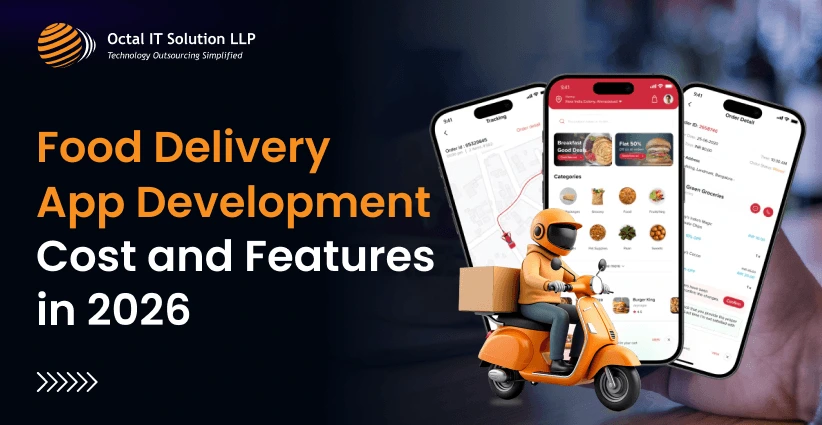
Are you looking to know how to create a food ordering app? If yes, you are on the right page. The food industry is rapidly shifting toward digital ordering platforms.
Businesses are increasingly investing in food delivery app development to meet evolving customer expectations and stay competitive in the digital marketplace. The global food delivery app industry is projected to grow to a market value of $213 billion by 2030.
With widespread smartphone adoption and high-speed internet access, ordering food has become faster and more convenient than ever. Modern food ordering applications help restaurants streamline operations, expand their customer base, and improve service efficiency.
From emerging startups to established enterprises, companies are leveraging food delivery platforms to drive consistent revenue growth. A strategically developed application not only improves customer experience but also strengthens brand visibility and operational performance.
This blog serves as a comprehensive guide to food delivery apps, covering their different types, development costs, emerging trends, and essential features.
Why are Food Delivery Apps Gaining Popularity in the Market?
Food delivery apps provide unparalleled convenience to the consumer of the modern world. Customers are more than happy to order food without having to go to the actual restaurant sites. The hectic lifestyles are creating a need to have speedy and convenient food ordering systems and due to this, digital modernization services are getting popular.
Food app development can allow restaurants to expand access to broader audiences online. Live tracking and making payments online increase customer satisfaction and trust.
The popularity of mobile apps for food ordering is also enhanced by promotional offers. Therefore, the development of delivery applications is still increasing in the world markets.
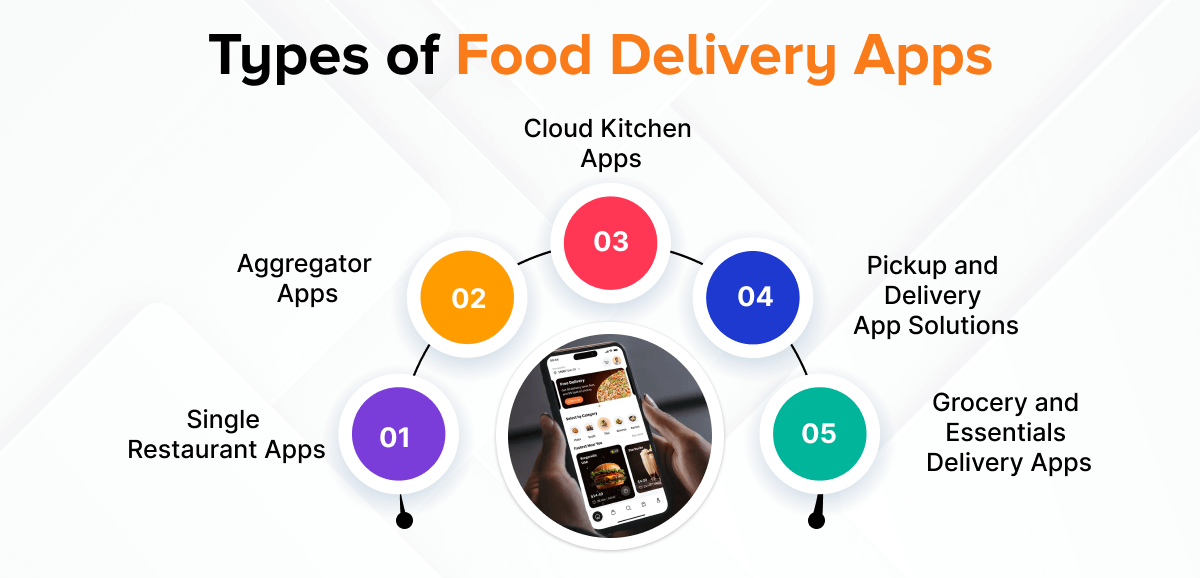
Major Types of Food Delivery Apps
There are various business models in which food delivery apps are created. The models target particular customer needs and operating objectives. The development of the app related to delivery requires the selection of the appropriate type.
The table below outlines major food delivery app categories.
| App Type | Target Users | Core Purpose |
| Single Restaurant Apps | Individual restaurants | Direct online ordering |
| Aggregator Apps | Multiple restaurants | Centralized food ordering |
| Cloud Kitchen Apps | Delivery-only kitchens | Operational efficiency |
| Pickup and Delivery App Solutions | Restaurants and users | Flexible order fulfillment |
| Grocery Shopping App Development | Consumers | Daily essentials delivery |
Single Restaurant Apps
Mobile app development for restaurants is based on brand-specific delivery. They do away with both third-party commission and increase profit margins. The development of food delivery app for individual restaurants adds customer loyalty.
Companies have complete control of menus, prices, and customer information. The apps are helpful in supporting pizza delivery app development and specialty food brands. Food Delivery App Ideas for Restaurant Businesses can be a revenue-generating idea for organizations working in this business domain.
Aggregator Apps
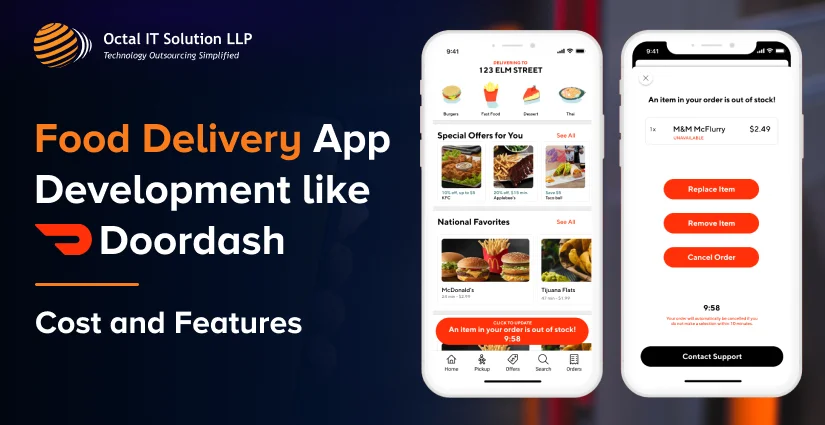
An aggregator app links the customer to a variety of restaurants. They would earn money by commission and delivery fees. This category of apps needs a scalable architecture to develop food delivery apps.
These are platforms that handle ordering volumes and complicated logistics. Aggregator-based food delivery app solutions have been used by many businesses to expand in a short period of time.
Cloud Kitchen Apps
Cloud kitchen applications are useful to delivery-only restaurants. They do not have the facility of dine-in and hence cut down on operational expenses. Cloud kitchen development assists in the development of food ordering apps that aid in streamlining the order workflows.
These applications have much emphasis on back-end effectiveness and analytics. The cloud kitchens enjoy tailored food delivery application strategies.
Pickup and Delivery App Solutions
The pickup and delivery application solutions provide flexible options for order fulfillment. Customers will use it as a self-picked or doorstep service. This model minimizes the dependence of delivery to restaurants.
This type of development, in delivering apps, enhances customer satisfaction. Most businesses create logistics optimization applications in the form of delivery applications.
Grocery and Essentials Delivery Apps
Essentials and grocery apps provide goods for the home daily. They do not just stop at meals and develop grocery shopping apps. Food delivery apps supports repeat orders from customers.
These applications are concerned with speed, stock, and path optimization. Most of the brands are focusing on grocery delivery app development in collaboration with delivery platforms.
Food Delivery App Development Process
An orderly development process brings about scalability and performance. The first question that comes to mind is how to create a food delivery app. Companies adopting agile methodologies lessen risks and decrease time-to-market. Organizations that operate by a specified procedure perform more effectively.
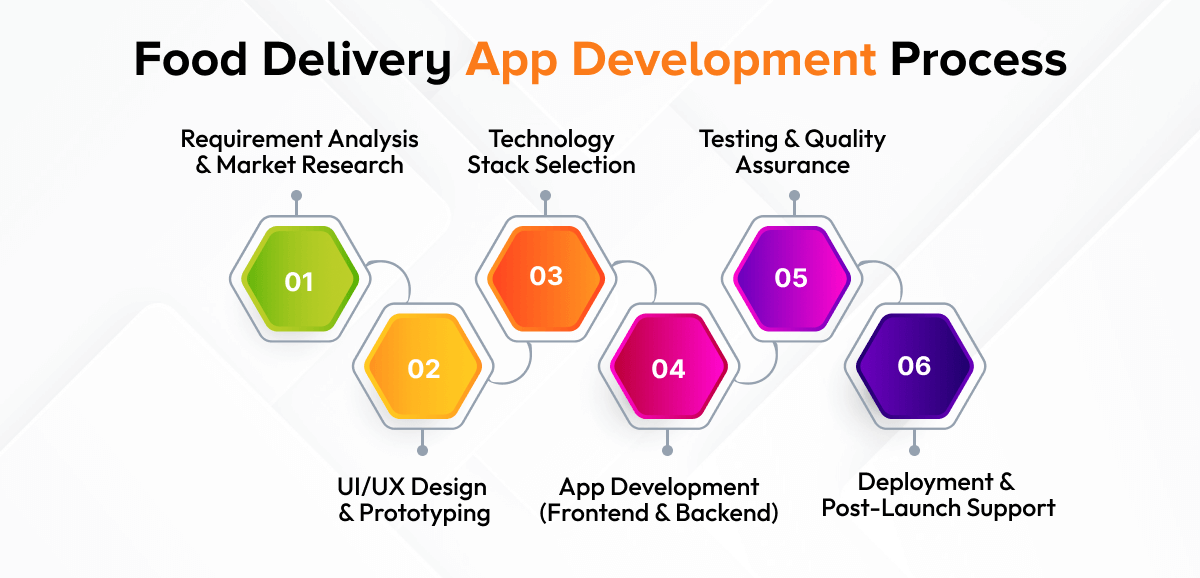
The table below outlines the six essential development steps.
| Step | Purpose | Outcome |
| Requirement Analysis | Define goals and scope | Clear roadmap |
| UI/UX Design | Improve usability | Better engagement |
| Technology Selection | Ensure scalability | Stable architecture |
| App Development | Build core functionality | Working application |
| Testing | Fix bugs and issues | Quality assurance |
| Deployment | Launch and optimize | Market readiness |
Step 1: Requirement Analysis & Market Research
This step determines business expectations and requirements. Competitor analysis will assist in establishing feature gaps and opportunities. The development of food delivery applications starts with the elaboration of requirements.
The food delivery business model is characterized by teams at the beginning. Elaborated requirements minimize development time and cost overrun.
Step 2: UI/UX Design & Prototyping
Design is concerned with ease and accelerated checkout procedures. The wireframes help display user journeys throughout the application. The development of food ordering apps has the advantage of having a user-friendly interface. Prototypes will check the design concepts prior to development. Good UI generates more retention and repeat orders.
Step 3: Technology Stack Selection
The choice of technology has performance and scalability implications. Backend, frontend, and database technologies are selected by developers. Secure and scalable frameworks are needed in the development and delivery of applications. APIs are third-party and deal with payments, maps, and notifications. The stacks today promote the development of applications in the long run.
Step 4: App Development (Frontend & Backend)
The development will involve customer, restaurant, and delivery panels. Admin dashboards control the operation of the platform. Order tracking is incorporated as part of customized food delivery app development. Payment gateways and push notifications are put into practice by developers. The aim is to have a stable and responsive application.
5. Testing & Quality Assurance
Testing ensures smooth performance across devices. Security, usability, and compatibility are tested by the QA teams. The development of food ordering mobile applications must be bug-free. Without any errors in automated and manual tests, reliability is enhanced. Crash testing saves crashing after the launch.
6. Deployment & Post-Launch Support
It implements apps on Android and iOS. Post-launch monitoring is done so that stability and performance are guaranteed. The updates to the food delivery app solution enhance user experience. Frequent maintenance contributes to scalability in the long run. User feedback and improvement are dealt with by support services.
Food Ordering App Development Cost
The price of developing a food delivery app varies according to the complexity and features. Simple applications are cheaper compared to sophisticated solutions. The average cost may range between $15000 to $ 120000+ because the actual cost is determined by a number of factors. Pricing is influenced by customization, integrations, and scalability.
Below are estimated cost ranges with figures.
Cost Based on App Complexity
| App Type | Estimated Cost (USD) |
| Basic MVP | $15,000 – $40000 |
| Mid-Level App | $40,000 – $60,000 |
| Advanced App | $70,000 – $120,000+ |
Food Delivery App Development Cost by Region
| Region | Hourly Rate (USD) | MVP Cost (USD) | Basic App Cost (USD) | Advanced App Cost (USD) | Timeline (Months) | Expertise Level |
| United States | $100–$180 | $40,000–$60,000 | $70,000–$100,000 | $120,000–$200,000 | 5–7 | Very High |
| Canada | $90–$150 | $35,000–$55,000 | $60,000–$90,000 | $100,000–$160,000 | 5–6 | High |
| United Kingdom | $80–$140 | $30,000–$50,000 | $55,000–$85,000 | $95,000–$150,000 | 4–6 | High |
| Eastern Europe | $40–$80 | $18,000–$30,000 | $35,000–$55,000 | $70,000–$110,000 | 4–5 | Medium–High |
| India | $20–$50 | $10,000–$18,000 | $20,000–$35,000 | $45,000–$70,000 | 3–5 | High |
| Southeast Asia | $25–$60 | $12,000–$20,000 | $25,000–$40,000 | $50,000–$75,000 | 3–5 | Medium |
| Middle East | $45–$90 | $20,000–$35,000 | $40,000–$65,000 | $80,000–$120,000 | 4–6 | Medium–High |
Cost Based on Development Components
| Component | Cost Range (USD) |
| UI/UX Design | $3,000 – $8,000 |
| Backend Development | $10,000 – $30,000 |
| Mobile App Development | $12,000 – $35,000 |
| Testing & QA | $3,000 – $7,000 |
Cost Based on Platform Selection
| Platform | Estimated Cost (USD) |
| Android App | $10,000 – $25,000 |
| iOS App Development | $10,000 – $25,000 |
| Cross-Platform App | $18,000 – $40,000 |
The food delivery app development cost increases depending on AI features. Further investment is brought about by sophisticated analytics and automation. Budgets in businesses should be well planned to yield in the long term. Most brands consider the cost of food app development prior to scalability.
Features of a Successful Food Delivery App
An effective app is oriented to usability, speed, and reliability. Good qualities enhance customer loyalty and work effectiveness. The development of food delivery apps relies on the performance of features.
The table below highlights key features and usability impact.
Key Features and Usability Overview
| Feature | User Benefit | Business Impact |
| Easy Registration | Faster onboarding | Higher conversions |
| Advanced Search | Quick discovery | Better engagement |
| Real-Time Tracking | Order transparency | Reduced support queries |
| Multiple Payments | Flexible checkout | Higher order completion |
| Push Notifications | Timely updates | Improved retention |
| Ratings & Reviews | Trust building | Better credibility |
| Loyalty Programs | Repeat orders | Customer retention |
| Admin Dashboard | Central control | Operational efficiency |
Easy User Registration
One-screen sign-up enhances the speed of onboarding. The social logins save a lot of user friction. The development of food ordering apps is based on fast access. Snap-on registration boosts the level of adoption of the app. Minimal form-based onboarding is a favorite of the users.
Advanced Search and Filters
Search assists the users in locating food fast. Filters optimize the results based on cuisine and price. The discovery experience is targeted by food app development. Enhanced customer satisfaction is promoted by better search. Smart filters enhance the frequency of orders.
Real-Time Order Tracking
Live tracking leads to transparency and trust. Customers can follow the delivery of orders through the preparation. The development of food delivery mobile apps relies on the accuracy of tracking. Live updates allow the customer to be less anxious. Monitoring enhances the general user experience.
Multiple Payment Options
Repeated payments enhance the success of the checkout. Customers like cards, wallets, and online payments. Secure gateways are incorporated in the app development of deliveries. The bending of payments minimises cart abandonments. Security generates long-term confidence in the user.
Push Notifications
Users know what is going on with notifications. The status of orders and promotions is shared. The development of food delivery apps is dependent on timely notifications. Push messages increase the engagement levels, and they promote repeat buys.
Ratings and Reviews
The reviews assist users in making well-informed choices. Ratings boost the platform’s credibility. The solutions of food delivery apps consist of review systems. Feedback enhances quality of service. These conversions will be driven by trust and eventually increase the revenue.
Loyalty Programs
Rewards for loyalty promote repeat orders. Customers receive discounts and points. Loyalty engines are supported by the custom food delivery application development. Rewards enhance retention statistics. They enhance lifetime value.
Admin Dashboard
Platforms are centrally controlled by admins. Dashboards are used to regulate users, orders, and commissions. A food delivery app solution relies on the efficiency of the administrators. Analytics is used to improve decision-making. Scalability of platforms is provided by control.
Benefits of Food Delivery Mobile App Development
The development of food delivery mobile apps offers quantifiable business returns. Apps optimize customer interactions and awareness. Online media minimizes friction. The following are the major business benefits.
Increased Customer Reach
Apps are available to people who go beyond geographical boundaries. Customers are increased through online presence. Restaurant mobile app development helps with expansion. Online access enhances orders. Reach enhances the consistency of revenue.
Higher Order Frequency
Orders can be repeated with the help of Apps. Convenience is enhanced in saved preferences. The development of food ordering mobile apps increases reorders. Convenience also drives loyalty, and users come back frequently.
Reduced Third-Party Dependency
Owned apps decrease the reliance on aggregators. Commission expenses are saved by businesses. Development of a custom food application enhances profitability. Direct orders enhance control. Branding gets enhanced by ownership.
Better Customer Engagement
Personalized promotions are aided by apps. Push offers are more interactive. The development of food delivery apps enables targeting. Personalization improves conversion, and stronger engagement drives retention
Operational Efficiency
Order management is automated with Apps. Manual errors are minimized because of the digital workflow. Restaurant app development enhances efficiency. Automation saves time. Efficiency lowers costs.
Brand Visibility
Apps enhance brand presence. Tailor-made design indicates identity. Recognition is created through food delivery application development. Good branding enhances trust and loyalty, which is raised by visibility.
Data-Driven Insights
Businesses can gather data on user behavior using applications. Decisions made in business are informed by analytics. Companies involved in the development of food delivery apps use insights.
Scalability and Growth
Apps adjust to business growth. Cloud architecture promotes expansion. Development solutions for food apps allow scaling. Scalability safeguards investment as growth is also stable.
Read Also: How to Develop Food Delivery App like Zomato
Types of On-Demand Food Delivery App Development
Various development techniques are applicable to diverse objectives. Both types have an effect on cost and scalability. Making the right move is the only formula for success in the long run.
Native App Development
Native applications are high-performance applications. They employ platform-specific technologies. Android app development facilitates the performance of operations faster than iOS app development, enhances a user-friendly experience, and Native apps are able to scale effectively.
Cross-Platform App Development
Single codebases are used in cross-platform apps. They shorten the time of development. The application development of deliveries is accelerated. Maintenance cost is reduced, and time to market is also enhanced.
Custom Food Delivery Application Development
Apps that are customized address special needs. They are totally flexible. Branding occurs with the help of their customized food delivery apps. Differentiation is better through customization, and because of this, competitive advantage is achieved by the business.
White-Label App Development
Quick launches are made possible by white-label apps. They minimize the time of development. The development of food delivery apps is suitable for startups. Individualization is still low,w and speed is the key.
On-Demand App Development
The instant services platforms are supported by a leading on-demand app development company. They are efficient in terms of traffic. The development of food delivery apps is concerned with speed. Automation enhances the speed of responses, es and it aids in satisfying the demands of the user for promptness.
Future Trends in Food Delivery App Development
The technology of food delivery is developing. The trend determines the future-ready app. Innovation raises user expectations. Some of the important trends in the industry are explained below.
AI-Powered Recommendations
Artificial intelligence customizes food recommendations because it examines user patterns. Food delivery AI development enhances interaction. AI recommendations increase average order value by surfacing relevant items, which improves overall satisfaction.
Contactless Delivery
Contactless delivery increases safety. The users would want a few interactions. This trend is supported by building food delivery apps on user demand. Adoption is augmented by trust, and safety is paramount.
Voice-Based Ordering
Voice ordering makes communication easier. Smart assistants assist with commands. Voice options are provided on how to make a food delivery app. Voice ordering improves accessibility for hands-free use, driving higher adoption.
Subscription Models
Subscriptions will provide steady earnings, and customers will have free deliveries. Recurring plans are supported by the development of food delivery apps. This increases retention, and foreseeable income is good for businesses.
Read Also: How to Develop a Food Delivery App like Talabat: Cost and Key Features
Why Hire Octal IT Solution For Food Delivery App Development?
Choosing the right Food Delivery App Development Company can define the success of your digital venture. Octal brings years of industry expertise, delivering scalable and feature-rich food delivery solutions. Our services are tailored to startups, restaurants, and enterprises.
When hiring food delivery app developer teams from Octal, businesses gain access to experienced professionals skilled in building user-friendly interfaces, real-time tracking systems, secure payment integrations, and advanced order management features.
Octal follows a strategic development approach that includes market research, UI/UX design, agile development, rigorous testing, and seamless deployment. The company focuses on performance optimization, security compliance, and future-ready architecture to ensure long-term growth.
With transparent pricing models, flexible engagement options, and dedicated support, Octal ensures smooth communication and timely project delivery.
By partnering with a trusted Food Delivery App developer like Octal, businesses can confidently launch competitive apps that drive higher customer engagement and revenue growth.
Conclusion
Food delivery platforms play a vital role in driving digital transformation across the restaurant industry. Sustainable growth depends on clear strategy, market research, and feature alignment with evolving customer demands.
Successful food delivery app development requires a balance between innovation, usability, and operational efficiency.
The rapid expansion of food ordering applications creates significant opportunities for scalable business growth.
Companies investing in robust food delivery solutions strengthen customer loyalty, expand market reach, and build a strong competitive position.
Now is the right time to launch a dedicated delivery application tailored to specific business goals. Partnering with experienced professionals ensures efficient development, optimized performance, and faster market entry. Hiring on-demand app developers can accelerate success and help secure a competitive edge within the industry.


 Get in Touch
 By
By April 30, 2026