


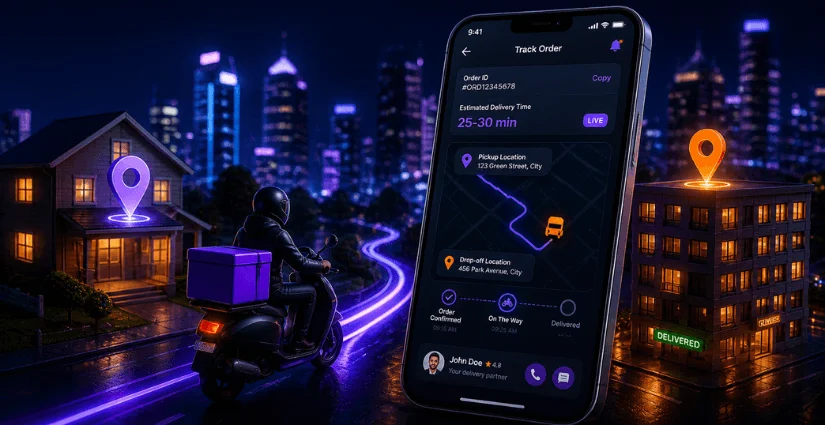
Is your business ready to keep pace with a world that expects everything “now”? As we enter 2026, the on-demand delivery mobile app development landscape has shifted from a luxury to a baseline necessity for survival.
The worldwide market for delivery-as-a-service solutions will experience tremendous growth as it expands from a value of $597 billion in 2025 to reach a market size of over $1.17 trillion by 2032 with a compound annual growth rate of 10.12%. The market experiences this rapid expansion because businesses shift toward hyperlocal delivery systems while simultaneously developing customized pickup and delivery applications.
The guide shows startups and enterprises how to create pickup and delivery applications and will help them achieve market leadership in 2026.
Understanding Business Models for Your Delivery Startup
The success of an on-demand delivery application begins with selecting the appropriate framework. Your selected model determines both your operational expenses and your ability to manage fleet operations and expand your business.
1. Aggregator Model
This delivery model enables users to access local merchant services through its connection with third-party vendors. The development company prefers this model because it enables them to expand their on-demand delivery services without needing to maintain physical stock.
2. End-to-End Delivery Solution
It enables users to control all operations beginning at your warehouse or store through to your delivery operations. This permits complete quality management and forms the foundational element of contemporary logistics application development companies.
3. Hybrid Marketplace + Logistics
Merchants use this system to display their product offerings while you handle the transportation of their items. The service provides businesses with a delivery and pickup system that operates at low risk while maintaining high delivery performance standards.
4. SaaS Delivery Platform for Startups
The software functions through a white-label system and enables you to lease it for your operational needs. This enables companies to establish their delivery application presence through a quick platform that requires them to invest only a small amount of technical resources.
5. Peer-to-Peer (P2P) Delivery
This model regular commuters as delivery personnel who transport packages between locations. The practice has become a popular approach to package delivery app development, serving to decrease both carbon emissions and business operational expenses.
Visit: Lawn Mowing App Development
Industry Use-Cases: Beyond Food and Grocery
The pickup and delivery services, operating according to customer needs, have become essential for all business sectors since their first use in restaurant services.
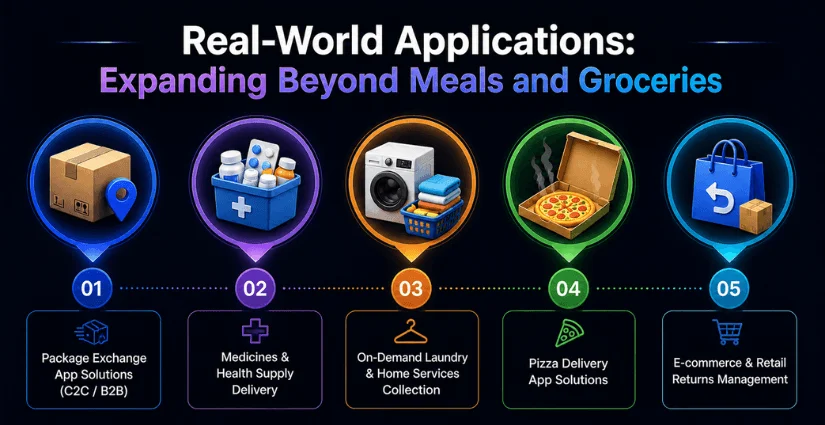
1. Parcel Delivery App Development (C2C/B2B)
People and offices can use the apps to send and receive documents and packages between their various locations. The primary aim of all companies that create parcel delivery applications exists within this particular component of their delivery system.
2. Pharmacy & Healthcare Logistics
The delivery system needs to deliver prescriptions and lab samples in a secure way while maintaining temperature control through advanced delivery application development that meets safety and compliance standards.
3. Laundry & Home Service Pickups
The solution enables users to schedule door-to-door garment care and creates a new business opportunity in mobile app development services.
4. Pizza Delivery App Development
Food logistics systems in this specialized area use two main methods to deliver hot products to customers, helping maintain product quality because food stays at optimal temperatures.
5. Retail & E-commerce Returns
The application uses a standard system that handles returned items through dedicated reverse logistics to enhance the complete customer journey.
Must-Have Features for a Robust Pickup and Delivery App Solution
The application needs to deliver an uninterrupted user experience through its three interfaces and establish a continuous connection between users, drivers, and management staff to achieve success against established industry competitors.
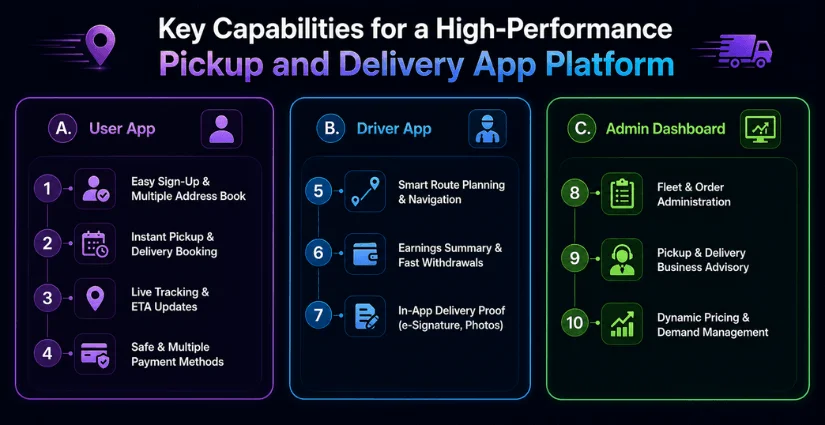
A. The Customer App
1. Seamless Onboarding & Multi-address Management
This enables users to start their journey through social media and biometric authentication methods. Users can store multiple addresses, such as “Home,” “Work,” and “Gym,” which will help them finish their checkout more quickly when using your pickup and delivery application.
2. On-Demand Pick-up and Delivery Scheduling
Users can select between two service options, including immediate service and scheduled service windows. It provides on-demand pickup and delivery service and enables users to select between urgent delivery requests and planned delivery operations.
3. Real-time Tracking & ETA (Live GPS)
This feature creates trust through its live map system and enables users to track the present location of the courier. uses accurate GPS technology to deliver precise one-minute interval ETAs, helping customers experience less stress and create fewer support requests.
4. Secure Multi-channel Payments
This supports various payment methods through multiple gateways, including Apple Pay, Google Wallet, and crypto. Modern delivery applications require businesses to establish diverse payment systems because diverse payment methods help them achieve higher customer acquisition rates.
B. The Driver/Courier App
5. Route Optimization (AI-powered mapping)
It uses AI technology to determine the most efficient routes and help drivers avoid traffic congestion and construction work. The feature serves as a crucial element for developing on-demand courier applications because it enables faster delivery times while decreasing fuel usage.
6. Earnings Dashboard & Instant Payouts
Couriers can access their complete daily earnings information, including their tips and performance bonuses. This provides clear information and helps your business keep its top talent in your courier delivery app development environment.
7. In-app Proof of Delivery (e-Signatures, Photos)
The security and accountability process needs digital confirmations. The drivers use their cameras to record proof of delivery by taking pictures of packages that they delivered to the customer’s doorstep, and they use e-signatures to create a permanent record of their work achievements.
C. The Powerful Admin Panel
8. Fleet & Order Management
Your business needs to operate because you need to watch all your drivers who work at present and all your outstanding deliveries. This enables dispatch operators to perform their work because it helps them choose drivers while managing their operational responsibilities, making it essential for logistics app development companies.
9. Pickup and Delivery Business Consulting Services
Businesses can use their unprocessed data to create specific insights that show areas with the highest customer demand and times that experience the most customer traffic. The analytics system enables your business to experience controlled growth while achieving maximum return on investment.
10. Dynamic Pricing & Surge Management
It needs to change delivery pricing automatically in response to changes in weather conditions, traffic patterns, and periods of high customer demand. Your courier delivery app development services will maintain profitability because your delivery operation will continue to function during difficult times.
Internal Note: The implementation of grocery delivery app development functions, including barcode scanning and inventory synchronization, will boost efficiency and order precision at high-traffic platforms, according to our internal assessment.
Advanced Tech Trends in 2026
The present-day on-demand courier app development market requires businesses to adopt emerging technologies to achieve market leadership.
1. AI-powered Demand Forecasting
Utilize machine learning to analyze historical data and predict upcoming order spikes that occur before actual delivery. The logistics application development company recommends this method because it permits your fleet to remain in areas experiencing peak demand.
2. Dark Store Integration
Your platform needs to establish connections with delivery-only warehouses to deliver products within extremely short “quick commerce” timeframes. This method enables businesses to manage their inventory at a local level and results in delivery times of 10 minutes that meet the requirements of current customers.
3. Sustainable Logistics (EV Routing)
You should create your pickup and delivery app solution through the implementation of EV-first routing, together with real-time carbon-offset tracking. This solution helps businesses meet urban emission standards while attracting environmentally friendly customers.
4. Drones & Autonomous Bots
Explore “Last-100-Yards” automation, enabling contactless and cost-effective deliveries through busy urban areas. The on-demand delivery app development industry has made this trend its primary target because it helps it achieve cost reductions.
5. Blockchain for Immutable Transparency
This uses decentralized ledgers to establish a secure record that tracks each package’s complete route from its starting point to its final delivery location. It establishes trust and remains unmatched for all high-value deliveries in the on-demand app development company space.
The Step-by-Step Pickup and Delivery App Development Process
The process of creating a high-performance application requires organizations to work with professional logistics application developers.
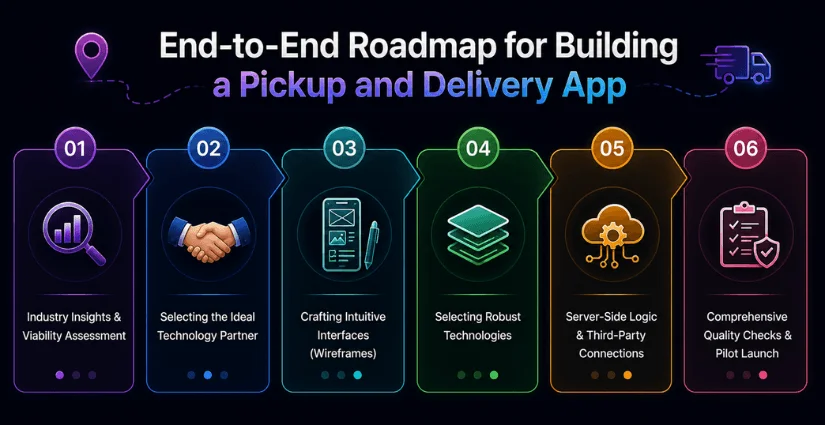
Step 1: Market Research & Feasibility Analysis
Your business should create a unique value proposition and show specific local solutions after studying the gaps in competitor operations. The research should identify demographic data that will help your pickup and delivery application create a product that meets real market needs.
Step 2: Choosing the Right Development Partner
The best approach to selecting a delivery application development partner requires you to choose a company that demonstrates successful project achievements and possesses technical skills. Your selected partner will support your entire process of mobile app development from start to finish.
Step 3: UI/UX Design (Wireframing the Experience)
The “One-Tap” interface design should develop an ordering system that users can operate with their mental capacity. Users need to access application features without facing challenges because this function stands as essential for achieving successful outcomes in the competitive delivery application development market.
Step 4: Choosing the Tech Stack
Developers can build delivery apps for both iOS and Android platforms through the modern frameworks Flutter and React Native provide. It maintains its highest operational performance while requiring low maintenance costs during your business development.
Step 5: Backend & API Integrations
In this step, it creates an essential foundation through the integration of Google Maps navigation services and Twilio alert services. The delivery mobile application development project depends on these integrations as its most essential components.
Step 6: Rigorous QA and Beta Testing
Perform rigorous stress tests that will check its ability to process 1000 simultaneous orders without experiencing any performance issues. The delivery application development company depends on this process to ensure they will achieve a successful product launch that contains no software errors.
Know More:- On Demand Flower Delivery App Development
Tech Stack Required in Pickup and Delivery App Development
Choosing a high-performance tech stack is crucial for your on-demand delivery mobile app development project to be scalable, secure, and able to handle real-time data processing without latency.
| Category | Recommended Technology Stack |
| Mobile Frontend | Flutter, React Native (Cross-platform), Swift (iOS), Kotlin (Android) |
| Web Frontend | React.js, Vue.js, Angular |
| Backend Development | Node.js, Python (Django/Flask), Go, Ruby on Rails |
| Database | PostgreSQL, MongoDB (NoSQL), Redis (for caching) |
| Cloud Hosting | AWS (Amazon Web Services), Google Cloud Platform (GCP), Microsoft Azure |
| Real-time Navigation | Google Maps Platform, Mapbox API |
| Push Notifications | Firebase Cloud Messaging (FCM), OneSignal, Apple Push Notification service (APNs) |
| Payment Gateways | Stripe, PayPal, Braintree, Square |
| SMS & Communication | Twilio, Nexmo, SendGrid |
| Analytics & Tracking | Google Analytics, Mixpanel, Appsflyer |
Pickup and Delivery App Development Cost Breakdown
The pickup and delivery app development cost depends on the complexity of features, APIs to be integrated, and the tech stack selected. Understanding these financial variables is critical for startups to calculate their pickup and delivery service startup costs and ensure sustainable, long-term ROI.
Table 1: Cost by Development Phase
The table shows how all costs need to be divided across three development stages, starting with strategic planning and ending with product launch. Your pickup and delivery application development process becomes completely visible through your budgeting system and prevents any unapproved expenses from accumulating during development.
| Phase | Estimated Cost (USD) | Timeline |
| Discovery & Strategy | $5,000 – $10,000 | 2-3 Weeks |
| UI/UX Design | $8,000 – $15,000 | 4-6 Weeks |
| Development (MVP) | $30,000 – $60,000 | 3-5 Months |
| Testing & QA | $7,000 – $12,000 | 3-4 Weeks |
Table 2: Cost by App Complexity
The total cost to develop pickup and delivery app solutions varies based on the features integrated. Startups should choose basic apps, but those who need advanced platforms with AI-driven logistics should prepare for increased upfront costs.
| Complexity | Features | Est. Cost |
| Basic | Essential delivery & tracking | $40k – $70k |
| Medium | AI-routing & multiple payments | $70k – $150k |
| Advanced | Real-time AI, Dark Stores | $150k+ |
Table 3: Cost by Region (Per Hour)
Your pickup and delivery service startup costs depend on the geographic area you choose to operate from. Businesses can save money on developer costs by choosing developers from Southeast Asia and Eastern Europe instead of hiring expensive North American developers.
| Region | Hourly Rate |
| North America | $120 – $200 |
| Eastern Europe | $40 – $80 |
| India / SE Asia | $25 – $50 |
Table 4: Maintenance & Scalability
Post-launch costs are crucial for long-term success. Your pickup and delivery app solution maintains its operational efficiency through these expenses, including cloud hosting, security patches, and mobile app development services updates that support your growing user base.
| Component | Annual Cost |
| Cloud Hosting (AWS/GCP) | $2,000 – $10,000 |
| API Fees (Maps/SMS) | $1,000 – $5,000 |
| Security Updates | $3,000 – $7,000 |
How to Hire the Best Pickup and Delivery App Developers
To hire on-demand app developer, it requires organizations to assess more than basic programming capabilities because they need to consider the candidates’ background in specific industry work.
- The parcel delivery app development company needs to demonstrate its capacity to build operational logistics platforms through its development work portfolio assessment.
- The experts should prove their abilities to work on projects through their skills in tracking operations with real-time GPS technology and their ability to optimize routes through artificial intelligence.
- The assessment requires examination of their capability to build on-demand delivery mobile apps through two particular platforms, including Flutter and React Native.
- The company provides consulting services for pickup and delivery operations and assists businesses in developing their operational strategies after their launch.
- The client testimonials provide information about the development process the company uses to show its commitment to dependable work and its ability to manage project costs.
How to Start a Delivery Business with an App?
Launching the app requires additional work because you need to create a complete business plan that will enable the company to maintain its delivery services after its initial startup costs.
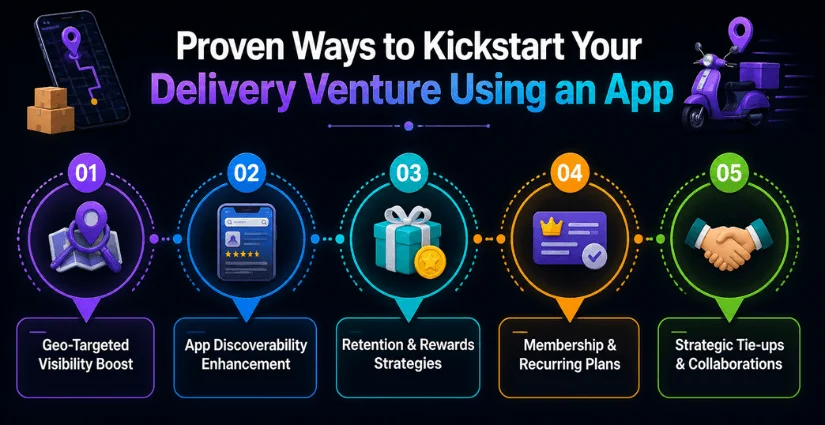
1. Hyperlocal SEO
Your business needs to optimize its online presence for “near me” searches because this will help you reach customers who want to buy products from local stores. The development expenses of the pickup and delivery application will decrease because this solution reduces marketing overhead costs.
2. App Store Optimization (ASO)
The app stores will display your app higher when you use suitable keywords related to courier delivery application-development services. The initial organic downloads require high visibility throughout the entire application.
3. Loyalty Programs
The program gives users points for every delivery they successfully complete, building customer loyalty. A user base that remains faithful to your product helps your business to save money on acquiring new customers over time.
4. Subscription Models
Customers can purchase the “Priority Delivery” pass, which provides them with delivery service for a fixed monthly cost. This arrangement establishes a steady stream of income and helps your business maintain consistent yearly costs for running pickup and delivery services.
5. Strategic Partnerships
You should create exclusive delivery application partnerships with local businesses. The B2B contracts enable your company to build its operational capacity by providing essential business needs.
How Octal IT Solution Helps in Pickup and Delivery App Development?
Octal IT Solution operates as a top delivery app development company and develops user-friendly technological solutions that address complex logistics challenges. We provide high-performance solutions to prepare your business for future growth, and we deliver customized solutions to fulfill your specific business needs.
- Cutting-Edge Tech: Our team possesses knowledge in artificial intelligence, route optimization, and blockchain systems that we use to develop secure pickup and delivery applications that ensure future security.
- End-to-End Support: Our services start with business consulting for pickup and delivery operations, and we continue our work until we finish our post-launch maintenance duties.
- Global Quality: Our teams dedicated to their work create platforms that meet international quality standards and allow them to manage heavy system loads while performing seamless third-party API integrations.
- Proven Track Record: Our team has spent many years developing successful on-demand courier app development solutions that we now offer to startups and enterprises around the world.
Final Words
Logistics will evolve through three main components, requiring quick response capabilities, fast delivery, and smart technologies. Your business can successfully handle current delivery challenges through a partnership with the best pickup and delivery app development company. Also will gain its strongest competitive edge through the ability to expand your pickup and delivery app solution because customers increasingly demand instant service. Business needs the correct technology package because it will enable you to grow your local startup operations and your enterprise-level fleet operations in the delivery app development industry. Your delivery market dominance journey begins today.


 Get in Touch
 By
By June 2, 2026