



Have you ever wondered exactly what sets LLM vs Generative AI apart in today’s tech-driven world? In 2025, Large Language Models (LLMs) and Generative AI are buzzwords. However, many still use them interchangeably and grow more confused with time.
With both technologies moving fast and powering everything from chatbots to custom content engines, a difference worth knowing has become crucial. The phenomenal growth of enterprise adoption in industries ranging from fintech to e-commerce, banking to education, means that choosing the approach is not just any technical decision, a completely strategic one.
Whether you are a business leader looking to make the next big digital move, a developer creating AI-powered tools, or a strategist mapping future context, this guide will help you clearly through the world of Generative AI vs LLM and help you make informed decisions about your projects.
What is Generative AI?
Generative AI is an extreme branch of AI that powers the development of new creations-text, images, audio, video, or even code. By 2025, this concept should not be known as a mere buzzword anymore but rather as a famous technology across industries.
According to Grand View Research, the generative AI market (Global) is worth an estimated USD 16.9 billion in 2024, the generative AI market is projected to increase to USD 109.4 billion in 2030, registering a CAGR of ~37.6% during the forecast period of 2025-2030.

Sometimes people confuse Generative AI with LLM; the fact to be understood is that Generative AI talks about a broader range of technologies than just language models.
Examples of Generative AI Tools
Some of the leading generative AI tools in 2025 include:
- ChatGPT (OpenAI) – for conversation, content writing, and coding
- DALL·E 3 – image generation
- Suno AI – music generation
- Runway ML – video editing and synthesis
- Jasper AI – content marketing and copywriting
- GitHub Copilot – code suggestion and generation
These tools highlight the wide scope of applications under the Generative AI vs LLM debate.
What is an LLM (Large Language Model)?
When talking about LLM vs Generative AI, one sees that a Large Language Model (LLM) is a branch of AI models that is purposely trained to know, interpret, and generate human language. Although there are many generative AIs, the prime targets of LLMs are language-based tasks such as answering questions, summarizing content, translating, writing, etc.
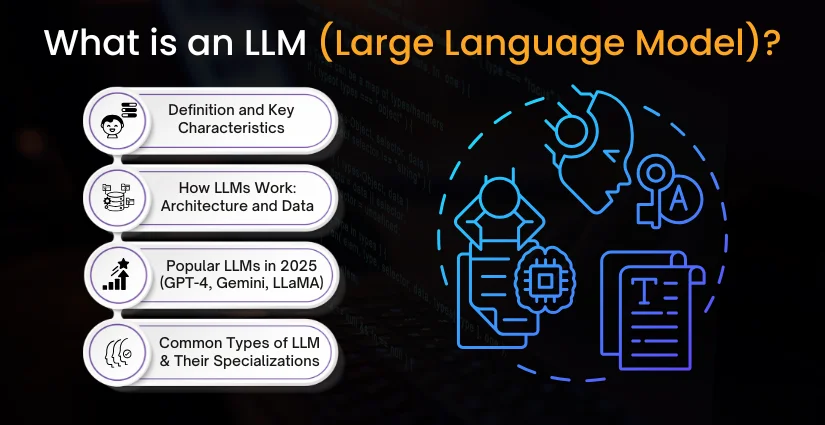
In 2025, LLMs would constitute the backbone of most applications in enterprises, ranging from customer service chatbots to intelligent programming assistants.
1. Definition and Key Characteristics
LLM is a deep learning model built on massive datasets of text: books, websites, articles, conversations, etc. Its purpose is to predict the next word or phrase in a sentence, given the contextual basis. Key characteristics of LLM:
- Natural language understanding and generation
- Context awareness
- Text summarization and translation abilities
- Conversational fluency
They are powerful tools for industries requiring language-based automation and personalization.
2. How LLMs Work: Architecture and Data
LLMs are constructed with transformer architecture, enabling them to process lengthy text and grasp context effectively. These models are initially trained on large datasets, and later on, they are adapted for specific tasks or fields. The training phase consists of a vast number of parameters, figuratively speaking “knobs” the model turns to capture language features.
After the training is done, LLMs can be incorporated into applications to act like customer service representatives or create documentation. This facility for comprehending and producing language that mimics human speech is the main reason why generative AI and LLM are often conflated concepts in comparison articles.
3. Popular LLMs in 2025
By the year 2025, a bunch of LLMs will be the outstanding crowd in the marketplace, achieving a breakthrough in AI with their different capabilities:
- GPT-4 (OpenAI): It is the best at chat, coding, and text creation
- Claude (Anthropic): With a safety-first principle during the whole development, it is ideal for enterprise use
- Gemini (Google DeepMind): Multimodal nature, read, see, hear
- LLaMA (Meta): Platform for openness and lightweight nature is its strength for research and private deployments
Virtually everything is influenced by these models, from virtual assistants to LLM product development in enterprise environments.
4. Common Types of LLM and Their Specializations
There are different types of LLM designed for specialized use cases:
- General-purpose LLMs: Trained on wide datasets for common tasks (e.g., GPT-4)
- Domain-specific LLMs: Concentrated on legal, medical, or financial sectors.
- Multimodal LLMs: Trained not only on the text but also on images, videos, or code (e.g., Gemini).
- Instruction-tuned LLMs: Additionally trained to comply with the user’s commands more efficiently (e.g., ChatGPT)
Knowing these differences is very important when you are comparing LLM against Generative AI and deciding the best model for your project.

LLM vs Generative AI: Key Differences Explained
People are often confused and mistakenly use the two terms interchangeably. However, if one is aware of the LLM vs Generative AI distinction, then individuals understand that the difference is significant, especially in the year 2025 when they are both playing a vital role in creating innovative solutions for different sectors.
However, LLMs are a subset of generative AI; they are solely concentrated on language-based tasks, while generative AI is an extensive area of content creation, which includes visuals, audio, code, and more. We can now decipher the main points of distinction between Generative AI and LLM that will enable you to find the most fitting solution for your problem.
1. Scope of Application
- LLMs are language-based, and they have the nature of a task which they are good at, such as writing, summarizing, translating, or coding.
- On the other hand, generative AI is a bigger area, and not only does it produce text, but it can also generate images, audio, videos, and other data types.
- This is the reason why in the generative AI vs. LLM, the scope of the fields of work argument is usually the one which wins.
2. Training Methodology
- LLMs rely mainly on the enormous text corpora of transformer architecture to perform various language tasks.
- Generative AI systems, depending on the target result, can be trained on multiple modal data – text, images, or even sound.
- This difference defines the main features of LLM vs Generative AI.
3. Input-Output Formats
- LLMs usually receive text prompts and return text-based answers.
- Generative AI models, depending on their design, may take text, images, or videos as input and produce a variety of content formats.
- For instance, DALL-E creates pictures from words while GPT generates text from text.
4. Content Generation vs. Language Understanding
- LLMs are great at grasping the context, semantics, and user intent in conversations and texts.
- Generative AI, certainly carrying content creation in its arsenal, however, is not guaranteed to exhibit deep language understanding unless it is an LLM-based model.
- The Generative AI vs LLM scenario is thus a good analogy for the choice between creativity and understanding.
Real-World Use Cases of LLM in 2025
There is no secret that businesses are still pushing ahead with the experiments on the intelligence of AI to help their work. Hence, grasping the practicalities of LLMs is quite essential at such a juncture. Moreover, despite skirmishes going on between LLMs and Generative AI, LLMs hold ground in the provision of language-based intellect to different sectors.
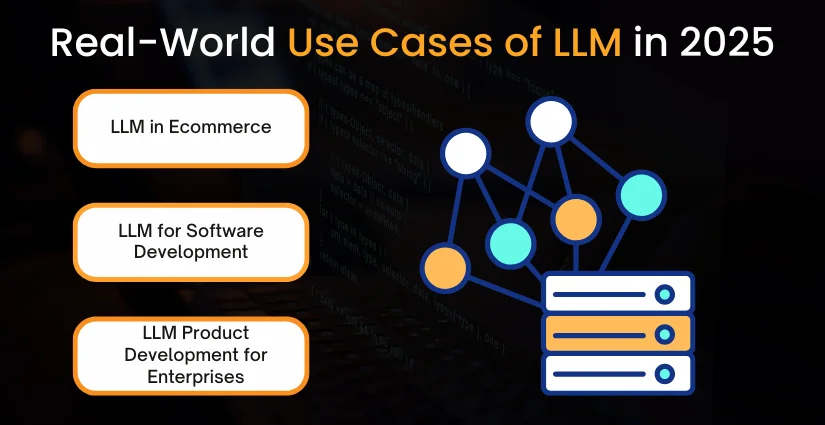
They are not merely provided as trial instruments in 2025 but also are the main agents in the implementation of the developing AI solutions in the domains of eCommerce, software development, and enterprise productivity. Below are some of the significant methods organizations have found to harness the LLM’s power in their transformational quest.
1. LLM in Ecommerce
LLMs have a place in the eCommerce industry in a way that they generate product descriptions based on the preferences of customers, they also provide support through chatbots, and improve the accuracy of search results. Their command of language helps brands deliver smarter, human-like customer experiences, often preferred in the generative AI vs LLM in eCommerce.
2. LLM for Software Development
LLMs enable developers to write, debug, and update documentation automatically. The use of GitHub Copilot demonstrates their ability to accelerate development, increase productivity, and improve the quality of code, which makes it the most suitable software task for LLMs.
3. LLM Product Development for Enterprises
Corporations utilize LLMs for the development of AI applications that are related to customer service, analysis, as well as the automatization of internal activities. Through LLM product development, enterprises are empowered to conceive intelligent solutions that go beyond language and are able to debug domain-specific.
Generative AI vs. LLM vs GPT: Clarifying the Confusion
Generative AI vs. LLM vs GPT are some of the buzzwords that are quite confusing to most people nowadays.
Are they different from each other? And, do they work in a similar way? In 2025, as these technologies become more integrated into daily business and tech operations, understanding how they relate to one another is more important than ever.
1. Is GPT an LLM or Generative AI?
GPT (Generative Pre-trained Transformer) is a Large Language Model; thus, it belongs to the category of LLMs. However, since it can produce text, write code, give summaries, and so on, it is also a generative AI.
Therefore, the GPT is both an LLM and a generative AI model, which makes it a perfect example of the overlap of the two technologies.
2. How GPT Fits into the Generative AI vs LLM vs GPT Framework?
In the framework of generative AI vs LLM vs GPT, think of it this way:
- Generative AI is the broad category (text, image, audio, video generation)
- LLMs are a specialized part of generative AI, focused on language
- GPT is one of the most well-known LLMs—and by extension, also part of generative AI
Thus, GPT serves as a conduit between the two ideas.
3. Understanding Overlaps and Boundaries
Nevertheless, all LLMs happen to be generative AI models; it is not true that all generative AI models are LLMs. Let us take an example of a tool that uses text to produce artwork (like DALL·E). This is generative AI only and not an LLM.
But, on the other hand, machines such as GPT, Claude, or LLaMA are LLMs that write text, and thus are a particular kind of generative AI. Grasping these frontiers will help enterprises to make smarter decisions when choosing the appropriate compatibility for their tasks, such as content creation, automation, or product development.
4. Generative AI vs LLM vs GPT: Comparison Table
| Feature / Aspect | Generative AI | LLM (Large Language Model) | GPT (e.g., GPT-4) |
| Definition | AI that generates content (text, image, audio) | A type of AI that understands and generates text | A specific LLM developed by OpenAI |
| Category Type | Broad umbrella term | Subset of generative AI | Subset of both LLM and generative AI |
| Focus Area | Multi-modal: text, image, code, audio, video | Language-based: text generation and understanding | Language tasks: writing, coding, chat, summarizing |
| Examples | DALL·E, Midjourney, Runway, Suno | GPT, Claude, Gemini, LLaMA | GPT-3.5, GPT-4, GPT-4o |
| Input / Output | Inputs: text/image → Outputs: various formats | Inputs: text → Outputs: text | Inputs: text/code → Outputs: text/code |
| Use Cases | Content creation, design, music, code, visuals | Text summarization, translation, Q&A, chatbots | Chatbots, copywriting, code generation, support bots |
| Training Data | Multi-modal data | Large-scale text datasets | Text, code, and web-scale data |
| Belongs to | AI family (broad scope) | Generative AI category | LLM + Generative AI |

When to Use Generative AI vs. LLM?
What businesses consider in 2025 include: what is generative AI vs LLM? Which one should I choose? It depends on your use case. LLMs are used for deep language-based tasks like writing, coding, and chatbots, whereas generative AI can create content in a broader paradigm consisting of images, video, and audio.
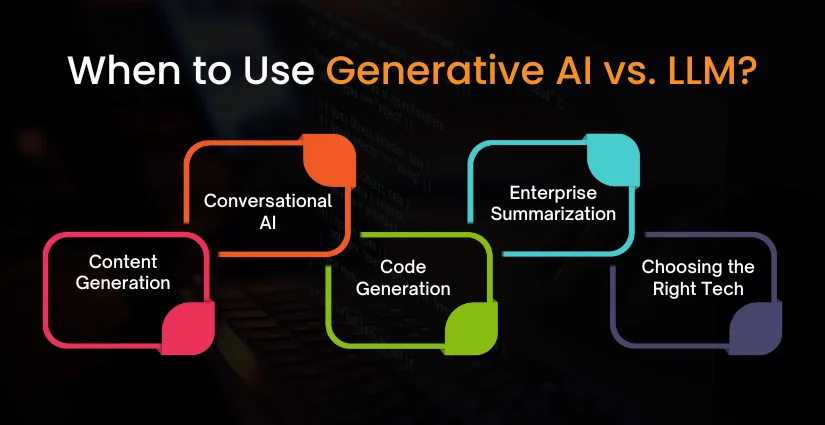
1. Content Generation
Generative AI for blogs, ads, or images. Use it when the deliverables are numerous and in several formats.
2. Conversational AI
Use LLMs if you’d like to have chatbots or virtual assistants that generate natural context-aware responses.
3. Code Generation
Use LLMs, such as GPT-4, for code assistance since such models understand logic and syntax very well.
4. Enterprise Summarization
Use LLMs to summarize reports and extract insights from massive text documents.
5. Choosing the Right Tech
If text is fine, use LLMs; if not and multiformat is required (text + visuals + audio), generative AI is your answer.
Benefits and Challenges of Using LLMs
LLMs are highly powerful tools for writing, programming, and conversing. They come pre-trained with an enormous language skill set; their size, cost, and sometimes erroneous output can all pose challenges. Finding the most suitable kind of LLM is very important to getting proper use out of it.
Pros:
Natural Language Capabilities: LLMs have a deep understanding of the language. They grasp context, tone, and intend, thus being perfect for chatbot creation, translation, content writing, and conducting support jobs.
Pre-trained Intelligence: LLMs are good at reasoning and rapidly producing output in a wide array of application areas because they have been trained on enormous data sets.
Cons:
Model Size: LLMs have a very large size and need powerful hardware, which may not be affordable for smaller teams.
Training Cost: To fine-tune the model, a lot of resources and technical skills are needed. Hence, many people prefer pre-trained models.
Hallucinations in LLMs can generate wrong or misleading information, and that can be quite dangerous for cases like finance and health care.
Benefits and Challenges of Generative AI
Generative AI is allowing companies to create various forms of content more quickly and efficiently that are texts, images, videos, audio, and code.
On the other hand, it is expected that the massive adoption of generative AI for automation and innovation in 2025 will be accompanied by challenges such as bias, misuse, and data quality issues.
Pros:
Thanks to generative AI, it is possible to produce more content in diverse forms in a shorter period of time, which is very good for various fields of work in marketing, designing, software, and media. It allows for creativity, saves time, and facilitates the process of scaling up content production.
Cons:
If the data provided is of poor quality, the AI might produce biased or incorrect content. Besides that, the AI technology misuse might lead to the creation of fake media or misinformation; thus, it will be necessary to implement strict control in order to prevent it from occurring.
LLM vs Generative AI: A Side-by-Side Comparison Table
A quick graphical outline of the fundamental gaps in objectives, fields of usage, and power between the two concepts for settling the LLM vs Generative AI quarrel in a straightforward way.
| Aspect | LLM (Large Language Model) | Generative AI |
| Definition | AI model trained to understand and generate human language | Broad AI category that generates content (text, image, audio, etc.) |
| Scope | Focused on text-based tasks | Covers multiple content types: text, image, video, code, audio |
| Use Cases | Chatbots, text summarization, translation, code generation | Content creation, design, synthetic media, automation |
| Input/Output | Text in → Text out | Text/Image in → Text/Image/Video/Audio out |
| Technology Base | Transformer architecture (e.g., GPT, Claude) | Can include LLMs + image/audio-based models (e.g., DALL·E) |
| Popular Tools | GPT-4, Claude, Gemini, LLaMA | ChatGPT, DALL·E, Runway, Jasper, GitHub Copilot |
| Best For | Natural language understanding and communication | Multi-format content generation and creative applications |
Real-World Use Cases Across Industries
The year 2025 will see the use of large language models and Generative AI, which are now solving real business problems. From generative AI in banking to retail management, education, and software development, these emerging technologies enable automation of activities, customization of experiences, and productivity improvement.
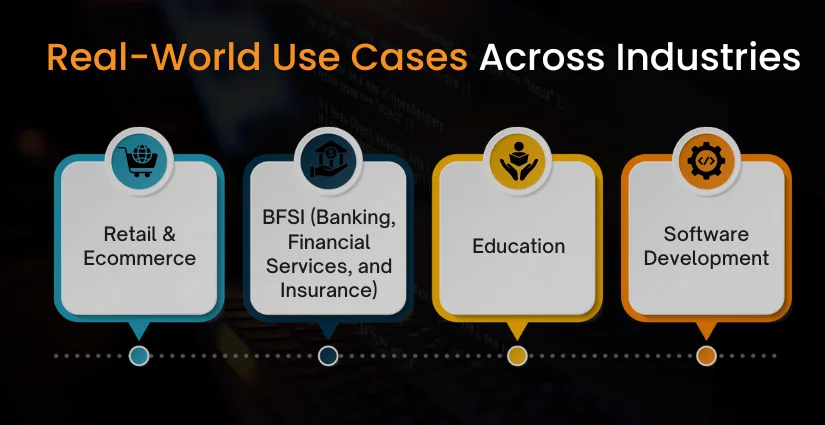
So, let’s consider some examples of how businesses employ Generative AI and LLMs today.
1. Retail & Ecommerce
Generative AI in eCommerce assists online retailers in creating thousands of product descriptions and advertisements with personalized touches, along with AI-generated banners. In effect, customer engagement improves, and content creation accelerates.
LLM-based solutions in e-commerce also enable chatbots, intelligent search engines endowed with natural language questioning, and product recommendation systems that remedy their deficits by acting like a human-agent interface and thus, assisting the sales level and shopping experience.
2. BFSI (Banking, Financial Services, and Insurance)
In the banking domain, generative AI in fintech crafts tailor-made financial advice for prospective clients, automates response generation for client queries, and simulates client interaction for training.
Companies in fintech employ AI for creating synthetic financial data, generating ad hoc investment reports, and automating the drafting of regulatory documents-lending speed and intelligence to operations.
3. Education
Generative AI in education is changing how students learn and how instructors teach. The AI generation tools create lesson plans, quizzes, summaries, and explanations of complicated concepts in less complicated language.
They make the learning experience tailored for each student, thus making education more accessible and enjoyable.
4. Software Development
LLM for software development is speeding up how developers write code, fix bugs, and document projects. The LLM-powered tool, like GPT-4 and GitHub Copilot, assists with real-time coding, suggesting coding, and enabling developers to do the job faster and accurately.
Final Verdict: Which is Better
There is no definite answer to LLM vs Generative AI. If your use case is looking at tasks that involve writing, coding, or chatbots, then LLMs shall be the perfect match because of their profound understanding of text.
For more expansive requirements, such as producing visuals, videos, or multi-format content, generative AI fits the bill more. The trend of 2025 is businesses using both for different tasks. The principle is to identify the right tool for your target, be it speed, accuracy, creativity, or scale.


 By
By May 22, 2026





 Get in Touch