


Classrooms look different today than they did five years ago. Students now ask questions to AI tutors, not only teachers. Generative AI in education is reshaping how children learn every subject.
Schools and colleges are adopting new AI tools at a record pace. Teachers use them to save hours of planning time. Students use them to get instant, personalized help. Interest in generative AI for education keeps growing across every grade level.
This blog covers real use cases, costs, and simple steps to build one. You will also learn why global brands trust Octal IT Solution.
- Global Generative AI in Education Market
- Key Advantages of Generative AI in Education
- Top 10 Use Cases of Generative AI in Education
- Cost of Generative AI in Education Solutions
- How to Implement Generative AI in Education?
- Why Hire Octal IT Solution for Generative AI Development Services?
- Final Thoughts
- FAQs
Global Generative AI in Education Market
Grand View Research says the AI in education market hit $8.3 billion in 2025. The same report projects it will reach $57.2 billion by 2033. That growth reflects a CAGR of nearly 26 percent.
The Business Research Company shows the generative AI edtech segment growing nearly 44 percent yearly. A HEPI and Kortext survey found 92 percent of UK students now use AI.
Gallup and Walton Family Foundation show teacher adoption doubled in one year, to 53 percent. These figures show the real advantages of AI in education are no longer theoretical. Demand for solid generative AI platforms for education keeps climbing every quarter.
The adoption of solid generative AI platforms for education continues to rise, quarter after quarter. Now is the time for institutions to invest in robust AI Development Services, and later they will be at the forefront of their industry. There is still time for early intervention, but it is rapidly closing.
Key Advantages of Generative AI in Education
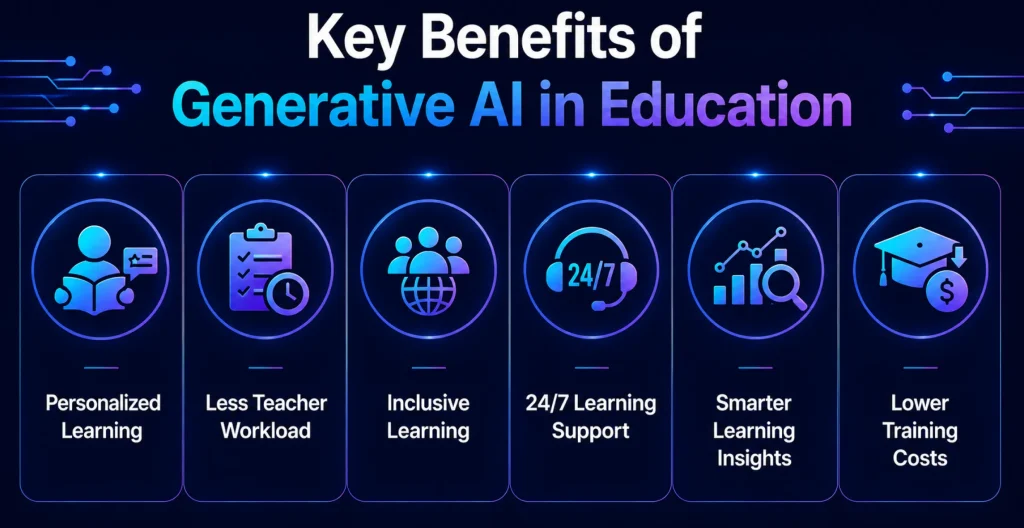
It’s never too early to take a step back from the details and see the whole picture before exploring specific use cases. Here are major advantages of AI in education that schools and institutes can gain from this technology today.
1. Personalized Learning at Scale
All students are different learners and learn in different ways. With Generative AI and AI analytics, lessons, pacing, and difficulty can be automatically adjusted for each learner. Previously, this sort of attention was achieved at a very high level in large classrooms.
Thousands of students can now receive customised help in one go. Teachers take charge of the process, with AI doing the tedious adjustment tasks behind the scenes.
2. Major Time Savings for Teachers
Teacher time is consumed each week in lesson planning, grading, and report writing. Now these materials can be created in minutes instead of hours with the help of AI. Teachers check and improve the products rather than create new ones.
Many schools also work with an experienced education software development company from day one to invest the time of teachers in more productive tasks. This allows time for mentoring, discussion, and one on one student support. Burnout reduces when repetitive admin tasks are a lot less over the course of a school term.
3. Wider Accessibility for All Learners
Oftentimes students with disabilities and language barriers have trouble with regular materials. Content can be translated, and captions can be automatically generated using Generative AI for any lesson. It can also read text to the user and make difficult text more intelligible upon request.
This provides equal opportunity for students who learned differently previously. No child is left behind due to their information processing style.
4. Round-the-Clock Learning Support
The traditional tutoring method relies on tutor availability and fixed hours. AI tutors are available during all hours, weekends, and holidays. Students who find themselves with homework problems late at night can still get genuine assistance!
This is 24/7, which helps build confidence and reduce stress at night while studying. Support that doesn’t require office hours or appointments is appreciated by parents, too.
5. Data-Driven Insights for Better Outcomes
Each interaction with the AI yields valuable insights into student comprehension. Teachers get immediate feedback on a class’s weaknesses. This is a way to avoid guesswork and get clear, actionable classroom information.
Schools can then direct their attention to the topics that require the most focus. This data can also, over time, be used to predict those students who may require early intervention.
6. Lower Long-Term Training Costs
Teachers’ traditional training and teaching materials are costly and time-consuming. Generative AI saves time by creating drafts, plans, and materials in a flash. Less department and grade-level duplication of school content.
Staff also accelerate their ramp-up with training materials assisted by AI. These savings over the years frequently far exceed the cost of the technology itself.
Top 10 Use Cases of Generative AI in Education
The following are 10 generative AI use cases in education you can use. In combination, they illustrate the authentic way generative AI is present in education today.
1. Personalized AI Tutoring
All students are not the same and progress at different rates and levels. AI tutors can tailor explanations to the student’s level of understanding.
Khan Academy’s Khanmigo provides every student with their very own tutor, one-on-one and patient. Solves math queries with hints, but not answers. A total of 1.4 grade-level gains were reported in reading by pilot districts. This is one of the most obvious examples of generative AI use in education today. For schools with constrained budgets, this is where to begin, as there are free tiers.
2. Conversational Language Learning
Practice of the language may get stuck without a genuine conversational partner in the immediate vicinity. AI has filled in that void with natural, adaptive conversation.
AI roleplay and video calls are introduced into lessons with Duolingo Max. Learners achieve 4 semesters of Spanish in 150 hours. More than 100 million people utilize Duolingo’s AI capabilities every month today. One of the best language skills use cases for generative AI in education. It demonstrates the potential for one platform for generative AI for educators and generative AI for self-learners.
3. Automated Lesson Planning
It takes up a lot of teacher time to plan new lessons each week. With AI, these plans are now rapidly drafted with great initial versions.
MagicSchool AI enables teachers to create lesson plans in minutes, not hours. More than 3.2 million teachers are already using it every day. It also automatically generates rubrics, quizzes and parent letters. This shows how useful generative AI applications are in education for overworked teachers. The teacher has more time for his/her evening and sometimes the quality of his/her lessons is enhanced.
4. Adaptive Assessment and Grading
Basic tests tend to assess memory rather than knowledge. Adaptive AI assessments vary in difficulty to identify real skill gaps.
One of the great strengths of ALEKS is that it tests for true comprehension, rather than memorized results. It will dynamically adjust the level of challenges as per the actual performance of the student. McGraw Hill saw a 35 percent increase in course completion. This is a strong case of the application of generative AI in education. Automating the grading process also allows teachers to concentrate on teaching.
5. AI-Generated Course Content
It used to take months to create a full course from the ground up. This has all been dramatically accelerated by Generative AI. Today, universities are leveraging AI to create complete courses in just days.
AI coaching is now combined with content from the best schools through platforms such as Coursera. Instant explanations on demand for students taking Stanford or MIT courses. This is a clear example of how generative AI is proving to be a force of strength in the higher education context. Content used to take months to create, but can now be done in a week.
6. Administrative Task Automation
The amount of paperwork, emails, and repetitive reporting that schools receive each term can overwhelm them. This is now automated with AI for much of the routine admin.
Brisk Teaching automates emails, reports, and feedback comments for staff. Schools spend a huge number of administrator hours term after term. This allows for the use of the budget for teaching materials, not paperwork. It indicates the emerging potential of Generative Artificial Intelligence (GAI) in educational operations. Administrators are freed up to do their strategic planning.
7. Accessibility and Inclusive Learning
Not all students are able to learn from the same content. With Generative AI eLearning app development, content gets transformed in a matter of seconds to suit various requirements. You can now use AI tools to translate lessons and instantly create live captions. Materials are tailored to children’s learning differences.
This has a direct impact on the use of artificial intelligence in education for underserved communities. Voice-to-text and text-to-speech tools serve a variety of classrooms. These accessibility tools are exemplary AI education tools today and will continue to be so in the future. Every pupil is provided for, and no one is left behind through a language or disability barrier.
8. Special Education Support
There is a lot of paperwork and a lot of follow-up with special education. However, much of this work can be automated by AI agents. Staff are automatically tracked on the Individualized Education Program (IEP) goals by the AI agents.
They produce progress reports and identify unmet accommodations at an early stage. This is emblematic of the increasing penetration of generative AI in education systems designed for compliance. Manual paperwork tracking is eliminated, which is an hours-long time-saver for special education teams. Families receive clearer and faster feedback on their pupils’ progress, too.
9. Corporate and Skills Training
Schools and Universities are not the only places for training. In today’s age, companies are also taking a similar approach to employee training. AI-powered eLearning platforms are used to create internal academies for staff within the company. Compliance and skills are acquired through interactive AI modules for new hires.
This is just one of several applied uses of generative AI in education outside the school environment. The number of training hours is significantly reduced, but there is a significant increase in retention. Faster hiring and onboarding, reduced training repetition every year for businesses.
10. AI Writing and Research Assistants
The skills of writing and researching continue to be the most important. AI can aid this process, but never take the place of original thinking. Students can utilize AI to generate structure for essays, grammar, and source citations, with tools like an AI-powered research assistant for literature reviews handling citation-checking directly inside the draft. It can be used properly and actually educate about structure rather than supplant creative thinking.
Here are some of the examples of generative AI in education writing lab that are common today. The use of AI is now being taught as a course within its own right in universities. It is a debate that is at the core of the pros and cons of generative AI in education. It is a testament to the extent of the integration of Generative AI in everyday education.
Cost of Generative AI in Education Solutions
Prices are significantly different depending on features, location and project size. By knowing the eLearning App Development cost in the initial stages, schools can make realistic plans. This is broken down by complexity, feature, and region in the tables below.
Cost by Project Complexity
| Project Type | Typical Cost Range | Timeline |
| Basic AI tutoring chatbot | $10,000 – $40,000 | 6 – 10 weeks |
| Mid-tier adaptive learning platform | $50,000 – $150,000 | 4 – 6 months |
| Enterprise AI-enabled LMS | $150,000 – $480,000+ | 6 – 9+ months |
At one end of this spectrum are simple, single-purpose tools. Full platforms with grading, analytics, and integrations are more expensive. Clients can also Hire AI Developers on flexible, project-based engagement models.
Cost by Core Feature
| Feature Module | Estimated Cost |
| AI chatbot development or tutor engine | $15,000 – $45,000 |
| Adaptive assessment and grading | $20,000 – $60,000 |
| LMS or school system integration | $10,000 – $35,000 |
| Accessibility tools (captions, translation) | $8,000 – $25,000 |
| Analytics and reporting dashboard | $12,000 – $30,000 |
Feature scope, not screen count, drives most of the final price. Careful education app development planning keeps these costs predictable from day one.
Regional Development Cost Comparison
| Region | Senior Developer Rate | Mid-Tier Platform Total Cost |
| United States | $120 – $250/hour | $150,000 – $320,000+ |
| United Kingdom & Western Europe | $90 – $180/hour | $110,000 – $220,000 |
| Eastern Europe | $45 – $90/hour | $70,000 – $150,000 |
| Latin America | $50 – $95/hour | $75,000 – $160,000 |
| India | $30 – $65/hour | $50,000 – $120,000 |
| Philippines & Southeast Asia | $18 – $55/hour | $35,000 – $90,000 |
India and Southeast Asia offer strong senior talent at lower rates. Teams in India can deliver comparable quality at roughly half the US cost.
This makes India a smart base for schools building on a budget. Ongoing hosting, model usage, and updates add monthly running costs too. A trusted Custom Software Development partner can help you avoid hidden costs later.
How to Implement Generative AI in Education?
Building the right solution takes a clear, structured approach.
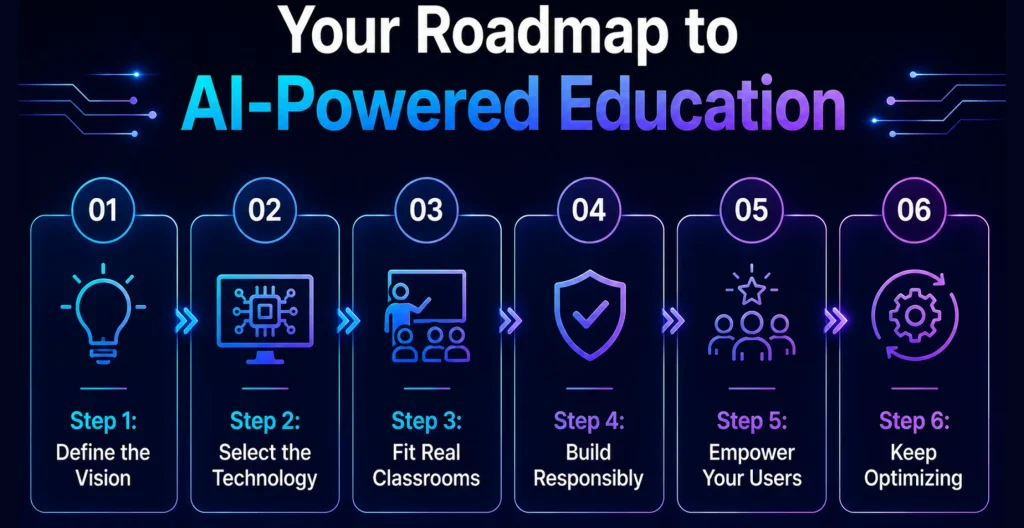
- Define your goals
Decide if you need tutoring, grading, or admin automation first.
- Choose the right technology
Pick foundation models or custom builds based on scale needs.
- Design for real classrooms
Involve teachers early so the tool fits daily routines.
- Build and test safely
Run pilots with small student groups before full rollout.
- Train staff and students
A short generative AI for educators course builds real confidence.
- Monitor and improve constantly
Use feedback loops to refine accuracy and safety over time.
Partnering with strong AI Consulting Services at each step reduces risk significantly.
Why Hire Octal IT Solution for Generative AI Development Services?
Octal IT Solution has built software since 2007. Our team has delivered more than 300 eLearning and education projects. Brands like ZEE5 and Hungama Games have trusted our engineering teams. That same rigor now shapes our education-focused generative AI work.
When you hire generative AI developers from Octal IT Solution, you get real depth. Our engineers work across React, Flutter, Node.js, Python, and cloud AI stacks.
We are recognized as a reliable generative AI app development company worldwide. Our generative AI consulting services map your goals before writing any code. We also offer generative AI integration services for schools with legacy systems.
We build AI Agent Development projects for tutoring and support. Our smart learning platforms already use adaptive paths and interactive AI tutors. Every project stays transparent, on budget, and tied to measurable outcomes.
Final Thoughts
The use of Generative AI in education is no longer a trend but a reality. Schools that take action now will be ahead of the curve in the industry for years to come.
From an eLearning App Development project to a chatbot or tutor, we can help you. Our generative AI development services transform your idea into a functional product in no time. If you are interested, please contact us today, and together we will create the next great learning tool.


 Get in Touch
 By
By March 24, 2026