

It has permanently altered the consumption patterns of video content by the audience. With on-demand movie marathons, live sports events, virtual classrooms, and creator-driven channels, people now expect high-quality video streaming without any interruptions directly on their phones. For businesses, this would be a colossal opportunity, and it would start with investing in video streaming app development.
Whether you are an entrepreneur developing the next big OTT platform or a media business modernizing its delivery infrastructure. A startup trying to establish a niche in the creator economy, this guide will take you through all the details you will need to know. We discuss the entire process of creating a streaming product, including architecture and features, tech stack choices, and cost estimates.
- What is a Live Streaming App?
- Interesting Live Streaming Market Statistics
- Different Types of Streaming Apps
- Key Features to Include in a Video Streaming App
- Key Tech Stack Considerations for Live Streaming App Development
- Challenges and Solutions in Video Streaming App Development
- Video Streaming App Development Process
- Video Streaming App Development Cost
- How We at Octal IT Solution Can Help You Develop a Live Video Streaming App?
- Why Partner with Octal IT Solution?
- Final Thoughts
- FAQs
What is a Live Streaming App?
A live streaming app refers to a software platform used to transmit audio and video information in real time or on demand over the internet to the final users. These applications record, encode, transmit, and decode media, allowing viewers to see what is going on or watch pre-recorded media when they have the time.
The live video streaming app development has grown far beyond simple broadcasting. The current platforms combine social functionality, monetization, an adaptive bitrate engine, multi-device synchronization, and even AI-driven recommendations. Consider how Netflix is tracking what you watch. How Twitch is making live gaming interactive; both are the result of advanced streaming and video application development that combines content delivery with an engaging user experience.
Streaming mobile app development aims at creating this experience for users of smartphones and tablets who have become the largest consumers of video around the world. The category includes short-form content apps to complete live broadcasting solutions, and is expanding rapidly.
Interesting Live Streaming Market Statistics
Understanding the scale of the opportunity is the first step for anyone considering video streaming mobile app development. The following are some of the main data points that will influence the industry in the upcoming years.
- The global video streaming market is projected to exceed $416.8 billion by 2030, growing at a CAGR of over 21.5% in the period 2025 to 2030.
- Live streaming is a market on its own, a 184 billion industry, with sports, gaming, events, social media, and broadcast as the diverse motivators.
- Almost 70 percent of all video content viewing is carried out via mobile, and mobile-first development is no longer a bargain.
- The average consumer is spending an excess of 100 minutes a day watching video content online.
- The number of subscribers on OTT platforms increased by 50 percent between 2020 and 2024, and there is no indication that the trend will slow down.
- Gaming streaming services and esports such as Twitch increased their number of monthly active users to more than 140 million.
- Among all business models of streaming, VOD based on subscription generates the greatest ARPU (average revenue per user).
These figures are a strong argument, and if you consider developing video streaming app solutions, it has never been a better time in the market.
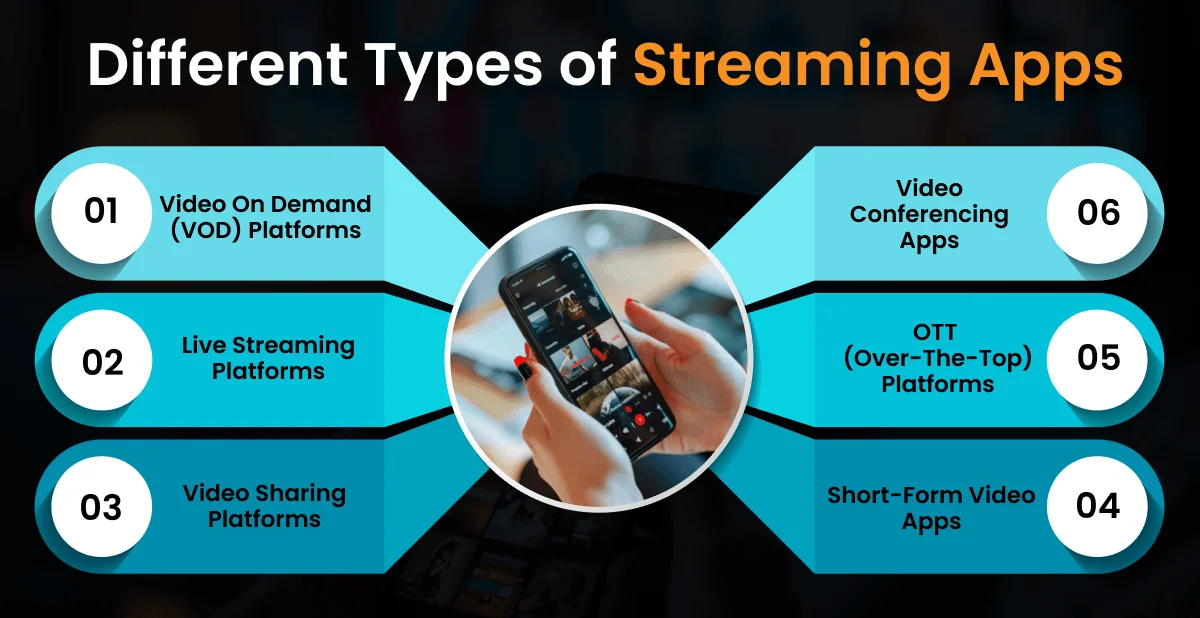
Different Types of Streaming Apps
One should be familiar with or have as much knowledge about the various types in this space before getting into architecture or tech stack. The streaming applications are not all the same, and the type of application you are developing will greatly determine the direction you will take.
Video On Demand (VOD) Platforms
These are the sites where the users have access to recorded content at their own time. The most well-known are Netflix, Amazon Prime Video, and Hulu. The VOD app development is devoted to the content library, recommendation engines, offline watching, and subscription payment. It is your category in case you want to develop an app such as Netflix.
Live Streaming Platforms
Such apps live-stream events, shows, or user-generated content. It emphasizes ultra-low latency, dynamic bitrate delivery, and real-time interaction (chat and reactions) features in its architecture. The popular ones are YouTube Live, Twitch, and Instagram Live.
Video Sharing Platforms
These allow users to upload, discover, and share video material. Video sharing app development involves robust upload pipelines, content moderation, social engagement features, and creator monetization tools. The leading reference is YouTube, although education, fitness, and professional niche platforms are rapidly increasing.
Short-Form Video Apps
The development of short video apps has become an outrageous trend due to the popularity of TikTok, Instagram Reels, and YouTube Shorts. These applications are based on algorithm feeds, super-fast content loops, and ultra-interactive editing features, which are inherent in the application.
OTT (Over-The-Top) Platforms
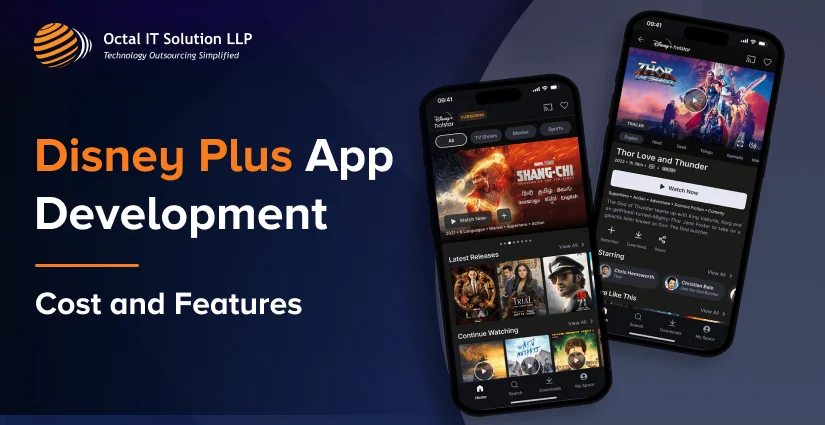
OTT services are meant to stream content directly to the audience through the internet by bypassing conventional cable or satellite. The development of OTT apps integrates both live and on-demand services into one platform. The Disney Plus app development can be regarded as a great illustration of a multi-region, multi-tier OTT platform.
Video Conferencing Apps
The video streaming and conferencing mobile app development is focused on the professional and social communication products such as Zoom, Google Meet, and Microsoft Teams. Conferencing apps, like their counterparts but more oriented towards bidirectional communication, whiteboarding, and collaboration tools rather than passive viewing, are similar in underlying technology.
Key Features to Include in a Video Streaming App
The functionality you develop will decide a lot on how many people will stay with you and how many can be monetized. This is a list of must-have and advanced capabilities, arranged around the development lifecycle.
Core User Features
- User Registration and Profiles: Adding a user through email, using social accounts (Google, Apple, Facebook), and family multi-profile. The combination of profile-level preferences promotes personalization.
- Advanced Search and Filters: Full-text search, genre/category filters, language options, release year, and mood-based discovery. Churn is minimized with a robust search system.
- Recommendations: Machine learning algorithms that recommend content based on viewing history, ratings, and behavioral indicators. It is one of the most powerful retention features that can be created.
- Video Player • Custom or SDK-based, with adaptive bitrate streaming, multiple quality selections, subtitles, user choice of audio track, and accessibility.
- Offline Viewing: Enable users to download content to watch it offline, regardless of being connected to the internet – an essential feature to mobile-first viewers in emergent markets.
- Payment Gateway Integration: Subscription billing, one-time purchases, and rental transactions should be integrated with payment processors, such as Stripe, Razorpay, or PayPal, receipt management flows, and subscription cancellation flows.
Social and Engagement Features
- Live chatting and responses.
- Favorites and watchlists management.
- Keep watching on devices.
- Share to social functionality.
- Ratings and review system
- Push notifications and new content, upcoming events, and personalized suggestions.
Admin and Creator Features
- Media uploading, scheduling, and management in a Content Management System (CMS).
- Create dashboards and analytics of the audience and monetization.
- Live broadcast management with stream key generation
- Moderation tools on user-created content.
- Subscription analytics and revenue analytics.
Key Tech Stack Considerations for Live Streaming App Development
The decision on the appropriate application streaming technologies is also one of the most significant in the development process. Incorrect decisions in this case result in scalability issues, security risks, and technical debts. The following is a breakdown of the layers.
Frontend Development
React Native and Flutter are the most common platforms to be used in cross-platform development. They enable the same codebase to be used to run on both iOS and Android, saving a lot of time and cost in the process. Nativeness in Swift (iOS) or Kotlin (Android) is still the option for applications that need maximum performance and device integration, which is especially important in Android video streaming app development for a premium application.
In the case of web, React.js or Vue.js are the preferred options, normally combined with a video.js or Shaka Player instance to play via the browser.
Backend Development
The non-blocking I/O architecture that is employed in Node.js has made it widely applicable in real-time streaming applications due to its ability to efficiently service multiple connections simultaneously. Go (Golang) is a growing favorite of high-throughput streaming backends as it has a performance profile. Python (Django, FastAPI) can be an excellent solution for analytics work and recommendation systems, as well as content processing flows.
The modern-day standard of any platform that is likely to scale heavily is a microservices architecture managed using Kubernetes and implemented on AWS, GCP, or Azure.
Video Delivery and Hosting
- Streaming Protocols: HLS (HTTP Live Streaming) and MPEG-Dash to support adaptive bitrate delivery; WebRTC to support ultra-low latency live interaction (less than 500ms).
- Transcoding: FFmpeg in the case of self-managed transcoding; AWS Elemental MediaConvert or Mux in the case of managed services.
- CDN: Cloudflare, AWS CloudFront, or Akamai to distribute content globally.
- Storage: AWS S3, Google Cloud storage, or Backblaze B2 for raw and processed data.
Database Layer
- PostgreSQL or MySQL for relational data (user accounts, subscriptions, content metadata)
- MongoDB with adaptable content schemas and user activity logs.
- Redis as a caching, session, and real-time leaderboard service.
- Swift content search and discovery with Elasticsearch.
Security Stack
- Widevine, FairPlay, and PlayReady multi-DRM content protection.
- The authentication and authorization will use JWT (JSON Web Tokens).
- AWS Shield/ Cloudflare in place of DDoS mitigation.
- AES-128 file content and content transit encryption.
Challenges and Solutions in Video Streaming App Development
All the teams that are developing a video streaming app are faced with a set of foreseeable technical and business issues. Being aware of them early enables you to plan resiliency at the very beginning.
| Challenge | Description | Recommended Solution |
| Latency in Live Streams | High latency degrades the live experience — viewers see a 30+ second delay compared to real-time. | Adopt WebRTC for sub-second latency or Low-Latency HLS (LL-HLS) for near-real-time delivery at scale. |
| Video Quality Under Poor Networks | Buffering and quality drops kill user retention on mobile networks. | Implement adaptive bitrate streaming (ABR) that dynamically switches resolutions based on available bandwidth. |
| Scalability During Peak Events | A product launch or live sports event can cause sudden traffic spikes of 10–100x. | Use cloud-based auto-scaling with CDN load distribution. Kubernetes allows horizontal scaling of backend services on demand. |
| Content Piracy and DRM | Unauthorized redistribution of premium content is a critical revenue threat. | Implement multi-DRM (Widevine + FairPlay + PlayReady) with token-based URL signing and forensic watermarking. |
| Cross-Device Compatibility | Users expect seamless experiences across phones, tablets, smart TVs, and browsers. | Build using platform-agnostic streaming protocols (HLS/DASH) and test exhaustively across target device profiles. |
| Monetization Complexity | Supporting SVOD, AVOD, and TVOD simultaneously requires complex billing and access control logic. | Use modular subscription management platforms (Recurly, Chargebee) with flexible entitlement systems. |
| Storage and Bandwidth Costs | Video storage and egress costs scale rapidly as the content library and user base grow. | Use tiered storage (hot/cold), transcode to efficient codecs (H.265/AV1), and negotiate CDN volume pricing. |
Video Streaming App Development Process
This stepwise approach is the key distinction between scaling and struggling products. The following is the overall process that would be undertaken by a professional video streaming app development company.
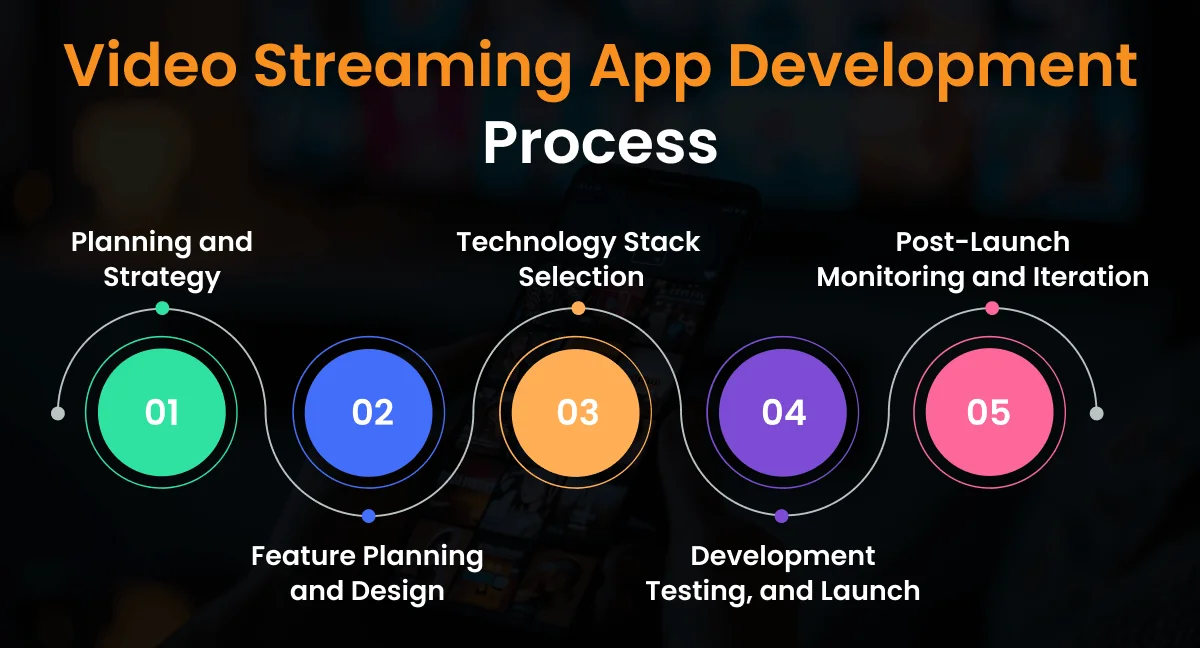
Phase 1: Planning and Strategy
Any good, great product begins with clarity. This stage consists of three workstreams that will run simultaneously:
Define Your Niche and Audience: Are you aiming at sports fans, teachers, gamers, or entertainers? The content partnerships, monetization strategy, and feature priorities are dependent on your niche. Specificity here is to prevent a costly pivot in the future.
Competitor Analysis: Video game platforms such as Netflix, Twitch, Vimeo, and YouTube, and niche platforms in your target vertical. Determine their capabilities, weaknesses, cost, and response. You can use this analysis to inform your differentiation strategy.
Choose Your Business Model: There are three main models to drive the streaming economy:
- SVOD (Subscription Video On Demand): It is a type of subscription where customers pay a subscription fee and can watch as many movies as they want with unlimited access. Even revenue, reduced transaction friction. Most suitable to content libraries and content original platforms.
- AVOD (Advertising-Based Video On Demand): Free access with Advertising revenue. Performs well with content for a large audience. The overpowering example is YouTube.
- TVOD (Transactional Video On Demand): Pay-to-watch or pay-to-rent. Ideal to have new releases, live events, and premium one-time content. It is often implemented in addition to SVOD.
Numerous successful platforms are a combination of various models, such as a free AVOD model with a premium ad-free subscription. The awareness of the OTT revenue model structures at this point would determine your entire technical architecture.
Phase 2: Feature Planning and Design
After deciding on the strategy, the product and design teams determine the precise set of features to be included in the initial release and plot the user experience.
Essential Features for MVP: Registration and profiles of the users, content browsing and search, adaptive video playback, payment integration, and simple analytics. Other characteristics are also given importance in the next releases through offline viewing, live streaming, and creator tools.
UX and UI Design: Streaming apps are successful in terms of discoverability and playability. The design must ensure minimal distance between opening an app and starting a video – two taps are preferable. It should not start by A/B testing the homepage layouts, recommendation surfaces, and onboarding flows after the launch.
Phase 3: Technology Stack Selection
Depending on the product requirements and scale targets, the engineering team completes the entire technology stack. The major decisions like the frontend framework (React Native vs. Flutter vs. native), the backend language and architecture (monolith vs. microservices), CDN and transcoding partners, and database choice will be offered.
Managed services ( Mux, AWS Elemental, Cloudflare Stream) simplify the complexity of infrastructure in teams that are developing their first streaming product. Platforms at scale usually move to customized, cost-optimized pipelines over time.
Phase 4: Development, Testing, and Launch
Build an MVP First: An MVP of a streaming platform would consist of user authentication, content library, and a functioning video player, as well as basic subscription billing. Putting this into the hands of actual users is where feedback loops are received that will feed into every subsequent build sprint.
Rigorous Testing: Video applications need to be tested on dozens of devices with different models, OS versions, screen sizes, and network conditions. The QA cycle should include functional testing, load testing (to simulate concurrent stream events), performance profiling, and security penetration testing before any kind of public launch. The process is applicable when you are creating a consumer OTT application or a video streaming website.
Launch and Marketing: The staged implementation, which is the beta version of the project to select users, followed by a wider implementation, would enable the team to detect the flaws in the infrastructure before it is exposed to all users. Prior to the launch, marketing needs to start with waitlists, content previews, and alliances.
Phase 5: Post-Launch- Monitoring and Iteration
Gather User Feedback: Rating triggers, in-app surveys, and community forums are more likely to reveal product issues compared to an internal testing process. Take feedback as input on the product.
Use Analytics: Video start time, buffering rate, watch-through rate, churn, and feature adoption. Such metrics indicate technical issues (slow start times mean there is a problem with CDN or transcoding) and product issues (high churn due to a particular type of content).
Iterate and Scale: According to data, the next feature set, infrastructure investments, and content partnerships should be given priority. Streaming products are the living ones; the first launch is not the last step in the product development.
Octal IT Solutions’ Live Streaming App Case Study: Connecting People Through Conversations & Live Streaming
Video Streaming App Development Cost
One of the most common questions we receive is about the video streaming app development cost. The frank assessment is that it depends considerably on the scope, team placement, and technology options. This is a realistic breakdown.
Cost by App Type
| App Type | Estimated Cost Range | Key Cost Drivers |
| Basic VOD App (MVP) | $20,000 – $60,000 | Core player, auth, basic CMS, single platform |
| Live Streaming App | $60,000 – $120,000 | Real-time infrastructure, chat, multi-device |
| Full OTT Platform | $120,000 – $300,000+ | Multi-DRM, multi-tier subscriptions, analytics |
| Short-Form Video App | $50,000 – $100,000 | Content feed algorithm, in-app editing tools |
| Video Conferencing App | $70,000 – $150,000 | WebRTC, screen share, multi-party sessions |
Cost by Development Phase
| Phase | Typical Cost Share | Notes |
| Discovery & Planning | 5–10% | Market research, tech architecture, wireframes |
| UI/UX Design | 10–15% | User flows, high-fidelity screens, design system |
| Backend Development | 25–35% | APIs, media processing, CDN integration, database |
| Frontend / Mobile Dev | 25–30% | iOS, Android, or web client development |
| QA & Testing | 10–15% | Device matrix, load testing, security testing |
| Deployment & Launch | 5–10% | Cloud setup, monitoring, CI/CD pipeline |
| Post-Launch Support | Ongoing | Bug fixes, feature updates, infrastructure tuning |
The other factor that impacts cost greatly is geography. In North America or Western Europe, teams cost between $100 and $200 an hour, and in India, where most of the mobile app development services are outsourced, similar quality teams cost between $25 and $60 an hour. Based in India, Octal IT Solution is an enterprise-level delivery model providing competitive rates; it has a global delivery model.
In more detail, those investigating the cost of OTT app development may want to mention that continuing infrastructure expenses (CDN, storage, transcoding) are sometimes as high as development expenses at scale, as high as more than 0.01/l of streaming delivered. A properly planned approach will prevent financial surprises once the operations commence.
How We at Octal IT Solution Can Help You Develop a Live Video Streaming App?
At Octal IT Solution, we are an end-to-end video streaming application development company that has a portfolio of OTT platforms, live sports broadcast apps, creator monetization tools, and enterprise communication platforms. We have in our ranks mobile engineers, backend architects, DevOps experts, and UX designers who have worked on and developed streaming products and have scaled them in several verticals.
What We Bring to Your Project
- Platform Expertise: Whether you want to develop a video streaming app like Vimeo, launch a Twitch app clone development, or build a niche educational streaming product, our team has direct, hands-on experience with the patterns and pitfalls of each platform type.
- Proven Tech Stack: We work with the application streaming technologies that power today’s best platforms, React Native, Node.js, WebRTC, HLS, Kubernetes, AWS/GCP, and multi-DRM security frameworks.
- Scalability by Design: We architect for the audience you are building toward, not just the audience you have on day one. Auto-scaling infrastructure, efficient transcoding pipelines, and CDN integrations are built in from the start.
- Dedicated Hire Models: Need to augment your internal team? We offer flexible engagement models where you can hire mobile app developers on a dedicated or part-time basis.
Our Service Offerings
- OTT app development: End-to-end development of subscription and ad-supported video applications.
- YouTube app development: Upload pipe, analytics, and monetization creator-facing platforms.
- Media app development: Digital asset management, content delivery, and broadcast integration.
- Disney Plus app development: Multi-region, multi-language, and multi-tier subscriptions, Enterprise OTT.
- Short video apps development: TikTok-like platforms with an algorithmic feed and in-app creation features.
- Video conferencing app development: WebRTC-based video communication solution development.
Why Partner with Octal IT Solution?
We realize that a decision on a development partner is a high-stakes one. We are their preferred vendor because we do not only provide the same technical expertise as others, but we also communicate honestly and tell you what is doable, what will cost more than you might assume, and where we can save a few dollars, but do it at your expense of you in the long term.
Our video streaming OTT development teams have provided products with millions of simultaneous users, and this production experience, which we have, is transferred to each new engagement, no matter the size of the project. Whether you are starting with a concept that you need validated or a global platform that is fully developed, our process is scaled to your expectations and budget.
When you are willing to create a product out of your idea, contact us, and we will offer a free technical consultation. We will take you through your specifications, give you pertinent case studies, and provide you with a realistic scope, schedule, and cost estimation.
Final Thoughts
The streaming industry has not yet reached the maturity stage. Consumer expectations are increasing, new niches are being created, and the technical world is changing – AV1 codecs are being embraced, AI-driven content recommendations are on the horizon, and immersive VR streaming is being developed. This is the best time to invest in developing a video streaming app.
This space is not only about technology, but it is about knowing your audience, making the right business model, and developing and doing it with the discipline to iterate on what you are doing based on actual user behavior. The winning platforms are those that trade between technical excellence and product innovations.
The roadmap in this guide provides you with the base, whether you are a first-time founder reviewing your first build or a modern media company that is updating a precedent platform. And when you are set to construct, Octal IT Solution is there to assist you to reach your- strategy to launch and even further.
 By
By February 14, 2025


 Latest Stories
 Get in Touch