


Introduction
Every few years, a technology changes how startups build and grow. Blockchain is now transforming businesses across industries. What started as the engine behind Bitcoin has just grown into a tool that powers finance, healthcare, gaming, and the supply chain. Startups no longer ask if blockchain is profitable. They ask where they should apply it first.
This change is not always just hype. Billions of dollars are invested in blockchain projects every year, and new blockchain use cases are becoming compliant with industry regulations. For founders, this means a real opportunity. The hardest part is choosing the right blockchain app ideas before you start building.
That’s what this guide is for. We will walk through practical, revenue-ready ideas for blockchain apps across 8 industries. Each comes with a simple use case, a revenue model, and a concrete ROI approach. After this, you can decide your fit before investing a single rupee or dollar.
Once you’ve chosen an idea, the next step is to execute it. That’s where experienced blockchain app development services make the difference between a great idea and a working product.
What is Blockchain: A Simple Explanation
Blockchain is a digital ledger. Instead of sitting on a company’s server, it’s copied across thousands of computers. Each entry, called a transaction, gets locked into a “block”. The pieces are linked together to form a secure chain, as it were. Once a piece is delivered, it cannot be quietly changed or deleted.
This configuration gives blockchain three features that organizations care about. The first is transparency, then security, and third is trust beyond the intermediary. Healthcare providers can verify that the medical record has not been changed. A bank can process a payment without waiting 3 days. The retailer can prove a product’s origin instantly.
Blockchain also helps businesses reduce operational costs. This removes the need for a trusted third party to verify every transaction. Rather than paying banks, lawyers, or auditors to verify that something has happened, the blockchain itself becomes the proof. For startups, that means reduced costs and faster operations from day one.
Most blockchain app development platforms are built on Ethereum, Solana, Polygon, and Hyperledger. So, founders rarely want to build core infrastructure from scratch.
Blockchain Market Stats You Should Know
The numbers make the opportunity easier to see. Here’s where the blockchain industry stands heading into 2026:
- The worldwide blockchain technology market is valued at roughly 54.08 billion USD in 2026 and is estimated to reach 610.96 billion USD by 2031, growing at a CAGR of 62.4%. The important drivers of this growth are banks, supply chain companies, hospitals, and government bodies.
- Funding for blockchain startups is rapidly declining. In 2025, total funding was $14.8 billion, more than double the previous year, according to PitchBook information.
- Blockchain startup funding is growing rapidly. Total funding reached $14.8 billion in 2025, more than double the previous year, according to PitchBook data.
- 88% of DeFi businesses captured the largest share of that investment, while blockchain infrastructure businesses took the second-largest share at 23%.
Simply put: Buyers are actively investing in blockchain application ideas that solve real business problems, not just speculative token projects.
Despite being ahead of the curve, tracking blockchain trends before they go mainstream is the way to go. For this reason, early adopters in each category tend to capture the most market share.
Why Invest In Blockchain Application Ideas
Before we get to the ideas themselves, here’s exactly why the founders are betting on blockchain right now:
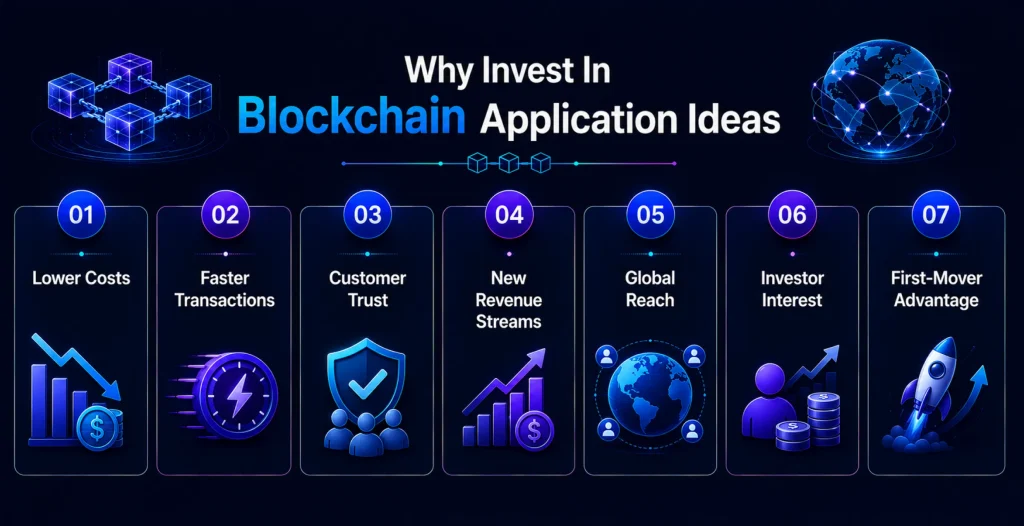
1. Lower Operating Cost
Smart contracts remove manual paperwork, middlemen, and repetitive verification steps.
2. Faster Transactions
Payments, approvals, and report updates that took days can now be viewed in minutes.
3. Stronger Trust With Customers
Every transaction is visible and cannot be changed in secret, which builds trust quickly.
4. New Revenue Models
Tokenization, subscriptions, and transaction costs open up profit streams that traditional apps can’t provide.
5. Global Reach from Day One
A blockchain app idea can serve users anywhere when there is no banking infrastructure nearby.
6. Investor Appetite is High
With funding up sharply year-over-year, well-positioned startups have real access to capital.
7. The First-Mover Advantage Still Exists
Many industries have started using blockchain, making room for early participants.
Planning around blockchain app development cost is easier now. With more skilled teams in the market, founders can budget accurately, instead of guessing.
Top Block App Ideas for Startups: Use Case, Revenue Models & ROI
This is the core of this guide. Below are proven ideas for blockchain apps.
Organized through industries, each using practical use cases, examples, revenue models, and an ROI mindset. And if you need examples of blockchain app use cases that delve beyond this list, our team is happy to walk you through more examples.
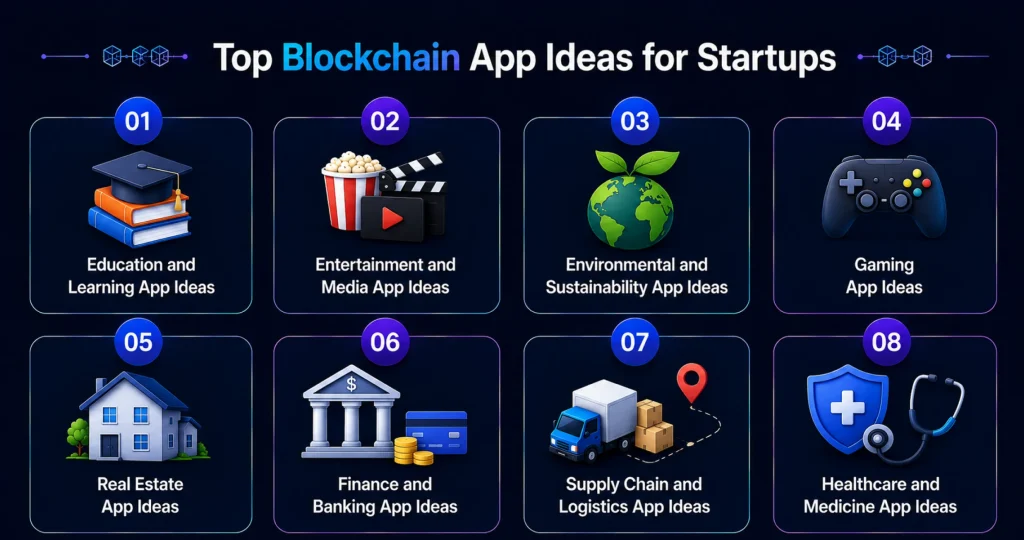
Top Education and Learning App Ideas
- Certification Verification Platform
Store degrees and certifications on the blockchain so that each person can verify them immediately.
Use Case: Universities and employers verify credentials by calling the issuing school.
Revenue Model: Per-certification rate charged to employers or groups.
ROI: High because authentication fraud is common, and organizations are willing to pay to prevent credential fraud.
- Decentralized Course Marketplace
Educators can sell courses directly to learners through crypto-payments, without platform lock-in.
Use Case: Freelance tutors will not lose large fees to global university students.
Revenue Model: Low transaction costs on each course sale.
ROI: Moderate to high, with high-quality content that connects deeply with the instructor.
- Micro Certificate Application
Issue an NFT-based badge for full skills that can be stacked directly onto a verified learner profile.
Use Case: Hiring managers mainly show evidence of detailed skills instead of a traditional resume.
Revenue Model: Membership fees for the organization that issues the badge
ROI: Strong in corporate training and transformation markets.
- Anti-Plagiarism Research Registry
Store research papers on the blockchain to prove original authorship.
Use Case: Universities protect students’ and faculty’s research from duplication claims.
Revenue Model: Annual license fees paid by institutions.
ROI: Consistent, driven through academic integrity requirements.
- Scholarship Disbursement Platform
Automate scholarship payment through smart contracts tied to attendance or grades.
Use Cases: NGOs and donors provide a way to track exactly how education budgets are spent.
Revenue Model: Platform fee charged to donor organization.
ROI: High trust value, appealing to grant-funded applications.
Top Entertainment & Media App Ideas
- NFT Event Ticket Application
Issue tickets as NFTs to eliminate scalping and fake tickets.
Use Case: Concert and event organizers support verifiable, resale-controlled ticketing.
Revenue Model: Percentage cost of primary and resale ticket transactions.
ROI: High, as ticket fraud losses are a well-documented corporate problem.
- Royalty-Transparent Music App
Track song streams on-chain so artists can see exactly what they are owed.
Use case: Independent musicians get paid without waiting for label reports.
Revenue Model: Small cut of streaming or download revenue.
ROI: Strong appeal among independent artists tired of opaque royalty systems.
- Fan-Funded Content Platform
Producers can raise funds from fans in exchange for access or early profits.
Use Case: Filmmakers or podcasters finance operations without studio support.
Revenue Model: Platform cost per investment campaign.
ROI: Average, based on the creator’s audience size.
- Creator Collectibles Marketplace
Sell limited digital collectibles linked to shows, creators, or franchises.
Use Case: Fans buy established, tradable virtual memorabilia.
Revenue Model: Commission on each marketplace sale.
ROI: High, easy, long-term for the duration of the launch promotion.
- Content Authenticity App
Watermarking and timestamping of media documents to demonstrate originality and fight piracy.
Use Case: News organizations and studios show that content has not changed.
Revenue Model: B2B licensing for media houses.
ROI: Demand is growing as concerns about deepfakes increase
Top Environmental and Sustainability Ideas
Sustainability teams are building app ideas using blockchain to verify their ESG claims are real, and not just marketing claims.
- Carbon Credit Trading Market
Groups buy, sell, and retire proven carbon debt securely.
Use Case: Companies meet ESG goals with a clear, auditable carbon credit.
Revenue Model: Transaction fee for every carbon credit trade.
ROI: Very high, as carbon markets are estimated to grow to more than $120 billion.
- Peer-to-Peer Energy Trading App
Allow homes with solar panels to sell excess energy directly to neighbors.
Use Case: Communities reduce reliance on centralized energy grids.
Revenue Model: A small fee per energy transaction.
ROI: Moderate, most effective in areas of high solar use and adoption.
- Recyclable Rewards App
Reward users with tokens for approved recycling activities.
Use Case: Municipalities increase recycling spending through gamified incentives.
Revenue Model: Government or token support contract.
ROI: Medium, best suited for public-private partnerships.
- Ethical Source Tracker
Trace ingredients from bottom to shelf to demonstrate ethical sourcing practices.
Use Case: Fashion and food brands demonstrate that they provide sustainable supply chains.
Revenue Model: Subscription pricing per brand or supplier network.
ROI: High, as consumers increasingly demand transparency in sourcing.
- ESG Reporting and Verification App
Provide a tamper-proof way for companies to establish a sustainability charter.
Use Case: Investors evaluate ESG standards before investing.
Revenue Model: Annual SaaS subscription for groups.
ROI: High as ESG reporting mandates expand globally.
Top Gaming Application Ideas
- In-Game Asset Market
Players must purchase, contribute, and modify in-game items certified as NFTs.
Use Case: Players own digital assets with real-world value.
Revenue Model: Commission per usage change.
ROI: Strong in games with large, engaged communities.
- Cross-Game Asset Platform
Allow items purchased in one game to be used or traded in another game.
Use Case: Studios partner to increase player retention in titles.
Revenue Models: Licensing fees between partnered game studios.
ROI: Advanced opportunity, high upside for early adopters.
- Esports Tournament & Betting App
Run clear, proven fair tournaments with on-chain prize pools.
Use Case: Esports organizers avoid disputes over prize money.
Revenue Model: Participation fees and percentage of profits.
ROI: High in regions with a strong esports tradition.
- Play-to-Earn Game Platform
Reward players with tradable tokens for in-game achievements.
Use Case: Casual gamers earn real income through gaming.
Revenue Models: Market costs and in-game purchases.
ROI: High potential, although it depends closely on game quality and retention.
- Gaming Guild Management App
Help gaming guilds manage shared assets and revenue splits transparently.
Use Case: Guild leaders distribute play-to-earn income fairly among members.
Revenue Model: Small management fee on distributed profits.
ROI: Average, growing along with play-to-earn adoption.
Top Real Estate App Ideas
Real estate is one of the most significant areas for app ideas for blockchain. Since ownership and title records are slow and paper-heavy.
- Property Tokenization Platform
Divide property ownership into tradable digital tokens.
Use Case: Small investors buy fractional shares in high-value properties.
Revenue Model: Fees from token issuance and secondary trading.
ROI: High, starting real estate investing for a much broader target audience.
- Smart Rental Agreement App
Automated rent collection and lease terms through smart contracts.
Use Case: Landlord reduces disputes and overdue bills.
Revenue Model: Monthly SaaS fees aligned with indexed assets.
ROI: Stable, appealing for asset managers with more than one unit.
- Title Verification Platform
Record property titles on-chain to prevent fraud and duplicate claims.
Use Cases: Buyers verify property titles before finalizing a deal
Revenue Model: Per transaction confirmation fee.
ROI: High, since title fraud remains a high-value, ongoing problem.
- Real Estate Crowdfunding App
Pool small investments from multiple users to finance property purchases.
Use Case: Retail buyers have access to commercial real estate deals.
Revenue Model: Percentage fee of funds raised.
ROI: Strong, especially in high-growth urban markets.
- Escrow-Enabled Property Marketplace
Hold funds in a smart contract until all sale conditions are met.
Use Case: Buyers and sellers complete transactions outside of a traditional escrow agent.
Revenue Model: Transaction interest instead of traditional escrow fees.
ROI: High, because it completely removes a costly middleman.
Top Finance & Banking App Ideas
- Blockchain-Powered Neobank
Offers digital banking services with blockchain-based contracts downstream.
Use Case: Underbanked customers have access to accounts without a physical branch.
Revenue Models: Interchange fees and premium account tiers.
ROI: High because the neobanks are replacing traditional retail banking.
- Peer-to-Peer Lending App
Match lenders and borrowers directly using smart contract terms.
Use Case: Small businesses get loans without heavy bank paperwork.
Revenue Model: Origination fees plus spread on interest.
ROI: Strong, especially in underserved credit markets.
- Cross-Border Remittance App
Send global payments instantly at a fraction of the bank fee.
Use Case: Migrant workers send money home without high wire costs.
Revenue Model: Small percentage fee per transfer.
ROI: Very high given the size of the global remittance market.
- Stablecoin Payment Gateway
Give merchants access to stablecoin invoices with instant settlement.
Use Case: E-commerce store avoids card processing delays and fees.
Revenue Model: Transaction fee per payment processed.
ROI: High because stablecoin adoption in retail is fast.
- Tokenization Investment Advisory App
Offers robo-advisory app services backed by tokenized assets and a portfolio.
Use Case: Retail investors have access to various portfolios with low minimums.
Revenue Model: Annual management fees for assets under management.
ROI: Moderate to high, tied to specific market trends.
Top Supply Chain & Logistics App Ideas
- Product Provenance Tracker
Tracks the entire journey of a product from the factory to the buyer.
Use Case: Shoppers explore the authenticity of luxury goods or food items.
Revenue Model: Subscription fee per brand or manufacturer.
ROI: High, especially in industries plagued by counterfeits.
- Smart Freight Tracking App
Automatic shipment payment once delivery conditions are checked on-chain.
Use Case: Freight business reduces price disputes and delays.
Revenue Model: Transaction fees per shipment.
ROI: Strong, given the current level of high-value logistics disputes.
- Cold Chain Monitoring Platform
Monitoring temperatures and handling conditions for sensitive shipments.
Use Cases: Pharma and food companies show that the product stayed within safe limits.
Revenue Model: SaaS fees per controlled shipment.
ROI: Very high, since spoiled shipments result in significant financial losses.
- Supplier Verification App
Verify supplier certifications and compliance records on the blockchain.
Use Case: Manufacturers avoid working with non-compliant vendors.
Revenue Model: Annual license price tailored to the agency customer.
ROI: Steady, increasing with global compliance guidelines.
- Blockchain Inventory Ledger
Maintain a shared, tamper-proof inventory ledger between multiple partners.
Use Case: Vendors and suppliers avoid stock inconsistencies.
Revenue Model: Monthly platform membership per warehouse.
ROI: Moderate, most powerful in multi-partner supply chains.
Top Healthcare & Medicine App Ideas
Hospitals and pharma organizations are testing app ideas on blockchain to endorse longstanding data and address problems.
- Patient Health Record App
Give patients a portable, secure record shareable across providers.
Use Case: Patients switch doctors without losing medical history.
Revenue Model: Licensing fee for hospitals and clinics.
ROI: High, as interoperability remains a major pain point in healthcare.
- Drug Traceability Platform
Track drugs from manufacturer to pharmacy to prevent counterfeiting.
Use Case: Pharmacies verify drug authenticity before dispensing medicine.
Revenue Model: Per-unit tracking fee paid by the manufacturer.
ROI: Very high, given the scale of international counterfeit drug losses.
- Insurance Claim Automation App
Auto-validate tangible claims through smart contract rules.
Use case: Patients get faster reimbursements with less paperwork.
Revenue Model: Per-claim processing fee charged to insurers.
ROI: Strong, due to claims processing costing insurers heavily today.
- Secure Telemedicine App
Enables remote consultations with encrypted, blockchain-secure data sharing.
Use Case: Rural patients have access to specialists without traveling outside.
Revenue Model: Per-session fee or subscription plan.
ROI: High, especially for underserved areas with limited access to specialists.
- Medical Supply Chain Tracker
Monitor the movement of clinical devices and substances in real time.
Use Case: Hospitals can monitor supplies in real-time to avoid shortages.
Revenue Model: SaaS fee per facility network.
ROI: Moderate to high, proven valuable during supply shock.
How Octal IT Solution Can Help You Build a Blockchain Application
Choosing the appropriate idea is simply half of the process. Here’s why Octal IT Solution is the right partner to build it:
Proven Delivery Across Industries
We’ve delivered apps to fintech, healthcare, gaming, and supply chain. So we understand the unique needs of each business.
Flexible Technology Choices
Whether you want Ethereum, Solana, Hyperledger, or Polygon, our team will build a blockchain solution that fits your needs.
Clear Upfront Pricing
Our team scopes projects from day one. So, there are no surprise payments mid-development.
Hands-on Blockchain Consulting Services
Before writing a single line of code, our blockchain consulting services help you validate your idea. The team will help you understand your revenue model and target market.
A Team That Stays Up-to-Date
Our developers use new tools and standards, so your app stays aligned with modern blockchain standards.
Octal IT Solution is a trusted name among blockchain development firms. Startups and enterprises alike choose us for reliable delivery and long-term support.
If you already have one of the ideas above in mind, our team can turn it into a working product without guessing.
Final Thoughts
Blockchain has passed the hype stage. It is now a real, practical tool that solves real problems in several industries. Startups profiting in this space don’t follow the trends. They choose a focused idea, validate the demand, and build with the right technology partner.
Any concept from this guide fits your vision, the opportunity is real, and the market is ready. The only question left is which one to build first.
Read More : best blockchain development companies in uk


 Get in Touch
 By
By September 8, 2026