



Key Takeaways
- The blog shows how digital transformation in banking creates complete changes to the financial system.
- The banking digital transformation process has reached its current status because modern financial institutions consider it their most vital business requirement.
- This blog presents key advantages that include faster service delivery, better security measures, AI-based process automation, and improved customer satisfaction.
- This guide identifies some main challenges which organizations face when implementing digital transformation from their existing systems to compliance difficulties and increasing transformation expenses.
- It covers current digital banking technologies that banks use to achieve digital transformation through AI, cloud computing, and blockchain technology.
- The study explains different implementation methods while predicting upcoming banking developments that will happen after 2026.
Introduction
Have you ever considered the ways that banking systems throughout the world are changing their operations? The finance industry requires more than physical bank locations and traditional document processing because modern customers expect their financial needs to be met through instant and accessible intelligent solutions. The banking industry needs to implement digital transformation as its primary growth strategy because it has become essential for maintaining its competitive edge.
According to VerifiedMarketResearch, the worldwide market of digital transformation in banking has reached explosive growth, which forecasts that digital transformation across the financial services sector will exceed double its current value of approximately 710 billion dollars in 2024 to attain 1.37 trillion dollars by 2032 with a 9.2% compound annual growth rate.
The BFSI digital transformation market will achieve a market value of 31067 billion dollars by 2032 because organizations worldwide are moving to digital-first business models. The blog explains why this shift is important by presenting its benefits, challenges, and showing effective methods to handle it according to the current revolution in digital banking.
What is Digital Transformation in Banking?
Digital transformation in banking involves transforming traditional banking systems through the implementation of advanced technologies, which include AI, cloud computing, automation, and data analytics. The system transforms operations while creating better customer experiences and providing better security protection.
The digital transformation banking industry requires institutions to move from their current state of minimal banking digitalization to achieve total modernization of both their operational activities and strategic business plans.
The Importance of Digital Transformation in Banking
- Through its mobile and online services, the system provides customers with an effortless experience.
- Banking digital transformation enables organizations to achieve better operational performance through automated systems, which decrease their need to use manual work.
- The system establishes better methods for detecting fraud and protecting against cyber threats.
- The system provides organizations with the ability to make their financial services smarter through data analysis.
- The digital transformation financial industry uses the system to build new products while maintaining its market position.
Why is Digital Transformation in Banking and Finance Gaining Popularity?
Why do banks need to adopt digital-first models at such a fast pace? Digital transformation in banking develops rapidly because customers have higher expectations, fintech companies present more competition, and technology advances quickly throughout both retail and commercial banking sectors worldwide.
Key Reasons Behind the Growth:
- More than 75% of worldwide banking customers now prefer digital channels, which they use to access banking services rather than visiting physical bank locations.
- The retail banking industry now shows 80% more people using digital banking services than it did in 2025, which has compelled banks to implement digital banking solutions.
- Commercial banks achieve operational cost reductions between 20% and 30% of total expenses through the implementation of AI-based automation technologies in their digital transformation projects.
- Financial institutions need to update their outdated systems because they face rising cybersecurity threats.
- Banks can develop new products more quickly through the combination of open banking and API ecosystems.
- Organizations need to maintain ongoing compliance with the regulatory framework, which mandates them to provide unrestricted access to their data.
Generative AI in Banking is very helpful because it improves customer service fraud detection systems and personalized financial advisory services.
Key Benefits of Digital Transformation in Banking
Digital transformation in Banking enables financial institutions to achieve their objectives while delivering better customer service.
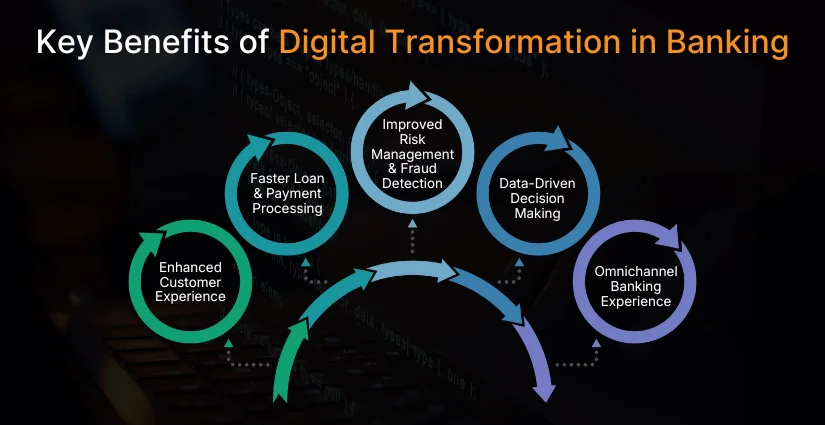
1. Enhanced Customer Experience
The digital banking transformation process creates personalized banking experiences that provide users with immediate assistance during their mobile activities and deliver better customer satisfaction results across all channels.
2. Faster Loan & Payment Processing
The banking industry uses automation and AI technologies to enhance its operational processes which results in faster loan processing times that decrease from multiple days to just a few minutes.
3. Improved Risk Management & Fraud Detection
Financial services organizations use advanced analytics together with AI-based monitoring systems to better their fraud detection abilities while decreasing financial threats and achieving their required regulatory standards during their digital change initiatives.
4. Data-Driven Decision Making
Real-time analytics enable banks to study customer behavior while they use precise financial data to forecast future digital banking trends and choose their tactical moves.
5. Omnichannel Banking Experience
The integrated platforms provide uninterrupted banking services across mobile and web and branch locations to create an uninterrupted banking and digital transformation process.
Major Challenges of Banking and Digital Transformation
Digital transformation presents vital importance for banking operations, yet financial institutions experience multiple operational, technical, and cultural barriers that block their digital transformation progress.
1. Legacy Systems & Infrastructure Issues
The existing core banking systems do not support digital transformation because their outdated nature restricts system expansion, system linkages, and system development across essential transformation areas.
2. High Implementation Costs
The implementation of technology upgrades, together with the process of cloud migration and Digital Transformation Services requires businesses to spend substantial amounts of money at their initial stage while also needing to allocate resources for an extended time period.
3. Regulatory Compliance Complexity
The requirement for financial institutions to track and store data and generate reports about shifting financial regulations creates challenges for their digital transformation initiatives.
4. Cybersecurity & Data Privacy Risks
The higher digital usage by banks makes them vulnerable to various cyber threats and data breaches, and the enforcement of strict global privacy laws.
5. Cultural Resistance & Skill Gaps
The combination of worker opposition to organizational change, together with the insufficient availability of digital professionals, creates obstacles that hinder organizations from achieving modernization while they seek to implement new innovations.

Step-by-Step Digital Transformation Process in Banking
Digital transformation in banking requires structured procedures, enabling them to update their operations while enhancing customer satisfaction through digital transformations that occur without affecting their fundamental banking functions.
Step 1: Assess Current Digital Maturity
Organizations need to evaluate their existing systems together with customer pain points, security systems, and business operations to determine their improvement needs and development opportunities.
Step 2: Define Vision & Strategy
The Digital transformation company needs to develop a comprehensive plan that shows how business objectives, compliance requirements, and core banking transformation projects will be executed throughout the upcoming years.
Step 3: Choose the Right Digital Transformation Solution
The organization needs to select technologies that can scale and automation solutions, and Digital Banking Application Development platforms, because these solutions match their specific requirements.
Step 4: Partner with a Digital Transformation Company
The organization should work together with a Digital transformation company that has experience and IT consultant Services partner to receive strategic direction and accomplish successful project delivery.
Step 5: Implement Digital Transformation Services
Our organization will implement Digital Transformation Services through the deployment of cloud systems, AI technologies, and automation systems.
Step 6: Monitor, Optimize & Scale
The organization uses two strategies, which involve performance tracking and digital platform optimization to achieve ongoing development and sustain its market edge.
Digital Banking Trends Shaping the Future of Financial Services
The financial ecosystems experience transformation through advanced technological progress, together with higher customer expectations, which prompt banks to undergo changes while their traditional business operations face disruption throughout worldwide markets.
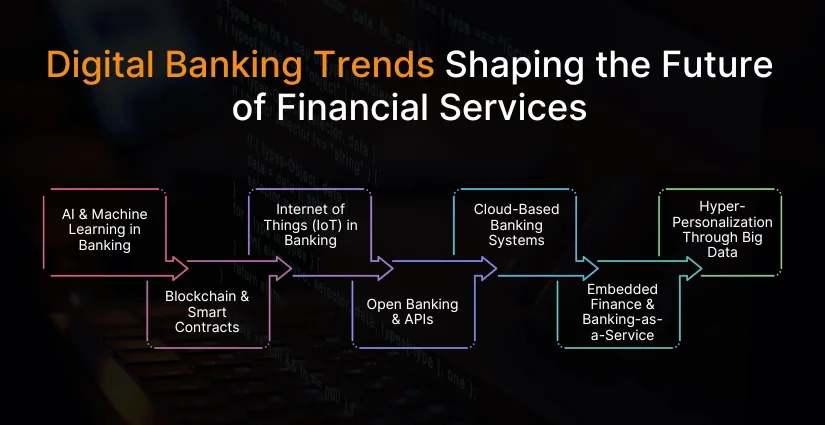
1. AI & Machine Learning in Banking
The implementation of AI in Digital Transformation processes enables banks to improve their fraud detection systems and credit scoring methods, while their retail operations and investment banking digital transformation efforts benefit from enhanced automation and predictive analytics capabilities.
2. Blockchain & Smart Contracts
The use of blockchain technology enables organizations to achieve better transparent operations while decreasing their transaction costs. The technology also provides organizations with a secure method to develop smart contracts, which they can use for processing international payments and conducting financial settlements.
3. Internet of Things (IoT) in Banking
IoT in Banking and Finance to achieve three main functions that include confirming payments in real time, tracking assets, and delivering customized insurance or lending solutions.
4. Open Banking & APIs
The use of APIs enables banks to work together with fintech companies, which leads to new financial solutions and allows for the smooth integration of third-party banking services.
5. Cloud-Based Banking Systems
Cloud infrastructure allows banks to achieve greater system flexibility because this technology reduces their operational costs and enables better handling of business operations during digital transformation initiatives.
6. Embedded Finance & Banking-as-a-Service
Financial services link directly with non-banking software platforms that help businesses develop new revenue sources while their customers gain easier access to their products.
7. Hyper-Personalization Through Big Data
Banks can use advanced analytics to develop personalized financial products that enhance their customer connections and support their business transformation efforts.

Technologies Driving Digital Transformation in Financial Services
The banking industry uses advanced technological systems to create digital transformation processes that improve its automation capabilities, security measures, system scalability, and customer interaction methods.
Financial institutions use modern technological systems to develop Banking & Finance Solutions, which provide better performance, greater strength, and faster operations during their digital transformation journey.
| Technology | Common Tech Stack / Tools |
| Artificial Intelligence (AI) & ML | Python, TensorFlow, PyTorch, IBM Watson |
| Cloud Computing | AWS, Microsoft Azure, Google Cloud |
| Big Data & Analytics | Hadoop, Apache Spark, Tableau, Power BI |
| Blockchain | Ethereum, Hyperledger, Solidity |
| Robotic Process Automation (RPA) | UiPath, Automation Anywhere, Blue Prism |
| Cybersecurity Technologies | Firewalls, SIEM tools, Multi-Factor Authentication |
| API & Open Banking Platforms | REST APIs, Postman, MuleSoft |
| Internet of Things (IoT) | IoT sensors, Edge computing platforms |
The banking industry uses these technologies to improve its digital transformation process because they enable organizations to create new products while adhering to regulatory standards and running their operations efficiently.
How Much Does It Cost to Build Banking and Finance Apps?
The total development costs for banking and finance applications depend on the specific functions needed, the required security measures, the mandatory compliance standards, and the chosen development team structure.
The digital banking app development cost for basic applications starts at $40,000, while the cost for enterprise banking platforms reaches over $300,000 based on their system complexity and required integrations.
| Role | Estimated Monthly Cost (USD) |
| Project Manager | $6,000 – $12,000 |
| Business Analyst | $5,000 – $10,000 |
| UI/UX Designer | $4,000 – $8,000 |
| Frontend Developer | $5,000 – $12,000 |
| Backend Developer | $6,000 – $14,000 |
| Mobile App Developer | $5,000 – $12,000 |
| DevOps Engineer | $6,000 – $13,000 |
| QA/Test Engineer | $4,000 – $9,000 |
| Cybersecurity Expert | $7,000 – $15,000 |
| AI/ML Engineer (Optional) | $7,000 – $16,000 |
1. Region-Wise Digital Transformation Cost
The different regions experience different cost patterns because of their talent costs, their compliance standards, their infrastructure development status, and their access to Digital Transformation service providers who have expertise.
| Region | Estimated Cost Range (Enterprise-Level Projects) |
| North America | $250,000 – $1,000,000+ |
| Europe | $200,000 – $800,000 |
| Middle East | $150,000 – $600,000 |
| Asia-Pacific | $80,000 – $400,000 |
| Latin America | $70,000 – $300,000 |
2. App Complexity-Wise Cost
The Digital Transformation costs increase with higher app complexity because of the extra costs associated with system integrations and artificial intelligence capabilities, security systems and required regulatory compliance.
| Complexity Level | Estimated Cost |
| Basic Banking App | $40,000 – $80,000 |
| Mid-Level Digital Platform | $80,000 – $200,000 |
| Enterprise Banking Ecosystem | $200,000 – $700,000+ |
3. Factors Affecting Digital Transformation Cost
The primary elements that determine digital transformation expenses for banking projects include technology selection, cybersecurity requirements, system integrations, scalability development, and project customization.
| Cost Factor | Impact Level | Estimated Cost Influence (USD) |
| Technology Stack Selection | High | $20,000 – $100,000+ |
| Security & Compliance Requirements | Very High | $30,000 – $150,000+ |
| Legacy System Integration | High | $25,000 – $120,000 |
| Customization & Features | High | $20,000 – $200,000 |
| Data Migration & Modernization | Medium to High | $15,000 – $80,000 |
| Third-Party API Integrations | Medium | $10,000 – $50,000 |
4. Deployment Model-Wise Cost
The use of cloud services leads to lower infrastructure costs, while organizations that use hybrid systems and on-premise systems must spend more on initial Digital Transformation expenditures.
| Deployment Model | Initial Cost Range (USD) |
| On-Premise Infrastructure | $100,000 – $500,000+ |
| Cloud-Based Deployment | $40,000 – $200,000 |
| Hybrid Model | $80,000 – $350,000 |
5. Engagement Model-Wise Cost
The decision between in-house development, outsourcing services, and collaboration with an Android App Development Company determines both project costs and the ability to expand the project.
| Engagement Model | Estimated Cost Range (USD) |
| In-House Development Team | $150,000 – $500,000/year |
| Outsourced Digital Transformation Partner | $50,000 – $300,000/project |
| Dedicated Development Team | $8,000 – $25,000/month |
| Consulting-Based Model | $10,000 – $50,000 |
6. Technology Stack-Wise Cost
The implementation of advanced technologies such as artificial intelligence and blockchain technology results in higher implementation difficulties, which affect banks’ digital transformation projects that involve their infrastructure spending.
| Technology | Estimated Implementation Cost (USD) | Cost Impact Level |
| Artificial Intelligence / Machine Learning | $30,000 – $200,000+ | High |
| Blockchain Integration | $40,000 – $250,000 | High |
| Cloud Migration | $25,000 – $150,000 | Medium to High |
| Robotic Process Automation (RPA) | $20,000 – $100,000 | Medium |
| Big Data & Analytics | $30,000 – $180,000 | High |
| API & Open Banking Integration | $15,000 – $70,000 | Medium |
Real-Life Examples of Digital Transformation in Banking
The digital transformation of financial services is changing the way institutions operate, innovate, and provide customer service, while the banking industry throughout the world experiences faster digital development.
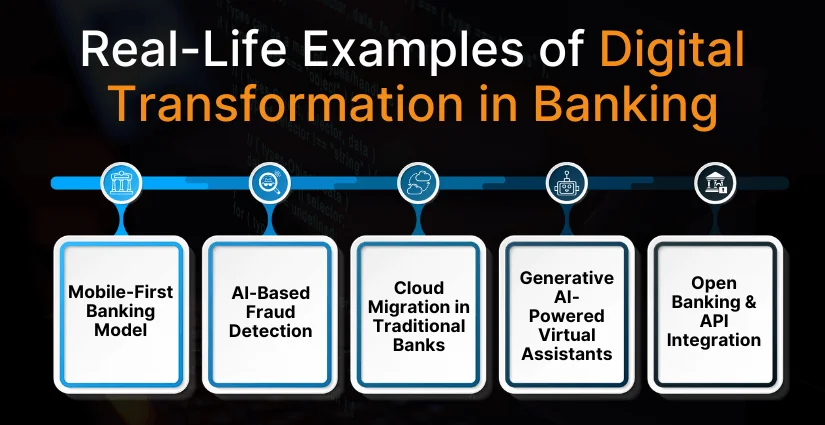
1. Case Study: Mobile-First Banking Model
A bank developed a mobile-first banking solution that allowed customers to open accounts and make payments instantly, and complete digital onboarding. This approach enabled banks to acquire more customers while their digital banking operations advanced through continuous app-based customer interactions.
2. Case Study: AI-Based Fraud Detection
AI/ML with Banking to track transactions throughout the day. The AI-powered system reduced financial losses from fraud by 30% while it improved both compliance accuracy and operational performance.
3. Case Study: Cloud Migration in Traditional Banks
Traditional banks shifted their outdated systems to cloud platforms, which resulted in lower IT costs and better system growth capabilities. Financial services went through a digital transformation because cloud adoption brought better disaster recovery solutions & operational flexibility.
4. Case Study: Open Banking & API Integration
Banks used banking API integration to work with fintech companies that allowed them to deliver embedded finance services that generated additional income streams while providing customers with quick and customized financial solutions.
5. Case Study: Generative AI-Powered Virtual Assistants
AI in Banking to create intelligent chatbots which could answer intricate questions and provide loan assistance and financial planning services to customers, thereby boosting customer interaction while decreasing support costs.
Case studies of Fintech Solutions: One-click payment solutions that make quick and safe transactions
How to Choose the Right Digital Transformation Company?
Successful banking and digital transformation initiatives depend on selecting an appropriate partner. The correct Digital transformation company assists you in developing your strategy while protecting your business from potential dangers and delivering secure and expandable systems that meet your digital banking transformation needs.
Key Factors to Consider:
- You should search for companies that demonstrate successful experience in executing digital transformation projects for financial institutions while meeting banking compliance standards.
- The organization needs to present its collection of completed banking projects and digital transformation initiatives.
- They should provide complete service solutions that include everything from consulting through to product launch and ongoing system support.
- The organization needs to demonstrate its technical capabilities through expertise in cloud technologies, artificial intelligence, cybersecurity solutions, and core banking system upgrades.
- Inquire about their status as an Android App Development Company because it enables them to create mobile banking applications.
- The organization needs to confirm that it provides financial institutions with customized Mobile app development services that can expand according to business needs.
- The organization needs to examine client feedback together with case studies and industry endorsements.
- The organization needs to evaluate three aspects that include how they communicate information to clients, their pricing system, and their capacity to offer assistance over an extended period.
Future of Banking Digitalization: What to Expect Beyond 2026
The future of banking digitalization shows improved intelligence because it operates at higher speeds while delivering better service to customers. Digital transformation in banking services will reshape banking operations because technological progress will enable financial institutions to provide customized services to their clients throughout the world.
What to Expect Beyond 2026:
- AI-powered automation will become more common in retail and investment banking as businesses implement digital transformation projects.
- Integrating Banking APIs into fintech ecosystems will drive the growth of embedded finance throughout the market.
- Investment banking will experience digital transformation through the adoption of advanced analytics and real-time trading systems.
- Biometric security systems and blockchain technology will become more popular for conducting secure financial transactions.
- Financial institutions will develop highly customized financial products through the application of predictive data modeling techniques.
- The industry will develop better digital banking solutions that focus on sustainable and environmentally friendly practices.
- Mobile Money & Agent Banking services will experience rapid growth in developing countries.
- The banking industry worldwide will adopt cloud-native core banking platforms as its new standard.

Final Thoughts
The financial service industry has reached a point where digital transformation activities require immediate implementation because they no longer serve as future development plans. Digital transformation in banking today establishes a new financial ecosystem through its capabilities to enhance customer experience and improve security and operational processes. Digitalization in banking will produce ongoing retail and enterprise innovations because market competition and technological advancements keep progressing forward.
Financial institutions need to adopt modern tools and secure platforms and establish partnerships with suitable technology vendors to maintain their competitive advantage in the market. Banking CRM Software Development solutions enhance customer engagement while collaboration with an experienced Android App Development Company delivers uninterrupted mobile banking services. The banks adopting digital transformation will establish their position as leaders in global finance.


 Get in Touch
 By
By June 5, 2026