


Key Takeaways of Digital Transformation in Healthcare
- Digital transformation in healthcare is no longer experimental; by 2026, it will be a strategic necessity for survival, scalability, and quality care delivery.
- Technologies such as AI, telemedicine, IoT, cloud computing, and blockchain are converging to create connected, data-driven healthcare ecosystems.
- Healthcare providers that invest in automation, analytics, and virtual care can significantly improve outcomes while reducing operational costs.
- Leaders must align digital investments with measurable patient outcomes, regulatory compliance, and long-term business value.
- Digital Transformation in the Healthcare Industry Overview
- What Is Digital Transformation in Healthcare?
- Why 2026 Is a Pivotal Year for Healthcare Digital Transformation?
- How Digital Transformation in Healthcare Is Shaping Modern Medical Systems?
- The Journey of Digitalization in Medical and Healthcare Systems
- What Are the Core Technologies Driving Digital Transformation in Healthcare?
- Key Areas of Digital Transformation in Healthcare Operations
- Benefits and Outcomes of Healthcare Digital Transformation
- Challenges and Risks in Healthcare Digitization
- Future Trends & What to Expect by 2026 and Beyond
- Real-World Use Cases of Digital Healthcare Transformation Solutions
- Our Proven Process for Digital Innovation in Healthcare
- How Octal IT Solution Helps Healthcare Organizations Lead Digital Transformation?
- What Healthcare Organizations Must Do to Stay Ahead by 2026?
- Common Queries About Digital Transformation in Healthcare
Digital Transformation in the Healthcare Industry Overview
The healthcare industry experiences fundamental changes because digital technology progresses rapidly, patient needs evolve, and the demand for affordable, high quality medical services increases. Digital transformation in healthcare now serves as a strategic, vital requirement for healthcare organizations and insurance companies, and technology providers who operate in worldwide markets.
The healthcare systems of 2026 will exceed their existing capabilities through improved system connectivity and enhanced intelligent technologies, and the development of patient centered medical services. The global digital transformation in the healthcare market reached a valuation of approximately USD 87 billion in 2025, which will grow at a compound annual growth rate of 14.6 percent from 2026 to 2033 because virtual care, AI-powered diagnostics, cloud based systems, and interoperable platforms become more widely adopted.
The Rise of Intelligent, Connected, and Patient-Centric Healthcare
The virtual healthcare market, which includes telehealth and remote monitoring services, will achieve a market value of approximately USD 6.96 billion in 2026 because digital tools such as video consultations and wearable technology will help healthcare providers offer better patient care while streamlining their operational procedures.
The 2026 digital transformation services guide for healthcare presents a comprehensive analysis of the complete transformation process, which explains its vital significance and its actual effects. The study shows that 2026 will serve as a critical turning point for the healthcare sector because it demonstrates how digital healthcare solutions enable organizations to achieve better results while they operate more effectively and maintain their industry position in an increasingly digital-centric market.
What Is Digital Transformation in Healthcare?
Healthcare organizations use digital transformation solutions to implement digital technologies, which they use to enhance their medical services, operational processes, and patient interactions with their facilities. The process encompasses more than just transforming physical medical records into digital form and automating back-office functions. Healthcare digital transformation seeks to develop new operational systems and medical treatment methods that depend on intelligent interconnected data systems.
Healthcare organizations use digital transformation to implement multiple technologies, which include electronic health records (EHRs) and telemedicine platforms, artificial intelligence (AI), cloud computing, and Internet of Things (IoT) devices, and advanced analytics. The technologies provide healthcare professionals with immediate access to patient information, deliver predictive tools for making clinical decisions, and permit ongoing patient contact through various channels.
Why 2026 Is a Pivotal Year for Healthcare Digital Transformation?
By 2026, healthcare digital transformation will become a necessity as organizations adopt connected, data-driven systems to improve efficiency, patient outcomes, and care delivery. Advances in AI, cloud, and interoperability are driving the shift toward predictive, value-based, and patient-centric healthcare models.
Digital Integration
Healthcare organizations are moving beyond isolated digital tools toward fully integrated systems that optimize clinical, administrative, and operational workflows for improved care delivery.
Data-Driven Decisions
Advanced analytics enable organizations to redesign workflows, improve care coordination, and support faster, more accurate clinical decisions across departments.
Connected Healthcare Ecosystems
Healthcare systems now support secure, real-time data exchange between providers, patients, payers, and partners, enabling continuous patient engagement and coordinated care.
Advanced Tech Adoption
Electronic health records (EHRs), telemedicine software development, AI-powered diagnostics, cloud computing, remote patient monitoring, and advanced analytics become standard components of modern healthcare systems.
Workforce Transformation
Digital success depends not only on technology but also on transforming organizational culture, upskilling employees, and redefining operational processes.
Leadership-Driven Transformation
Healthcare organizations prioritize governance frameworks and leadership alignment to ensure scalability, compliance, and long-term success of digital initiatives.
How Digital Transformation in Healthcare Is Shaping Modern Medical Systems?
The development of digital healthcare has progressed through three forces, which include technological improvements, policy changes, and new methods of providing medical services. The first stage of medical digitalization included hospital information systems, billing software, and electronic documentation as tools to improve administrative operations through digital technology, thereby replacing paper-based documentation.
The world of healthcare evolved with the introduction of electronic health records, which became the fundamental element for both healthcare systems and information technology developments. Through EHR adoption, healthcare organizations achieved three benefits, which included centralized patient data storage and record-keeping improvement, and better clinician collaboration. The first digital systems that were developed at that time operated as separate systems, which made it difficult to provide complete patient care because they could not share information.
The Journey of Digitalization in Medical and Healthcare Systems
Digital transformation in healthcare has revolutionized manual and conventional approaches to a system that is interconnected and driven by data.
- Conventional systems operated using manual processes, face-to-face consultations, and independent record-keeping
- Digitization allows for remote consultation and mobile access to medical information
- Medical professionals can now consult patients remotely and give them access to their medical records anytime
- Digitization improves efficiency and decision-making through automation and electronic diagnosis
- Digital transformation promotes collaboration and improved patient outcomes
- Adoption of data-driven and patient-centered care delivery systems
- By 2026, digitally mature entities will dominate the healthcare industry
How Data and Interoperability Are Transforming Healthcare?
- Digital healthcare transformation enables intelligent data systems and optimized data storage
- Advanced analytics, cloud, and AI turn data into actionable insights
- Shift from reactive care to predictive, preventive healthcare models
- Key drivers by 2026: interoperability, real-time data sharing, automated decisions
- Healthcare evolving into connected ecosystems (patients, providers, payers, tech partners)
- The rise of healthcare app development services supports value-based care, personalization, and continuous engagement
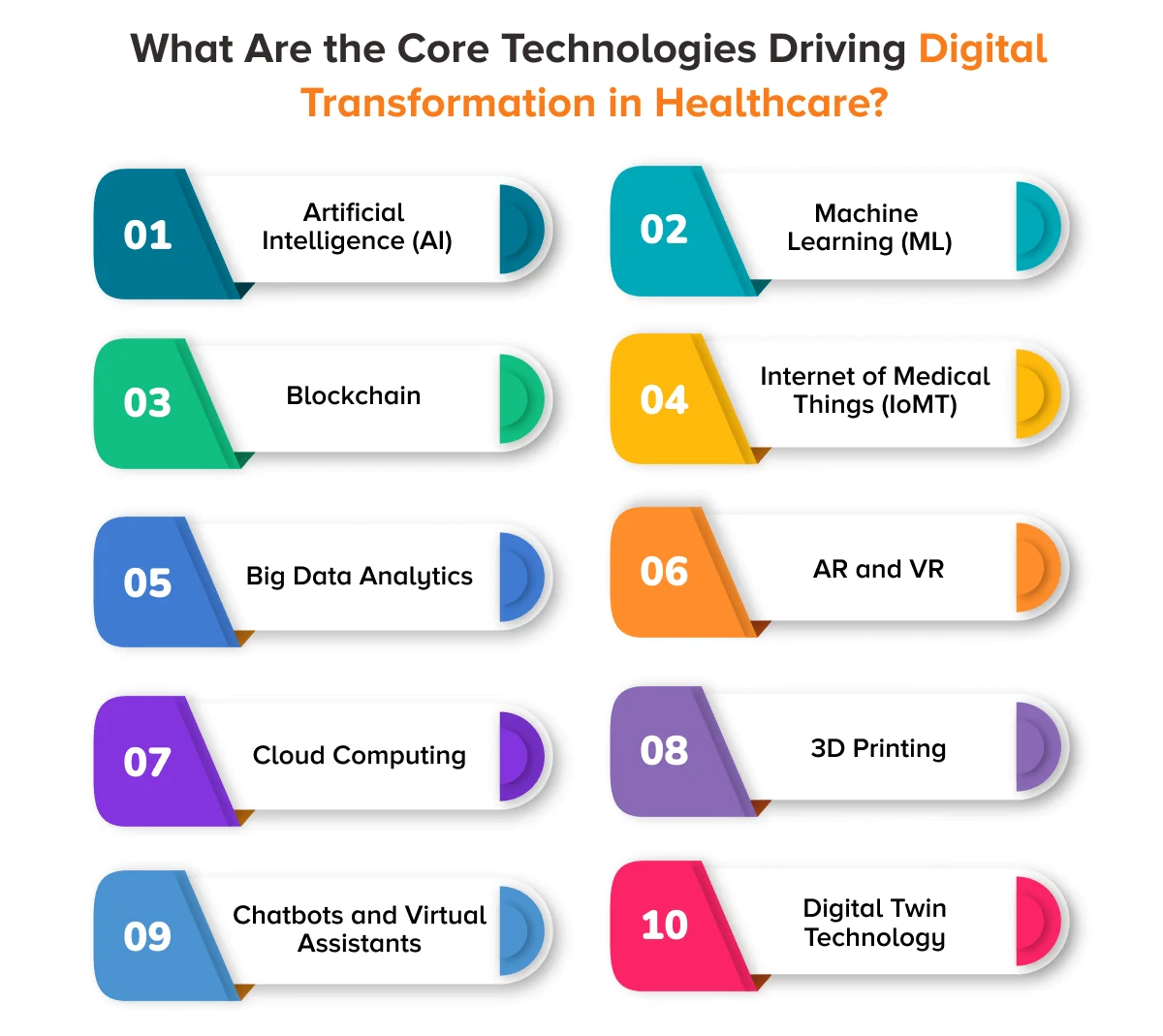
What Are the Core Technologies Driving Digital Transformation in Healthcare?
Core technologies such as artificial intelligence (AI), machine learning (ML), IoT-enabled medical devices, blockchain, cloud computing, and immersive tools like AR/VR enable secure data management, predictive analytics, personalized care, and seamless collaboration across healthcare ecosystems.
Artificial Intelligence (AI)
AI is transforming healthcare by enabling predictive diagnostics, personalized treatment plans, and real-time clinical decision support. Generative AI in Healthcare automating administrative tasks to enhancing patient care, AI improves efficiency and outcomes across healthcare systems.
Machine Learning (ML)
Machine learning analyzes vast amounts of clinical and operational data to detect patterns, predict disease progression, and optimize treatment protocols. ML algorithms support early diagnosis, resource allocation, and evidence-based decision-making.
Blockchain
Blockchain ensures secure, tamper-proof storage and sharing of sensitive healthcare data. It enhances transparency, protects patient records, enables safe health data exchange, and supports compliance with regulations like HIPAA.
Internet of Medical Things (IoMT)
IoT in Healthcare connects medical devices, wearables, and sensors to healthcare networks, enabling continuous patient monitoring and remote care. These devices provide real-time data that improve diagnosis, preventive care, and patient engagement.
Big Data Analytics
Big data analytics extracts actionable insights from massive healthcare datasets. It supports predictive modeling, population health management, resource optimization, and clinical research, ultimately improving patient outcomes.
AR and VR
Augmented reality (AR) and virtual reality (VR) are revolutionizing medical training, surgical planning, and patient therapy. They provide immersive learning experiences, enhance precision during procedures, and support rehabilitation programs.
Cloud Computing
These platforms offer scalable storage, seamless collaboration, and real-time access to healthcare data. Cloud computing supports telehealth, EHR systems, and AI-driven analytics while reducing infrastructure costs.
3D Printing
3D printing enables the creation of patient-specific medical devices, implants, and anatomical models for surgical planning. It improves surgical accuracy, reduces production time, and supports personalized medicine.
Chatbots and Virtual Assistants
AI-powered chatbots and virtual assistants automate patient interactions, answer queries, schedule appointments, and provide health guidance. They enhance patient engagement and reduce administrative workloads.
Digital Twin Technology
Digital twins create virtual replicas of patients or healthcare systems to simulate treatments, predict outcomes, and optimize operations. This technology enables personalized care, preventive interventions, and smarter hospital management.
Key Areas of Digital Transformation in Healthcare Operations
Digital transformation is reshaping healthcare operations across multiple areas, from patient management and clinical workflows to data analytics, telehealth, and administrative processes. By leveraging technologies like AI, cloud computing, and IoT, healthcare organizations can improve efficiency, enhance patient experiences, and enable smarter, data-driven decision-making throughout their operations.
Enhanced Patient Experience
Digital transformation places patients at the center of care delivery. Patient portals combined with mobile applications and AI-based chatbots enable users to schedule appointments and access their medical records and communicate in real time which leads to better user engagement and customer satisfaction.
Automated Clinical Workflows
Automation decreases administrative responsibilities which healthcare workers must handle. The process of billing and coding and claims processing together with documentation work can be made more efficient through automation which decreases mistakes while creating more time for healthcare workers to provide direct patient treatment.
Personalized Digital Medicine
Advanced analytics enable personalized medicine by leveraging genetic data, lifestyle information, and clinical history. This approach improves treatment effectiveness and reduces adverse events.
Remote Patient Monitoring
Remote monitoring solutions support home-based care models which especially benefit elderly patients and individuals with chronic medical conditions. Continuous data collection enables early intervention which reduces hospital readmissions and decreases total healthcare expenses.
Precision Predictive Diagnostics
AI-driven diagnostics and predictive analytics detect health hazards sooner which allows for preventive medical treatment that enhances long-term patient results.
Benefits and Outcomes of Healthcare Digital Transformation
Digital transformation in healthcare improves patient access, enhances care quality, reduces operational costs, and enables data-driven decision-making. These advancements highlight the benefits of healthcare app solutions, enabling healthcare organizations to deliver efficient, personalized, and future-ready care at scale.
Improved Access to Healthcare Services
Digital transformation extends healthcare services through its support of telemedicine and virtual consultations and mobile health platforms. Patients can easily book appointments and access medical advice and receive prescriptions online which removes all geographical and time restrictions. This method provides remote and underserved areas with faster access to medical services.
Better Patient Outcomes and Preventive Care
The implementation of advanced technologies which include AI and data analytics and remote monitoring systems enables healthcare providers to identify health problems at an early stage and create customized treatment plans for patients. The combination of ongoing patient observation with predictive insights delivers preventive care which helps decrease hospital readmissions while enhancing patient health outcomes throughout their lives.
Cost Optimization and Operational Efficiency
Business expenses decrease while operational efficiency increases through the combination of automated administrative processes and digital record keeping and AI-driven operational workflows. Organizations in the healthcare industry use these tools to decrease operational errors while achieving better resource management and process efficiency which leads to lower expenses and higher operational effectiveness without affecting patient care standards.
Enhanced Data-Driven Decision-Making
Digital healthcare systems provide organizations with real-time capabilities for data collection and operational data analysis which extends to both clinical and operational functions. Healthcare leaders use actionable insights to make decisions that lead to better treatment results and improved patient experiences and strategic business development through evidence-based planning.
Challenges and Risks in Healthcare Digitization
Healthcare digitization presents several challenges, including data security risks, system integration issues, and regulatory complexities. Understanding these challenges of digital transformation in healthcare organizations to implementing digital solutions safely and effectively.
Data Privacy, Security & Compliance Issues
Healthcare digitization involves handling highly sensitive patient data, making data privacy and security a major concern. Cyberattacks, data breaches, and unauthorized access can compromise patient trust and violate regulations such as HIPAA and GDPR. Ensuring strong encryption, secure data storage, and strict compliance frameworks is essential to protect patient information and maintain regulatory adherence.
Legacy System Limitations and Integration Barriers
Many healthcare organizations still rely on outdated legacy systems that lack interoperability with modern digital platforms. Integrating new technologies with existing infrastructure can be complex, time-consuming, and costly. Legacy system modernization limitations often result in data silos, workflow disruptions, and reduced system efficiency, slowing down digital transformation initiatives.
Talent and Digital Skills Gap
The successful adoption of digital healthcare solutions requires skilled professionals with expertise in AI, data analytics, cloud computing, and cybersecurity. However, there is a growing shortage of healthcare IT solutions, making implementation and maintenance challenging. Continuous training and upskilling of healthcare staff are necessary to bridge the digital skills gap and ensure smooth technology adoption.
Regulatory and Ethical Considerations
Healthcare digitization must align with evolving regulatory standards and ethical guidelines. Issues such as data ownership, patient consent, algorithmic bias, and transparency in AI-driven decision-making pose significant challenges. Healthcare organizations must adopt ethical AI practices and stay updated with regulatory changes to ensure responsible and compliant digital healthcare delivery.
Future Trends & What to Expect by 2026 and Beyond
By 2026, healthcare is expected to become more connected, intelligent, and patient-centric than ever before. Emerging trends such as AI-driven clinical workflows, next-generation virtual care ecosystems, cloud-native health platforms, and interoperable healthcare IT systems will reshape care delivery, improve patient outcomes, and drive efficiency across the entire healthcare ecosystem.
AI-Powered Clinical Workflows
By 2026 and beyond, AI agents will move beyond task automation to support autonomous clinical workflows. These intelligent systems will assist with patient triage, clinical documentation, diagnostics, and care coordination, allowing clinicians to focus more on patient care. AI-driven workflows will improve accuracy, reduce burnout, and accelerate decision-making across healthcare operations.
Next-Gen Virtual Care
Virtual care will evolve into fully connected ecosystems combining telehealth, remote patient monitoring, wearables, and AI-powered diagnostics. These ecosystems will enable continuous, personalized care rather than episodic treatment. Patients will experience seamless interactions across digital touchpoints, while providers gain real-time visibility into patient health beyond traditional clinical settings.
Scalable Cloud Health Platforms
Healthcare organizations will increasingly adopt cloud-native platforms to support scalability, flexibility, and rapid innovation. Cloud-based architectures enable secure data sharing, real-time analytics, and faster deployment of digital health solutions. As patient data volumes grow, cloud-native systems will ensure performance, cost efficiency, and resilience across healthcare networks.
Healthcare Interoperability & Standards
Interoperability will remain a critical priority as healthcare systems strive for seamless data exchange. Adoption of standardized frameworks such as FHIR and HL7 will improve system compatibility and care coordination. Enhanced interoperability will empower providers with a unified view of patient data, improve clinical outcomes, and support value-based care models.
Real-World Use Cases of Digital Healthcare Transformation Solutions
Digital healthcare transformation solutions are actively reshaping how medical services are delivered, managed, and experienced. From automation and robotics to telehealth and electronic health records, these real-world use cases demonstrate how technology improves patient care, streamlines operations, enhances data accessibility, and enables more efficient, patient-centric healthcare systems across the globe.
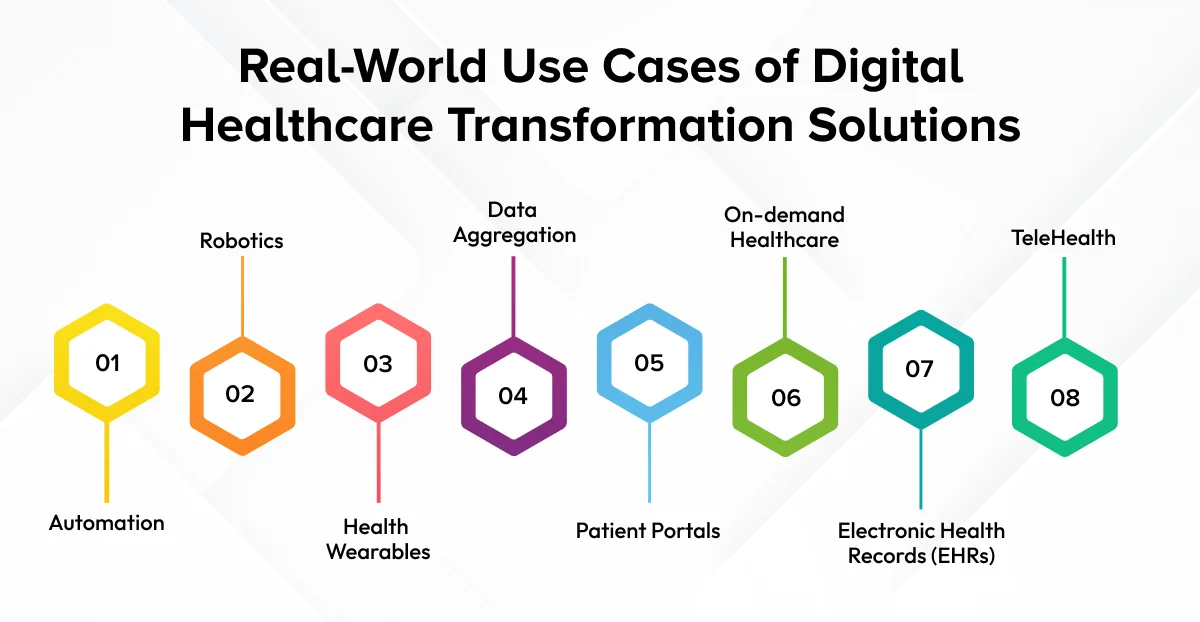
Automation
Automation in Healthcare streamlines routine healthcare operations such as appointment scheduling, billing, claims processing, and report generation. By reducing manual workloads and errors, healthcare providers can improve efficiency, lower administrative costs, and allow medical staff to focus more on patient care.
Robotics
Robotics is transforming healthcare through surgical assistance, rehabilitation support, and hospital logistics. RPA in Healthcare enhance precision in complex procedures, support patient recovery, and automate repetitive tasks, such as medicine delivery app development, improving both safety and operational efficiency.
Health Wearables
Health wearables such as smartwatches and fitness trackers enable continuous monitoring of vital signs like heart rate, activity levels, and sleep patterns. These devices support preventive care by providing real-time health data to patients and clinicians, enabling early detection and timely intervention.
Data Aggregation
Digital healthcare platforms aggregate data from multiple sources, including EHRs, wearables, lab systems, and patient apps. Centralized data improves clinical decision-making, reduces data silos, and provides healthcare providers with a complete view of patient health history.
Patient Portals
Patient portals give individuals secure access to medical records, test results, prescriptions, and appointment details. These platforms enhance patient engagement, improve communication with providers, and empower patients to actively manage their health.
On-Demand Healthcare
On-demand healthcare solutions allow patients to request medical services such as consultations, diagnostics, or home care through mobile apps. These platforms increase accessibility, reduce wait times, and deliver convenient, patient-centric care experiences.
Electronic Health Records (EHRs)
EHR systems digitize patient records and make them easily accessible across healthcare providers. They improve care coordination, reduce paperwork, enhance data accuracy, and support compliance with healthcare regulations.
Telehealth
It enables virtual consultations, remote diagnosis, and follow-up care through video calls and digital platforms. It expands access to healthcare services, particularly for remote populations, while reducing travel time and healthcare costs.
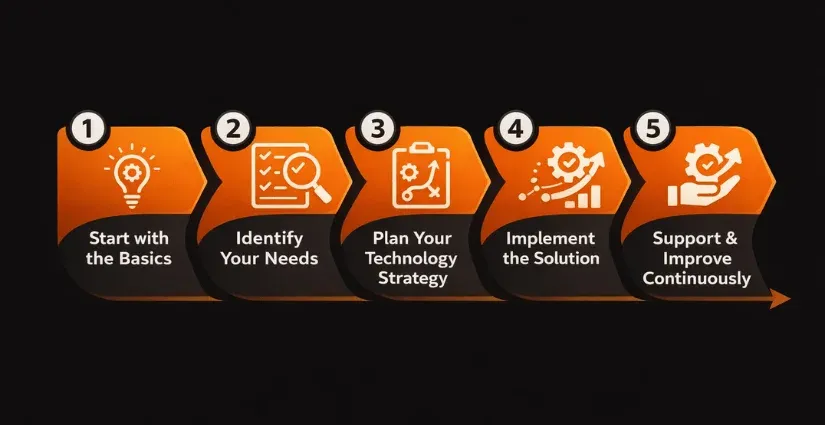
Our Proven Process for Digital Innovation in Healthcare
How Octal IT Solution Helps Healthcare Organizations Lead Digital Transformation?
Octal IT Solution supports healthcare organizations at every stage of their digital transformation journey, from healthcare digital strategy and consulting to design, development, and ongoing optimization. With deep expertise in healthcare software development, AI-driven solutions, cloud platforms, and interoperability standards, Octal IT Solution helps providers build secure, scalable, and patient-centric digital systems. By aligning technology implementation with real-world healthcare challenges and outcomes, we enable organizations to innovate faster, improve care delivery, and stay future-ready beyond 2026.
Summarizing the Digital Transformation Impact
Digital transformation has fundamentally reshaped how healthcare services are delivered, managed, and experienced. From improved access and personalized care to operational efficiency and data-driven decision-making, digital technologies are enabling healthcare organizations to move from reactive treatment models to proactive, patient-centric care. When implemented strategically, digital transformation not only enhances clinical outcomes but also strengthens system resilience and long-term sustainability.
What Healthcare Organizations Must Do to Stay Ahead by 2026?
To remain competitive by 2026, healthcare organizations must adopt a future-ready mindset. This includes investing in AI-driven solutions, cloud-native platforms, and interoperable systems while prioritizing data security and regulatory compliance. Equally important is building digital capabilities within teams and aligning technology initiatives with measurable patient outcomes.
Digital transformation company who embrace continuous innovation, collaboration, and ethical digital practices will be best positioned to deliver high-quality care in an increasingly digital healthcare ecosystem.

 By
By June 5, 2026






 Latest Stories
 Get in Touch