


Key Highlights
- The digital transformation market in automotive is projected to reach USD 4,617.78 Bn by 2030 at a CAGR of 28.5%
- Over 500 million connected vehicles are on the road globally, with 74% of new cars featuring connected technologies
- Digital transformation delivers 10 major benefits, from predictive maintenance and defect reduction to personalized customer experiences
- Key trends like 5G, MaaS, AI, AR/VR, and 3D printing are actively reshaping vehicle design, production, and ownership
- By 2026, SDVs, autonomous driving, and EV expansion will define the next era of competitive automotive innovation
- Key Highlights
- Getting Started
- What is Digital Transformation in Automotive Industry? Quick Overview
- Market Stats Related to Digital Transformation in the Automotive Industry
- Top 10 Benefits of Digital Transformation in Automotive Industries
- Use Cases of Digital Transformation in Automotive Industry
- How to Implement Digital Transformation in Automotive Industry?
- Top Digital Transformation Trends in Automotive Industry
- 5 Future Trends in the Automotive Industry: 2026 Outlook
- Conclusion
- FAQs
Getting Started
“We always overestimate the change that will occur in the next two years and underestimate the change that will occur in the next ten.”- Bill Gates
The automotive industry is undergoing its most significant evolution since the era when mass production first reshaped mobility. Today, this shift is being fueled not just by rapid technological advancements but also by changing consumer expectations and global demands. But the question remains the same: What drives customer loyalty and fulfills the demand of the global market?
Forewarning- Automotive Digital Transformation
It is transforming the design, construction, and experience of vehicles and is heading to a future where vehicles are smarter, more connected, and highly personalized to meet the needs of everyone. Transportation is evolving as the industry advances to become more flexible, intelligent, and perfectly integrated into our daily lives. Moving forward, we will cover trends, benefits, and future Outlook in this blog, which will provide you with eye-opening opportunities for your business in this industrial revolution.
What is Digital Transformation in Automotive Industry? Quick Overview
The concept of including digital transformation services in the automotive sector is the implementation of modern technologies in vehicle design. Their production and business aim to enhance efficiency, innovation, and customer satisfaction. It allows automakers to transition to less conventional processes that are more data-driven.
Through automotive digital transformation, technologies like AI, the IoT, and data analytics can be utilized to streamline the manufacturing process. Along with this, it can also enhance the quality of cars and assist related aspects of connected vehicles, including predictive maintenance.
Digital technologies such as online showrooms, automated customer service, and intelligent production improve sales operations, lower operational costs, and simplify supply chains. Altogether, the digitization in automotive industry enables companies to remain competitive as well as provide personalized, connected, and innovative mobility experiences.
Market Stats Related to Digital Transformation in the Automotive Industry
- Do you know the fact that the digital transformation service market is projected to reach USD 4617.78 Bn in 2030, growing at a CAGR of 28.5% from 2025 to 2030.
- Moving ahead, talking about the global Automotive Artificial Intelligence (AI) Market size, it is not that behind and is predicted to reach USD 25.78 billion by 2030, with a CAGR of 29.2% from 2024 to 2030.
- By 2024–2025, the global market will have surpassed 500 million connected passenger vehicles, with over 74% of new vehicles sold featuring connected technologies, highlighting the rapid growth of IoT development services in mobility.
- In advanced markets like North America and Europe, over 90% of new vehicles now include embedded telematics and connected systems, with widespread adoption of infotainment, smartphone integration, and OTA capabilities becoming standard features.
Top 10 Benefits of Digital Transformation in Automotive Industries
In the event we discuss the advantages of digital transformation in the automotive industry, this section refers to some of the highest ones that can revamp how vehicles are designed, used, and created. Ranging from sophisticated surveillance to AI in the automotive industry, the industry is adopting top automotive industry solutions, and this can be a game-changer initiative in the competitive market, providing improved customer experience and safety. We should begin to roll the dice in favor of the said benefits of automotive digital transformation.
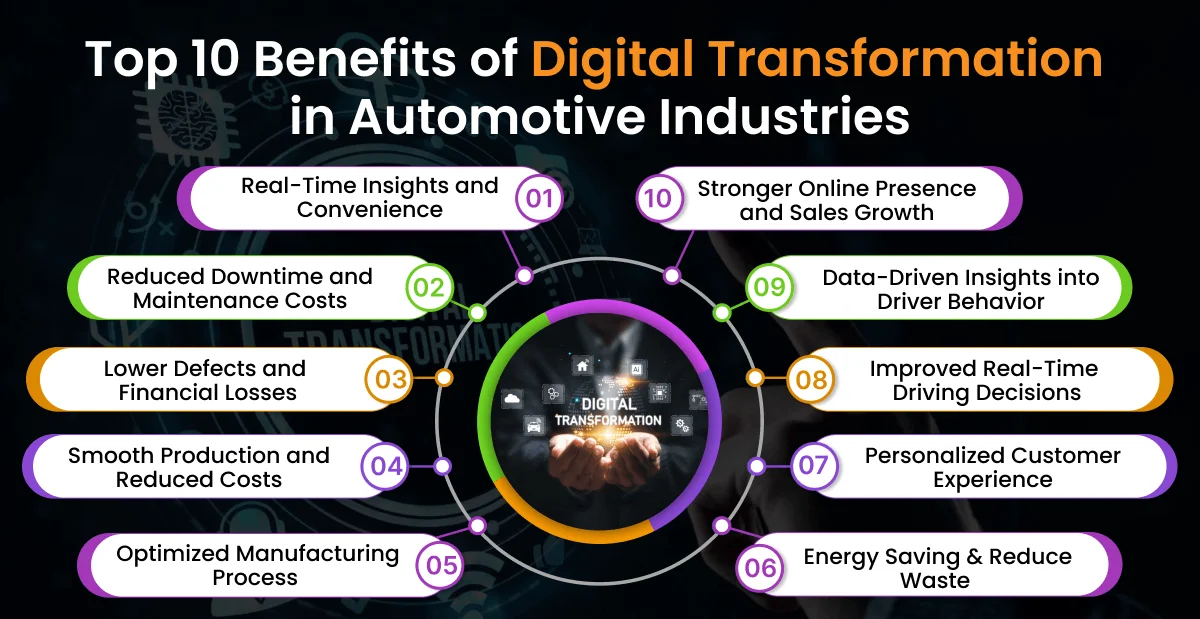
Real-Time Insights and Convenience
With automotive digital transformation, real-time information generated by networked systems helps enable faster decision-making, improved navigation, and smoother user experiences. This allows both manufacturers and drivers to benefit from accurate, real-time insights, enhancing efficiency, safety, and overall driving convenience.
Reduced Downtime and Maintenance Costs
AI-driven predictive maintenance assists in preempting possible failures. This minimizes the number of unforeseen failures, downtimes, and the costs of repairing vehicles are also considerably reduced, enhancing the overall vehicle reliability and operational efficiency.
Lower Defects and Financial Losses
The automated quality control in the manufacturing processes is higher due to advanced analytics and automation. The ability to identify defects early enables digital transformation companies to minimise wastage, prevent expensive recalls, and preserve improved product quality in competitive markets.
Smooth Production and Reduced Costs
Digital transformation automotive allows manufacturers to make repetitive work automatic, streamline processes. This will result in increased speed in the production cycle and will save considerable amounts of money throughout the entire value chain.
Optimized Manufacturing Process
Robotization increases the accuracy and uniformity of production lines. Robotization and intelligent systems enhance performance speed, standard quality, and enable the manufacturer to scale production effectively without distorting performance.
Energy Saving & Reduce Waste
Smart sensors and IoT-based systems are used to track energy consumption and resource consumption. This will help the companies to cut waste, minimize emissions, and be in line with sustainability objectives, and to keep up operational efficiency.
Personalized Customer Experience
Mobile applications and in-car systems are digital platforms that enable brands to provide personalized experiences. Such functions as voice assistants, infotainment, and connected services enhance the level of engagement and provide users with more personalized journeys.
Improved Real-Time Driving Decisions
ADAS and real-time data processing improve road safety. Drivers get immediate alerts, route guidance, and warnings about hazards, allowing them to make smarter and safer decisions on the road.
Data-Driven Insights into Driver Behavior
With the automotive industry digital transformation, companies are able to analyze the data of driving patterns, preferences, and usage. These insights help improve vehicle design, enhance safety features, and provide tailored services to customers.
Stronger Online Presence and Sales Growth
Virtual showrooms, online booking, and online customer journeys are made possible by the digitalization automotive industry. It not only enhances brand awareness but also increases sales because it provides convenience and a smooth purchasing experience.
Use Cases of Digital Transformation in Automotive Industry
Digital transformation services are enabling smarter, connected, and more efficient automotive solutions, while supporting advanced automotive software development to improve vehicle performance, customer experience, and operational efficiency across the entire automotive ecosystem.
Remote Vehicle Diagnostics and Troubleshooting
RVD is a remote vehicle diagnostics method that applies connected sensors, telematics, and an intelligent system to measure vehicle health in real time. It assists in spotting performance problems, system malfunctions, and service requirements without having to physically examine them.
How does this work? Using IoT in automotive industry, cars constantly transmit performance data to cloud-based applications. That allows manufacturers and service departments to identify problems at their initial stages and fix them in advance.
Real-life Example- BMW
BMW has implemented a platform known as the ConnectedDrive, which remotely scans the conditions of the vehicles and notifies their users of possible faults. The system enables technicians to diagnose problems beforehand, and this saves time on service and enhances the overall customer experience.
Over-the-Air (OTA) Software Updates
OTA updates enable car makers to update vehicles remotely, such as infotainment systems, security systems, and updates to enhance performance, without the necessity of a visit to the service centre.
Manufacturers use cloud computing in the automotive industry to roll out updates across fleets immediately, ensuring vehicles always have the latest features, bug fixes, and security patches.
Real-life Example- Ford
Through Power-Up software update, Ford vehicles can be updated continuously to add functionality and increase their lifespan without having to visit the dealership often.
Connected Car Ecosystem Integration
Connected car ecosystems are a collection of vehicles, mobile applications, infrastructure, and digital services that are integrated into a single platform to provide a smooth driving and ownership experience.
Through the automotive digital transformation, cars will be able to connect with the smart home, navigation systems, and third-party services, allowing the car to communicate in real time and provide better convenience to the users.
Real-life Example- Mercedes-Benz
The MBUX system in Mercedes-Benz links vehicles to smartphones and smart devices and enables the user to manage the vehicle functions, navigate, and communicate with digital assistants without any complications.
Smart Fleet Management Solutions
Fleet management solutions use connected technologies to monitor, manage, and optimize vehicle fleets in real time, improving operational efficiency and cost control.
With the help of digital transformation automotive, the business will be able to track the position of the vehicle, fuel usage, and driver activities, as well as service schedules, in order to maximize productivity and mitigate operational risks.
Real-life Example- Uber
As part of its modern fleet management, Uber has sophisticated systems that track driver operations, route optimization, and efficient ride placement within its international platform.
Augmented Reality (AR) for Maintenance and Training
Augmented Reality (AR) is turning the concept of vehicle maintenance and human training into interactive and real-time guidance through visualisation. AR tools help locate parts, guide repairs step by step, and reduce human errors, making training quicker and more efficient.
Real-life Example- Porsche
With the help of AR smart glasses, Porsche service technicians can work on complicated repairs and have a remote expert direct them, which enhances the accuracy of services.
Vehicle-to-Everything (V2X) Communication
V2X communication is a type of communication between vehicles and other vehicles, infrastructure, pedestrians, and networks to enhance efficiency and safety on the road.
Being a part of the automotive industry digital transformation, this technology aids in the exchange of data in real-time, thus minimizing accidents and traffic congestion in intelligent cities.
Real-life Example- Audi
Audi introduces V2X to exchange information with the traffic lights and enables the drivers to get information on changes in the traffic lights and manage the speed of their vehicles.
Personalized Marketing and Customer Engagement
Digital technologies, along with AI in digital transformation, can assist automakers in providing customers with a personalized experience throughout the purchasing process, from vehicle selection to post-purchase engagement.
Given customer information and analytics, the brand can provide recommendations, offers, and communication strategies to each individual’s preferences and enhance satisfaction and loyalty.
Real-life Example- Hyundai
Hyundai relies on digital platforms and related services to deliver customized offers, maintenance notifications, and personalized car visions.
AI-Powered Customer Service and Support
Customer support is evolving with the use of artificial intelligence because it is becoming faster, more accurate, and automatic responses to various channels.
In response to queries, booking of services, and real-time assistance, AI-powered chatbots and virtual assistants can be used to enhance customer satisfaction and lower operational expenses. Therefore, you can find a good AI development company that specializes in the field and provides you with similar services to your automotive business.
Real-life Example- Nissan
Nissan’s virtual assistants use artificial intelligence to help customers with vehicle information, service booking, and troubleshooting, making support seamless.
Automotive Cybersecurity Solutions
With the increased connectivity of vehicles, it is important to secure vehicles against cyber attacks. Cybersecurity solutions in the automotive industry protect passenger vehicles, vehicle systems, networks, and data against possible attacks.
The solutions will guarantee safe data transfer, privacy of the users, and integrity of the systems between the platforms that are connected.
Real-life Example- Bosch
Bosch creates security systems, which are well developed and used to monitor and protect the vehicle networks in real time, assuring safe and sound connected driving experiences.
How to Implement Digital Transformation in Automotive Industry?
Digital transformation in the automotive sector should be implemented in stages; consequently, it ensures long-term success, scalability, and measurable results. The following are the major steps to follow:
Assess Current Capabilities and Define Goals
Begin by assessing current systems, processes, and general digital maturity. Find areas of weakness, inefficiencies, and improvement opportunities, and formulate clear and measurable objectives in line with business objectives, like trying to improve customer experience or operational efficiency. This is a baseline move towards making the transformation efforts result-oriented and focused.
Build a Clear Digital Transformation Strategy
Develop a detailed roadmap that outlines the technologies to be used, schedules, investments, and expected results. It must focus on innovation and a smooth continuation with already existing systems and scalability in the long-term context. A clearly stated plan enables organizations to be on track and minimize the risks of implementation.
Invest in Automotive Software Development
Accelerate smart systems, connected vehicles, and data applications through automotive software development. This allows it to perform advanced features like predictive maintenance, real-time analytics, and improved in-car experiences. Their investments in powerful software solutions guarantee scalability, flexibility, and ongoing innovation.
Partner with the Right Technology Providers
Form joint ventures with other partners who provide software development services so that the implementation and integration of the latest technologies is facilitated. Professionals bring expertise, skills, and best practices that speed up change while reducing risks and disruptions.
Enhance Customer Experience with Mobile Solutions
Adopt mobile app development to create intuitive applications that allow users to access vehicle features, monitor performance, and receive real-time updates. Personalized engagement, enhanced customer satisfaction, and brand loyalty are other benefits of mobile solutions, resulting in an uninterrupted digital experience.
Implement Smart Manufacturing and Automation
Implement automation, robotics, and IoT-based systems in manufacturing lines that will improve their productivity and precision. Smart factories help to monitor in real time, minimize errors made by people, and enhance efficiency in production. This will result in shorter turnaround time and uniformity of products.
Strengthen Data Management and Analytics
Create powerful data collection, storage, and analytics systems to obtain actionable insights based on big data. Evidence-based decision-making contributes to the optimization of activities, the prediction of demand, and product development. It also allows the firms to react promptly to changes in the market.
Focus on Cybersecurity and Compliance
Effective cybersecurity strategies protect connected vehicles, systems, and sensitive data from potential attacks. Meet and keep within the industry standards and regulations to generate trust and prevent legal risks. Digital transformation needs a secure ecosystem to be sustainable.
Upskill Workforce and Foster Innovation Culture
Invest in training programs in order to prepare the employees to operate in advanced technologies. Promoting the culture of innovation and flexibility also supports the teams to accept change and make their contribution to the constant improvement. One of the success factors of transformation is the existence of skilled workers.
Monitor, Optimize, and Scale
Monitor the performance in terms of key measures and measure the success of the applied strategies. Determine improvements, streamline operations, and multiply effective initiatives throughout the organization. This guarantees the long-term development and maximization of the value of digital transformation.
Top Digital Transformation Trends in Automotive Industry
Advanced digital technologies are rapidly transforming the automotive industry, reshaping how manufacturers design, build, and deliver vehicles. These trends highlight how innovation is driving efficiency, connectivity, and customer-centric mobility solutions
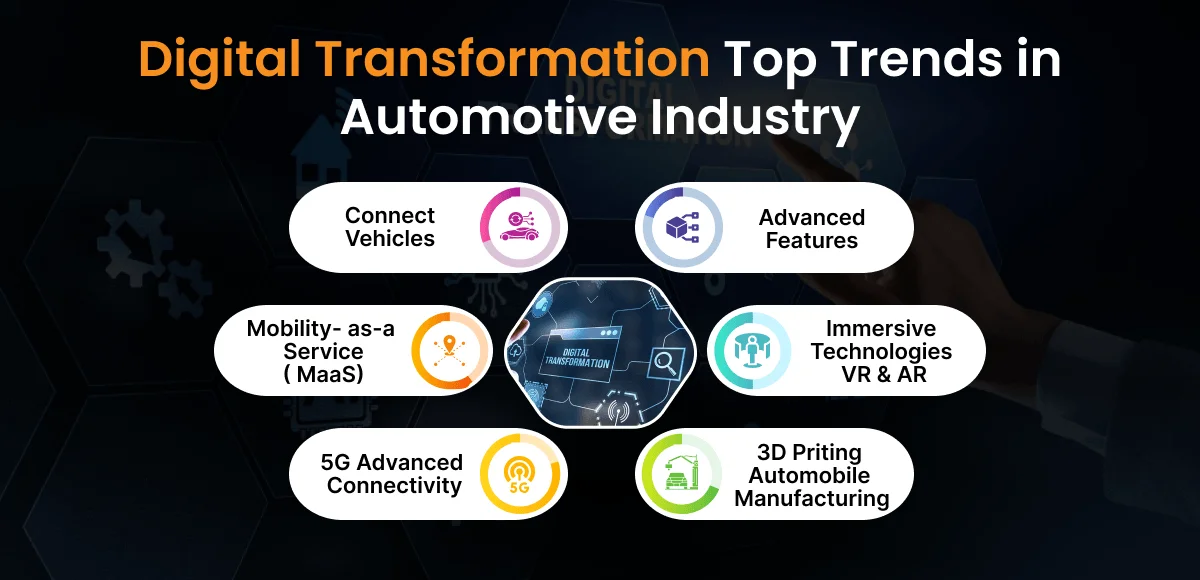
Connected Vehicles
The concept of connected vehicles is key pillar of automotive digital transformation, enabling real-time communication between cars, drivers, & infrastructure. As IoT development services grow, smarter & more efficient driving experiences become possible as vehicles communicate to predictively maintain and navigate.
Mobility-as-a-Service (MaaS)
Mobility-as-a-Service (MaaS) is changing the way individuals use transportation through the integration of various travel options into one system. This tendency diminishes the vehicle ownership dependence and increases convenience as a flexible, cost-effective, and sustainable type of mobility in modern urbanized settings.
5G: Advanced Connectivity
The automotive industry is revolutionizing with 5G technology, as it allows high-speed data transmission and low latency. It enables autonomous car communication, connected ecosystems, and intelligent traffic systems, which make cars more reactive and efficient, and are able to cope with advanced computerized functions.
3D Printing in Automobile Manufacturing
3D printing is transforming production by enabling rapid prototyping and reducing production costs. Combined with automotive software development, it enables automakers to produce complex parts. It also minimizes the use of materials and accelerates the innovation process; moreover, it does so without losing accuracy.
Immersive Technologies: VR & AR
Virtual Reality (VR) and Augmented Reality (AR) are improving customer experiences, design, and training. Such technologies provide virtual prototyping, immersive showrooms, and efficient workforce training, which allow companies to provide cost reduction and help them enhance the decision-making process.
Advanced Vehicle Features
Manufacturers have introduced ADAS, AI-based assistants, smart infotainment, and other innovative features in modern vehicles. These inventions improve safety and customization, helping automakers deliver smarter driving experiences in a competitive market.
5 Future Trends in the Automotive Industry: 2026 Outlook
With the automotive industry constantly changing, the year 2026 will be a leading year with an electrified, intelligent, and digitalized nature. Automakers are developing more connected and intelligent ecosystems with the rapid development of cloud computing services. The following are the major trends shaping the future of the car industry.
1. Rise of Electric and Hybrid Vehicles
Hybrid and electric cars are quickly becoming popular as the world becomes invested in the automotive industry that is focused on sustainable mobility. The battery technology and charging infrastructure are becoming more efficient, more accessible, and more practical every day. Making EVs more efficient and more practical to use in everyday life.
Nonetheless, difficulties such as expensive production, limited charging infrastructure, and international rivalry may slow growth in 2026. Consequently, car manufacturers are beginning to focus on hybrid cars. This provides a compromise between fuel economy, cost-effectiveness, and lower environmental impact.
2. Growth of Software-Defined Vehicles (SDVs)
Software-defined vehicles are transforming how manufacturers design cars and how drivers experience them. Modern vehicles no longer rely solely on hardware but use advanced software to control critical functions such as braking, steering, and infotainment systems.
To successfully implement such advanced systems, many companies choose to hire dedicated developers for digital transformation, ensuring seamless integration of software-driven architectures. By incorporating cloud computing services, car manufacturers can enable over-the-air updates, enhance vehicle performance, and introduce new features without physical upgrades, driving continuous innovation and improving the overall driving experience.
3. Expansion of Autonomous Driving Technologies
Engineers consider self-driving one of the most promising technologies in the automobile sector. Although it is still in the development phase of fully self-driving vehicles, in 2026, there will be a high level of development into more advanced driver-assistance systems (ADAS) and semi-autonomous features.
Level 2 and Level 3 vehicles are increasingly becoming popular, and they provide services like adaptive cruise control, lane assistance, and automated parking. Continued testing and advancement in regulations will likely continue to increase higher levels of automation adoption in the years ahead.
4. Emergence of Alternative Fuels
Electrification is the order of the day, but alternative fuels are being considered as an alternative solution to the problem. Other potential solutions, like hydrogen fuel cells, synthetic fuels (e-fuels), and so forth, are under consideration so as to minimize emissions without necessitating complete reliance on battery-powered systems.
The latter fuels are especially applicable to heavy-duty vehicles and the areas where electric infrastructure is not very advanced yet. Further research and investment will result in efficiency and the possibility of alternative fuels becoming an option in the future mobility ecosystem.
5. Evolving Supply Chain and Manufacturing Strategies
The automotive industry is still faced with a serious issue of supply chain disruptions. The lack of semiconductors, batteries, and other vital materials has demonstrated the necessity to build more resilient and local supply chains.
Manufacturers are automating, diversifying, and employing digital tools to be more visible and plan better in response to these challenges. The emerging technologies of advanced analytics and cloud-based systems are assisting businesses in anticipating demand and minimizing operational risk.
Conclusion
The automobile industry is in a fast-evolving phase of innovation, connectedness, and making decisions based on data. In intelligent production and sophisticated mobility platforms, automotive data analytics is becoming a key part of assisting companies. This enhances their business performance, provides more customer experiences, and remain competitive in a dynamic market.
In order to overcome this change effectively, it is important to engage the right technology expert. Octal IT Solution provides end-to-end digital solutions, which assist automotive organizations in creating scalable, secure, and future-ready solutions. Whether you want to modernize operations or develop next-gen applications, you can hire software developers from Octal to accelerate your digital journey and achieve long-term success.
 By
By June 5, 2026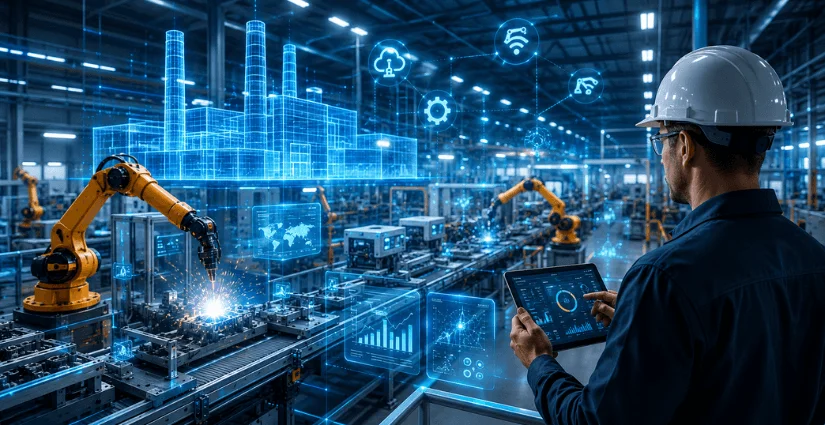




 Latest Stories
 Get in Touch