


Artificial Intelligence (AI) has been rapidly turning into a high-impact vision of the future and a convenient technology in contemporary workplaces. In various sectors of finance, healthcare, retail, manufacturing, and IT, AI is reshaping the way teams work, decide, and accomplish daily operations.
Nowadays, businesses desire greater efficiency, precision, and predictive power, which AI provides very well. AI is no longer something to be desired, regardless of whether it is smart automation tools, sophisticated analytics, conversational interfaces, or other integrations with enterprise systems. It is turning out to be the pillar of digital transformation today.
More and more companies partner with an AI app development company to develop tailored solutions that optimize workflows, increase productivity, and enhance employees’ work experience. With digital-first operations becoming the new reality, AI is fast becoming one of the most critical facilitators of work-related innovation.
This blog discusses the best applications of AI in the workplace, significant trends shaping the future of innovative workplaces, the advantages of smart workplaces, and the primary challenges companies face in their efforts to use AI.
AI in the Workplace: Why It Matters Today
Work environments are changing at a rapid rate. The hybrid models, remote teams, distributed operations, and increased expectations about productivity are compelling businesses to reconsider the traditional processes. It is in this change that AI is vital due to three main reasons:
- Repetitive tasks are automated- AI reduces human intervention in low-value repetitive duties, enabling workers to concentrate on innovative and strategic responsibilities.
- Intelligent decision-making- The predictive models and real-time insights provide more accurate and timely information in making data-driven decisions.
- Improved communication and cooperation– Tools based on AI, such as chatbots, virtual assistants, and workflow management, enhance internal communication, staff support, and workflow management.
As organizations depend more on digital solutions, they are seeking end-to-end solutions from an enterprise app development firm capable of integrating AI-driven systems into their existing enterprise ecosystems. A study by Founder Reports shows that 89% of workers already use AI as part of their jobs. On the same note, organizations that are using sales/support/customer-facing automations tend to partner with a crm software development firm to allow AI-based personalization, lead scoring, and customer insights.
Top Use Cases of AI in the Workplace
In this section, we have mentioned the top use cases of using AI in the workplace, resulting in better workplace engagement and outcomes.
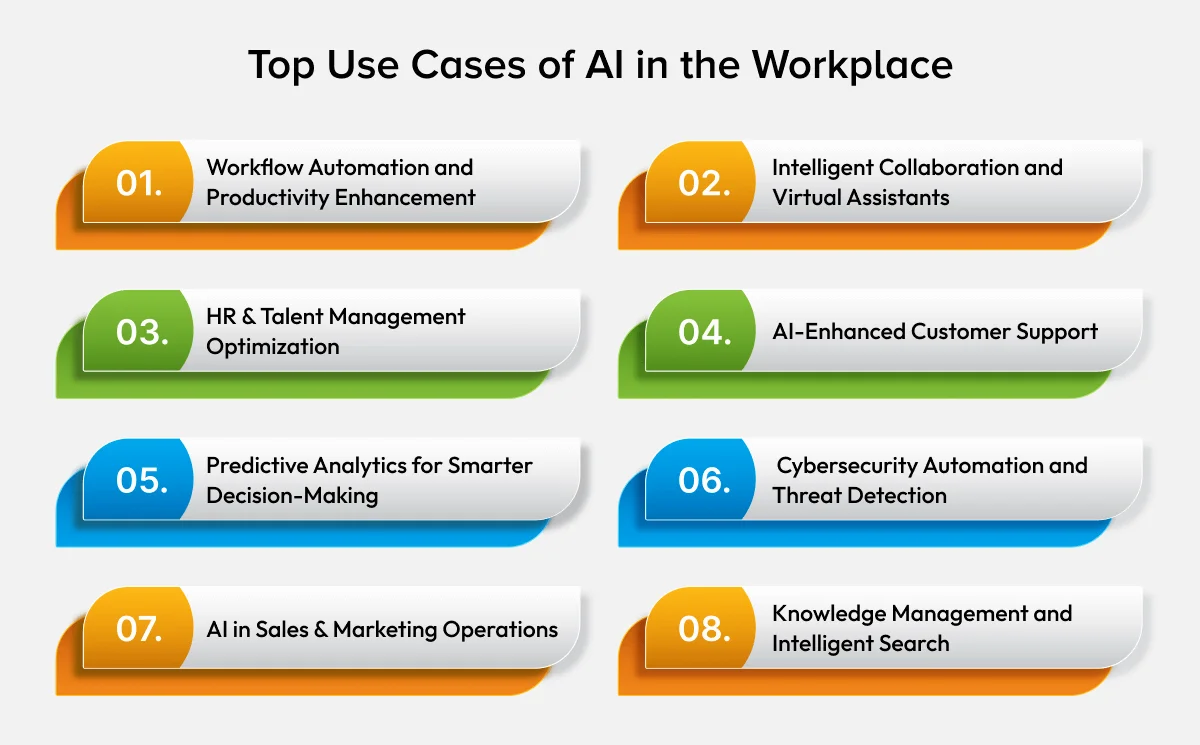
1. Workflow Automation & Productivity Enhancement
The AI-driven workflow automation software can process repetitive processes like data entry, ticket routing, document management, scheduling, and report generation. Intelligent bots enhance accuracy in operations, decrease turnaround, and also underpin scalable operations.
Key AI-driven workflow automation examples include:
- Automated invoice management.
- AI-triggered HR workflows
- Priorities and smart replies via email.
- Paper classification Robotically.
- Predictive task allocation
An AI development service provider is commonly called upon by businesses that need the creation of workflow bots or the application of AI to the work environment, tailored to the industry.
2. Intelligent Collaboration & Virtual Assistants
Virtual assistants, such as Microsoft Copilot and Google Gemini, powered by AI, are changing the process of teamwork. Such aids allow employees to create emails in a short period of time, make a summary of meetings, process data, or even create presentations.
Meeting notetakers are AIs.
Practical examples:
- Speaking with workplace assistants.
- Automated call transcription.
- Recommendations on team collaboration.
- Brainy messages and work priority.
AI assistants help reduce cognitive load and provide an opportunity to avoid missing critical tasks. For teams that also need to unify tasks, calendars, meetings, messages, and follow-ups across multiple apps, an all-in-one productivity tool like Akiflow can centralize daily execution, reduce context switching, and help workflows move efficiently.
3. HR & Talent Management Optimization
HR departments are adopting AI in recruitment, onboarding, employee engagement, as workforce planning. AI-based systems examine their own behavior, performance, and skill gaps to assist HR leaders in making smarter decisions.
AI in HR enables:
- Automated resume screening
- Objective candidate shortlisting.
- Talent forecasting
- Individual attention to learning and growth.
- Employee sentiment analysis.
As remote work grows, many companies use AI-powered software developed by an enterprise app development company to enhance the efficiency of their HR departments worldwide.
4. AI-Enhanced Customer Support
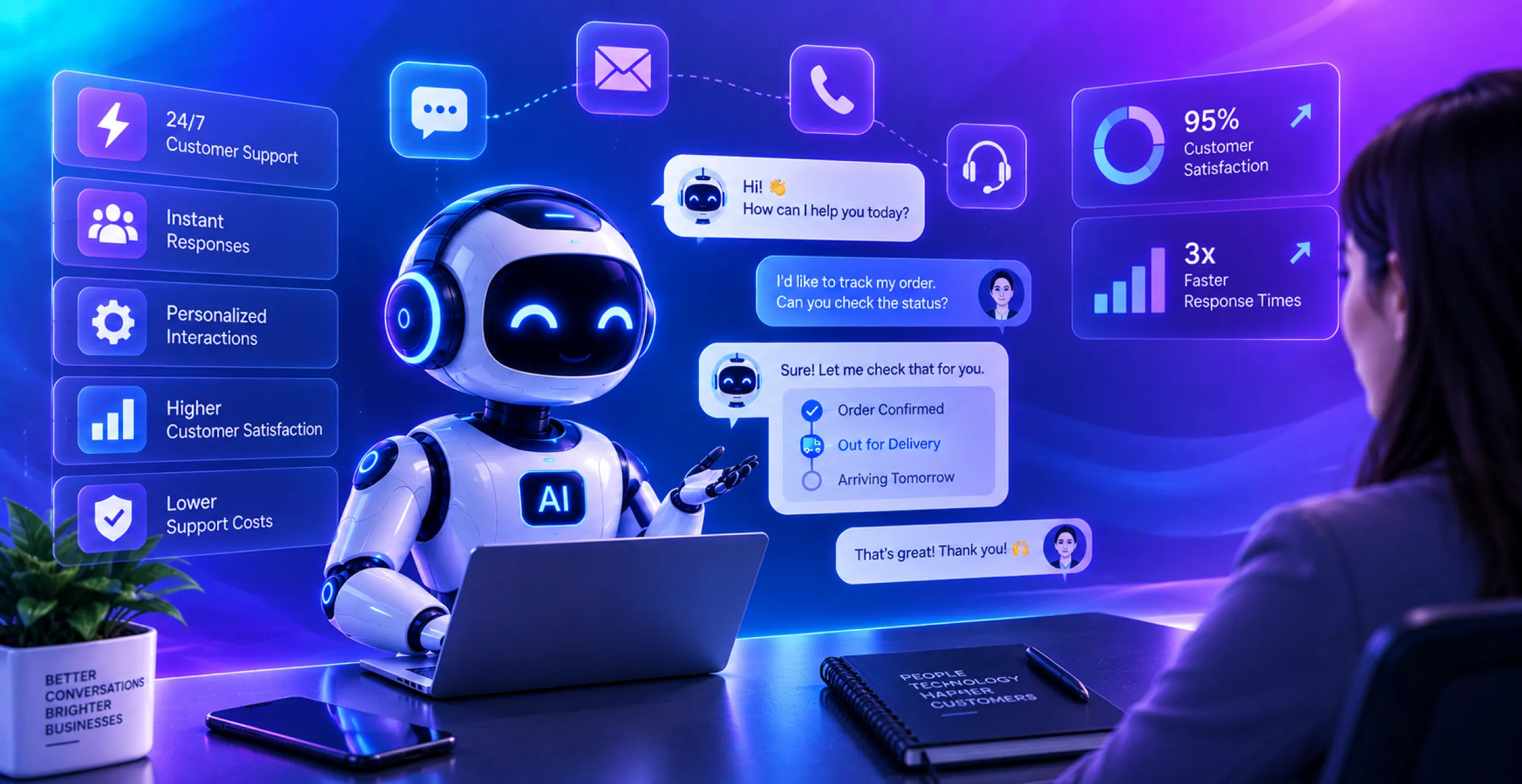
Chatbots, conversational AI, and voice bots have become inseparable in responding to customer inquiries 24/7. Such systems offer fast, reliable, and precise responses in a variety of channels.
AI improves support efficiency by:
- Predicting customer issues
- Automating the assigning of tickets.
- Offering individual solutions.
- Conversing and carrying out sentiment analysis.
A crm software development company can also help enterprises to directly incorporate AI into their customer support dashboards, CRMs, and messaging.
5. Predictive Analytics for Smarter Decision-Making
Predictive analytics utilizes both past and present data to extrapolate trends, customer demand, risks, and performance outcomes. AI models transform unprocessed data into actionable data.
Use cases include:
- Revenue forecasting
- Inventory prediction
- Risk analysis
- Trend reports
- Employee performance forecasting
IT leaders usually collaborate with firms that provide IT Consulting services to enact forecasting models that are specific to operations, finance, supply chain, and strategy planning.
6. Cybersecurity Automation & Threat Detection
In present-day cybersecurity, AI is an essential component of identifying anomalies, avoiding attacks, and minimizing vulnerabilities. AI systems detect suspicious behavior quickly than conventional tools.
AI strengthens cybersecurity by:
- Monitoring user behavior
- The identification of suspicious logins.
- Preventing phishing emails
- Identifying data breaches
- Automating threat investigations.
Companies are seeking IT consulting services to implement AI-based cybersecurity measures to secure sensitive organizational data.
7. AI in Sales & Marketing Operations
AI is enhancing the sales and marketing departments by turning the processes into data-driven and customer-focused ones. The tools can be used to analyze how users behave, group audiences, anticipate purchasing behavior, and make suggestions.
AI applications include:
- Automated lead scoring
- Content personalization
- Customer journey mapping
- Ad targeting optimization
- Campaign forecasting
CRM solutions developed by a crm software development firm using AI assist companies in personalizing customer experience and enhancing conversions.
Related Blog: Generative AI in HR – Use Cases and Benefits
8. Knowledge Management & Intelligent Search
AI increases knowledge access in organizations by enhancing semantic search, recommendation engines, and contextual insight for employees.
AI-driven search enhances:
- Document retrieval
- Policy and FAQ search
- Navigation on the internal knowledge base.
- Interdepartmental data discovery.
These are capabilities that are necessary to increase productivity among large enterprises.
Emerging AI Trends Shaping the Future Workplace
Here are some of the top AI trends that can change the future of the workplace. They not only help businesses gain adequate profit but also help them stay competitive in the marketplace. Have a look at each one.
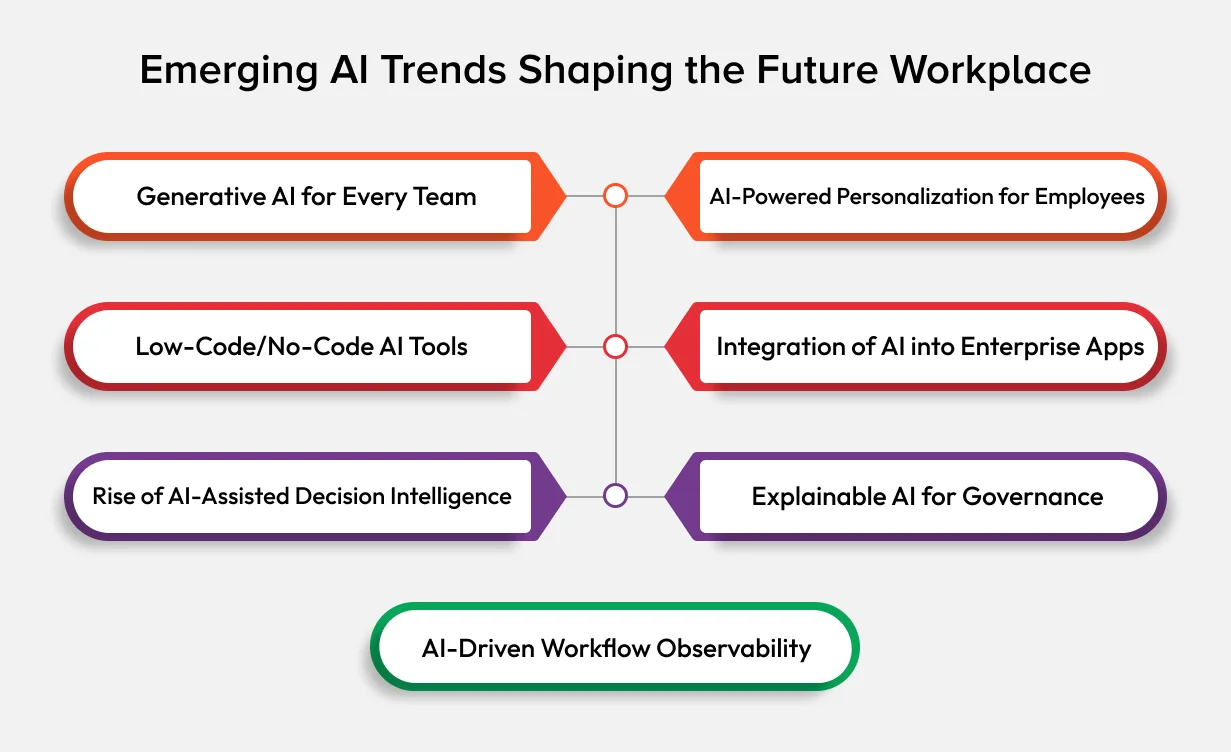
1. Generative AI for Every Team
Generative AI is changing content generation, decision making, design, coding, simulation, and problem solving. GenAI tools are being used in teams of HR, finance, engineering, and product development to achieve output faster. It enhances its efficiency in alleviating bottlenecks in its operations by automating both its creative and analytical functions. GenAI will continue to be progressively applied as the technology becomes mainstream to develop workflows, create prototypes, and automate ideation processes by organizations.
2. AI-Powered Personalization for Employees
AI is defining hyper-personalized experiences, such as learning suggestions or workplace wellness information, to enhance employee engagement and satisfaction. High-tech analytics can support customized nudges, which can assist employees in maximizing productivity and well-being. Such personalized engagements eventually create a more flexible and staff-focused working environment.
3. Low-Code/No-Code AI Tools
Businesses are moving to adopt low-code systems to implement AI fast without extensive engineering dependency. This quickens the process of digital transformation and lowers the cost of development. These applications enable non-technological employees to automate and create innovative applications. The more organizations adopt, the more agile and quicker the time-to-innovation they become.
4. Integration of AI into Enterprise Apps
A larger number of businesses use the services of an enterprise app development company to add AI to internal and external software. In the case of ERP to HRMS and CRM systems, AI improves capacity, security, and automation. Integrated AI provides the flow of data to flow seamlessly across the business systems and thereby allows the unification of intelligence. This leads to smarter operations, enhanced user experiences, and enhanced business continuity.
5. Rise of AI-Assisted Decision Intelligence
Decision intelligence systems, which integrate analytics, automation, and predictive AI, are being implemented by leaders to support high-stakes decision-making. These systems offer scenario-based recommendations that minimize uncertainties. The decision intelligence would eventually turn out to be a strategic resource that enhances the accuracy of planning and forecasting within the departments.
6. Explainable AI for Governance
With the growing use of AI, it is essential to have transparent and explainable models within organizations, particularly in regulated sectors of the economy such as finance, healthcare, and insurance. Explainability enables the leaders to determine why models act in a particular manner, which decreases risk and bias. This openness promotes transparency and responsibility, which makes AI implementation more sustainable.
7. AI-Driven Workflow Observability
AI has become the overseer of the health and effectiveness of workflows, identifying bottlenecks and suggesting how to improve processes. This observability in real-time assists teams in identifying inefficiencies before they cause disruption in operations. It also guarantees constant optimization that makes the enterprise workflows more predictable and resilient.
The Measurable Impact of AI on Business Outcomes
AI is providing quantifiable benefits in the areas of operational efficiency, employee productivity, customer satisfaction, and strategy decision-making. Some key benefits include:
1. Higher Productivity
AI automates monotonous labor and speeds up tedious procedures, and teams can work on new ideas and value-added work. This change minimizes burnout and boosts the productivity of the workforce at any level. There is an observed significant improvement in turnaround time and performance consistency in organizations.
2. Improved Accuracy & Reduced Errors
Automation and predictive analytics also minimize manual errors and make the results more consistent. Checks by AI offer data integrity on complicated workflows. This will give improved results, particularly in areas where accuracy is key.
3. Enhanced Customer Experiences
The AI enhances customer satisfaction by increasing the level of support, personalization, and the level of response. AI can facilitate more meaningful interactions and interactions in a timely manner because of the awareness of customer intent. This, in effect, leads to an increased level of loyalty and long-term customer value.
4. Cost Reduction
Automation lowers the cost of operation, decreases reliance on resources, and minimizes delays. Organizations save a lot of money by eliminating redundant, intensive workloads. These savings can be further invested in the innovation and growth process.
5. Improved Employee Experience
AI can aid in prioritization of work, alleviate the pressure of work, and create a balance at the workplace. Smart technology provides information on employee welfare and performance patterns. An enhanced workforce results in increased involvement and reduced turnover.
6. Faster Decision-Making
AI will allow real-time insights, predictive forecasting, and scenario simulation, which will empower the leaders to make improved decisions. Through evidence-based intelligence, the process of decision-making is more strategic and less reactive. This assists businesses in remaining at par with the dynamic market environment.
7. Improved Data Management
Through the assistance of an AI development company, organizations find it easy to manage, analyze, and draw insights from massive datasets. AI organizes unstructured data, and it becomes more convenient and usable. This enhances the general data governance and long-term digital initiatives.
Also Read: AI in Operations – Key Use Cases and Benefits
Key Challenges in AI Adoption
Notwithstanding its benefits, the AI adoption is not unhindered. Implementation barriers must be identified in order to achieve successful transformation in the organization.
1. Lack of AI-Ready Data
AI needs structured information that is clean. Numerous organizations have a problem of incoherent or disconnected data. The low quality of the data results in faulty predictions and poor model performance. Scaling AI should not be a top priority before making it strong in its data foundations.
2. Skill Gaps & Workforce Resistance
The adoption of AI may face resistance from employees because of the risk of job displacement or insufficient knowledge. The absence of internal AI expertise will impede implementation and operationalization. The resistance should be overcome with a clear message and constant training.
3. High Initial Costs
The development of their own AI is costly, and firms require consultation services to maximize the investments. The expenses go higher when implementing AI in sophisticated enterprise settings. Long-term ROI, however, is likely to exceed the investment when carried out successfully.
4. Integration Complexity
The slowdown or constrainment of AI implementation can be caused by data privacy concerns, algorithm bias, and security threats. The use of AI uncontrollably may put businesses under compliance risks. Strong ethical principles should be in place to make it adoptable responsibly.
5. Ethical & Security Concerns
Issues related to data privacy, algorithmic bias, and security vulnerabilities can delay or restrict AI deployment. Unregulated AI usage can expose companies to compliance risks. Robust ethical guidelines are necessary to ensure responsible adoption.
6. Lack of Governance Framework
In the absence of an effective governance framework, AI can pose risks to compliance or accidental business impacts. Organizations need to put up guardrails in the utilization of AI within teams. Transparency, fairness, and accountability can also be maintained by the governance frameworks.
7. Unclear ROI Expectations
A lot of organizations do not establish KPIs for AI initiatives, and thus, it will be hard to measure success. There are no quantifiable results, so AI projects may lose favor with the executive. Deterministic ROI models guarantee the correlation of strategic objectives and AI investments.
How Businesses Can Ensure Successful AI Adoption
Organizations should be structured and strategic in order to maximize the potential of AI.
1. Identify High-Impact AI Use Cases
Begin with the areas in which automation or intelligence can bring instant value, such as support, HR, analytics, workflow management, etc. The momentum and confidence of quick wins will lead to a larger adoption. This is also used to justify investments and buy-in of stakeholders.
2. Build a Scalable Data Infrastructure
Make data collection, cleaning, naming, and modelling possible to become ready to use advanced AI applications. With a good data basis, there will be good, reliable, high-performing models. Durable AI maturity and innovation are supported by scalable infrastructure.
3. Collaborate with Experts
Businesses will tend to engage a reliable AI development firm to create bespoke AI systems to suit their business requirements. Knowledgeable partners speed up implementation and minimize the risks of implementation. They also carry business best practices and methodologies.
4. Start Small and Scale Gradually
The piloting projects enable teams to learn, experiment, and streamline AI and then roll it out to the entire organization. This stepwise process minimizes the chances of failure and improves the reliability of the model. It also promotes team coordination during the transformation process.
5. Invest in Employee Training
Upskilling of workers through Electives ai training for employees would guarantee a seamless process and a higher uptake among the teams. The training programs will make the employees realize the advantages of AI and overcome resistance. In the long run, a digitally savvy workforce would be a competitive edge.
6. Ensure Security & Governance
Launch AI in a responsible manner with data governance and strict compliance. The development of rules assists organizations in dealing with ethical, legal, and operational risks. A governance-first strategy allows AI to be safe, transparent, and compliant.
7. Integrate AI with Enterprise Systems
AI should be incorporated into CRMs, ERPs, HRMS platforms, and other business applications. This is where a crm software development company or enterprise app development company would be useful. The potential of AI can be embedded through seamless integration to guarantee connected intelligence. Integrated solutions enhance efficiency, minimize paperwork, and boost the general digital maturity.
Conclusion
The transformation of AI in the workplace is taking the forms that have never been dreamt of before, such as how teams work, collaborate, and make decisions. The opportunities are unlimited, starting with automating the workflow and predictive analytics up to AI-based HR processes and smart customer support. Nevertheless, effective implementation of AI necessitates the appropriate strategy, control, technology collaborators, and change management programs.
With the future of organizations being efficiency and intelligence-driven, partnerships with skilled partners like an AI development company, IT Consulting services providers, an enterprise app development company, or crm software development company will make sure the organizations are able to use the full potential of AI and remain ahead of the pack.
FAQs
AI is being applied in the automation of repetitive duties, predictive data analysis, employee productivity applications, smart chatbots, human resources choice support, and customized learning systems. Businesses apply AI to improve customer experience, optimize operations, and make strategic decisions.
Artificial intelligence increases productivity, minimizes human error, speeds up decision-making, decreases operational costs, and increases efficiency at the place of work. It also facilitates individualized employee experiences, talent management, and organizational agility.
The most typical problems are the unavailability of quality data, expensive implementation, skill deficit, staff opposition, integration with the old system, and privacy/ethical issues. The problem of scaling AI beyond pilot projects is also common in many organizations.
The companies need to determine their data readiness, analyze those use cases that will have the highest ROI, support change management, create a strong security framework, and invest in employee training. The best thing to do is sometimes to start small and build up.
AI will not substitute whole jobs, but will automate some of the functions. Rather, it will enhance human capacity, which will allow employees to address creative, strategic, and high-value work. Other new job titles like AI supervisors, prompt engineers, and data governance specialists are also coming out.


 Get in Touch
 By
By October 9, 2026