


Can software really be able to predict the future? In this data-driven world, the answer is certainly positive, due to the predictive analytics software development. This technology is based on data, algorithms, and AI, which provide outcomes, trends, and customer behavior that is barely believable.
In the year 2025, businesses of all industries are changing their focus towards investing in predictive analytics solutions to become more productive and act faster. From personalized marketing to supply chain optimization, its use is expanding rapidly.
This guide covers the major trends, characteristics, tools, and tactics that constitute high-performing predictive analytics software. If you are either a beginner in AI predictive analytics or have the intention of creating a customized solution, there is no better place to start than this.
Why Predictive Analytics Matters in 2025
Predictive analytics may have at some point been merely a hype period, it is now a key strategic element in business. In 2025, more and more organizations will be getting the benefits of AI predictive analytics and such tools to better understand their customers’ behavior, efficiently manage their resources, and minimize the risks.
According to Grand View Research, the global market is anticipated to reach an approximate value of USD 22 billion in 2025, while the number is expected to jump up to nearly USD 82 billion in 2030, with the CAGR being roughly 28.3%.
Businesses are accepting that the bright predictive analytics solution is the mainstay of superior decision-making, making them able to cope with the competition, stay efficient, and be future-ready.
Key Features of Predictive Analytics Software
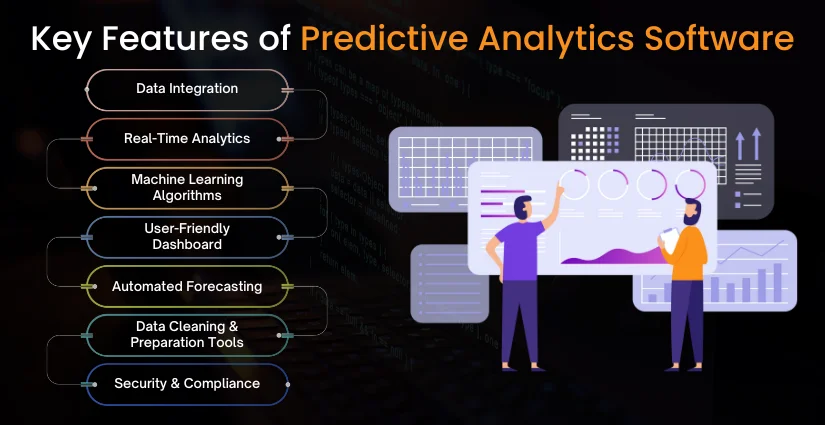
The real power of predictive analytics software development lies in its features. A well-developed solution will not only analyze data but transform that data into actionable insights that help business stakeholders graph for the future, analyze risk, and grow wisely.
Whether it’s for marketing, finance, or healthcare, the right features ensure accurate predictions and easy decision-making. Now, let’s discuss the prominent features in a modern predictive analytics software offered in 2025.
1. Data Integration
Collection and integration of data occur from various sources, such as CRMs, databases, APIs, and cloud applications, without using any other sources.
2. Real-Time Analytics
Because of this feature, live information is processed to extract insight and make a prediction at instant speed.
3. Machine Learning Algorithms
Uses AI models to learn from data and from changing environmental conditions to enhance the accuracy of its predictions over time.
4. User-Friendly Dashboard
It renders data into easy-to-understand graphics, with drill-down charts to help evaluate data quickly.
5. Automated Forecasting
This feature helps in the prediction of trends and near-future events from the precedent data.
6. Data Cleaning & Preparation Tools
Before the analysis, raw data needs to be pre-processed, filtered, and tested for correctness.
7. Security & Compliance
Keeps Vetting Information secured and compliant with various regulations, such as GDPR or HIPAA.

Top Predictive Analytics Tools in 2025
Choosing the right tool is the very first consideration to take into account while developing predictive analytics software. Hence, industries are acquiring insights through the world’s finest AI predictive analytics tools to streamline operations and stay ahead of the competition in 2025.
Some of their top features include machine learning capabilities, real-time dashboards, and integration with legacy systems. Our quick overview will very much like to take a peek at some of the best predictive analytics tools dominating today’s market:
| Tool | Overview |
| IBM SPSS | Phenomenal statistical software for data mining, forecasting, and modeling. |
| SAS Advanced Analytics | Top-notch AI tool with applications in healthcare and banking. |
| Microsoft Azure Machine Learning | The cloud platform for building and deploying your predictive model. |
| RapidMiner | An easy-to-use tool with drag-and-drop interface, great for non-coders. |
| Alteryx | A one-step solution for data preparation, analytics, and automation. |
| Google Cloud AI Platform | Scalable machine learning from Google and deep integration with their services. |
| DataRobot | Automated machine learning to build and deploy your models fast. |
The tools help data engineers and data scientists use to create intelligent, scalable, and accurate solutions for predictive analytics. Selecting one depends on the needs, skills of the people working on the project, and the size of the data.
AI & Predictive Analytics: How They Work Together
AI and predictive analytics operate on an equal footing: while predictive analytics tries to predict future events by examining the past, AI adds an extra measure of intelligence, speed, and accuracy to these predictions.
In a nutshell, they help an organization have a data-backed confidence to travel the road from “what has happened” to “what will happen.” Here’s how they work together in 5 simple steps:
1. Data Collection
This is the opening step, the huge sets of structured and unstructured data are collected from various sources such as apps, CRM systems, websites, and IoT devices.
2. Data Cleaning & Preparation
The raw data are cleaned, organized, and prepared by AI algorithms within this step-removing errors, duplicates, and inconsistencies, in order to make accurate predictions.
3. Pattern Recognition
By using machine learning, AI figures out the undiscovered patterns, the trends and the relationships entailed in the data that human analysts might not see.
4. Model Training & Prediction
The main purpose of predictive analytics software is to employ the AI models which have already been trained for the forecasting of the future outcomes of the customer behavior, sales trends, or equipment failures.
5. Continuous Learning & Improvement
Machine learning supported by AI technology continuously acquires new knowledge from new data, which consequently makes the predictive model more capable and accurate eventually.
Industries Benefiting from Predictive Analytics Solutions
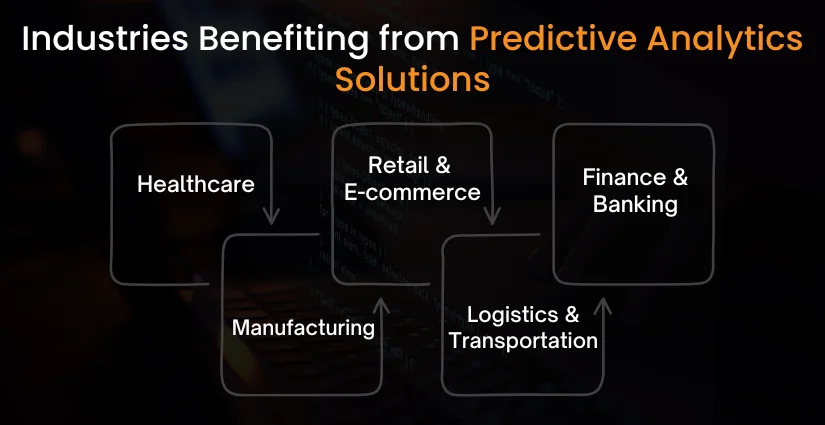
The application of predictive analytics is no longer limited to only one sector; it is easing the operations of many industries by illuminating the unclear data with valuable foresight. The decisions made by the companies can be multipurpose, ranging from customer experience to lowering risk and promoting efficiency; hence, businesses of various sectors can take this opportunity to organise themselves through the powerful predictive analytics solutions, and not get late for 2025. We can see that the following five industries seem to dominate the way forward:
1. Healthcare
Applications of predictive analytics in healthcare sector consist of the prediction of patient admission rates, the detection of diseases at the earliest stage, as well as the offering of personalized treatment plans for the patients, all of which contribute to both better care and saving more lives.
2. Retail & E-commerce
Retail predictive analytics are used for studying purchasing behaviour trends, inventory management, and the personalisation of promotions for higher customer satisfaction and sales.
3. Finance & Banking
Predictive analytics software is used by banks for the detection of fraud, assessment of credit risk, and prediction of market trends-whether for safer financial decisions or for smarter ones.
4. Manufacturing
Manufacturers use predictive tools to forecast equipment failure, reduce downtime, plan supply chains, and generate operational efficiencies.
5. Logistics & Transportation
The industry gains with proper delivery forecasting, route optimisation, and demand planning-it ramps up operational speeds and efficiency.

Development Strategies for Building Predictive Analytics Software
Creating efficient prediction and analytics software in 2025 involves more than simply feeding in data and algorithms; the predictive analytics software development approach needs to be clear. Everything needs to add value to the business, from setting objectives to choosing tools and a team to execute the program.
These are the approaches to lead your project to success, just hire or connect with a predictive analytics software development team with the best software development ideas.
1. Define Clear Business Objectives
There can be one or several specific problems that you want to solve. At a high level, the issue may be churn reduction or sales forecasting. Whatever the case may be, the objectives must specify every feature and function of the software.
2. Choose the Right Tech Stack
Develop or construct an appropriate set of tools, frameworks, and platforms. So the most relevant and fitting cloud services, machine-learning libraries, and data processing tools may content-wise need to be decided hand-in-hand with your particular performance and scalability criteria.
3. Build Scalable Data Infrastructure
Make your software able to handle the ever-increasing volume of data. Employ a secure and scalable database and a cloud storage solution supporting real-time processing and integration.
4. Implement Machine Learning Models Smartly
Zoom in on AI-powered models according to your use case. Initially, keep them simple and interpretable, then continuously train and test them to prepare for better accuracy.
5. Collaborate with the Right Development Team
Whether you are hiring software developers or custom software development services, choose a team that has good experience in AI, data science, and analytics for smoother development and better solutions.
Technologies Used for the Predictive Analytics Software Development
For any software tech stack plays a vital role. Thus, one has to be very precise when selecting the technologies. Choose the right predictive analytics software development consulting service that can provide you with an experienced team who are capable of performing tasks on the latest technologies and tools to make your project stand out in the market.
| Layer | Tools / Technologies | Purpose |
| Programming Languages | Python, R, Scala, Java, Julia | Core programming for statistical modeling and ML |
| Machine Learning & AI | TensorFlow, PyTorch, Scikit-learn, XGBoost, LightGBM, H2O.ai | Building, training, and deploying predictive models |
| Big Data Processing | Apache Spark, Apache Flink, Hadoop, Dask | Distributed processing of large datasets |
| Data Storage | PostgreSQL, MySQL, MongoDB, Cassandra, Amazon S3, HDFS | Structured, semi-structured, and unstructured data storage |
| Data Warehousing | Snowflake, Google BigQuery, Amazon Redshift, Azure Synapse | Centralized analytical storage for large-scale querying |
| ETL / Data Pipeline | Apache Airflow, Talend, Apache NiFi, dbt, Luigi | Extract-transform-load processes and workflow automation |
| Cloud Platforms | AWS (SageMaker, EC2), Microsoft Azure (ML Studio), Google Cloud (Vertex AI) | Scalable infrastructure for ML development & deployment |
| Visualization & BI | Tableau, Power BI, Looker, Grafana, Apache Superset | Visual representation of predictions and insights |
| Model Deployment | Docker, Kubernetes, MLflow, TensorFlow Serving, TorchServe | Model versioning, deployment, and scaling |
| APIs & Integration | REST APIs, GraphQL, FastAPI, Flask, gRPC | Connecting predictive models to front-end or other systems |
| DevOps & MLOps | Jenkins, GitHub Actions, Kubeflow, MLflow, DVC, Airflow | CI/CD, model lifecycle management, versioning |
| Security & Compliance | OAuth2.0, JWT, TLS/SSL, Data encryption, GDPR, HIPAA frameworks | Ensure secure data access, privacy, and compliance |
Future Trends in Predictive Analytics for Software Development
As we move forward towards 2025 and beyond, wherein predictive analytics software development is moving at a rapid pace, impelled by AI and ML advances.
1. Automation
Automation is the most trending phenomenon now transforming the predictive analytics software development lifecycle. While using automation, it minimises the need to intervene manually and to deploy. This, in turn, lowers operational costs for businesses and thus better performance.
2. AI-powered Models
Integrating AI models into the software can help businesses in a number of ways, such as continuously learning from streaming data to enable real-time prediction. This way, it makes the right decision, cost, and dynamic pricing in e-commerce. Along with this, it also provides proactive maintenance in manufacturing and is a dramatic uplift to responsiveness and efficiency.
3. Industry-specific Platforms
Industry-specific solutions continue to grow in sophistication. Tailored predictive analytics platforms that address business gaps and niche challenges, whether optimizing inventory in retail or forecasting patient outcomes in healthcare, are becoming standards.
4. Explainability AI
Lastly, talking about explainability and transparency is also gaining prominence. These models make them more interpretable for stakeholders, ensuring that decisions driven by analytics are understandable and trustworthy, a critical factor for the adoption of predictive analytics software development in healthcare, ecommerce, finance, and more.
Why Choose Octal for Your Predictive Analytics Software Development?
As a leading software development consulting services provider, Octal combines technical expertise and the latest trends to provide the top predictive analytics solutions. With over 250+ expert developers and more than 18 years of industry experience, our team understands the potential challenges and provides better solutions to businesses in various sectors.
It is a very important decision for anyone to select the right partner for predictive analytics software development for their business. Whether you are outsourcing or co-developing, your partner must possess more technical expertise, which they need for the industry insight, strategic vision, and operational maturity to build the best version of software that provides business value. We at Octal can provide you with critical attributes that one should consider while selecting your software development partner.
- Proven Expertise in AI and Predictive Analytics Solutions
- Industry Specific Case Studies and Domain Understanding
- Security, Data Governance Standards & Compliance
- Scalable and Flexible Architecture Capabilities
- Global Delivery with Local Compliance Alignment
This is what sets us apart from any other service providers. So if you are looking to develop predictive analytics software, then you are at the right place. Schedule a call today with our experts and get a quote for your project idea with a detailed overview of the project that our developers will help you with.

Final Thoughts
With predictive analytics software development, businesses are enabled to make smarter, prompt decisions in 2025. Predictive analytics tools and solutions powered by AI show trends, lessen risks, and maximize output.
Though concerns like data integrity or security come in the way, expert teams and the right custom software services for your needs do make a big difference. Custom-made solutions will always give you a better result than when you are provided with mass-produced software.
It’s time to invest in smart, scalable, and secure solutions for healthcare, retail, finance, or whatever sector the business belongs to build a future-ready business and for this you have to hire software developers.
FAQs


 Get in Touch
 By
By September 30, 2026