


Key Takeaways
- AI in Customer Support revolutionizes service by providing instant responses around the clock, meeting customer expectations.
- AI agents possess advanced reasoning, memory, and decision-making capabilities, significantly enhancing customer interaction quality.
- The global AI in customer support market is rapidly growing, projected to reach USD 83.8 billion by 2033, with a CAGR of 23.2%.
- Industries like eCommerce, banking, and healthcare utilize AI agents for tasks such as order monitoring, transaction verification, and appointment scheduling.
- Businesses adopting AI in customer support must navigate challenges like data readiness, integration complexity, and maintaining trust with consumers.
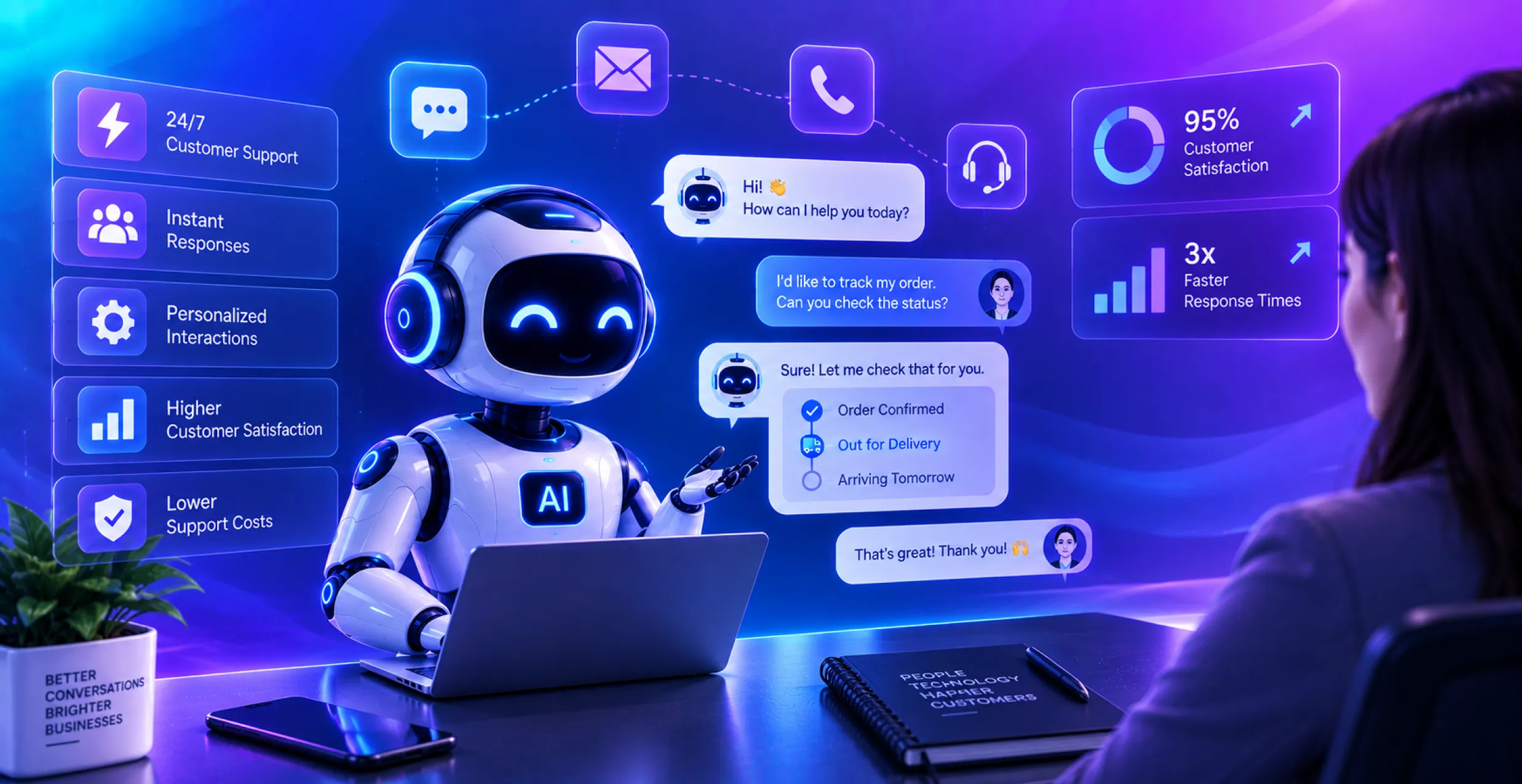
One customer ordered a laptop at midnight and the payment failed twice. She panicked, expecting no reply until office hours the next day. Instead, a message popped up within seconds, solving the entire issue. No hold music, no ticket number, just a real answer instantly. That is the shift happening across support teams worldwide right now.
Businesses are moving away from slow, reactive help desks for good. They are adopting AI customer service solutions that work around the clock. Customers today expect instant answers, not long waiting queues. AI agents deliver exactly that, without losing a personal touch. This shift is only getting faster from here.
What Are AI Agents in Customer Service?
AI agents are automated programs tasked with providing customer support. They know what to ask for, they perform and follow up requests with little supervision. The key difference between AI agents and traditional chatbots is intelligence.
The traditional chatbots are preprogrammed and they are likely to mislead authentic customers. When a question goes off script, chatbots break it down. AI agents reason and respond to context.
They extract information from your systems and address problems on-site. AI agents continue to engage in the conversation, even when the situation changes. They recall previous messages and do not repeat questions.
The focus is on reasoning, and not just on the reply, in good AI agent development. This will make the support seem more human, even if by a machine. That distinction determines if customers feel like they are truly heard or ignored.
AI Agent in Customer Services: Global Market Size
Below are the real market figures related to the AI agent in customer support:
- The global AI for customer service market was valued at USD 13,012.4 million in 2024.
- According to Grand View Research, it is projected to reach USD 83,854.9 million by 2033.
- This reflects a strong CAGR of 23.2% from 2025 to 2033.
- Autonomous AI agents are driving this growth by managing complex, multi-step customer interactions.
- These agents handle such interactions end to end, with little to no human intervention required.
Core Capabilities That Make AI Agents Different
AI agents rely on specific abilities that set them apart from basic tools. Here are the core capabilities powering modern support systems today. These features work together to create better customer experiences overall.
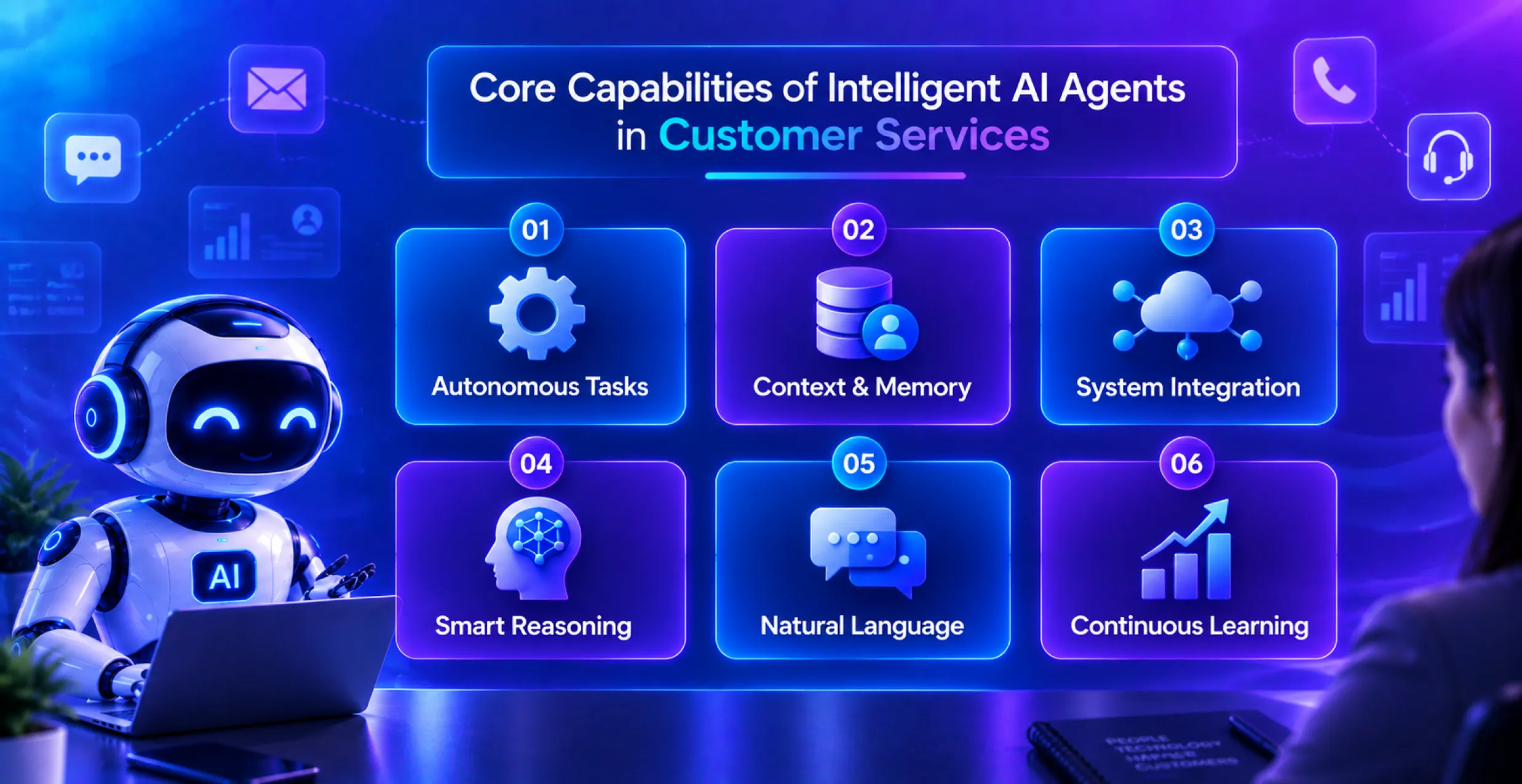
Autonomous Task Resolution
AI agents can perform tasks autonomously and without relying on human approval and oversight. They place orders, refund them themselves, and update accounts. This helps to save time for both consumers and the busy IT support team every day.
Context and Memory Across Conversations
AI agents keep track of previous discussions, even from other channels and days. Customers don’t repeat themselves because agents remember previous details instantly. This creates trust and makes support sound like it’s personal, and not robotic.
Tool and System Integration
The AI agents are able to communicate directly with CRMs, billing systems, and inventory systems. Strong AI integration services enable agents to fetch correct data in a flash. This relationships enables agents to handle problems without having to switch between tools.
Multi Step Reasoning and Decision Making
AI agents automatically decompose large problems into smaller logical steps. They make decision on what is the next best step, according to real customer context. This is the reasoning ability which can only be managed by complex requests, not simple bots.
Natural Language Understanding at Scale
AI agents have a good grasp of slang, typos, and alternative word usage. This AI development model understanding is accurate and reliable. This skill is synced across thousands of conversations simultaneously.
Continuous Learning From Interactions
The AI agents improve as they listen to every conversation, ebbing and flowing in their wisdom.As they listen to each conversation, AI agents get smarter and more noticeably so over time. They identify complaints and propose solutions before complaints escalate. This constant learning process with AI automation ensures that support quality is continually enhanced each day.
How AI Agents Are Transforming Customer Support Today?
The real impact of AI agents shows up in daily support metrics. Response times drop, resolution rates rise, and customers simply feel valued. Here is what that transformation actually looks like in practice.
Instant, Round the Clock Resolution
Support no longer sleeps, pauses for lunch, or waits for Monday morning. AI customer service automation answers questions the second they arrive. but With AI customer support solutions like Everhelp, customers in any time zone get help exactly when they need it.
Personalized Support at Scale
Every customer gets responses shaped around their own order and history. AI customer support automation removes the generic, copy paste feeling entirely. Personalization used to need large teams, but agents now handle it alone.
Proactive Issue Detection Before Customers Complain
Agents spot failed payments, shipping delays, or login errors before tickets arrive. A quick message gets sent out before frustration even has time to build. This proactive habit quietly prevents most complaints from forming at all.
Seamless Handoff to Human Agents
Not every issue suits full automation, and good systems know that clearly. Complex or emotional cases get passed to a human, with full context. Nothing gets repeated, and customers never feel stuck in a loop.
Reduced Wait Times and Ticket Backlogs
Backlogs shrink fast when routine questions no longer need a human reply. Support teams focus only on cases that genuinely need their judgment. Queue times drop, and customer satisfaction scores climb steadily as a result.
Consistent Support Quality Across Channels
Whether it is email, chat, or WhatsApp, tone and accuracy stay the same. Customers get identical, reliable answers no matter which channel they choose. This consistency builds long term trust that random human shifts rarely match.
Real World Use Cases of AI Agents for Customer Services Across Industries
AI agents are not a single solution applied the same way everywhere. Unlike generic AI tools, specialized AI agents can be configured to handle specific customer support tasks, understand customer needs, and support different business workflows. Each industry uses them differently, based on its own customer needs. Here is how different sectors are putting them to work.
eCommerce and Retail
Agents monitor orders, handle returns, and advise products in real-time interactions. The speed and accuracy in the development of AI customer service agents are emphasized here. During sales, when human teams become overwhelmed, shoppers are given instant help.
What was previously known as Amazon’s shopping assistant is now called Alexa for Shopping. Already used by more than 250 million customers. Users of this are more than 60% likely to complete a purchase. It was made possible with strong AI customer service agent development.
Banking and Finance
Balances are checked and charges are explained by agents and customers are safely guided through simple transactions. An AI virtual customer service agent validates identity prior to providing any sensitive data. This ensures that interactions are quick yet still very compliant.
In its very first month, Klarna’s OpenAI-powered assistant engaged 2.3 million customers. The resolution time was reduced from 11 minutes to less than 2 minutes per request. This AI Virtual Customer Service Agent now replaces hundreds of employees.
Healthcare
Insurance agents book appointments, send reminders and are able to clearly answer basic insurance related questions. Medical information is well guarded by strict access policies and encryption. Patients receive rapid responses without having to wait in line for admin staff.
One of New York’s biggest healthcare providers, Northwell Health, adopted an AI chatbot for making appointments. It directly manages appointment booking, rescheduling and cancellations for patients. The implementation reduced the volume of calls at a call center in the hospital system by 50%.
SaaS and Technology
Agents walk users through the setup, troubleshoot bugs instantly, and describe pricing plans. Many of these platforms emerge as a result of continuous AI app modernization of the existing support tools. This will help to decrease churn as users get “stuck” without realizing it and don’t give up.
Building these modern AI-powered support platforms also requires flexible and scalable user interfaces. Shadcn templates help developers quickly create SaaS dashboards, AI applications, and customer support interfaces with reusable components and a consistent design system.
Lightspeed Commerce is rolling out Intercom’s Fin AI agent, which is now included in 99% of its support conversations. It can solve approximately 65% of those conversations without human intervention. This is how many SaaS platforms are moving towards modernization of older support tools to become AI apps.
Travel and Hospitality
The agents work day and night for booking changes, cancellation and last minute travel disruption. Those waiting at the airport get real assistance and not a hold tune! This responsiveness directly impacts on travel brands’ reviews and repeat bookings.
Nearly 40% of customer support requests are now being answered by Airbnb’s AI-in-house agent. This is up from a few months ago when it was roughly one-third. It has a direct impact on travel brands’ reviews and repeat bookings.
Telecom and Utilities
Agents have no long queues for billing issues, outage inquiries, and plan changes. Automation is particularly useful for this industry, given the high number of tickets. Customers receive a quicker response, and customer care staff have to deal with far fewer repetitive calls.
The TOBi assistant at Vodafone processes approximately 600,000 customer dialogues per month in the markets. Approximately 74% of queries are solved within 10 seconds. Automation is particularly useful for telecom companies given that they tend to have higher ticket volumes.
What Will an AI Support Agent Cost Your Business?
Cost depends on complexity, integrations, and how much reasoning the agent needs. A simple chatbot costs far less than a fully autonomous support agent. AI customer service platform development scales in price with the features chosen.
Understanding AI app development cost early helps you plan a realistic budget. Below are practical cost ranges based on common project types.
| Solution Type | Estimated Cost (USD) | Development Timeline |
| Basic AI Chatbot | $15,000 – $25,000 | 4–6 Weeks |
| Advanced AI Support Agent | $40,000 – $80,000 | 10–16 Weeks |
| Enterprise AI Agent Platform | $100,000 – $200,000+ | 5–9 Months |
| Support Plan | Monthly Cost (USD) | What It Covers |
| Basic Monitoring | $500 – $1,000 | Uptime checks and quick bug fixes |
| Standard Support | $1,500 – $3,000 | Monitoring, updates, small feature additions |
| Dedicated Team | $2,200+ per month | A dedicated developer aligned to your roadmap |
Challenges Businesses Face While Adopting AI Agents For Customer Services
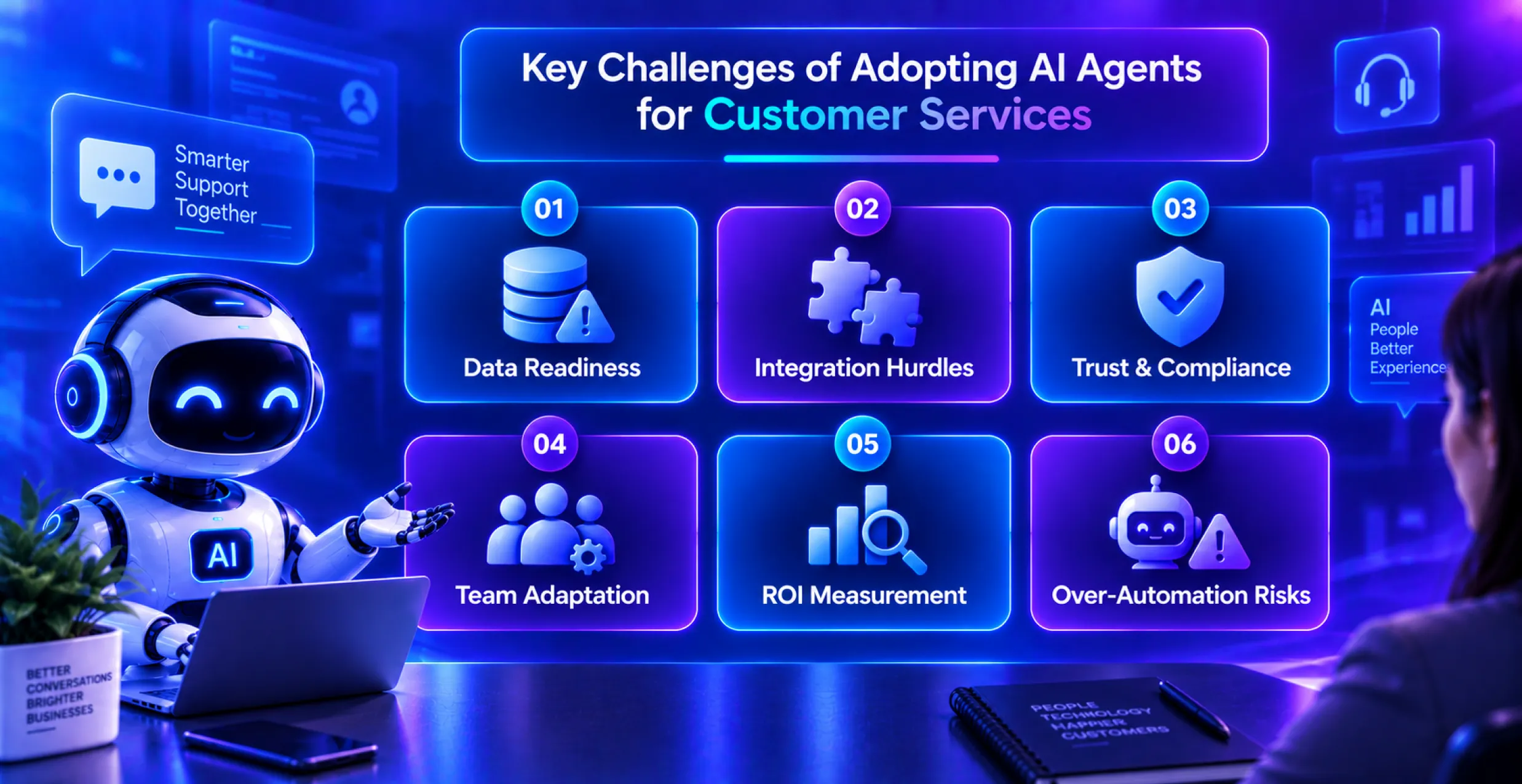
AI agents bring real benefits, but adoption is rarely completely smooth. Knowing the common obstacles ahead of time helps teams plan better.
Data Readiness
Agents require clear, organized information to provide correct and reliable responses. When records are not streamlined and organized, they waste time and slow down projects without anyone realizing it from the muddle of disconnected systems. A competent AI customer support development company rectifies this before constructing a single thing. This is when the right AI consulting can save significant time in the future.
Integration Complexity
It isn’t always easy to connect older CRMs and legacy systems together. Sometimes a customized middleware is required to connect everything together into a single workflow. This is the reason why you need to hire experienced development partners.
Trust, Escalation Design, and Compliance
Consumers must be certain that the sensitive data is delivered promptly to a human. Escalation rules should be well thought out and not simply tacked on. Compliance regulations such as GDPR and HIPAA dictate the handling of data.
Change Management for Support Teams
Some support agents are concerned that the automation will take away their job completely and unfairly. Clear Communication: Make AI a tool, not a replacement. Ensuring that staff are trained to handle exceptions helps maintain good morale while transitioning.
Measuring ROI Accurately
It’s difficult for companies to make a straightforward connection between automation and cost saving. Monitoring the resolution time, ticket volume and satisfaction ratings provide a better picture. These measurements are crucial to make continued investment in the project feel good.
Avoiding Over Automation
While it is technically feasible to automate every interaction, it is not necessary. Others just want to talk to a real person on the fast track. In the realm of AI, a reliable custom AI agent development partner strikes the delicate balance between automation and empathy.
How to Choose the Right AI Agent Approach for Your Business?
Choosing the right way can save money and save you from an unnecessary complexity down the road. You can use the following questions to identify what really works for your business.
Assess Your Current Support Volume and Complexity
Questions with high volume and repetition are ideal for automation. Highly specialized support may be more suitable to a lighter, simpler approach. Knowing this first of all helps you avoid overbuilding your system for your team.
Define Clear Escalation Boundaries
Determine from the start which scenarios can only go directly to a human agent. Those might typically fall under billing issues, health-related issues and grievances. Clear boundaries help to maintain customer trust and ensure general efficiency of automation.
Evaluate Build vs Buy Options
There are only very simple, generic use cases for which off the shelf tools are useful. For business with workflows that are distinctly different, they typically require AI customer service building solutions. AI customer service chatbot development is much more controllable in the long run. Your ongoing cost and flexibility will be determined by this decision.
Prioritize Data and Integration Readiness
Prior to development, validate that your systems can share data nicely. The most common delays in AI projects are at these points. Solving readiness problems upfront makes the actual build process much faster.
Start With a Pilot Use Case
For all, risk is reduced significantly if they launch one focused use case first. Value comes before broad investment from a single, well selected pilot. There are many teams that will only need to hire AI developers for this first step.
Plan for Continuous Optimization
Regularly reviewing performance data as a team, AI agents continuously improve their performance. Don’t view launch as a finished, final product. The process of developing a support agent with AI is an iterative and continuous one.
What’s Next: The Future of AI Agents in Customer Support
AI agents continue to rapidly evolve and the coming years will be critical. These trends are expected to influence the future of support teams.
Multi Agent Collaboration Systems
A team of specialists agents will replace one generalist agent. One person may be dealing with the billing, while another is dealing with technical issues. This division of labor is similar to the way that skilled human teams operate.
Voice Driven Conversational Support
Voice is no longer an assistive technology, it is a channel. With the breakthroughs in LLM development, natural and quick voice conversations have become feasible. People will increasingly talk to support the same manner they talk to their friends.
Predictive, Proactive Customer Engagement
Agents will be able to foresee issues by identifying patterns in customer behavior in the past. This shifts the focus of support from reactive to proactive prevention. This predictive change is driven by a large part by AI-powered customer service development. Complaints, in general, will be lower in businesses that take this proactive stance.
Deeper Emotional and Sentiment Intelligence
Future agents will be able to pick up on the tone and word choice, which will show him or her that he or she is frustrated or in a hurry. They will modify their responses as necessary, increasing in intensity when emotions are elevated. This emotional awareness closes a lot of the gap with human support.
Industry Specific Specialized Agents
Industry-specific deep learning agents will supplant the generic agents. RAG development enables agents to extract relevant answers directly from industry documents. The internal makeup of a healthcare agent and a banking agent will be vastly different.
Tighter Human AI Collaboration Models
Humans and agents will collaborate, not agent replacing human. Responses will be created by agents and approved or tweaked by staff in a timely manner. This relationship model maintains quality and also saves a lot of time.
Why Partner With Octal IT Solution for AI Agent Development?
Octal IT Solution has built digital products for global clients since 2007. Our engineers bring real experience across AI development platforms, not just theory. We have shipped chatbots, virtual assistants, and fully autonomous support agents worldwide.
Healthcare, finance, and retail clients all trust our AI agent builds. Every project starts with your actual support data, not a template. As a recognized AI customer service development company, we focus on measurable outcomes.
Faster resolutions and lower costs guide every decision we make. Our broader AI development services support teams long after launch too. That mix of experience, transparency, and long term support is what clients value most.
Conclusion
AI agents are no longer an experiment reserved for large tech companies. They are becoming the standard way businesses handle everyday customer support. Faster responses, lower costs, and happier customers all point in one direction.
Companies that delay adoption risk falling behind competitors who move faster. The technology has matured enough to handle real, complex customer problems now. What matters most now is choosing the right partner and approach.
A well built, custom AI customer service solution can transform support within months. Octal IT Solution brings the experience needed to make that transition smooth. Every solution we ship draws on genuine gen AI development expertise. The businesses that start today will simply be further ahead tomorrow.


 Get in Touch

 By
 October 23, 2026