



Key Takeaways
- The rise of AI trading apps reflects a shift in retail trading, where users demand intelligent insights beyond basic charting.
- Webull sets a benchmark with features like agentic trading, AI research analysis, and real-time simulations, becoming a key player in the market.
- Developers must focus on compliance, technology stack, and advanced features to build effective AI trading apps.
- The global market for AI trading platforms is expanding rapidly, predicted to reach $33.5 billion by 2030.
- Choosing the right development partner can significantly impact the success of an AI trading app project.
Introduction: The Rise of AI-Powered Trading Apps
Retail trading is changing rapidly. Users now expect more than charts. They want intelligent insights that support decisions. This shift is increasing demand for stock trading apps.
Every year, bigger founders explore Webull-like apps, testing the same AI depth at a fraction of the build risk. This is the platform that helped popularize AI-powered research tools and commission-free trading.
In 2026, the bar has moved. The best AI stock trading apps now need to do more than just display charts. Modern trading apps now require agentic AI, real-time sentiment scoring, and blockchain settlements. These features are now essential parts of trading platforms, not optional add-ons.
This guide breaks down what exactly it takes to build the WeBull-like platform. We will cover features, cost, technology stack, compliance, and parts that most guides overlook entirely.
Webull Unpacked: What Made It an AI Trading Benchmark
The Webull app did not win users through ads. It won them through product depth. These capabilities make Webull a useful benchmark for founders planning similar platforms. This makes it a useful reference point for companies planning to develop a stock trading app like Webull.
- Agentic Trading Through MPC
In June 2026, Webull began supporting the Model Context Protocol. It lets AI agents place trades using simple language commands instead of manual clicks. This is Webull agentic trading and Webull AI trading bot technology in its purest form. It represents one of the biggest changes in trading this year.
- Vega AI Research Analyst
Webull’s Vega Analyst conducts regular research reviews for any list of user searches. This Webull AI feature turns hours of market research into a few seconds of reading.
- Real-Time Paper Trading
With full trading simulation, Webull’s paper trading engine operates on real-time market data. Users can practice tactics in simulated market situations with Webull’s paper trading tool. It surpasses the majority of competitors.
- Order Flow Intelligence
The app flags unusual buy walls, sell walls, and institutional-sized orders before they hit the public tape. Webull algo trading gives traders insights that were once available only to Wall Street firms.
- Zero-Commission Depth
Webull extends $0 commissions to options contracts, not just stocks. That price release is now a table stake for any extreme AI stock trading app.
Market Overview: Size, Growth & Investment Opportunity
The market numbers show why this sector is attracting attention.
- The global AI trading platform market reached $16.2 billion in 2026. Researchers project the market will reach $33.5 billion by 2030, growing at a CAGR of 20%.
- North America accounts for the largest percentage, approximately 37-38% of worldwide revenue.
- Algorithmic trading is the largest application segment, accounting for almost 40% of total market revenue.
- Algorithmic trading represents a significant share of modern U.S. market activity.
- Cloud-based deployment leads the market because it scales faster than on-premises infrastructure.
- AI in investment strategies is no longer experimental; It is a popular practice in both retail and institutional settings.
This market is growing rapidly. That is why many founders are looking for a reliable AI trading app development company before competition increases.
Top 10 AI Trading Apps in the USA & UAE
Here is how modern market leaders compare across different areas. This helps founders benchmark before choosing a stock market app development company for their own app.
| Platform | Founded | Key Features | USP | Fee | Best For |
| WeBull | 2017 | Agentic trading via MCP, Vega AI analyst, order flow alerts | Deepest AI research layer on a retail app | $0 stocks/ETFs, $0 options | Traders wanting the best AI stock trading apps 2026 |
| Moomoo | 2018 | AI stock scoring, Level 2 data, community feed | Institutional-grade data at retail pricing | $0 stocks | Data-driven swing traders |
| Robinhood | 2013 | Simple UI, crypto + stocks, recurring investing | Easiest onboarding in the market | $0 | First-time investors |
| Trade Ideas | 2003 | AI scanner “Holly,” backtesting engine | Oldest AI stock-scanning engine still active | Subscription | Users wanting an AI day trading app |
| TrendSpider | 2018 | Automated technical analysis, multi-timeframe alerts | Chart automation nobody else matches | Subscription | Technical/swing traders |
| Tickeron | 2012 | AI pattern recognition, robo-advisory | Combines AI signals with managed portfolios | Freemium | Beginners wanting an AI robot trading app |
| Interactive Brokers | 1978 | Global market access, AI research tools | Widest asset coverage worldwide | Low per-share fees | Advanced/global traders |
| Sarwa | 2017 | Robo-advisory, Shariah-compliant portfolios | UAE’s trusted local robo-advisor | 0.5-0.8% advisory | Passive UAE investors |
| Baraka | 2020 | Fractional US shares, Halal filters | Dubai’s “Robinhood-style” self-directed app | $0 on select trades | Self-directed UAE investors |
| eToro | 2007 | Social trading, copy-trading, crypto | Largest social trading community globally | Spread-based | Beginners in UAE and USA alike |
Key Features: Blending AI & Blockchain in Trading Apps
Most competitor blogs stop at basic charts and static AI alerts. There are many features, from basic tools to truly advanced ones.
Core Features
- Real-Time Market Data & Charting
Live costs, candlesticks, and watchlists across stocks, options, and crypto in one dashboard. Every AI in stock market starts with secure account setup and compliance processes before users can invest.
- KYC & Automated Onboarding
Identity verification that clears SEC and FINRA assessments within minutes. Slow onboarding remains the leading cause of new trading apps losing signups within the first week.
- Portfolio Tracking Dashboard
A single view of holdings, P&L, and allocation across each asset value. Users increasingly expect platforms to update this in real time, not after a delay.
- Trade Execution Engine
Market, Limit, and Stop-loss orders, processed with sub-second latency. This speed is essential for any AI options trading app handling fast-moving contracts.
Advanced Features
- Multi-Agent Trade Negotiation
Instead of an AI model deciding the trade, multiple specific agents debate the call internally before execution. One weighs the possibility, another weighs speed, and a third checks control. Almost no one in this field is writing about this yet.
- Behavioral Bias Detection
AI detects trading revenge, panic selling, and overtrading. It alerts users to take a break before making another trade and helps reduce emotional decisions.
- Federated Learning Models
AI improves trading models using shared patterns without exposing users’ personal trading data. This improves AI stock prediction accuracy, while addressing a privacy concern many AI-powered trading apps still ignore.
- Digital Twin Portfolio Simulation
Users stress-test their real portfolios against thousands of simulated market scenarios. It allows users to test portfolios against extreme market conditions generated through AI simulations.
- On-Device AI Inference
Core prediction models run locally on the user’s phone instead of a remote server. This reduces latency and keeps trading plans private.
- Explainable Audit Trail
Each AI recommendation logs a plain-language explanation. This creates a compliance-ready record that regulators can review easily.
- Tokenized Asset Settlement
Traders can use asset tokenization alongside blockchain and smart contract solutions for faster settlements. These technologies reduce delays between transaction steps.
- Embedded Crypto Wallet
A native cryptocurrency digital wallet allows users to manage their crypto and stock assets through the platform. It supports an AI based crypto trading app without requiring separate apps.
Real-World Use Cases of AI Trading Apps
Beyond simple buy-and-sell actions, AI trading apps now solve real, precise problems. Most of these use-case examples go beyond what most guides cover.
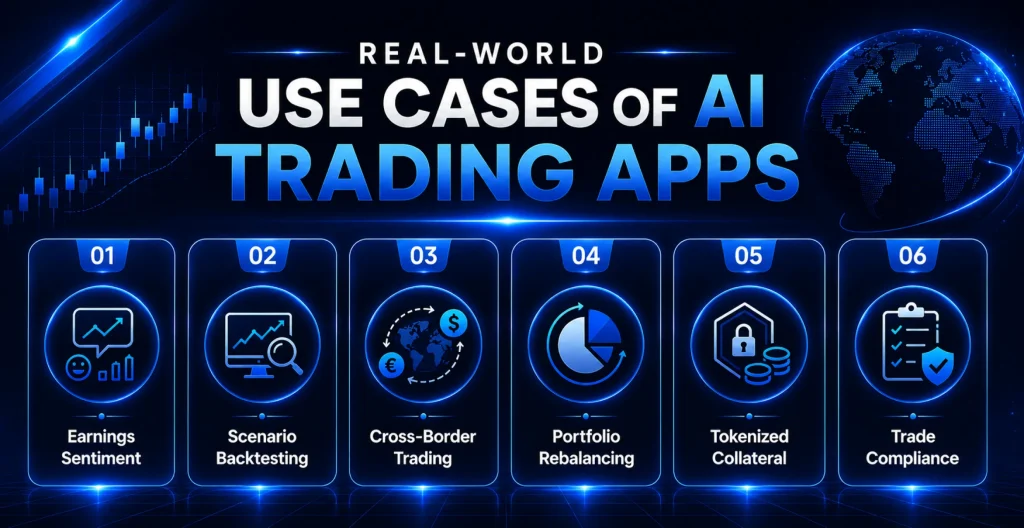
- Cross-Model Earnings Sentiment Analysis
AI reads tone and pacing from earnings call audio, not just transcribed text. It detects nervousness or confidence that written words may miss entirely.
- Synthetic Scenario Backtesting
Generative AI creates market conditions that never happened before. It tests strategies against events like rate shocks and currency crises before risking real capital.
- Cross-Border Text Optimization
AI models identify which trades trigger tax events in one jurisdiction but not another. This helps users trading across regions like the USA and UAE.
- Multi-Agent Portfolio Rebalancing
Multiple AI strategies suggest different portfolio allocations. The system selects the one with the best risk-adjusted outcome.
- Tokenized Collateral Trading
Tokenized assets infrastructure allows users to use digital assets as collateral for margin trades. This expands what counts as usable trades.
- Regulatory-Aware Trade Blocking
AI blocks trades before submission if they violate PDT rules or regional limits. This helps prevent costly compliance violations.
Teams looking to develop a crypto trading app like CoinSwitch Kuber can use many of these features and use cases in their own platform. They help improve asset management and enable faster transactions.
How Do You Build An AI Trading App? Step-by-Step Process
Building an AI trading platform follows many of the same principles as modern mobile app development, with additional AI, blockchain, and compliance requirements.
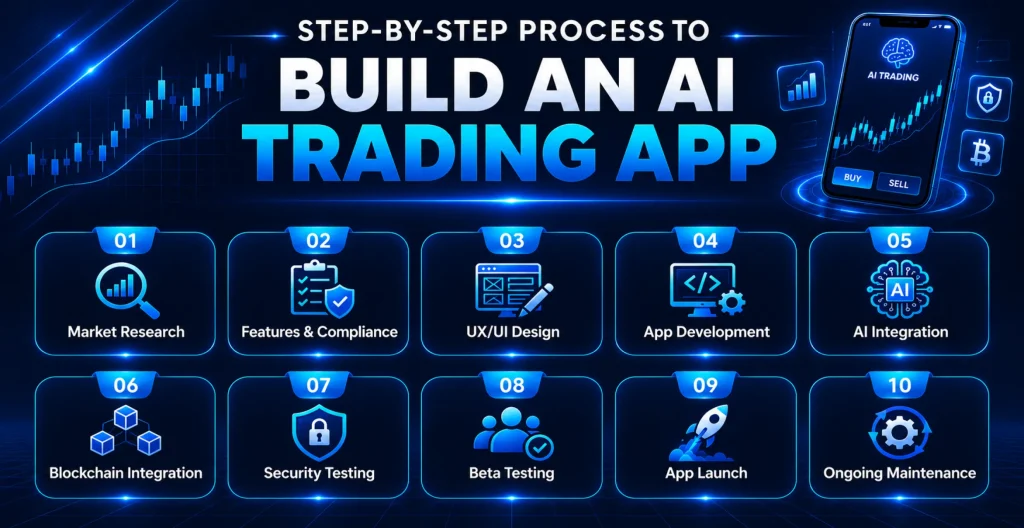
- Market & Competitor Research
Analyze regional players like WeBull, Moomoo, and Baraka to identify market gaps. This is especially important if you are planning to build a Webull clone app. Choose the exact gap that your app will fill. This research also shapes your compliance scope from day one.
- Feature & Compliance Mapping
Before you write a single line of code, align your MVP feature list with SEC, FINRA, SCA, or DFSA requirements. Skipping this step is the most common cause of expensive late-stage rework.
- UX/UI Design
Design dashboards that simplify dense financial data without hiding the level of detail that power users need. Prototype and test with real traders before committing to final screens.
- Core Development
Build account management, trade execution, and market data integration in parallel sprints. This segment typically consumes a significant percentage of your development budget.
- AI Model Integration
Train and deploy models for prediction, emotion, and agentic execution. Decide ahead of time whether you are building custom models or integrating third-party AI APIs.
- Blockchain & Wallet Integration
Add settlement layers and crypto wallets, if your app supports digital assets. Smart contract development audits need to start here, not after release.
- Security & Compliance Testing
Run penetration testing, encryption audits, and full regulatory checklists before any public release. Teams should not shorten this section just to save time.
- Beta Launch & Feedback Loop
Launch the app to a limited group of customers and closely monitor real user transactions. Use these statistics to catch AI models’ blind spots before scaling up.
- Full-Launch & Marketing
Go live in all app stores with incremental regional releases, starting with your most powerful market ready for compliance.
- Post-Launch Maintenance
Markets are changing, and AI models are drifting with them. Budget for quarterly retraining, accuracy audits, and non-stop compliance monitoring. This is the step most guides overlook, and most apps quietly fail.
How Much Does It Cost to Build An AI Trading App Like Webull?
Projects that include decentralized exchange development, blockchain settlement, and advanced AI capabilities typically require a higher investment due to additional security and compliance requirements.
The cost to develop an AI trading app largely depends on how advanced your AI level is.
| App Tier | Core Features | AI Capability | Blockchain/Crypto | Estimated Cost | Timeline |
| Basic | Account management, charting, manual trades | Simple prediction alerts | None | $40,000 – $60,000 | 2-3 months |
| Intermediate | Portfolio tracking, real-time alerts, KYC automation | Sentiment analysis, robo-advisory | Optional wallet | $60,000 – $150,000 | 4-6 months |
| Advanced | Multi-asset trading, dual-region compliance | Agentic execution, multi-agent negotiation | Full tokenized settlement | $150,000 – $300,000+ | 8-12 months |
| Enterprise | Institutional tools, white-label licensing | Custom-trained models, federated learning | Cross-chain settlement | $300,000 – $500,000+ | 12+ months |
Factors That Affect Cost
| Factor | Why It Matters | Cost Impact |
| App complexity | Agentic AI needs far more engineering than static prediction models | Can shift total cost by 3-5x |
| Platform choice | Cross-platform frameworks share code across iOS and Android | Saves 30-40% vs native builds |
| Compliance scope | Dual-market rules (USA + UAE) mean two separate legal reviews | Adds $15,000-$40,000+ |
| Data licensing | Real-time exchange data feeds carry ongoing licensing fees | $2,000-$10,000+ per month |
| Blockchain integration | Smart contracts require specialized audits before launch | Adds $10,000-$30,000 |
| AI model training | Custom-trained models cost more than off-the-shelf APIs | Adds $20,000-$80,000+ |
| Team location | Offshore teams cost far less per hour than US-based teams | $25-$40/hr vs $95-$100/hr |
| Post-launch maintenance | AI retraining and compliance monitoring never really stop | 15-25% of build cost annually |
Tech Stack: You Need To Build An AI Trading App
The right stack determines whether your app scales well or breaks under load. Here are the technologies commonly used to build WeBull-style trading platforms in 2026.
| Layer | Technology | Why It’s Used |
| Frontend | React Native, Flutter | Cross-platform speed with native performance modules |
| Backend | Node.js, Go | High-concurrency trade execution at low latency |
| AI/ML | PyTorch, TensorFlow | Custom prediction and sentiment models |
| Agentic layer | LangChain, Model Context Protocol | Natural-language trade execution, the same layer WeBull just adopted |
| Data streaming | Apache Kafka | Real-time market data ingestion at scale |
| Database | PostgreSQL, TimescaleDB | Transactional data plus time-series market history |
| Blockchain | Ethereum, Solana | Tokenized assets and on-chain settlement |
| Cloud infrastructure | AWS, Google Cloud, Kubernetes | Auto-scaling during high-volatility trading hours |
| Quantum sandbox | Amazon Braket | Early-stage portfolio risk simulation, early stage technology |
| Security | Zero-trust architecture, HSM, biometric auth | Financial-grade protection for sensitive trading data |
Compliance & Security Essentials for USA & UAE
Most trading apps struggle at this stage, because trust depends on strong compliance and security. These are the compliance and protection requirements that each sector expects.
- SEC & FINRA Registration
Every U.S. trading app must register and follow regulatory requirements. It must comply with FINRA’s updated guidelines for pattern day traders. This went into effect in June 2026. Non-compliance here can shut down operations altogether.
- SCA, DFSA and FSRA licenses
UAE apps need approval from the Securities and Commodities Authority (SCA). This may also need approval from the DFSA in Dubai or the FSRA in Abu Dhabi, depending on the target region. Each has specific disclosure requirements, primarily for groups building AI apps for crypto trading aimed at the Gulf market.
- Agentic AI Accountability Framework
When an AI agent autonomously executes a bad trade, who is responsible? Is it the user, the platform, or the model publisher? Both regions are actively working on regulatory frameworks for this area.
- Adversarial Data Poisoning Defence
Attackers can quietly corrupt the data that feeds your prediction model, causing biased or manipulated trading signals. Periodic supply audits of records and discrepancy detection are actually genuine security needs, not nice-to-have.
- Fund Segregation
The company must keep customer funds in separate accounts. Agencies cannot mix customer funds with their working capital because UK and UAE law strictly prohibits it. Mixing them, even briefly, risks revocation of the license.
- Real-Time Fraud Detection
AI models flag unusual account activity and trading patterns early. They can catch account takeovers within seconds before major losses occur.
- Third-Party Security Audits
Annual SOC 2 or ISO 27001 audits simultaneously build trust with regulators and users. Leaving these out makes it difficult to secure institutional partnerships. Every WeBull clone app development company learns this when working with enterprise clients.
Key Challenges in AI Trading App Development & How to Solve Them
Every AI trading build runs into real, specific barriers, not broad ones. Here are the challenges that honestly rise to the surface with real solutions.
- Challenge: AI models overfit to historical backtest data and fail live.
Solution: Validate each model against out-of-sample data before deployment. Also test it through paper trading instead of relying only on past performance checks.
- Challenge: Adversarial actors poison the data feeding your AI models.
Solution: Check each data source and run anomaly detection on incoming feeds. Retain versioned clean backups for immediate rollback.
- Challenge: Agentic AI creates unclear liability when trades go wrong.
Solution: Create clear user consent flows and audit trails. So that each autonomous decision has a traceable audit path.
- Challenge: Regulatory rules for AI-driven advice differ sharply between the US and the UAE.
Solution: Create a modular compliance layer that can update rules as regulations change. A brokerage app development company should make this flexibility clear from the start.
- Challenge: Real-time market data licensing costs scale fast with usage
Solution: Negotiate layered statistical contracts and collect non-critical data locally to reduce API calls. This helps control the cost when scaling AI apps for stock trading with high-volume transactions.
- Challenge: Users don’t trust AI decisions they can’t understand.
Solution: Add interpretation steps that explain the reasoning behind each recommendation. This provides more than just a confidence score and supports better AI stock trading app development.
Monetization Strategies for Your AI Trading App
Membership and commission fees alone cannot support a modern trading application. These strategies did not wipe out the sales of most competitors.
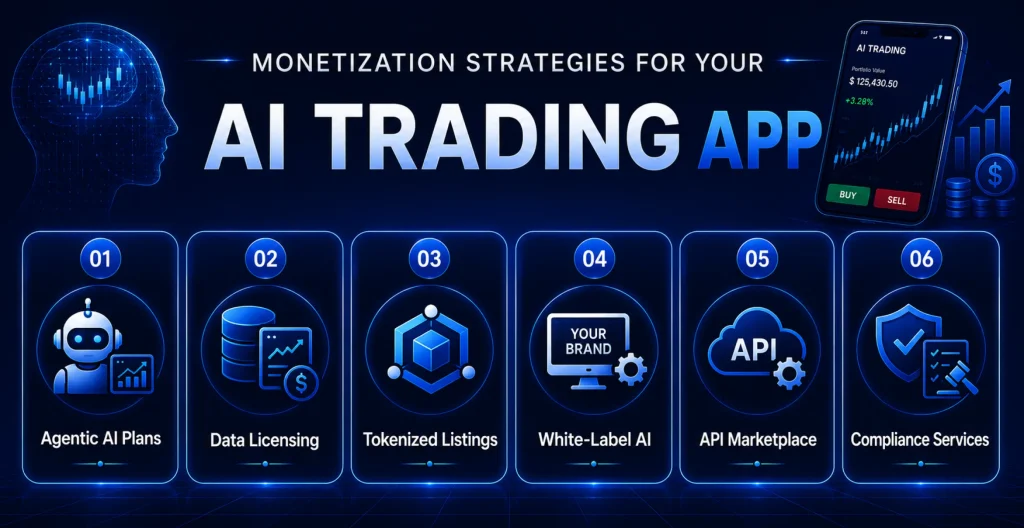
- Agentic AI Premium Tier
Charge extra for autonomous trading capabilities. This feature supports the latest and most valuable opportunities in the current market. Early adopters are already showing a willingness to pay specifically for this.
- Data-as-a-Service Licensing
Sell anonymized trading insights to hedge funds and research firms. This creates recurring B2B revenue beyond retail trading fees. This practice creates B2B sales that do not depend on the amount of retail activity.
- Tokenized Assets Listing Fees
Pay issuers to list tokenized shares or funds through their crypto exchange development infrastructure. This opens up a revenue driver linked to the payout of assets, and not just retail activity.
- White-Label AI Licensing
License your entire AI engine to smaller regional brokers or nearby agents who can’t build one themselves. This completely transforms your technology stack into a second product line.
- API Access Marketplace
Allow third-party developers to build tools on your platform for a monthly fee. This creates demand for services like hire webull API developers associative.
- Explainability-as-a-Compliance-Service
Offer your audit trail and explainability layer as a standalone compliance tool for other fintech app development companies. Regulators increasingly require these features for AI-driven systems.
The growing demand for an AI app for trading crypto allows lightweight platforms to attract customers quietly. They can later offer advanced AI features as premium upgrades.
Why Choose Octal IT Solution to Build Your AI Trading App
Many companies know how to write code, yet few understand this particular criterion. Here’s what definitely sets Octal IT Solution apart from this build.
- As a full-service AI trading app development company, we meet everything from method to launch, not just the code.
- We have built in-depth knowledge of the WeBull clone app. So you get a partner who is already aware of the level.
- For funded teams, we operate as an AI investment app development company. Our team builds a robo-advisory layer on top of a core trading engine.
- We double as a partner for fintech apps. Our team builds wallets, exchanges, and lending tools other than just trading.
- Teams that hire AI trading app developers through us will have a dedicated team, not constantly changing developers.
- Our Team has shipped the Webull portfolios system module to a client. They were looking for deeper analysis than individual applications.
- If you want a crypto Trading Bot Development for your team, we can immediately start one in a sprint.
- We create custom development for Webull dashboards. That reflect the real trading experience users expect.
- We serve as a partner for trading software development for larger enterprise-grade productions.
- As a fintech software partner for Webull-style building, we recognize the exact benchmarks you are building against.
Conclusion
Building the best AI trading app in 2026 requires more than charts and buy buttons. It requires agentic AI, blockchain capabilities, and strong compliance.
WeBull has proven that this model works, serving 28 million customers by pushing AI further than most competitors dared. The potential is real, but so is the complexity.
The right development partner makes the difference between a stable Webull clone and a successful AI-powered trading app. With deep expertise in stock trading app development, Octal IT Solution builds solutions that close that gap.


 Get in Touch
 By
By March 8, 2025