



Key Takeaways
- The article discusses how to reduce mobile app development cost by adapting to changing market dynamics.
- It emphasizes that efficiency involves prioritizing essential features rather than cutting scope.
- Key cost drivers include app complexity, platform choice, and team structure.
- Market trends like offshore development rates and AI-assisted tools greatly affect budgeting decisions.
- Proven strategies such as MVP-first scoping and modular architecture can significantly lower costs.
Let’s reframe this before we get to the strategies. Prices aren’t just high right now; the whole cost structure is changing beneath teams’ feet. This segment explains why the rest of the guide reads differently than a 2023 model would.
The Old Cost Model vs. The 2026 Reality
A single wrong decision in your first sprint can quietly double your budget before launch. For years, that felt unavoidable, a price stamped on every project the moment you picked a platform and hired a team. That old script is breaking down in 2026. AI-assisted coding, mature cross-platform tools, and managed cloud backends have changed the rules. Smart teams are finally asking the right question: how to reduce mobile app development cost without compromising quality.
What “Reducing Cost” Really Means Now (Efficiency, Not Just Cutting Scope)
Cutting costs does not imply stripping features till the app feels empty. It means spending on what moves the needle and skipping what does not. This guide breaks down the key factors that drive mobile app development cost. It also explains the market forces shaping costs through 2026 and helps you choose the right strategies.
What Actually Drives Mobile App Development Cost
Before you can cut spend, you need to know what drives it in the first place. These are the mobile app development cost factors that shape every estimate, from a simple MVP to an enterprise platform.
App Complexity & Feature Scope
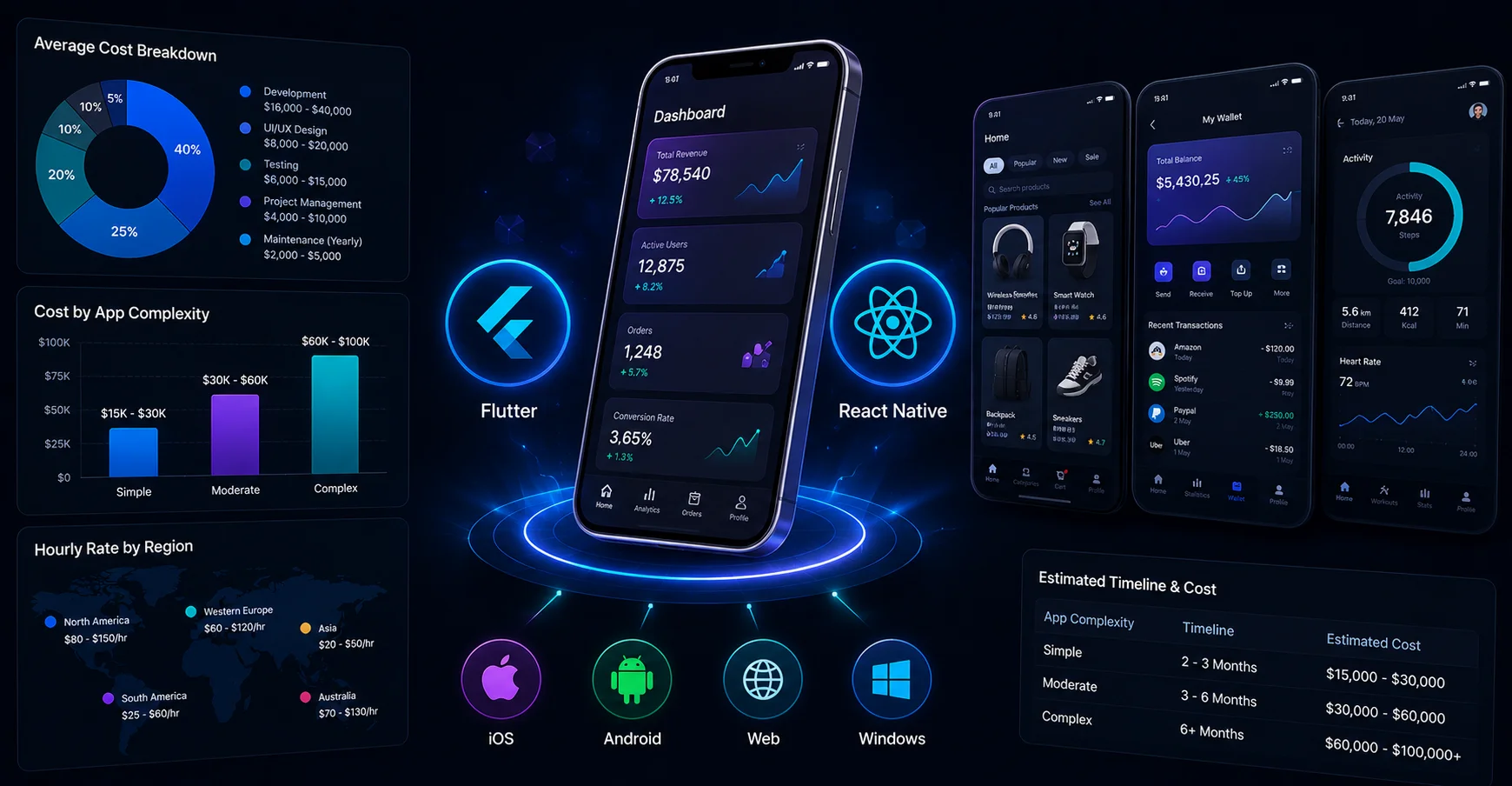
Complexity is the single biggest cost driver in any mobile app development cost estimation. A basic app with login and a dashboard costs a lot less than one packed with real-time sync, payments, and custom animations. Scope creep right here is where most budgets quietly fall apart.
Platform Choice (Native vs. Cross-Platform)
Choosing native iOS and Android separately roughly doubles your engineering efforts. Cross-platform frameworks like Flutter and React Native let one codebase serve both. That can be one of the quickest ways to cut spend without significantly affecting performance.
Design & UX/UI Depth
Custom, bespoke interfaces take longer to design and build than standard, component-based UI. A strong design system speeds up design and development and keeps future updates cheaper.
Team Location & Structure
Hourly costs vary, especially by location and whether you hire in-house, freelance, or through an organization. This single decision can change the total project cost by 30 to 60 percent.
Tech Stack & Backend Architecture
A simple backend with basic authentication costs much less. A backend built for real-time data, AI models, and millions of users costs more. The stack you choose early shapes both your launch budget and years of maintenance ahead.
| Cost Factor | Lower-Cost End | Higher-Cost End |
| App complexity | Simple utility app | AI-powered, real-time platform |
| Platform | Cross-platform (shared code | Separate native iOS + Android |
| Design | Standard UI components | Fully custom, animated UI |
| Team location | Offshore agency | US/UK in-house team |
| Backend | Basic auth + storage | Real-time sync, AI models, millions of users |
Market Trends Quietly Affecting Your App’s Budget
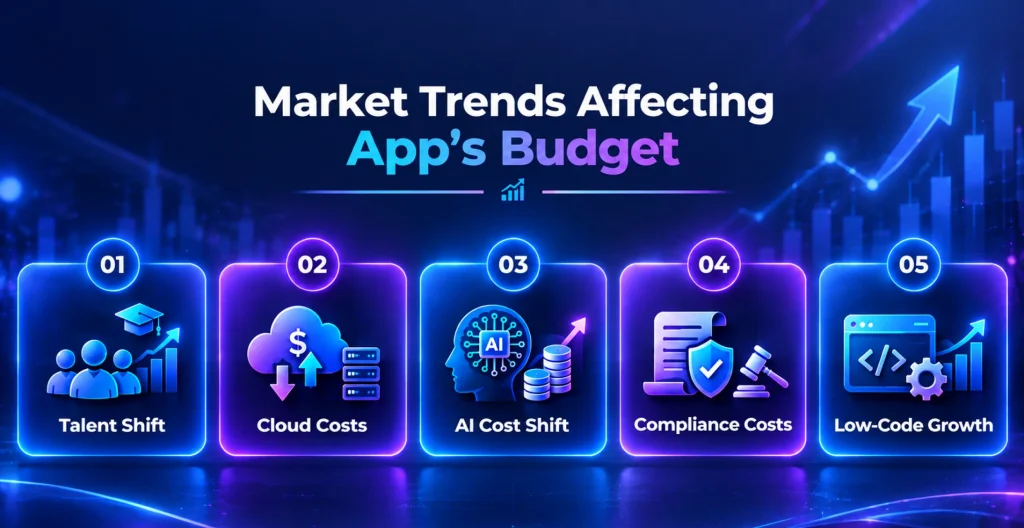
Your app’s budget isn’t shaped only by internal choices like team size or tech stack. External forces are quietly reshaping mobile app development cost optimization for every team building in 2026.
Global Talent Market Shift
Offshore hubs are not limited to India and Eastern Europe. Through 2026, cross-platform development in India runs $20 to $30 an hour. The same work in the US costs $60 to $130 per hour. That gap is precisely why mobile app development outsourcing stays one of the most reliable methods to control cost. Southeast Asia and Latin America now compete for the same projects.
Cloud & Hosting Price Trends
Cloud cost is not slowing down. Omdia expects the global cloud market to grow another 27%. AI-driven demand for compute and storage will drive most of this growth. Backend and hosting costs are rising for app teams. Efficient, managed infrastructure can help control these costs.
Rising AI Costs vs. Falling Dev-Hour Costs
Here is the paradox shaping 2026. AI coding tools are reducing development hours significantly. IBM reported a 60 percent drop in build time for internal apps using AI-assisted coding. The reasoning models behind these tools can increase token utilization up to 20 times. This increase is forcing platforms to raise their charges. The net effect still favors teams that adopt AI carefully.
Regulatory & Compliance Pressure
Privacy law is no longer a launch-day afterthought. US state laws like the CCPA now impose real compliance duties. GDPR fines still reach €20 million or 4 percent of global sales. Building compliance in early costs far less than fixing it later.
Low-Code/No-Code & Open-Source Tooling Growth
The low-code and no-code market is projected to reach $187 billion by 2030, growing at 31 percent a year. For startups and internal teams, this shift is making cost-effective mobile app development more accessible. They can now avoid writing custom backend code.
| Market Force | Where It’s Heading (2026) | Impact by 2030 |
| Offshore dev rates | Offshore cross-platform: $20-30/hr vs. US $60-130/hr | Gap narrows as more regions industrialize; outsourcing stays cost-effective |
| Cloud & hosting | Global cloud market growing ~27% this year | Managed infrastructure becomes essential to control rising compute costs |
| AI-assisted development | Build times down up to 60%, AI tool pricing rising | Net savings persist for teams that use AI on the right tasks |
| Data privacy regulation | CCPA, GDPR enforcement tightening | Compliance-by-design gets cheaper than compliance-by-lawsuit |
| Low-code/no-code | Market growing toward $187B by 2030 | Simple apps get dramatically cheaper; complex apps still need custom code |
The Cost Reduction Decision Framework
Generic advice does not work for every project. This simple framework helps you find the quickest way to reduce app development cost for your specific budget, timeline, and team.
Self-Assessment: Budget, Timeline, Complexity & Team Maturity
Answer four brief questions about your project: What is your budget? How soon do you need to launch? How complex is the build? How experienced is your team? Your answers determine exactly how to reduce app development costs for your situation, not a one-size-fits-all approach.
Which Factors Apply to Your Project
A short routing table maps your answers to specific strategies. A tight budget and a simple app point toward MVP scoping and cross-platform tools. A complex, regulated app points toward experienced outsourcing instead.
Proven Cost-Cutting Strategies (2026 Guide)
Once you understand your cost drivers, it’s time for action. These mobile app development cost-saving strategies can reduce upfront and long-term costs without hurting your product.
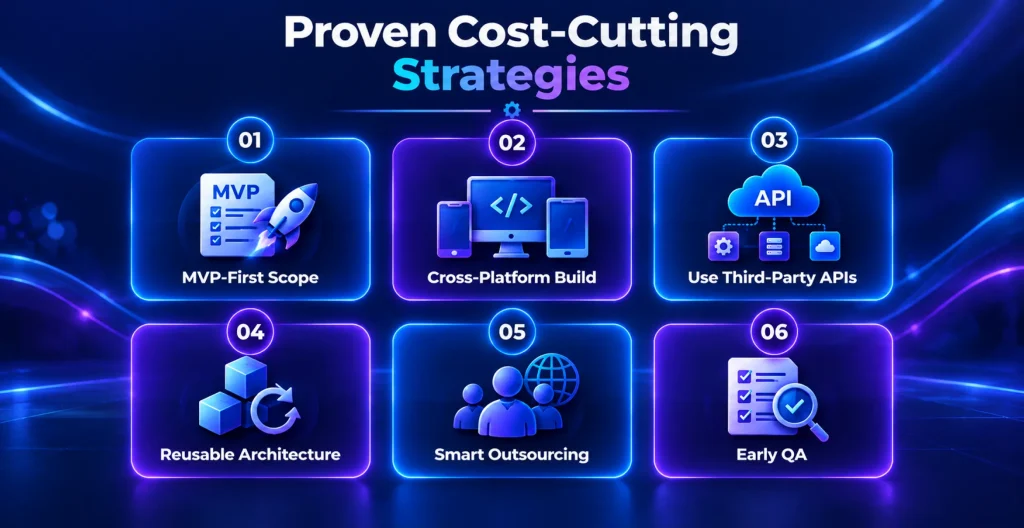
MVP-First Scoping
Launch with only the features your core users actually need. This choice can cut initial spend by a third or more, depending on the scope. It also lets you check real demand before building further.
Cross-Platform Frameworks (Flutter/React Native)
One codebase for each platform eliminates repetitive engineering work. Most teams cut spending by 20 to 40 percent compared to separate native builds. The savings become clearer when you compare Android development estimates.
Third-Party APIs vs. Custom Build
Payments, maps, chat, and authentication rarely need to be built from scratch. Established APIs can save months of development time and have already been tested at scale.
Modular, Reusable Architecture
Building in reusable components means future features and updates cost less to add. This decision pays off long after release, not just during the first build.
Outsourcing & Location Arbitrage
Partnering with a skilled offshore team can reduce hourly prices by 50 percent or more. Quality and communication requirements do not have to drop with the savings.
Early QA to Prevent Costly Rework
Catching bugs during development costs less than solving them after launch. Teams that include QA from day one avoid costly, rushed rework that takes more budget late in a project.
| Strategy | Typical Savings |
| MVP-first scoping | 30%+ on initial build |
| Cross-platform frameworks | 20-40% vs. native |
| Third-party APIs | Weeks to months of dev time saved |
| Outsourcing to India | 50%+ on hourly rates |
| Early QA | Avoids costly post-launch rework |
AI-Assisted Development: The New Cost Lever (2026-2030)
AI-assisted and agentic coding is becoming a practical way to reduce development costs.
What Vibe Coding / Agentic Dev Actually Changes About Cost
AI coding assistants now handle boilerplate code, repetitive screens, and first-draft logic. This shifts developer time towards architecture and evaluation, which changes where budget actually goes.
Where AI-Assisted Development Genuinely Saves Money
Prototyping, internal tools, and easy CRUD-style features can see the biggest savings. IBM reports a 60 percent drop in build time for internal apps using AI-assisted coding.
Where It Doesn’t (Security Debt, Complex Architecture)
Roughly 45% of AI-generated code contains security vulnerabilities, according to recent industry research. Complex structure, compliance-heavy features, and security reviews still need experienced engineers.
How This Shift Will Change Hiring & Outsourcing Decisions Through 2030
Teams are hiring fewer junior developers for repetitive work and more senior engineers for evaluation and architecture. Expect this shift to reshape outsourcing contracts well before 2030.
Hidden Costs That Quietly Break Your Budget
Even a lean build can get expensive if you overlook the costs that come after launch. These are the hidden layers of mobile app development costs that do not often show up in an initial quote.
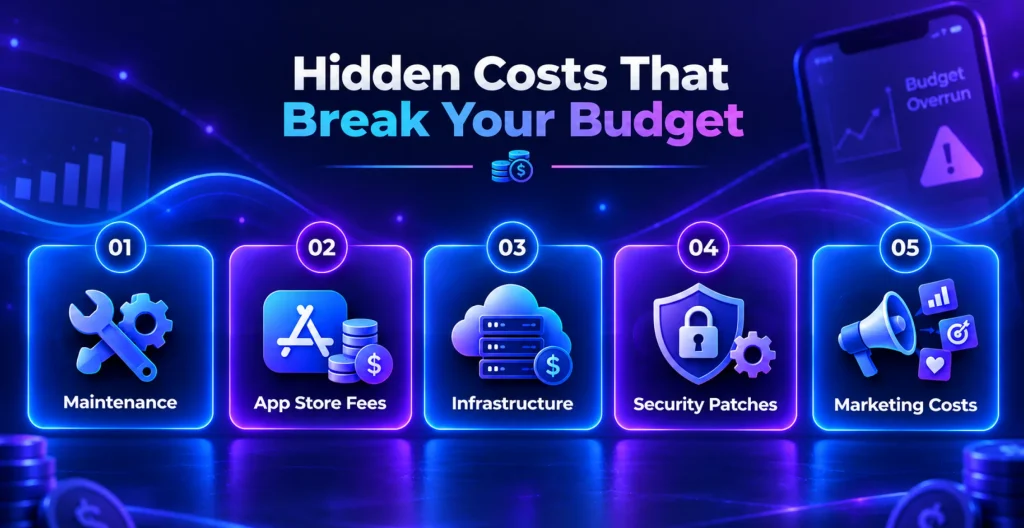
Post-Launch Maintenance
Budget 15 to 20 % of your original build cost every year for bug fixes, OS updates, and small feature additions.
App Store & Listing Fees
These fees are small but recurring: Apple charges $99 a year, Google Play charges a one-time $25 registration fee. Factor these into one-year planning.
Infrastructure & Scaling Costs
Hosting and database expenses climb with your user base. Plan for this growth curve early instead of reacting to a surprise bill.
Security Patching
Regular audits and patches protect user records and your reputation. Skipping this to save money can lead to higher costs later.
Marketing & User Acquisition
Marketing can become one of the biggest post-launch expenses, especially when you scale user acquisition. A brilliant app without an advertising and marketing plan rarely gets discovered.
Reducing Cost Without Reducing Quality: What Not to Cut
Not every shortcut is well worth taking. This is where smart teams draw the line when reducing mobile app development costs. They avoid options that save money now but cost more later.
| Category | Examples |
| Safe to cut, for now | Custom animations, a native-only build before validating demand, a large in-house team before product-market fit |
| Never cut | QA cycles, security review, real user testing, post-launch monitoring |
Cutting QA to Save Time
Skipping QA cycles appears like a quick win early on. Real users can find bugs after launch. Fixing those bugs costs more support time and can hurt users’ trust.
Skipping Security Review
A security gap discovered after a breach can cost far more than a security review would. Fixing it under pressure, with real users already affected, is far more expensive than fixing the issue during development.
Neglecting Real User Testing
Building the wrong features well is still a wasted budget. A short round of user testing before release is far cheaper than rebuilding a feature that nobody wanted.
Choosing the Cheapest Developer Over the Right One
The lowest hourly rate isn’t the lowest total cost. An inexperienced team can create rework, delays, and technical debt that cost more than the rate you thought you saved.
Future-Proofing Your Budget: 2027-2030 Outlook
Cutting costs today means little if you have to rebuild everything in two years. This segment plans your mobile app development budget for the next 4 years, not just the next 4 months.
Cross-Platform Tooling Maturing Further
Flutter and React Native keep closing the performance gap with native apps. By 2030, native-only development will likely be reserved for a small number of highly specialised use cases.
AI-Native Development Becoming Default
AI-assisted coding is moving from an optional tool to a popular workflow. Teams that build this into their workflow now can gain a cost advantage over teams that adopt it later.
Managed Infrastructure as the New Baseline
Managed cloud infrastructure is becoming the standard choice for many app teams. Managed cloud and database services reduce the ongoing engineering hours needed simply to keep an app running.
Planning Budgets Around Rising Inference, Falling Dev-Hour Costs
Separate these two trends while planning your budget. AI tool and inference costs are rising, while developer hours remain stable as feature work becomes more efficient. Plan for both when forecasting years two and three.
Real Cost-Saving Scenarios
Three quick scenarios make these strategies easier to understand. Each is drafted from common project styles, not a single named client.
Startup MVP: Scoped & Shipped Lean
A customer app initially planned at $120,000 for the full feature set. The team cut it to a $65,000 MVP and expanded it after real user testing.
Healthcare App: Compliance Built In Early
Building HIPAA and data-security requirements into the architecture from day one avoided an expensive retrofit later.
E-Commerce App: Modular Architecture Pays Off
Reusable modules can reduce the cost of adding a loyalty feature and a 2D payment gateway. They can cut the cost by roughly half compared with a rigid, monolithic build.
Why Work With Octal IT Solution for the Best Cost-Reducing Strategies
Choosing the right partner is itself a cost choice. Octal IT Solution is among the mobile app development companies that use transparent pricing for cost-conscious teams.
Transparent, Milestone-Based Pricing
You get a clear cost of developing a mobile app before work starts, broken into milestones. You can see how the budget is allocated before each milestone begins. This keeps each stakeholder aligned on spend from kickoff to launch.
Cross-Platform Expertise
Our teams use Flutter and React Native when cross-platform development fits the project. One shared codebase for iOS and Android significantly cuts iOS app development costs, compared to building native apps separately.
MVP-First Development Approach
We start most projects with a lean, focused build instead of every feature immediately. This keeps your MVP app development cost low while giving you a chance to validate the idea with real users before scaling.
Clear, Defined App Development Process
Every project follows the same structured app development process: discovery, design, development, testing, and launch. You always know which stage you are in and what it costs, instead of guessing where the budget went.
Dedicated Teams, Efficient Rates
You partner with the same skilled developers throughout your project. Our global delivery model keeps prices efficient without cutting quality. This is what makes affordable mobile app development realistic for startups and mid-size businesses.
Reliable Timelines That Protect Your Budget
Delays are one of the biggest hidden cost drivers in any project. Octal IT Solution sets a practical app development timeline in advance and tracks against it weekly. So your budget does not quietly expand the longer the project runs.


 Get in Touch
 By
By September 30, 2026