


Have you ever thought about why founders keep rushing to ship a decentralized exchange instead of going with a classic trading platform in 2026? The worldwide DEX market is likely to rise from about $53.97 billion in 2026 up to $120.65 billion by 2030. Consequently, that’s a CAGR of more than 22%. (Source: ResearchAndMarkets)
Because of that, companies are increasingly looking for professional blockchain partners. It can juggle both engineering realities and the budgeting side too. No matter where you are right now, figuring out the real DEX development cost 2026 is the first move. In the direction of building a platform that lasts and scales.
- What Is a Decentralized Exchange (DEX)? A Quick Introduction
- Types of DEX Applications and Software
- How Much Does It Cost to Build a DEX in 2026?
- CEX vs. DEX Development Costs: What's the Real Difference?
- Key Factors That Influence Decentralized Exchange Development Cost
- Cost to Build a Decentralized Exchange: Breakdown by Platform Type
- DEX Development Cost by Region: US vs. India vs. Europe vs. UAE
- Feature-Wise Cost Breakdown for a Decentralized Exchange
- Beyond the Build: Additional Costs That Add Up
- White Label DEX vs. Custom DEX Development Cost
- Decentralized Exchange Development Process: Step-by-Step
- Tech Stack Used by Top DEX Development Companies
- How Long Does It Take to Build a DEX?
- How to Reduce DEX Development Cost Without Cutting Corners
- Why Partner with a Custom DEX Development Company Like Octal IT Solution?
- Final Words
- Frequently Asked Questions
What Is a Decentralized Exchange (DEX)? A Quick Introduction
A decentralized exchange (DEX) is a blockchain-powered trading place where people can switch cryptocurrencies from their own wallets. With no middle person holding their funds. Smart contracts handle each trade automatically and in a way that’s visible to everyone.
And if you’re asking about DEX cost, then getting comfortable with this basic setup should come first. Before you start thinking too deeply about extra features, which blockchain choice, or final budget.
Types of DEX Applications and Software
Not every decentralized exchange does the same thing. Before you even start developing a decentralized exchange. Useful to grasp the 4 common models that are currently shaping what people see in today’s market.
1. Order Book DEX
This type is like a more traditional exchange, where buy and sell orders get matched by smart contracts. It tends to give exact pricing, but it also requires heavier backend logic. So it can push up the DEX development cost compared to simpler models.
2. AMM-Based DEX
With an automated market maker style, users trade against liquidity pools rather than waiting for an exact match on an order. Uniswap and PancakeSwap helped make this approach widely known. Furthermore, right now it’s still one of the quickest paths to launch a decentralized exchange platform.
3. DEX Aggregators
Aggregators like 1inch go out and check multiple exchanges to choose the best possible cost for your trade. A lot of companies also work with a dApp development company to add smarter routing logic directly into their platform.
4. Hybrid DEX
A hybrid model mixes the responsiveness people expect from centralized systems with the auditability of decentralized settlement. It’s more expensive to build, yet it’s attractive for platforms trying to serve both retail users and institutional traders.
How Much Does It Cost to Build a DEX in 2026?
The cost to build a decentralized exchange depends on how complex the platform gets. But most projects end up around $20,000 for a lean MVP and $250,000+ for an enterprise-grade build. Additionally, be sure to plan your budget realistically.
| Development Stage | Estimated Cost (USD) |
| Discovery & Planning | $3,000 – $7,000 |
| UI/UX Design | $5,000 – $10,000 |
| Smart Contract Development | $8,000 – $25,000+ |
| Frontend & Backend Development | $10,000 – $30,000 |
| Testing & Security Audit | $7,000 – $15,000+ |
| Deployment & Launch | $2,000 – $6,000 |
| Post-Launch Support (Monthly) | $2,000 – $5,000 |
- Smart contract complexity is usually the highest cost DEX driver.
- MVP-level builds can land on the lower end of each range.
- Multi-chain or enterprise builds tend to push most stages right toward the upper limit.
CEX vs. DEX Development Costs: What’s the Real Difference?
That gap between CEX vs. DEX development costs comes down to custody, compliance, and infrastructure. The centralized model leans on licensing and a matching engine, while the decentralized setup leans on smart contracts instead.
| Aspect | CEX | DEX |
| Fund Custody | Exchanges hold user funds | Users retain full custody |
| Development Cost | $200,000 – $500,000+ | $20,000 – $250,000+ |
| Licensing & Compliance | Mandatory, region-specific | Minimal in most jurisdictions |
| Core Engine | Centralized matching engine | Smart contracts/liquidity pools |
| Time to Launch | 6–12 months | 6 weeks – 6 months |
| Security Model | Single point of failure risk | No central vault to hack |
- DEXs skip custody infrastructure. This is an explanation of why on-chain crypto DEX development services can be cheaper to launch.
- CEXs can deliver faster trade execution, but they carry more regulatory overhead.
- Founders aiming at DeFi native users are increasingly choosing the decentralized route for DEX cost reasons and trust reasons.
Key Factors That Influence Decentralized Exchange Development Cost
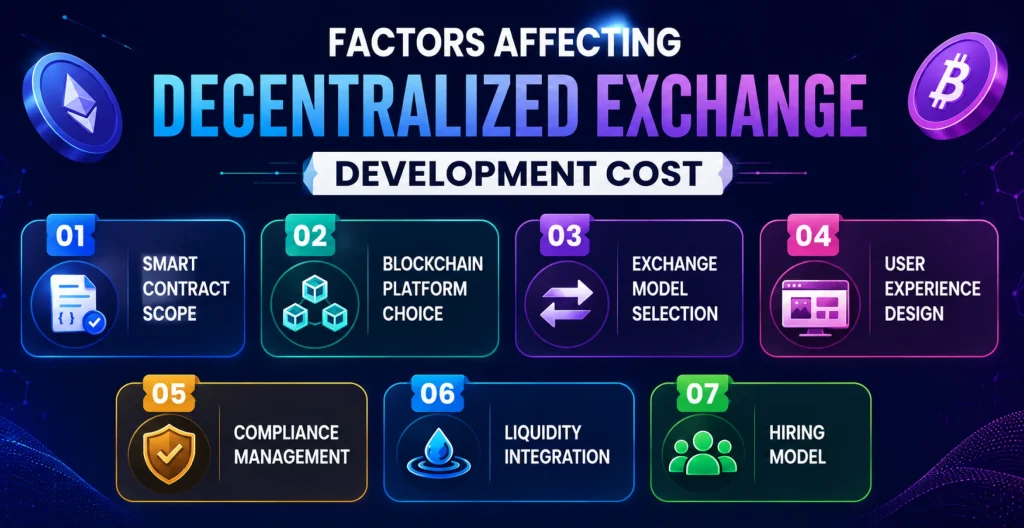
Several moving parts shape your final budget, from the tech stack to your team’s location. Here are the 7 factors that matter most when you’re estimating decentralized exchange development costs.
1. Smart Contract Complexity
Smart contract development is the technical core of any DEX; it manages swaps, liquidity, and also fee logic. The more custom functions you require, the higher the audit and coding effort ends up being and the higher the cost DEX too.
2. Blockchain Network Choice (Ethereum, BNB Chain, Solana, Polygon)
Ethereum gives you the widest reach, but you pay for it with higher gas fees. Solana, Polygon, and BNB Chain are becoming increasingly popular for cost-sensitive builds. Without giving up speed in the process.
3. DEX Type: AMM vs. Order Book vs. Hybrid Model
Each architecture requires different backend engineering. AMM models are the quickest and most affordable way to develop a decentralized exchange. Hybrid approaches are the most expensive.
4. UI/UX & Frontend Design
A clean, intuitive interface pushes user trust and adoption. Custom wireframes, prototypes, and mobile-responsive layouts all contribute to the frontend budget.
5. Security Audits & Compliance
Independent third-party audits are basically non-negotiable for any live platform that touches real money. Most serious projects should reserve funds for at least one full audit cycle before launch.
6. Liquidity Pool Integration
Bringing up and motivating liquidity pools takes both technical work and capital. Under-supported pools are one of the most common reasons new DEXs kind of stall after launch.
7. Team Location & Engagement Model
Hire DEX developers, based on swinging your budget by around 40-60%. Offshore teams sometimes deliver similar results at a fraction of US or Western European rates.
Cost to Build a Decentralized Exchange: Breakdown by Platform Type
The DEX you choose hits your final invoice right on the nose. Like, here’s roughly what each model costs to build in 2026, in straight-up dollar terms.
| Platform Type | Estimated Cost (USD) |
| AMM-Based DEX | $20,000 – $80,000 |
| Order-Book DEX | $30,000 – $100,000 |
| Hybrid DEX | $80,000 – $250,000+ |
So if you are trying to match a model to your budget. An AMM-based build still stays the most reachable way to ship a decentralized exchange project without needing heavy backend time.
DEX Development Cost by Region: US vs. India vs. Europe vs. UAE
Where your developers sit changes the numbers a lot. Below is a realistic regional comparison based on current hourly rates and typical project scope.
| Region | Hourly Rate (USD) | Typical DEX Build Cost |
| United States | $75 – $200 | $80,000 – $300,000+ |
| India | $15 – $50 | $15,000 – $60,000 |
| Europe | $50 – $120 | $40,000 – $150,000 |
| UAE | $60 – $120 | $35,000 – $120,000 |
More founders lately are doing a two-step move. They bring in blockchain consulting from lower-cost regions just to map the architecture. Then they hire locally for actual development. A sensible way to stretch a tight budget while keeping quality on track, even if you’re cautious about corners.
Feature-Wise Cost Breakdown for a Decentralized Exchange
Every extra feature you add moves the total spend, so it matters. Here’s what the most typical components cost, from wallet integrations to admin tools.
| Feature | Estimated Cost (USD) |
| Web3 Wallet Integration | $2,000 – $5,000 |
| Swap Engine (AMM Core) | $8,000 – $20,000 |
| Staking Module | $5,000 – $12,000 |
| Governance / DAO System | $5,000 – $15,000 |
| Admin Panel | $4,000 – $8,000 |
| Token Development Services | $3,000 – $7,000 |
Wallet connectivity and swap logic are non-negotiable for launch. But staking and governance pieces are better added after your core platform proves demand.
Beyond the Build: Additional Costs That Add Up
Beyond core development work, there are additional factors that often confuse founders. If you plan for them early, you avoid budget whiplash after lunch.
| Hidden Cost Item | Typical Range (USD) |
| Additional Audit Cycles | $5,000 – $50,000 |
| Liquidity Bootstrapping | $50,000 – $500,000 |
| Ongoing Infrastructure (Monthly) | $3,000 – $15,000 |
| Bug Bounty Program | $20,000 – $100,000 pool |
| Legal & Compliance Review | $10,000 – $100,000 |
| Marketing (First 6 Months) | $30,000 – $200,000 |
Working with a professional blockchain development company from the start helps you flag those costs sooner. Instead of discovering them mid-project.
White Label DEX vs. Custom DEX Development Cost
A white label DEX development path can get you to market faster and for less, while a custom build gives you real ownership.
| Aspect | White Label DEX | Custom DEX |
| Cost | $10,000 – $60,000 | $20,000 – $300,000+ |
| Timeline | 4 – 8 weeks | 3 – 9 months |
| Code Ownership | Limited | Full ownership |
| Customization | Restricted to branding/UI | Complete architectural control |
| Best For | Fast market validation | Long-term, scalable business |
Startups trying to validate an idea start as a white label setup. Finally, they switch to a custom build once trading volume and community demand make the investment.
Decentralized Exchange Development Process: Step-by-Step
Knowing the decentralized exchange development process helps you plan time and people more accurately. Below are the five core stages most serious builds go through.
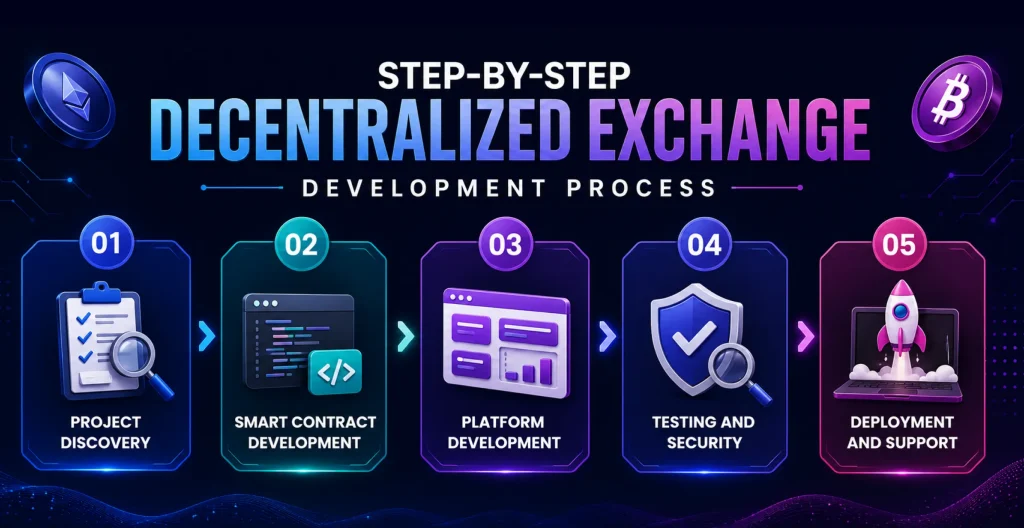
Step 1: Discovery & Planning
Here you lock in your DEX model, choose the target blockchain, and outline the core features. Competitor research and user research also get done in this phase, which shapes the roadmap before any code is written.
Step 2: Smart Contract Development
Developers write and test the contracts handling swaps, liquidity, and fees. This is the most technical stage and usually consumes the largest share of the budget.
Step 3: Frontend & Backend Build
Designers and developers connect the user interface to the blockchain layer. So you can build wallet connections, charts, and admin dashboards that actually make the platform come to life.
Step 4: Testing & Security Audit
Test every function repeatedly, and the smart contracts go through third-party audits too. Just to catch issues before any real funds are at risk.
Step 5: Deployment & Post-Launch Support
Once everything is approved, the platform pushes to mainnet, and the liquidity pools go live. However, then the crew mostly switches to monitoring, bug fixes, and continuing feature rollouts over time.
Tech Stack Used by Top DEX Development Companies
The right stack impacts both performance and cost. So, a Web3 development company will rely on a combination of tools when building a production-ready decentralized exchange in 2026.
| Layer | Common Technologies |
| Blockchain Networks | Ethereum, BNB Chain, Solana, Polygon |
| Smart Contracts | Solidity, Rust |
| Frontend | React, Next.js |
| Backend | Node.js, Go |
| Wallet Integration | MetaMask, WalletConnect, Trust Wallet |
| Price Oracles | Chainlink |
| Data Indexing | The Graph |
How Long Does It Take to Build a DEX?
In DEX projects, cost and timeline travel together. A lean MVP can be online in less than about 10 weeks; a full-featured setup tends to stretch into several months.
| Development Stage | Estimated Timeframe |
| Discovery & Planning | 1 – 2 weeks |
| UI/UX Design | 2 – 3 weeks |
| Smart Contract Development | 3 – 6 weeks |
| Frontend & Backend Build | 4 – 6 weeks |
| Testing & Security Audit | 2 – 4 weeks |
| Deployment & Launch | 1 week |
Overall, you’re often looking at 6-10 weeks for an MVP, then maybe 3-9 months for a larger platform. If your team is doing P2P crypto exchange development features next to the DEX. You should add extra weeks for the escrow rules and dispute handling too.
How to Reduce DEX Development Cost Without Cutting Corners
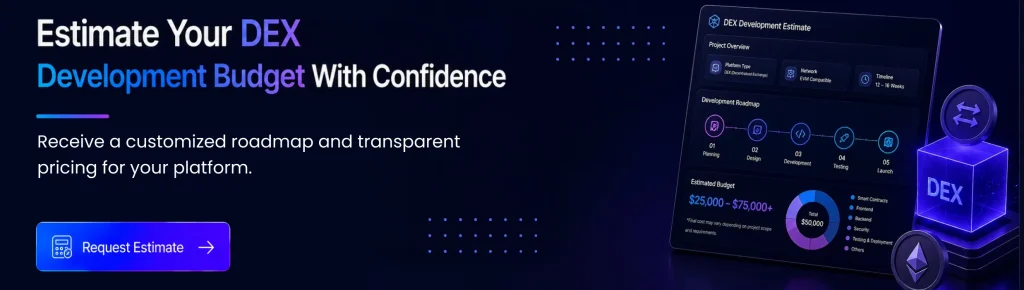
These five practices help in your DEX development cost under control in 2026, while security and quality stay intact.
1. Start With an MVP
Launch with the main things first: wallet connection and swaps. Then validate demand before you pour budget into staking, governance, or those advanced analytics modules.
2. Choose a Cost-Efficient Blockchain
Networks like Polygon and BNB Chain can give lower gas fees and faster deployment than the Ethereum mainnet. So they reduce both development effort and user costs.
3. Use Open-Source Frameworks
Forking audited protocols, like Uniswap, can cut down coding time a lot and reduce security risk. Compared to writing everything from scratch.
4. Work With an Offshore Development Team
If you select reputable teams in India or Eastern Europe, you get the same technical quality at lower prices. That is like 40-60% lower than those of US or Western European agencies.
5. Combine Automated and Manual Audits
Automated scanning tools usually catch the usual flaws early, and they do it at a low cost. So you can preserve your manual audit budget for the final, pre-launch checkpoint phase of your contracts.
Why Partner with a Custom DEX Development Company Like Octal IT Solution?
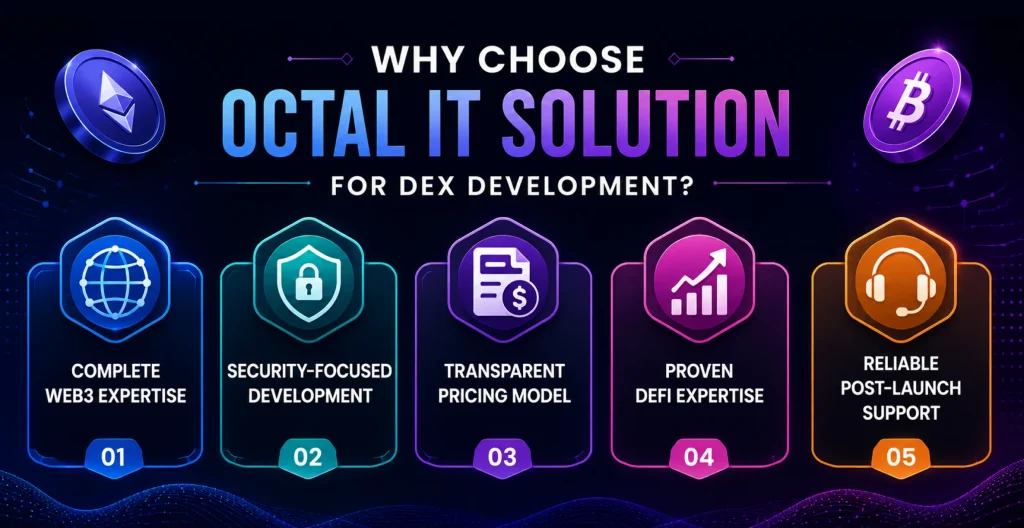
Picking the right partner shapes the whole project outcome, not just the coding part. Here’s what you can affordably expect when you work with an experienced custom DEX development company.
1. End-to-End Web3 Expertise
A capable decentralized exchange development company takes care of architecture, implementation, and deployment. So you’re not stuck coordinating several vendors across the build.
2. Security-First Development
More experienced teams build audit checkpoints into each stage. Rather than pretending security is some “last-minute” task right before launch.
3. Transparent, Milestone-Based Pricing
Clear DEX cost breakdowns by stage help you track spending and avoid the unexpected costs in custom DeFi exchange development company engagements.
4. Proven DeFi and Smart Contract Track Record
Look for teams that can show real case studies and audited code. Additionally, a prior DEX or DeFi launch, not just generic blockchain experience.
5. Long-Term Post-Launch Support
Clear cost DEX breakdowns by stage help you monitor spending. Furthermore, they reduce the unexpected costs that are quite common in DeFi development company collaborations.
Final Words
Building a decentralized exchange in 2026 is more accessible than it has ever been, with real budgets spanning from a lean $20,000 MVP all the way up to a $250,000+ enterprise platform. What matters most isn’t just hunting for the absolute lowest number. But aligning your DEX development cost with your actual business intent is crucial. Like who your audience is, which blockchain you choose, and how quickly you want to get to market.
Also, skipping security audits or even basic liquidity planning just to cut spend is still the most common thing that makes new platforms wobble after they go live. If you team up with the right technical partner and you keep a grounded budget. A DEX can turn into a sustainable, revenue-producing operation, not merely some other crypto experiment.

 By
By September 8, 2026





 Latest Stories
 Get in Touch