



The adoption of digital assets worldwide has created a tremendous opportunity for businesses to exploit blockchain technology. It can be financial institutions that allow trading crypto, merchants who allow paying with digital assets, or businesses that are considering tokenization, but crypto adoption is ever-increasing.
However, in spite of such obvious advantages, the process of introducing crypto products is not easy. Blockchain systems are highly insecure, require excellent development skills, regulation, and substantial investment in infrastructure.
The Crypto-as-a-Service (CaaS) is the solution that comes to the rescue in this scenario. CaaS allows businesses to have access to the turnkey blockchain and cryptocurrency infrastructure, including wallets, trading, custody, and compliance, through a set of easy API and integration modules.
Businesses can use the scalable, expert-backed, and secure crypto integration services as an alternative to developing crypto infrastructures themselves to launch their crypto products more quickly and efficiently.
In the guide below, let us discuss why CaaS is emerging as the most intelligent model of businesses seeking to innovate with blockchain technology, and how it is revolutionizing the development of crypto products in industries.
What Is Crypto-as-a-Service (CaaS)?
Crypto-as-a-Service offers configured blockchain infrastructure and crypto features available to businesses and embedded into their applications.
Such features might encompass wallet development, trading of crypto, transferring of tokens, automating compliance, accessing liquidity, multi-chain, and others. Businesses just add these features with the help of APIs or SDKs without creating the back-end systems themselves.
Essentially, CaaS will allow companies to embrace crypto features in the same manner that they have embraced payment gateways or cloud services. For business organizations venturing into the digital asset platform development, CaaS boosts speed in the development and, at the same time, provides security and regulatory compliance.
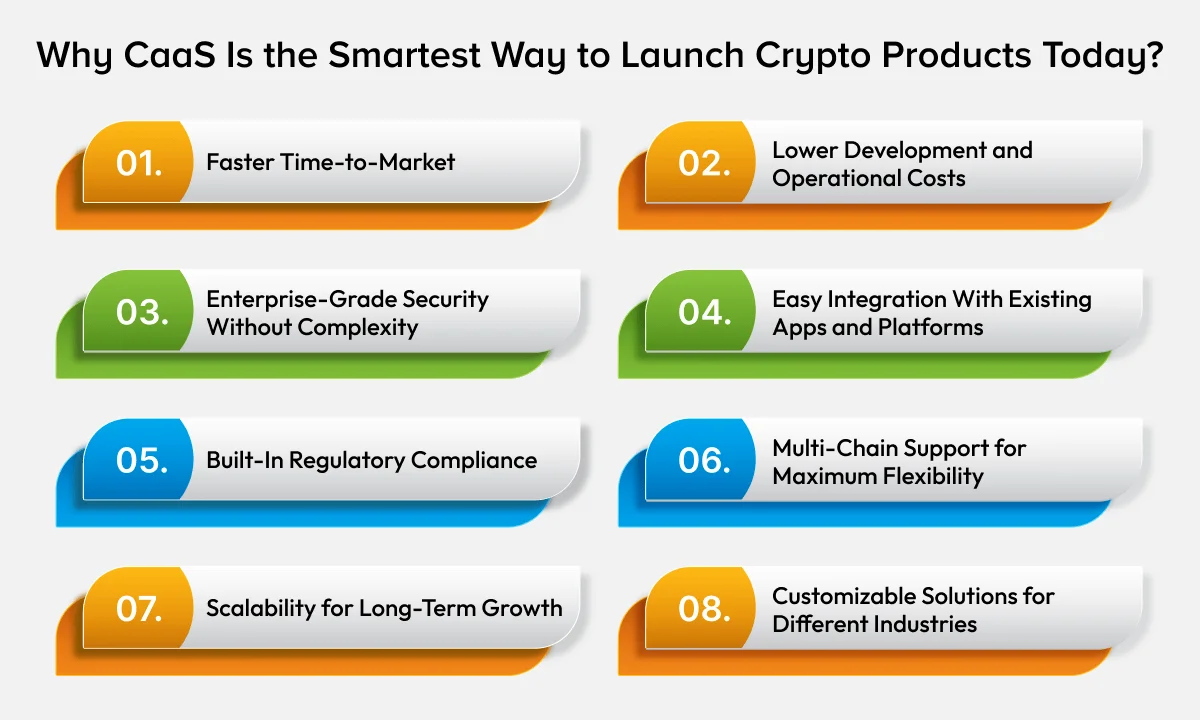
Why CaaS Is the Smartest Way to Launch Crypto Products Today?
Below are some of the key reasons why CaaS is the best way to launch crypto products today.
1. Faster Time-to-Market
The traditional process of launching a crypto product involves extensive planning, architecture, smart contracts, blockchain, node setup, and testing. This may require as much as one year or longer to complete, particularly when the business is new to blockchain.
CaaS is a significant reduction in time-to-market since all the necessary infrastructure is already established and ready to produce. APIs enable enterprises to combine such features as wallets, asset transfers, or trading in days rather than months. This is because the businesses are able to react immediately to the market trends, user demands, or competition without procrastinating on launching the products.
Speed is of the essence in both startups and businesses. First movers gain market share, attract investors earlier, and establish stronger brand positioning. CaaS enables a company to be started within a shorter period of time and at the same time achieve high-quality engineering, which cannot be achieved through custom development alone.
2. Lower Development and Operational Costs
Building crypto products from scratch is expensive. You need specialized blockchain developers, security experts, DevOps teams, compliance officers, and legal support. Additionally, operating blockchain infrastructure requires continuous monitoring, updates, audits, and maintenance, further raising operational costs.
CaaS solutions reduce these expenses by providing turnkey infrastructure and ongoing support under a predictable fee model. Businesses use the services they need without paying for full-time blockchain teams or expensive security tools. This makes CaaS ideal for companies that want to launch crypto products but lack a large development budget.
Instead of investing heavily in in-house development, businesses can allocate resources toward scaling, marketing, or user experience. As a result, crypto integration services become not just a cost-effective alternative but a smart long-term investment strategy for sustainable growth.
3. Enterprise-Grade Security Without Complexity
Security is one of the biggest challenges in crypto product development. From managing private keys and safeguarding user assets to preventing hacks and fraud, crypto platforms face significant risks. Implementing strong security measures requires advanced expertise, specialized tools, and continuous audits.
CaaS providers handle these challenges by offering enterprise-level protections such as:
- MPC (Multi-Party Computation) and multi-signature key management
- Bank-grade encryption
- Cold wallet and hot wallet infrastructure
- DDoS and fraud protection
- Secure authentication systems
- Automated risk scoring
- Real-time anomaly detection
These features ensure that businesses do not need to reinvent the wheel or worry about vulnerabilities that could compromise user trust. With CaaS, companies gain access to hardened security frameworks that have been tested across different industries and use cases.
4. Easy Integration With Existing Apps and Platforms
Businesses often hesitate to adopt crypto capabilities because they fear the integration process will disrupt their existing systems. Traditional blockchain development usually requires rewriting application architecture or building custom modules, which can be time-consuming and risky.
CaaS removes this barrier by offering plug-and-play integration through:
- REST APIs
- SDKs for web and mobile
- Webhooks
- White-label modules
- Embedded widgets
This allows businesses to add wallets, payments, or trading features with just a few lines of code. Companies exploring how to build a crypto product can integrate blockchain capabilities without significant changes to their current platforms.
Even legacy systems can adopt crypto features efficiently using middleware provided by CaaS vendors, making it easier for enterprises to innovate without operational complications.

5. Built-In Regulatory Compliance
Crypto regulations vary across countries and change frequently. Businesses must comply with strict standards around KYC, AML, suspicious activity reporting, data privacy, and financial transparency. Building these systems internally requires legal expertise, compliance automation tools, and continuous updates.
CaaS providers embed regulatory compliance directly into their platforms. They offer built-in KYC/AML systems, transaction monitoring, risk checks, identity verification tools, and audit trails. This ensures that businesses launching crypto products remain compliant from day one without needing a whole compliance team.
For companies planning crypto exchange development or crypto wallet development service, compliance-ready infrastructure is essential, and CaaS delivers it effortlessly.
6. Multi-Chain Support for Maximum Flexibility
Modern crypto users expect support for multiple blockchains, not just Bitcoin or Ethereum. However, integrating additional networks like Solana, Polkadot, Avalanche, or Polygon requires additional engineering, custom tools, and individualized node setups.
CaaS platforms include native multi-chain compatibility, allowing businesses to support several networks instantly. This boosts user accessibility and scalability, enabling companies to launch products that serve broader markets with minimal effort.
For enterprises interested in digital asset platform development, multi-chain support ensures flexibility and future-proofing.
7. Scalability for Long-Term Growth
As crypto platforms grow, they require higher transaction throughput, faster performance, and robust infrastructure that can handle global traffic. Without scalable architecture, platforms may experience downtimes, slow processing, or system failures during peak usage.
CaaS solutions are built to scale automatically. They include:
- Distributed cloud infrastructure
- Auto-scaling servers
- Optimized blockchain nodes
- Failover systems
- Load balancing
This means businesses can grow without worrying about performance issues or infrastructure limitations. Whether serving 10,000 or 10 million users, CaaS ensures consistent efficiency and reliability.
8. Customizable Solutions for Different Industries
CaaS platforms are designed with modularity in mind, enabling businesses across various sectors to tailor crypto features to their specific needs. For example:
- Fintech companies can offer crypto trading, custody, and payments.
- eCommerce platforms can accept crypto payments with built-in conversion tools.
- Gaming companies can launch token-based economies and NFT assets.
- Banks can implement digital asset investment platforms.
- Real estate firms can tokenize property ownership.
These customizable modules make CaaS adaptable to both consumer and enterprise use cases. For businesses seeking enterprise blockchain solutions, this modularity ensures efficiency and long-term scalability.
How CaaS Accelerates Crypto Product Development?
Launching a crypto product usually requires blockchain architecture design, smart contract development, backend integration, security frameworks, and compliance systems. With CaaS, businesses can bypass much of this complexity.
CaaS accelerates development by providing:
- Ready-made blockchain infrastructure
- Production-ready modules
- Easy API integration
- Smart contract templates
- Multi-chain support
- Enterprise-grade security
For organizations exploring crypto product development or services like crypto wallet development service and crypto exchange development, CaaS serves as the perfect foundation for faster innovation.
Final Thoughts
In today’s fast-evolving digital economy, adopting blockchain capabilities is no longer optional; it’s a competitive necessity. But building crypto infrastructure internally is expensive, slow, and risky. Crypto-as-a-Service (CaaS) offers a smarter, safer, and faster way to launch crypto products while ensuring compliance, security, and long-term scalability.
Whether your business wants to integrate wallets, payments, tokenization, or trading, CaaS provides the tools to innovate efficiently. By leveraging crypto integration services, companies can focus on their core business while experts handle the complexities of blockchain.
In a world shifting toward decentralized finance and digital assets, CaaS is undeniably the most strategic path forward. As a leading blockchain development company, Octal IT Solution can help you launch your own cryptocurrency.
So, connect with our developers now and create cryptocurrency like Bitcoin!
Read More : cryptocurrency exchange development companies
FAQs
Crypto-as-a-Service (CaaS) solutions provide ready-made blockchain infrastructure such as wallets, custody, trading, and compliance accessible through APIs and SDKs. Instead of building systems from scratch, businesses can integrate crypto features within days, significantly reducing development time.
This is especially useful for companies researching how to build a crypto product or looking for scalable crypto integration services.
Yes. Custom crypto product development requires specialized blockchain engineers, complex infrastructure, and high security investment. CaaS simplifies the entire process by offering turnkey, pre-secured, and compliance-ready modules.
Whether you’re planning crypto wallet development, crypto exchange development, or full digital asset platform development, CaaS reduces cost, accelerates go-to-market time, and eliminates operational complexity.
Absolutely. Most CaaS platforms offer enterprise-grade tools such as MPC-based key management, automated compliance, multi-chain support, and high scalability.
These features make CaaS ideal for organizations looking for enterprise blockchain solutions or those needing robust infrastructure to support millions of users. Enterprises can deploy secure and regulated digital asset services without maintaining in-house blockchain operations.
Any business planning to launch crypto capabilities can benefit including fintechs, banks, eCommerce platforms, gaming companies, Web3 startups, real estate tokenization projects, and more.
CaaS helps these organizations integrate wallets, payments, tokenization, or trading with minimal effort. Companies aiming to launch crypto products or expand into Web3 can leverage CaaS to innovate safely, quickly, and cost-effectively.


 Get in Touch
 By
By August 7, 2026