


FinTech still continues to transform the way businesses handle money, transactions, and data. This guide covers all the aspects of fintech software development, its main advantages and functions, cost, trends, and applications.
Startups will be able to learn how the development of financial software provides digital innovation in the banking, payment, and investment industries. We shall also explain how the industry is being transformed by the emergence of new tools such as AI in software development and Generative AI in FinTech.
Whether you want to create payment gateways or digital banking applications, this one-stop guide will enable you to see what fintech companies helps you to be successful in 2026.
Introduction
The FinTech sector is transforming consumer and business relationships to financial systems. As financial software is highly developed, companies get the opportunity to automate payment procedures, enhance data protection, and provide customers with smooth experiences. In the case of a startup, developing specific financial software will provide improved scalability, compliance, and interest in the software.
The global financial software market, valued at USD 550 billion in 2024, is expected to grow to approximately USD 1,200 billion by 2033, registering a compound annual growth rate (CAGR) of 9.55% between 2026 and 2033.
The new financial institutions have relied on custom financial software development solutions to combine analytics, AI-driven insights, and mobile accessibility. Besides, fintech software development has continued to erase the distinction between traditional banking and tech startups, providing novel lending, investment, and blockchain-based payment solutions.
Choosing one of the best financial software development companies is very important in achieving regulatory compliance, stability, and promptness of transactions, all of which are fundamental in the current competitive digital finance environment.

What is Fintech Software Development?
Fintech software development is a term used to describe the development of digital solutions used to simplify various financial activities, including banking, trading, insurance, and payments. Such applications may be either web-based, mobile, or cloud-driven to maintain more efficiency and accessibility for businesses and their users.
An experienced financial software development company is oriented on creating secure and user-friendly platforms that are applicable to regulatory requirements such as PCI DSS, GDPR, and AML. Such financial software is all the way from personal finance trackers up to large enterprise financial management systems.
Due to the dynamism of the FinTech market, it is more probable that startups choose to develop their own custom financial software to align with their business model, minimize expenses, and improve security with more advanced technologies, including blockchain and artificial intelligence. By incorporating such technologies in the applications, you can develop the best fintech mobile apps for your business.
Key Features of Financial Software Development
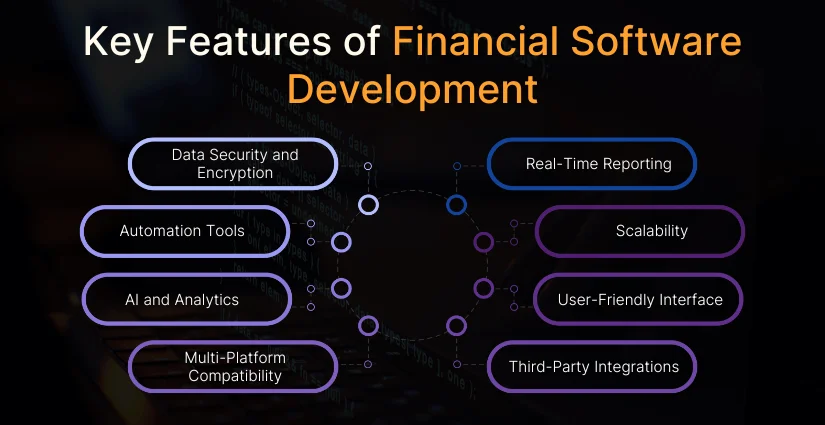
Financial software development is determined by the ability to integrate advanced features. It has some key characteristics, among which are listed below.
1. Data Security and Encryption
Data security and encryption in fintech software development have been used to safeguard confidential financial information against unauthorized access. Multi-protocols, such as the use of SSL, AES, and biometric authentication, would ensure that international standards are adhered to, which minimizes cyber threats and user confidence in all financial websites.
2. Automation Tools
Financial software development automation allows repetitive financial procedures, including billing, reconciliation, and reporting, to be automated. They reduce the impact of human error, enhance workflow, and allow faster data processing, allowing financial institutions to concentrate on innovation, customer service, and core business growth.
3. AI and Analytics
AI and analytics can be used to create financial software because the technology offers predictive analytics to mitigate risks, detect fraud, and forecast investments. With AI in software development, startups are able to provide personalized financial experiences, automate decision-making, and increase overall operational intelligence and profitability.
4. Multi-Platform Compatibility
Multi-platform compatibility guarantees that the software development solutions of financial services work harmoniously on mobile, web, and desktop platforms. It also makes it more visible, user-friendly, and flexible, enabling customers to do whatever they need with their finances wherever they are, and making the performance and the data available on all devices to perform similar operations.
5. Real-Time Reporting
Fintech software development offers real-time reporting that gives immediate access to major financial indicators, including cash flow and transactions, as well as performance analytics. It is able to facilitate prompt decision-making, bring in transparency, and enable the financial managers to respond proactively to the changes in the business operations.
6. Scalability
The custom financial software development has scalability, which guarantees that the system can scale with the increase of users, data sets, and changing business requirements. It eliminates downtime, ensures stability in performance, and enables startups to scale effectively without necessarily rewriting the system or having to overhaul the infrastructure.
7. User-Friendly Interface
Financial software development with a user-friendly interface can ease the complex financial tasks so that the user can navigate and accomplish activities effortlessly. Accessibility, engagement, and satisfaction are enhanced with the help of intuitive design, and both non-technical and technical users can have a pleasant experience of using digital finance.
8. Third-Party Integrations
Third-party integrations enable financial software development services to communicate with APIs, payment gateways, banking systems, and CRM Software Development solutions. By integrating CRM software development platforms with financial applications, businesses can manage customer data, track interactions, personalize financial services, and improve customer relationship management.
These features are customized by each financial software development company depending on the needs of the clients. Furthermore, the software development of financial services is increasingly becoming AI-driven in order to enhance personalization, fraud detection, and customer experience.
Benefits of Custom Financial Software Development
Custom financial software development offers startups several benefits over off-the-shelf tools.
Enhanced Security
The increased security of the custom financial software development guarantees the protection of vulnerable data by means of high-level authentication, encryption, and controls. The customized systems minimize the weaknesses and risks, secure transactions, and ensure adherence to the cybersecurity laws, instilling a sense of trust among the users and financial institutions.
Better Compliance
Fintech software applications are tailor-made to address regional financial controls, tax policies, and reporting policies. This assures complete legal compliance, reduces audit risks, and assists businesses in remaining transparent as they easily adjust to the changing financial laws in the country and globally.
Scalable Architecture
Scalable architecture in financial software development enables financial software applications to support more users, bigger datasets, and more transactions easily. It provides stable performance, simple feature addition, and effortless system upgrades due to the expansion of the business and the market needs.
Improved Efficiency
With the help of custom software development, repetitive financial operations such as data entry, reconciliation, and reporting are automated, which increases the overall performance. It reduces human mistakes, makes the processes faster, and enables financial departments to think about the strategy, innovation, and better customer service delivery.
Competitive Advantage
The custom financial software solutions have a competitive advantage, as they have unique features, branding, and user experiences. They help the businesses to be unique, quicker to follow market trends in the fintech industry, and offer customers more personalized financial services to appeal to and keep them.
An effective fintech software development system will streamline business activities, automation, and the accuracy of data. Startups will eliminate risks and have control over their data infrastructure by engaging a professional financial software development company.
Moreover, the services of the development of financial software allow businesses to integrate technologies, such as blockchain, AI, and cloud computing, to enhance flexibility and increased functionality that are not possible with the help of standard tools.
How AI are Transforming Fintech Software Development?
FinTech is changing the nature of the functionality of financial apps through Artificial Intelligence (AI) and Generative AI. Artificial intelligence will assist in automating fraud detection, customer check-ups, and risk analysis. Generative AI builds predictive engines, recreates market dynamics, and helps to generate automated reports.
AI-driven fintech software development allows offering a more personalized customer experience based on the insights of data. AI chatbots, smart analytics, and recommendation systems are now a common feature in software development in the financial services sector.
The inclusion of AI in software development not only improves decision-making but also lowers the operational expenses, which will guarantee improved accuracy and compliance. FinTech startups that will embrace AI are acquiring a powerful competitive advantage in 2026.
Trends in the Fintech Industry and Financial Software Development
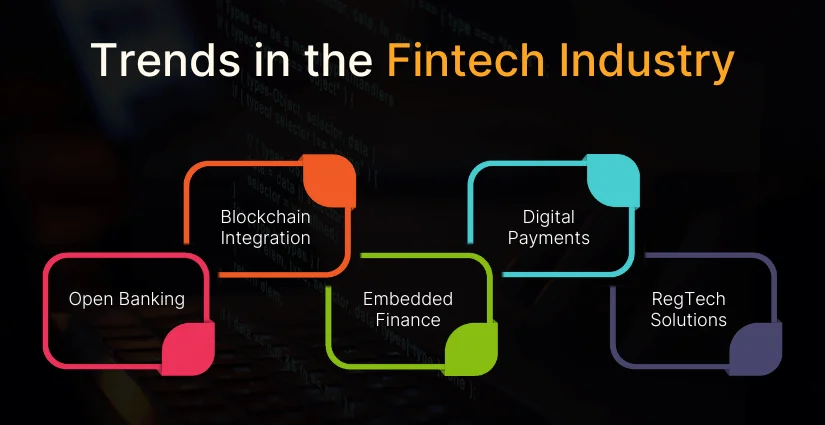
The Trend in the FinTech Industry highlights how innovation is driving smarter financial systems. Key trends are stated as follows.
- Open Banking
Open Banking facilitates the sharing of data (safely) between financial institutions and third parties to ensure innovation, customized financial services, and better control of customer financial data via standardized APIs.
- Blockchain Integration
The implementation of blockchain in financial technology will guarantee the provision of transparency, traceability, and security of data. It minimizes fraud, empowers smart contracts, and increases confidence in online transactions in the banking and financial sectors.
- Embedded Finance
Embedded finance is a financial service that offers financial products such as payments, lending, or insurance to non-financial applications, making users experience financial functionality through applications that are integrated into the e-commerce, retail, or service-based digital ecosystem.
- Digital Payments
The emergence of digital payments, such as contactless and mobile wallets, is changing the way people and companies make payments, providing more secure and faster transactions and convenient financial transactions between various devices.
- RegTech Solutions
RegTech (Regulatory Technology) eases the work of compliance management through automation and AI applications, allowing financial institutions to adapt to the changes in regulations, minimize errors in their reports, and reduce operational expenses effectively.
All trends have a direct impact on the fintech software development strategies. The new development of custom fintech software is now centered on modular and API-driven architecture to conform to new regulations and technologies.
By partnering with a reliable financial software development firm, the novelty, safety, and scalability that modern FinTech ecosystems need are guaranteed.
How to Choose the Right Financial Software Development Company?
Selecting the right financial software development company is crucial for a startup’s success. Here are key factors to consider, listed below.
- Expertise
Choose a team experienced in the development of financial services software, compliance management, and FinTech innovation to have secure, efficient, and regulation-compliant solutions to meet your business requirements.
- Portfolio
Examine and analyze the prior project examples of FinTech by the company, customer reviews, and success stories to assess their technical expertise, level of familiarity in the domain, and their capacity to offer scalable and quality financial software development solutions.
- Technology Stack
Ensure that the team is knowledgeable about the latest programming languages, APIs, databases, and encryption solutions to create trustworthy, future-proof, and high-performance applications in the custom financial software development.
- Security Measures
Make the financial software development company adhere to the international cybersecurity risks framework, such as encryption of data, access control, and adherence to the GDPR or PCI DS, to secure sensitive financial information.
- Support & Maintenance
Your financial software development is guaranteed by ongoing technical support, frequent updates, and proactive monitoring.
Development services are safe, conscientious, and in line with the emerging market and regulatory needs.
When you collaborate with a well-established financial software development firm, your own financial software development project would be viable as well as compliant.
Consultation on the new technologies is also offered by the leading FinTech App Development Company, which will allow the startups to innovate effectively without jeopardizing risk control and data integrity.
Cost Factors in Financial Software Development
Development services of financial software are more expensive with the incorporation of future technologies, such as AI, blockchain, or analytics dashboards. Custom financial software development is normally more expensive to invest in, but it will guarantee long-term ROI with custom scalability and security.
Quality can also be optimized by outsourcing to a trusted software development services provider in order to use special expertise at a lower cost.
It is true that budgeting assists startups in starting sustainable digital transformation journeys without undermining performance.
Transparent communication, agile approach, and delivering post-deployment support are the mechanisms of implementing these standards by a professional fintech software development company. The custom software development methods allow the business to react quickly and stay competitive in the volatile financial markets.
Best Practices in Financial Software Development
To ensure quality outcomes in financial software development, startups should follow these practices:
- Conduct risk and compliance assessments early.
- Choose secure coding frameworks.
- Implement continuous testing and DevOps automation.
- Include robust encryption and backup systems.
- Focus on UX and accessibility for better customer trust.
A professional financial software development company ensures these standards through transparent communication, agile methodology, and post-deployment support. Adopting custom software development approaches enables businesses to adapt faster and maintain a competitive advantage in dynamic financial markets.

Conclusion
Innovation, data security, and the automation of fintech app development are the future of its development. In the case of startups, custom financial software development provides scalability, flexibility, and adherence within a competitive financial environment.
The collaboration with a seasoned financial software development firm gives startups the capacity to develop intelligent, secure, and efficient online platforms that will boost client confidence and business competencies.
Financial inclusion and technological evolution, this is the case with financial software development services, which are becoming critical with the new tools and ongoing digital disruption. Regardless of either researching Fintech App Development Ideas or studying the most successful Fintech Mobile Apps, any startup going forward in the FinTech ecosystem would need to adopt a strategic plan, innovation, and ethical use of data in order to succeed in the modern ecosystem.


 Get in Touch
 By
By August 24, 2026