



Key Takeaways
- The demand for AI, blockchain, and embedded economic capabilities is fueling the rapid rise of the global fintech outsourcing market.
- Businesses can harvest expert talent through fintech software outsourcing without the costs and delays associated with full-fledged in-house teams.
- Any outsourcing agreement must have compliance requirements (PCI-DSS, GDPR, SOC 2).
- The fintech outsourcing cost varies widely depending on the proximity and complexity used; Using outsourcing to Eastern Europe or Asia can reduce development costs by 40–60%.
- The biggest threat is choosing the wrong partner; Development capability, IP security, and screening techniques are as important as technical knowledge.
- Almost all technical functions in fintech can be successfully outsourced, from AI risk engines to payment gateway integration.
Introduction
Despite the close relationship between technology and finance, their combo is already changing how entire organizations operate. Whether it’s a company that makes international payments in seconds, a new bank that opens without an in-person presence, or an AI-powered investment platform that makes real-time choices, fintech has evolved from a trailblazer to a mainstay.
But the fintech products are hard to grow. It requires speed, an iron-clad security structure, in-depth knowledge of economic rules, and expert skills. The vast majority of companies, new or well-established, just don’t have all that much in the workforce.
Fintech development outsourcing can help with that.
Everything you want to understand is covered in this comprehensive guide, along with what to outsource, how to outsource, how much it will cost, and how to reduce your risk. This is your broad context for 2026, whether you’re developing your first outsourced product or enhancing an already existing product.
Fintech Development Outsourcing: Market Overview
One of the fastest-growing sectors in this decade is the result of a combination of technology and finance. There is a huge need for engineering expertise that far outpaces supply as global fintech investments continue to attract billions of dollars each year.
Financial software outsourcing has emerged from a calculated approach to this talent shortage. The global IT outsourcing market is estimated to have grown from a price point of over $617 billion in 2023 to over $1 trillion by 2030. Within that, there is a vibrant vertical financial technology.
The key factors pushing this growth in 2026 are as follows.
- Talent shortage: Most Western economies, however, may have a shortage of certified fintech engineers, especially those with an understanding of blockchain, AI, and cloud native infrastructure.
- Speed to market pressure: The movement of technology funding is accelerating. Incumbent and newly established companies must deliver goods before market changes.
- Cost-effectiveness: It can cost between $150K and $250K per year to hire and retain senior fintech engineers in the US or UK. This is significantly reduced with the use of economic software outsourcing.
- Regulatory complexity: Many companies can alternatively partner with a fintech outsourcing partner familiar with regional compliance.
As a result, there is an international network of fintech outsourcing companies with knowledge on a whole range of topics from core banking modernization to mobile payment apps.
Is Fintech Development Outsourcing Right For Your Business?
Outsourcing is not a unique technique, and not all businesses are on the same level. Here is a simple way to think about it.
You’re probably a good fit for outsourcing fintech projects if:
- You have a validated product idea, but you don’t have the internal workforce to expand it.
- A fintech MVP development outsourcing strategy can help you reach the market in 3 to 4 months.
- As your business grows, you need to increase capacity without the costs associated with hiring a group of full-time employees.
- You are entering a new market and need to understand local regulations.
- Financial products or services, no longer software engineering, are your main strengths.
Outsourcing may not be an ideal option if
- Your proprietary technology is your primary competitive advantage, which must be stored in-house or under strict IP regulations.
- You build highly sensitive systems with zero tolerances for any external access.
- You don’t have someone internally to manage and communicate with the external team.
For most businesses, the fact is that outsourcing is more appropriate if you employ your provider as a partner instead of just a contractor. Fintech development outsourcing services will be most beneficial to companies that invest in the abundance of communication, special specifications, and continuous cooperation.
Why Do Businesses Rely on Fintech Development Outsourcing?
Most internal teams have difficulty keeping up with the pace of financial progress in technological environments. The following explains why so many companies decide to contract out fintech development:
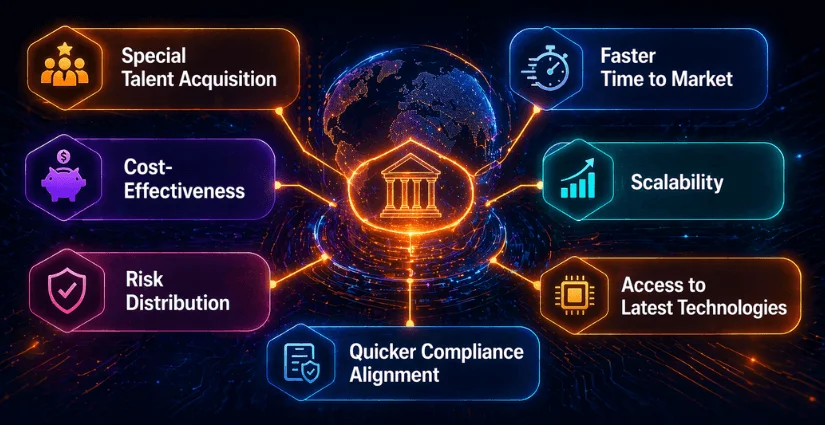
Special Talent Acquisition
It takes 12 to 18 months to assemble a fintech app development company level in-house team capable of developing a fintech app. With outsourcing, you have immediate access to engineers who have already developed business tools, credit systems, and cost structures.
Faster Time to Market
Fintech development outsourcing can significantly shorten your release timeline if you have already engaged teams. With the right partner, a product that takes 18 months to complete internally will take only 6–8 months.
Cost-Effectiveness
This is often the initial motivation for companies to explore financial software outsourcing, and it remains true. Recruitment cost, benefits, office space, and the overhead to keep all employees through recessionary times have all been eliminated.
Scalability
Do you need 5 more engineers for Function Dash? Completed. Need to downsize after release? simple. Outsourcing can provide greater flexibility than a full-time workforce.
Risk Distribution
Reliable fintech outsourcing services providers relieve some of the burden from your in-house team by taking care of transportation niches, deadlines, or even regulatory issues.
Access to Latest Technologies
Leading outsourcing companies stay ahead. You can leverage teams that are currently using Web3, AI, and ML without having to hire or train those skills yourself.
Quicker Compliance Alignment
Businesses want the fintech apps that adhere to stringent laws like GDPR or PCI DSS, which can be difficult to evaluate with internal teams. Therefore, outsourcing companies incorporate compliance frameworks so that clients can deploy business apps without encountering any delays.
What Fintech Functions and Technology Stacks Can Be Outsourced?
Financing today spans dozens of product categories, and much of the engineering effort that goes into them can be outsourced, and many more than most people realize.
Core Features Businesses Can Outsource
- Payment Systems: Build and integrate pocket infrastructure, business engines, and payment gateway integration solutions. For example, one startup created multi-foreign pockets in much less than five months.
- Banking Applications: Account monitoring, central banking platforms, and banking software solutions, including front-end interfaces and ledger logic.
- Lending Platforms: Credit scoring models, automatic insurance, and mortgage origination.
- Trading and Investment Tools: Algorithms for trading, robo-advisory engines, and portfolio management.
- Insurtech: Risk assessment, claims automation, and coverage management.
- Registration Techniques: Audit trails, compliance, and KYC/AML systems.
- DeFi and Blockchain: Tokenization, decentralized business structures, and smart contract development.
- Analytics and AI: Personalization engines, predictive risk models, and fraud detection.
Tech Stacks Commonly Used:
- Backend: Node.js, Python, Java, Go
- Frontend/Mobile: React Native, Flutter, Swift, Kotlin
- Cloud: AWS, Azure, GCP
- Blockchain: Solidity, Hyperledger
- AI/ML: TensorFlow, PyTorch, scikit-learn
- Databases: PostgreSQL, MongoDB, Cassandra
Whether you need mobile-first solutions, AI fintech development services, or fintech web development offerings, they all fall right within what experienced outsourcing teams do daily.
Use Case of Fintech Development Outsourcing
Here are some examples of real businesses using fintech product development outsourcing:
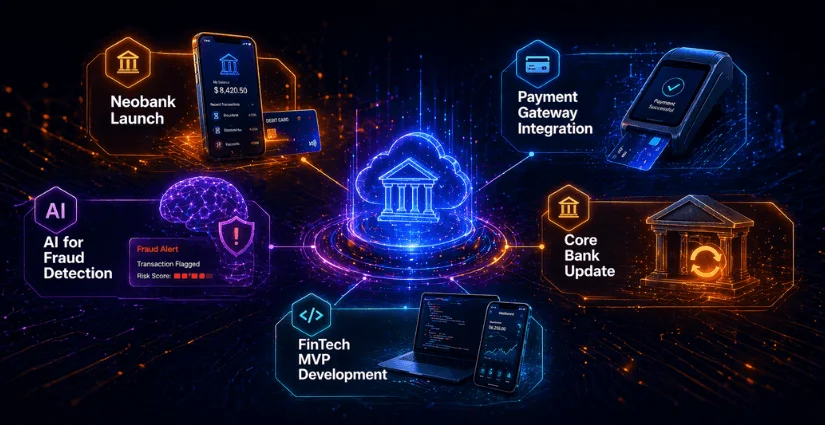
Neobank Launch
The Eastern European group was restructured to be hired by a European company to address all aspects of its mobile banking offering, such as account setup, KYC, card management, and push notifications, and the product turned into a launch in 7 months.
Payment Gateway Integration
Stripe, Eden, and neighborhood payment technology were adopted in 12 markets with the help of a US e-commerce industry business that outsourced multiple foreign currency payment processing steps.
AI for Fraud Detection
Six months later, the lending platform partnered with a team of AI experts to improve its real-time fraud scoring engine and reduce fraud-related losses by 38%.
Core Bank Update
This task, which could require more than 4 years to complete internally, was outsourced by a regional financial institution to replace its former central bank systems with a cloud-native microservice architecture.
FinTech MVP Development
Before their Series A investment, many companies hired fintech MVP development outsourcing to quickly validate product ideas by growing a useful prototype, testing with real customers, and iterating.
Outsourcing Models Options for Fintech Solutions
Choose the appropriate engagement model before you start creating. Cost, management, flexibility, and communication are all considered using this method.
Project-Based (Fixed Cost)
Ideal model for projects with a properly described scope. Works well for growing a specific workforce or outsourcing fintech MVP development. The downside is that adjusting the scope is expensive.
Dedicated Team
A whole team working exclusively for your product, including producers, a well-liked approach, and a project manager. Enterprise fintech software development outsourcing is the most ideal technique for developing applications because it allows you to manage when you are not paying for employees.
Nearshore Outsourcing
Connecting with teams in neighboring countries certainly provides an opportunity for simple communication and cultural alignment. So, this method can fit in size with cost savings if you are a Middle Eastern organization that wants to outsource fintech development.
Offshore Outsourcing
This approach works excellently when you want to collaborate with groups in far-off nations to save a significant amount of money from outsourcing. This strategy is traditional within the financial industry because innovative companies are not able to pay prices without problems, and there is always a need for skilled people.
Hybrid Method
Some groups combine internal staff with outsourceable teams; Such a balance is good for organizations that want to fulfill sensitive responsibilities internally. However, they are able to use outside expertise to accomplish the necessary innovation and speed, even when sensitive activities are retained in-house.
Staff Augmentation
Give the current team more specialized responsibilities. This is a satisfying option if you need to hire fintech developers temporarily, outside of long-term dedication.
Managed Services
The provider takes all responsibility for the production, maintenance, and assistance of the product or feature. Ideal for companies looking to fully implement mid-tech initiatives.
The dedicated team model is preferred by most companies that want fintech mobile app development outsourcing or full-platform development due to its mix of flexibility and control.
How to Outsource Fintech App Development: A Step-By-Step Process
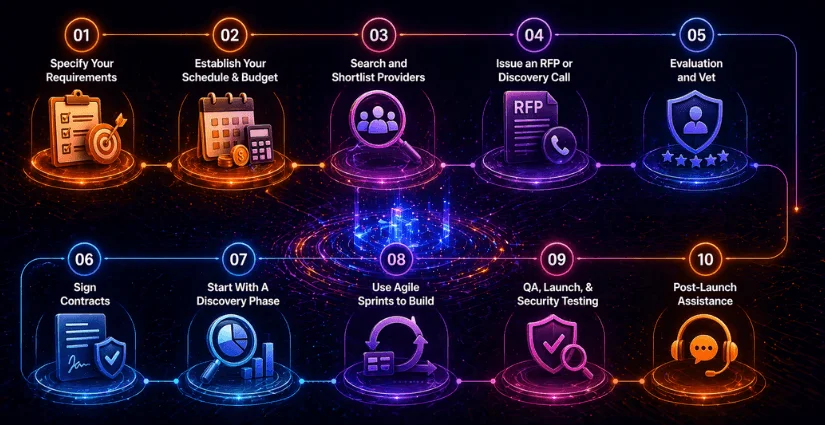
Specify Your Requirements
List target users, features, integration, and legal requirements. Your proposals may be better if your brief is clearer.
Establish Your Schedule & Budget
Confirm your Fintech outsourcing cost before talking to vendors. This determines which markets and group sizes are practical.
Search and Shortlist Providers
Investigate fintech outsourcing companies that have current projects in their portfolio. Create a short list of 4-6 businesses using LinkedIn, GoodFirms, or Clutch.
Issue an RFP or Discovery Call
Request a technical proposal from the vendors you have identified by sending them your specifications. You can use AI RFP to draft the first pass of these proposals from a shared knowledge base as well, so subject matter experts focus on tailoring the differentiating few paragraphs instead of retyping the same compliance, security, and integration answers. Asking lots of questions is a hallmark of a good provider.
Evaluation and Vet
Screen proposals, verify references, and measure technical talent. See Chapter 10 for a complete test proposal.
Sign Contracts
NDAs, IP ownership provisions, SLAs, and record processing agreements must all be in place before any images begin to develop.
Start With A Discovery Phase
Plan a structure, decide the assessment of the technology stack, break down the behavior into 2-4-week discovery streaks, and inform the team. This laid the foundation.
Use Agile Sprints to Build
Projects are kept in vision and direction with the help of weekly sprints that include demos, comment loops, and public standups.
QA, Launch, & Security Testing
Performance testing, compliance monitoring, and penetration testing are performed before going live.
Post-Launch Assistance
Assist the contractor with specific maintenance. A structured post-launch roadmap is a regular feature of the best fintech product development services.
How to Choose the Right Fintech Development Outsourcing Firm?
The most important choice you will make in your business is choosing a fintech software development company. Here’s a way to do it effectively.
Find Domain Expertise
While the apps can be implemented by sanctioned companies, fintech requires specialized knowledge of security requirements, regulatory policies, and financial protocols. Look for a fintech app development agency with an amazing financial services department.
Validate Their Compliance Knowledge
Directly ask, “How does PCI-DSS cope with compliance in customs actions?” If they make a mistake, walk away. Simple.
Review Real Portfolio
Ask for case studies from projects involving fintech software development services. Find initiatives that are compatible with what you are building.
Evaluate the Level of Communication
Unsatisfactory dialogue is the most important hidden risk in finance app development outsourcing. Assess responsiveness, English proficiency, and time zone overlap.
Clear Ownership of IP & Records
Your code can be yours. Certain contracts make it clear that you can get all work products upon payment.
Security Clearances
Partners must be SOC 2 compliant and have ISO 27001 certification. They need to conduct official conservation audits and adhere to consistent development strategies.
Security & Compliance Considerations For Fintech Development Outsourcing
Technology-related finance is subject to regulations that pure tech firms are not. Outsourcing calls for further care in this situation.
Key Compliance Frameworks
PCI-DSS
Required for all tools that manage cardholder records. This needs to be understood from an architectural angle through your outsourcing partner.
DPDP and GDPR
The processing and transmission of consumer statistics are affected by data protection legislation within the EU and India.
SOC 2 Type II
A standard of trust for service providers. Vendors with SOC 2 certification preferred.
AML/KYC Regulations
This is required in most financial product categories.
Open Banking Standards
PSD2 in Europe and RBI requirements in India are relevant in terms of account aggregation or access to third-party features.
Security Requirements (Must Have)
- Complete encryption for data in transit and at rest.
- Multi-language authentication with each entry point.
- Test timely access (preferably every launch, but at least once a year);
- Access monitoring based on the role of the development team.
- Dependency Checking and Static Code Reviews in CI/CD
Make sure your agreement actually requires these security practices when you hire fintech software developers.
Key Risks in Fintech Development Outsourcing & Ways to Prevent Them
| Challenges | What it Means | How Does It Impact Business | How to Prevent |
| IP & Data Theft | Source code or financial data accessed by vendor staff | Loss of competitive advantage, regulatory breach, legal liability | Strong NDAs, role-based access controls, and background checks on key team members |
| Communication Gaps | Misunderstood requirements due to timezone or language differences | Rework, delays, cost overruns | Structured daily standups, shared tools (Jira, Confluence), English-proficient PM on the vendor side |
| Compliance Failures | Features built without factoring in regulatory requirements | Product can’t launch, or faces post-launch fines | Include compliance review checkpoints; involve a legal advisor early in the project |
| Vendor Lock-In | Deep dependency on one vendor’s proprietary tools or undocumented code | Switching vendors becomes extremely expensive | Insist on well-documented, standard-stack code; own all repositories from day one |
| Quality Inconsistency | Junior developers substituted mid-project | Bugs, tech debt, security vulnerabilities | Name key team members in the contract; require code reviews and test coverage metrics |
| Hidden Costs | Scope creep, change requests, support gaps | Budget overruns of 30–50% vs. the initial estimate | Detailed SOW, agreed change request process, and post-launch support included in contract |
Cost Breakdown of Fintech Development Outsourcing
You can examine vendor proposals more effectively and create a practical finance plan if you are aware of the initial fintech development outsourcing cost.
Cost by Project Complexity
| Project Type | Estimated Cost Range |
| Fintech MVP (core features only) | $25,000 – $60,000 |
| Mid-complexity app (payments, wallet, auth) | $60,000 – $150,000 |
| Full-featured fintech platform | $150,000 – $400,000+ |
| Enterprise core banking/trading system | $400,000 – $1M+ |
Cost by Outsourcing Region
| Region | Average Hourly Rate |
| North America | $100 – $200/hr |
| Western Europe | $80 – $150/hr |
| Eastern Europe | $40 – $80/hr |
| India / South Asia | $25 – $55/hr |
| Southeast Asia | $30 – $60/hr |
| Latin America | $40 – $75/hr |
The exact version of the fintech software development pricing can be explained through these programs. A $500K project in the US with a similar professional team in Eastern Europe or India can cost anything between $180K and $220K.
Key Factors Influencing Fintech Development Outsourcing Cost
Seniority and Team Size
The value of a team of senior developers is much more than that of a team of a whole bunch of juniors.
Regularity Complexity
For projects that require major compliance work (PCI-DSS, SOC 2), the cost expands from 15% to 25%.
Third -Party Integrations
Every bank API integration, KYC company, and payment gateway gives times and rates.
Safety Specifications
While they may be non-negotiable, penetration testing and encryption architectures are expensive.
Post-Launch Maintenance
15% to 20% of the development cost every 12 months.
Asking providers to limit cost through phasing, discovery, development, QA, and assistance will help you estimate the cost of fintech development outsourcing. You can choose the project risk profile by being aware of the different Fintech outsourcing pricing models (perpetual, T&M, and retainer).

Latest Trends in Fintech Development Outsourcing for 2026 & Beyond
A new stage begins within the combination of production and finance. Outsourcing fintech projects will be affected by the following factors in 2026:
AI-First Development
The fastest-growing market is AI fintech development services. AI is now a fundamental skill rather than a luxury, from LLM-powered financial advisors to automated underwriting and real-time fraud detection.
Finance Embedded
Technology makes delivering finance invisible by integrating it into chain tools, HR systems, and e-commerce. This is driving the demand for outsourced fintech web development services that include financial capabilities for non-financial products.
Cloud Design
The transition to cloud-native infrastructure and microservices is happening fast. These days, custom fintech software development is continuously enhanced by cloud-first architecture on AWS, Azure, or GCP.
RegTech Automation
Automation requires consistency. Financial companies are creating computerized KYC, AML, and reporting systems with the help of outsourcing teams by understanding RegTech, significantly reducing compliance fees.
Nearshore Outsourcing Growth
For time zone synchronization, American companies are increasingly selecting teams from Latin America. Eastern Europe is becoming increasingly popular with European companies. Nearshoring combos tie in nicely with cost discounts.
Open Banking Ecosystem and APIs
Open banking APIs are used to produce multiple fintech product development services with rapid innovation in mind, without starting from scratch with a mediocre infrastructure.
Octal IT Solution Built Smoov: A Fintech Payment App for a Global Market
Octal IT Solution was chosen by a fintech client who wanted to outsource services and needed a scalable, secure digital payment platform designed for customers worldwide. This is how the project was completed.
Project Brief
The client asked for a business and peer-to-peer payment app that allowed users to split bills, send money, visually adjust expenses, and pay in their native language. Transactions seemed as natural as sending a message because contacts must be accessed immediately from cell phones. From the beginning, the platform had to be stable, consistent, and ready for the global target market.
| Industry | Fintech / Digital Payments |
| Product Type | P2P & Business Digital Wallet |
| Platform | iOS & Android |
The Challenges
1. Regulatory Compliance
Comply with KYC, AML, and payment requirements of authorities in many markets with the help of the software; Compliance should have been incorporated into the preferred architecture to be enforced later.
2. Security At Every Layer
Running with real money and data, there is no place for error. From the beginning, secure information processing, static authentication, and multi-layer encryption were inevitable.
3. UX Simplicity
Contact and native payments, bill splitting, visual analytics, and multilingual assistance should all work together without overwhelming the user.
4. CrossBorder Functionality
Internationalization at the level of structuring became essential to navigate the many currencies, value paths, and languages written from right to left, preferring only the level of translation.
Our Approach
Before they touched the interface, the Octal team was at the forefront of compliance and protection. They used secure transaction processes, encrypted information storage, and KYC-ready identity verification on top of an infrastructure that connects with regulatory requirements first in consideration.
Without the need for account numbers or routing, the contact-native payment flow was modified to connect directly to a person’s phone. Instead of providing customers with a flat transaction list, expense insight was elevated as a visible layer within the app. Multilingual assistance, multi-foreign money control, and bill sharing were all intended as internal capabilities in terms of conversions.
Outcomes
- Payment platforms that are fully tailored to all target markets
- Anonymous, secure infrastructure designed for excessive transaction volume within the real world
- Context-aware user interface that reduces payment friction to just a few seconds
- Visual cost analysis distinguishes Smoov from convenient pricing methods.
- Multilingual assistance that does not affect individuals’ experience across geographical barriers
- After launch, the user’s audience actively adopts
Why Octal IT Solution is the Best Choice for Fintech Development Outsourcing?
For all the right reasons, Octal IT Solution stands out as a trusted development partner to outsource fintech app development.
Octal IT Solution is one of the top fintech app development companies with a team that understands the technical and regulatory aspects of each fintech technology, as well as deep domain information and a track record of successful project delivery.
1. 18+Years of Experience
Octal has been developing mobile products since 2007. Every architectural choice they make reflects this institutional understanding.
2. Complete Fintech Expertise
Practical knowledge in banking, wealth management, insurance, lending, and payments; not ordinary web development converted for fintech.
3. Comprehensive services
The entire fintech software development services under one roof, with idea, architecture, development, best warranty, launch, and relentless maintenance.
4. AI-Powered Development
Octal’s AI-powered Fintech development framework allows clients to hire a team that has already invested in the technology to develop iOS apps with AI capabilities, personalization, fraud detection, and predictive analytics.
5. Compliance-Ready Builds
PCI-DSS, GDPR, and financial requirements are taken into consideration from the very beginning of every project.
6. Clear Pricing
Whether you are considering outsourcing fintech MVP development or creating in-house enterprises, the value of fintech software development is transparent and without hidden costs.
7. Custom Engagement Models
Whatever works for your level and budget – dedicated groups, fixed-price campaigns, or staff augmentation.
8. Effective Communication
Sprint demos, frequent updates, and a dedicated project manager who acts as your single point of contact are all features of structured agile transportation.
9. Enterprise Standards
CMMi Level 3 assessed and ISO 9001:2015 certified, a startup MVP is subject to the same level of scrutiny as a Fortune 500 build.
10. Global Presence
Having a registered office in the UK indicates that they are familiar with the local market and legal system. Global delivery from Singapore and India translates into enterprise-level iOS development.
Octal IT Solution is worth discussing if you are planning to outsource fintech app development to a partner who has done it successfully in the past.

Wrapping It Up
Fintech development outsourcing is now a strategic advantage over backup planning. Technology is moving funding along more quickly than any in-house team can keep up with, and outsourcing providers are accessing an international pool of skills that is deeper, more specialized, and cost-effective than ever before.
Today, the successful fintech companies are those that can be dedicated to their product vision and collaborate with ideal technical teams to execute it. Outsourcing gives you the speed, information, and agility to compete, whether you’re developing your first fintech MVP, developing an invoicing platform, or modernizing an existing economic structure.
Use this guide to make informed decisions about what to outsource, who to trust, what the price range is, and how to keep it secure. The right fintech outsourcing partner will do more than improve your product in every way. They will help you build the right one.


 Get in Touch
 By
By August 24, 2026