


The telecom industry is undergoing a huge transformation, and IoT is at the heart of this evolution. With the increasing demand for hyper-connectivity, 5G, and smooth digital experiences, to optimize operations or to improve the delivery services, telecom business owners are integrating IoT in telecom and unlocking business models.
Do you know that according to Statista, the total IoT market globally is expected to grow to approximately 419.8 billion U.S. dollars in 2025, and rise to more than 908 billion U.S. dollars in 2034, more than doubling its revenue in ten years. There are multiple research studies as well, which show that including IoT in the system can improve the performance and cost by $ 1.2 trillion. Yes, we know this is huge for only one factor. There are multiple other factors that are improved when integrating the Internet of Things into your system. Thus, you can anticipate how IoT can be helpful for your business and can be a factor in achieving heights in the market.
In this blog, we will cover all the required information you need related to the integration of IoT in telecommunications, its benefits, and key use cases in the present and upcoming years.
What is IoT in Telecommunications?
In brief, IoT requires telecommunication networks to enable enhanced communication, monitoring, and management of connected devices.
But first, let’s back up for a second and explain the definition of IoT, or the Internet of Things. In short, it’s things (refrigerators, freight trucks, water sprinklers…) being enabled to send information back and forth via the internet with the help of sensors, often connected with SIM cards just like the one in your mobile phone. Your smartwatch, that location tracker in your luggage, and the ability to fire up your apartment A/C unit from work so that it reaches the perfect temperature just before you get home is all IoT. And on the industrial level, IoT sensors can now be found in everything from factory equipment to irrigation systems.
So, the role of telecommunications in IoT is to provide the networks that actually enable all the “things” in the Internet of Things to communicate with each other. And by combining IoT devices with the speed of 5G, telecom operators can accelerate that network performance, setting the stage for the rapid advancement of IoT into robotics, security, health care, and any other sector that needs real-time response.

Latest IoT Technologies Used in Telecommunication to Support Growth
With the help of the latest technologies and innovations of IoT are impacting the whole telecommunication industry. Here are some of the key ones we have included in this section.
Sensors: These are the physical devices that detect and measure the physical parameters of the environment and convert them into electrical signals. These signals are then sent to the connected systems with the help of the internet for further processing and analysis. You can also say the sensors play the role of a bridge between the physical and digital world in IoT systems.
Connectivity: Every IoT device requires a reliable and ubiquitous connection to transmit the data. Telecommunication networks, including lower power wide area network (LPWAN,) critical tech for rural areas, provide the necessary infrastructure for smooth communication between devices.
Data Processing and Analytics: IoT in telecommunication generates vast amounts of data from towers, customer devices, and network systems. Advanced data processing tools and analytics platforms help convert this raw data into actionable insights. With predictive analytics, telecom operators can foresee maintenance needs, optimize resource allocation, personalize customer experiences, and streamline operations. This leads to increased efficiency and better decision-making across all layers of the telecom value chain.
IoT Platforms: IoT platforms act as centralized hubs that manage device connectivity, data ingestion, analytics, and application integration. These platforms offer telecom companies a unified environment to control, monitor, and scale their IoT ecosystems. Whether it’s managing thousands of connected sensors or integrating AI and ML models for smarter automation, robust IoT platforms play a vital role in delivering agile, secure, and scalable telecom services.
Also Read: IoT in Automotive Industry: Key Use Cases and Benefits
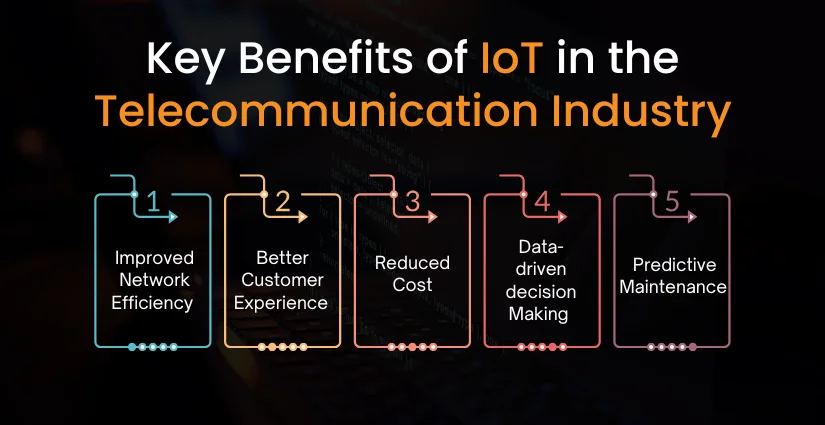
Top Benefits of IoT in the Telecommunication Industry
There are multiple benefits of including IoT in telecommunication. IoT offers telecom providers various opportunities to enhance their services and overall performance. By incorporating digital transformation services, telecom companies can leverage IoT to streamline operations, automate processes, and better meet the evolving needs of their customers. Below are some of the most significant benefits that IoT brings to telecom.
Improved Network Efficiency
One of the top benefits of the IoT in telecommunication is the ability to optimize network performance. With IoT-enabled sensors, operators can monitor network health in real-time, detecting and resolving issues before they affect service quality. This leads to reduced downtime, enhanced performance, and extended network equipment lifespan.
Better Customer Experience
Telecon IoT providers can use the technology to offer more use-case-specific services. By collecting and collating data on network usage and customer behavior, operators can plan out and build service offerings to address specific customer goals. This does not just elevate customer satisfaction but also helps lower the system churn rates, keeping customers loyal to the network providers.
Reduced Cost
IoT in telecom reduces operational costs by automating traditionally manual processes such as network inspections and maintenance. Predictive maintenance powered by IoT can anticipate equipment failures, helping telecom companies avoid expensive repairs and outages. Additionally, the technology allows operators to manage energy usage more effectively, lowering costs related to power consumption.
Data-driven Decision Making
There are multiple use cases of the IoT in telecom, thus they generate a large amount of data, which provides valuable insights into customer behavior, network performance, and service usage patterns. By using and analyzing this data, the telecom companies can make informed decisions about how to improve customer services, optimize resources, and develop new offers. Leveraging data analytics helps businesses to be at the top of the competitive market, enhancing their services.
Predictive Maintenance
Integrating IoT in telecom provides the ability to perform predictive software maintenance and support of the business. The IoT sensors help in identifying all the wear and tear or equipment failures and all the health issues related to the telecom infrastructure. With the help of adequate data, the businesses can predict failures and issues and when and where maintenance is needed, minimizing downtime and reducing overall costs.
Key Use Cases of IoT in Telecom in 2025
Here are the top key use cases of IoT in telecommunication in the current market that can improve business efficiency. Have a look at each one and know why to integrate IoT in your business.
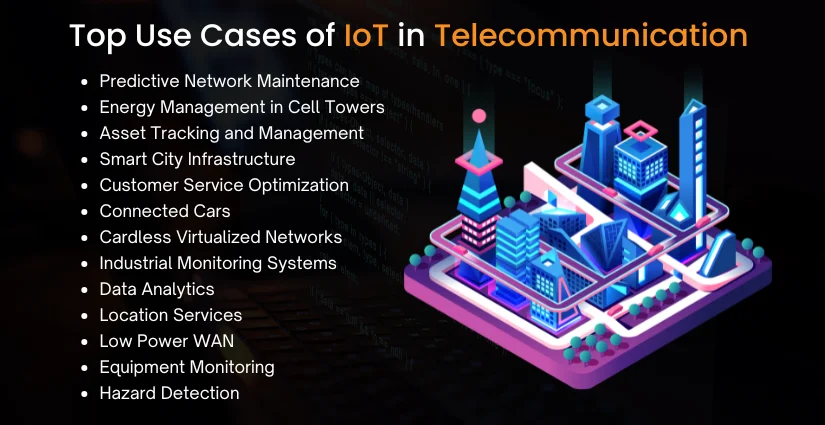
1. Predictive Network Maintenance
IoT sensors continuously monitor network equipment and infrastructure, enabling telecom operators to detect anomalies early, prevent failures, and schedule proactive maintenance. This reduces downtime, increases network reliability, and enhances service quality for users across the telecom infrastructure.
2. Energy Management in Cell Towers
IoT solutions help monitor and control power consumption in cell towers by tracking energy usage patterns, generator performance, and battery health. This enables telecom companies to reduce energy costs, improve efficiency, and adopt renewable sources more effectively.
3. Asset Tracking and Management
IoT-powered tracking systems provide real-time visibility of telecom assets such as routers, antennas, and vehicles. This helps in optimizing logistics, reducing losses, automating inventory, and ensuring that critical infrastructure is always operational and accounted for.
4. Smart City Infrastructure
Telecom companies use IoT to support smart cities with connected streetlights, traffic signals, waste systems, and surveillance. These systems depend on reliable networks, which telecom providers enhance through IoT integration, contributing to smarter urban management and sustainability.
5. Customer Service Optimization
IoT-enabled insights from network and device usage help telecoms personalize offerings and predict customer issues. Automated support systems, such as AI-powered chatbots, improve responsiveness and customer satisfaction while reducing support costs and manual intervention.
6. Connected Cars
Telecom networks support IoT in connected vehicles, enabling real-time communication for navigation, diagnostics, infotainment, and safety alerts. IoT enhances V2X vehicle-to-everything capabilities, contributing to smarter mobility, improved traffic systems, and the advancement of autonomous driving.
7. Cardless Virtualized Networks
IoT helps enable virtualized networks by reducing dependency on physical SIM cards. eSIM and software-defined networks streamline connectivity, simplify provisioning, and improve flexibility across telecom services, especially in devices requiring seamless, on-the-go connections.
8. Industrial Monitoring Systems
IoT in telecom aids industries by providing seamless connectivity for monitoring machinery, production lines, and remote operations. Telecom networks enable data transfer from industrial IoT sensors to control centers, enhancing uptime, safety, and operational decision-making.
9. Data Analytics
Telecom companies use IoT-generated data to gain insights into user behavior, network performance, and resource utilization. Advanced analytics improves forecasting, customer segmentation, and product development while supporting more accurate and efficient decision-making. Moreover, with data analytics services offered by IoT implementation, businesses increase their capabilities, resulting in better ROI for the business and overall operations.
10. Location Services
IoT devices use telecom infrastructure to provide precise geolocation services, supporting logistics, fleet management, emergency response, and navigation. These services rely on low-latency, high-availability networks, which telecoms enhance using IoT-powered optimization tools.
11. Low Power WAN (LPWAN)
IoT in telecom leverages LPWAN technologies like NB-IoT and LoRaWAN for long-range, low-power connectivity. Ideal for smart meters and rural sensors, LPWAN extends battery life and ensures consistent data transmission across massive IoT deployments.
12. Equipment Monitoring
IoT devices embedded in telecom infrastructure continuously monitor the condition and performance of network equipment. This enables real-time diagnostics, reduces repair times, and ensures optimal performance, ultimately improving the quality of telecom services delivered to end-users.
13. Hazard Detection
IoT-based hazard detection systems monitor environments for fire, gas leaks, or structural threats in telecom facilities. Early alerts allow quick response, safeguarding personnel and infrastructure while ensuring uninterrupted service and regulatory compliance.
Learn More: IoT in Education: Key Use Cases and Benefits
Challenges of IoT in Telecom and How to Overcome Them
Despite a large number of benefits of IoT in the telecommunication sector, there are often multiple challenges that come with the development. However, we believe that these difficulties shouldn’t discourage telecommunication businesses from introducing the latest tech to their work. So let’s have a look at each one and how we can overcome them.
Big Data Management
The introduction of IoT solutions is closely tied to the work with high volumes of data. And it is one of the challenges for telecom operators today that want to deliver IoT services. To deal with this task, they need to use agile and scalable computing platforms that won’t negatively affect the productivity of apps.
Security and Privacy Issues
Ensuring absolute confidentiality and security is among the top tasks for IoT-powered systems. Nevertheless, IoT-connected devices usually have limited memory resources. It means that the info has to be stored remotely, which leads to increased risks. In addition, IoT devices also remain an attractive target for hackers. It means that telecoms need to invest heavily in the solution to such a problem in order to protect valuable data and win a new competitive advantage for themselves.
Need for Interoperability
When integrating IoT in the telecommunication sector, there should be multiple devices that are connected to each other, and they should also communicate with each other. To make sure everything is working properly and perfectly, it is required to use normalized protocols that will guarantee functional interactions
Future of IoT in Telecommunication
The perspectives for the rapid implementation and large-scale development of IoT in the telecom sector are expected, undeniable, and very up-and-coming. It is obvious that the full implementation of these innovations will take time; operators, developers, and consumers must gain experience and practice in this direction. However, this is a long-term investment that will definitely pay off.
For the foreseeable future, telecommunication enterprises and start-ups are expected to promote their IoT services in different segments. Integration of the IoT and telecommunication industry will become a solid competitive edge that optimizes productivity, improves service quality, unlocks extra opportunities, raises customer loyalty, increases profits, and leads the telecom business to success.

Conclusion
As we move deeper into the digital age, IoT in Telecommunication is no longer a futuristic concept; it’s a present-day catalyst reshaping the industry. From predictive maintenance and energy optimization to connected vehicles and smart city enablement, IoT is empowering telecom operators to deliver smarter, faster, and more reliable services.
By embracing advanced IoT technologies like sensors, LPWAN, and intelligent analytics, telecom providers can unlock new efficiencies, enhance customer experience, and expand into high-growth areas such as industrial monitoring and virtualized networks. The convergence of IoT and telecom is not just about connectivity; it’s about creating a more intelligent, agile, and responsive ecosystem that meets the evolving demands of both enterprises and consumers. But be sure it is not everyone’s cup of tea, thus requires a skilled team, their guidance, and expertise. Octal IT Solution, being a top IoT development company, has a team of expert developers who are well-versed in the latest tech and move with the trends to fulfill the demand of every business. So, without thinking much, connect to our team and get your dream project done.
Businesses that proactively invest in IoT-driven telecom solutions today will be better positioned to lead the market and adapt seamlessly to the future of hyperconnected communication.
FAQs
It is a term that describes the connection of all common devices via telecommunications networks for the purpose of real-time data exchange. This is very important because it transforms telecommunications operators into progressive service providers, for example, in the field of smart cities and predictive analytics.
IoT is revolutionizing telecom by enabling real-time monitoring, predictive maintenance, and automated network management. It enhances operational efficiency, reduces downtime, supports smart infrastructure, and opens up new revenue streams through connected services like smart cities and industrial IoT.
Key benefits include improved network reliability, reduced operational costs, enhanced customer experience, and efficient asset management. IoT also supports data-driven decision-making and helps telecom providers scale services faster with better infrastructure visibility and control.
Sensors, LPWAN, 5G, data analytics, and IoT platforms are critical technologies. They support large-scale connectivity, enable edge computing, and allow telecom operators to manage and monetize IoT-based services effectively across diverse industry sectors.


 Get in Touch
 By
By September 25, 2026