



Are cars capable of thinking, adapting, and communicating without human assistance? To a large extent, yes, the answer has been influenced by the exponential growth of the Internet of Things (IoT) network. The IoT in automotive industry in the year 2025 is not just a dream or a plan. Now, it’s a revolution that is changing the ways vehicles are made, operated, serviced, and enjoyed.
According to Market Research, the global Automotive IoT market was about USD 178.4 billion in 2024, with a projected jump to USD 593.4 billion by 2030, implying a stronger CAGR of 22.2 % from 2024 through 2030.
The smart car industry is presently being reshaped by the Internet of Things, which is evident in the use of smart navigation, predictive maintenance, real-time vehicle diagnostics, and enhanced driver safety that are thus far the most prominent areas of focus. The car manufacturers and technology companies are employing various technological means, such as the use of IoT sensors, cloud computing, AI, and big data, to design and produce safer and more efficient cars that are also the coolest and most intelligent in history.
The change affects the driver in a positive way and also allows businesses to enter a new competitive environment where they can optimize their fleets, remotely monitor their assets, and automate their services. Get ready! You will get an insight into the smart mobility that provides IoT in the automotive industry and a glimpse into the much brighter future of IoT in automotive industry that it brings.
What is IoT in Automotive Industry?
The IoT in the automotive sector simply entails the deployment of internet-connected devices and sensors inside vehicles and the related infrastructure to gather, send, and receive data. These intelligent gadgets assist vehicles in their interactions with their surroundings as well as with other systems, and they can also make quick decisions based on safety, performance, and user experience requirements.
Put concretely, your car is capable of warning you about low tire pressure, deciding with you the best route to avoid getting stuck in traffic, or planning a time for your car service check without asking you; all this is an outcome of the IoT. This is a sample of how IoT is implemented in the automotive industry, whereby the vehicles are connected to the internet and other systems, such as the cloud and other vehicles, hence making them smarter and more responsive. These intelligent capabilities are made possible through advanced IoT application development services that enable seamless communication and automation across devices.
The IoT’s capabilities in the automotive sector include not only car navigation and entertainment but also vehicle diagnostics and even autonomous driving. It’s enabling car manufacturers to create intelligent and connected vehicles that learn from the driver’s habits and the weather conditions on the road.
Top Applications of IoT in Automotive Sector
The IoT’s applications in automotive industry are vast and life-changing. IoT-powered cars have gone beyond simple connectivity; they now supply the driver with various functions that improve safety, convenience, and car performance.
IoT in automotive industry supports automakers, fleet managers, and drivers to step in a smarter way of travel through real-time diagnostics, entertainment systems, etc.
Here are some of the top uses that are changing the face of the IoT in the automotive sector:
1. Vehicle Telematics
The most powerful and common application of IoT in the automotive industry is telematics. This basically means, sensors and GPS are used to collect and analyze vehicle data. It is good not only for tracking the vehicle’s location but also for monitoring the driver’s behavior, measuring fuel saved, and changing the fleet operations for the best comfort.
IoT-driven Fleet Management Software Development is at the heart of this revolution, and all these can be the mega-benefits for businesses that have transport as their main operation.
2. Predictive Maintenance
In addition to the fact that IoT sensors monitor various parts of the vehicle, the predictive maintenance process is enabled due to these sensors. Mostly, these sensors are the ones that give data about the engine mechanical condition, the status of brakes, battery level, and those that the driver asks for in particular.
If some issue comes up, the system will inform the driver well before it becomes critical, thus avoiding unnecessary breakdowns. Among the advantages of IoT in automotive sector, this one is the biggest in terms of cost-saving.
3. In-Vehicle Infotainment Systems
IoT certainly takes car entertainment to the next level of interactivity and customization. Car occupants have the ability to listen to music, get directions, speak to the car, and always be up-to-date with traffic situations.
Such smart infotainment systems are also able to be changed in terms of user preferences, thus a more comfortable driving experience is guaranteed. This is a perfect illustration of the Internet of Things being exploited in the automotive industry for this purpose.
4. Smart Navigation and Traffic Management
Navigational systems that are IoT-based offer traffic information, provide alternative paths, and forecast traffic with the help of past data in real-time.
This not only shortens the travel duration but also removes the need for fuel. For drivers in the city and also fleet owners, this is a practical use of IoT in automotive industry that saves both time and money.
IoT app development companies play a key role in building such intelligent navigation solutions tailored for modern transportation needs.
5. Remote Diagnostics
Remote diagnostics are the major advantage of IoT in automotive systems. Car manufacturers and service centers can access vehicle data remotely to detect issues early.
Such a system allows proactive servicing that can reduce downtime and improve your vehicle’s health over time.
6. Over-the-Air (OTA) Updates
IoT lets companies send updates of their software to a car via the internet. Consequently, it is possible to fix bugs, add new features, and also be sure that security is not compromised, all of this can happen without the need for a service center.
OTA updates are clear and smooth examples of IoT in automotive industry in improving system functionality.
7. Autonomous Vehicles Support
IoT is a fundamental part of self-driving cars. Devices such as sensors, cameras, GPS, and connectivity consider the gathered information and share such data in real-time so that the car can perceive its environment and decide which driving maneuvers to take.
This is a strong example of how IoT is used in the automotive industry to enable autonomous transportation.
Also Read: IoT in Banking and Finance: Overview, Benefits & Use Cases
Key Use Cases and Real-World Examples of IoT in Automotive Industry
As the IoT in the automotive industry is conceived, practical use cases are unveiling the transformative power of this technology. From safety to operation, the utilization of IoT in the automotive industry has moved beyond mere concept models, it’s being put into action by leading automakers, fleet managers, and service providers.
Here are some key examples that show how connected technologies are shaping today’s mobility and delivering measurable value.
1. Tesla’s Over-the-Air (OTA) Updates
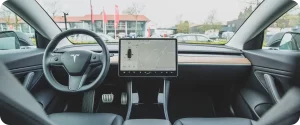
Tesla is the car that clearly displays the use of the IoT in the automotive industry. Elon Musk’s company is implementing the Internet of Things (IoT) for delivering instantaneously over-the-air (OTA) software updates, which allow the cars to be always up-to-date. These updates make the battery better, improve the autopilot features, and even enable new features, all without any inconvenience of coming to the service center.
2. BMW’s ConnectedDrive System
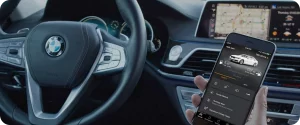
BMW’s ConnectedDrive is the most prominent example of IoT-based innovative and futuristic mobility services in the automotive sector. It supplies not only real-time traffic data but also information about the car condition, enables the car to be controlled remotely, provides predicting alerts for maintenance tasks, and also gives the user personalized infotainment. This system integrates IoT, AI, and cloud technologies to create a smooth and hassle-free driving experience.
3. Mercedes-Benz Fleet Management Solutions

The German brand Mercedes-Benz is a good illustration of electronics using Internet of Things technology for business fleet management, monitoring the performance of the fleet, the location of the vehicle, the fuel usage, and the behavior of the driver. This will enable the business to optimize the number of trips, decrease expenses, and guarantee driver safety. IoT is the crucial technology that makes these telematics platforms so efficient.
4. Ford’s SYNC Infotainment Platform
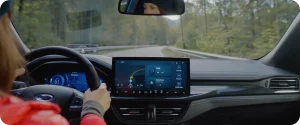
Ford SYNC is an IoT-approved system that offers voice control, GPS, smartphone compatibility, and emergency aid. It illustrates the IoT in the automotive sector as a perfect combination of entertainment, functionality, and driver safety enhancement, while also integrating Machine Learning solutions to deliver smarter and more responsive driving experiences.
5. Toyota’s Predictive Maintenance in Hybrid Vehicles
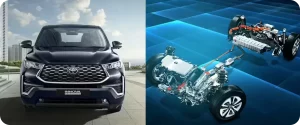
Toyota continuously monitors battery health, engine performance, and car usage through IoT sensors. Car owners get short warnings of possible problems if the system works correctly. This use case demonstrates the benefits of IoT in automotive by reducing downtime and improving vehicle lifespan.
6. Uber’s Smart Ride-Sharing Analytics

Uber employs IoT sensors that are installed in its cars to gather not only location data but also to keep track of driver activity and improve ride-matching instantly. This is an effective IoT application in the automotive sector, which is not only able to create operational efficiency but also improve customer satisfaction.
Read More: AI in Real Estate: Transformative Use Cases in Real Estate
Benefits of IoT in Automotive Industry
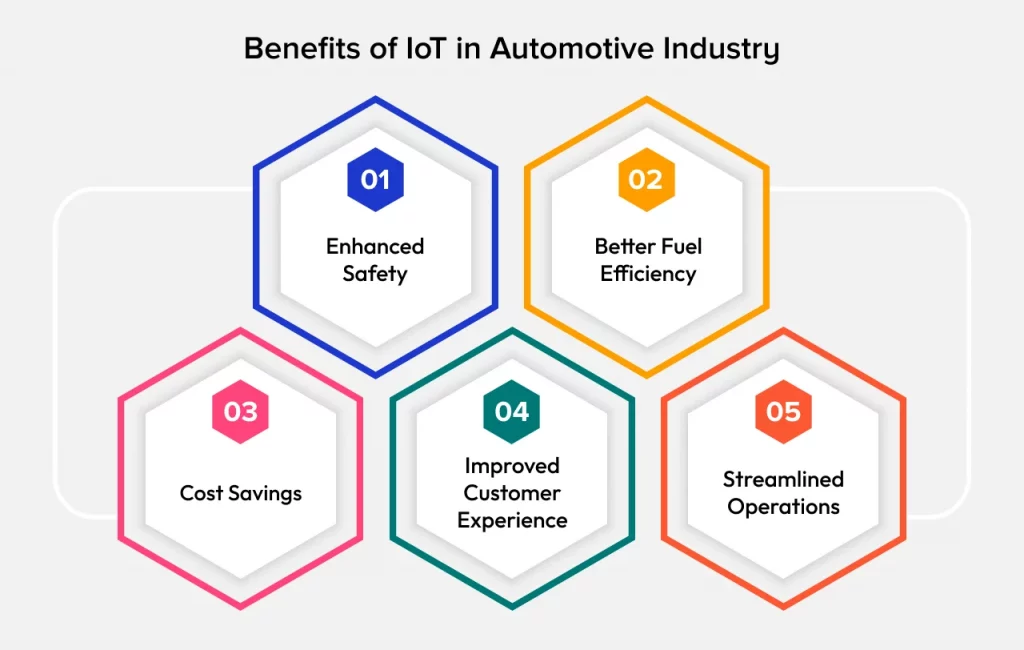
The expansion of the usage of the Internet of Things (IoT) in the automotive industry is causing a revolution in the industry that is leading to great benefits that are being delivered to the manufacturers, drivers, fleet operators, and service providers.
IoT makes real-time data exchange, remote monitoring, and automation accessible, and it is not only changing the way vehicles operate, but it is also changing the way the whole automotive ecosystem works. The benefits of IoT in automotive are rewriting the book on how we move, maintain, and manage our cars, be it by improving safety, reducing IoT app development cost, or creating seamless experiences for users.
1. Enhanced Safety
IoT-enabled sensors are diligently running a parallel surveillance of vehicle conditions and surroundings; in this way, they are aiding accident prevention through real-time alerts, lane assistance, automatic braking, and collision warnings. This is the drive becoming smarter and safer, the IoT in the automotive industry market’s most critical advantage.
2. Better Fuel Efficiency
IoT is a great help in keeping track of driving patterns, engine performance, and traffic conditions so that the most efficient fuel consumption behavior can be chosen. The saving of fuel will be all the more effective if the time spent waiting at the red light can be reduced or if the car chooses the most economical route. Such is the example of the most useful implement for IoT in the automotive industry by individual drivers and fleet managers alike.
3. Cost Savings
With each technology implementation, such as predictive maintenance, remote diagnostics, and efficient fleet management, vehicles experience fewer breakdowns and reduced repair costs. These features significantly lower overall ownership and operational expenses, one of the strongest benefits of IoT in the automotive industry.
4. Improved Customer Experience
Automotive IoT allows connected infotainment systems, unique driving preferences, and flawless mobile integrations. These smart features go beyond entertainment; they also increase comfort and happiness, which in turn, improve loyalty and brand perception in the IoT in the automotive sector.
5. Streamlined Operations
Fleet operators and automakers can get real-time information about vehicles, monitor vehicle usage, manage services remotely, and activate updates without any manual intervention. Such operational visibility and control are the main application of IoT in the automotive industry that enables improving productivity and making better decisions.
Advantages of IoT in Automotive Industry for Stakeholders
The use of IoT in automotive industry doesn’t just make life easier for drivers, it also offers massive benefits to vehicle manufacturers, fleet operators, software providers, service centers, and end customers.
The IoT use in the automotive industry makes it possible for real-time insights, automation, and data-driven decision-making to help streamline operations, reduce costs, and deliver exceptional user experiences. Let’s have a look at how different players in the automotive sector benefit from IoT adoption.
1. For Automakers
IoT gives car manufacturers the possibility to build smart, connected vehicles equipped with features that enable remote diagnostics, software update capabilities, and real-time data sharing. The result is quicker innovation, better product differentiation, and after-sales support that is more efficient. Moreover, it contributes to customer loyalty strengthening, one of the long-term advantages to develop YI IoT app in the automotive sector.
2. For Fleet Operators
Fleet businesses are the ones who heavily rely on IoT for vehicle tracking, predictive maintenance, and driver behavior monitoring. The aforementioned features will allow you to not only lower your fuel consumption but also make your route planning procedure more efficient and reduce your maintenance costs, thus making your operations highly reliable and sustainable. The use of IoT in automotive industry for commercial transport companies has this as its main benefit.
3. For Car Owners and Drivers
Driving becomes a more individualized, safe, and pleasurable experience for the end users. Smart infotainment, traffic alerts, vehicle health reports, and remote control through mobile apps are some of the examples of a user-friendly driving experience becoming highly intuitive and quite stress-free as a result of the IoT adoption. It clearly indicates the usage of IoT in the automotive industry to increase user satisfaction.
4. For Service Centers and Technicians
IoT allows remote diagnostics that enable service centers to identify problems without vehicle arrival, thus simplifying their work. This cuts down on service time, raises accuracy, and enhances customer trust. An efficient utilization of IoT in the automotive sector that energizes service efficiency.
5. For Insurance Companies
By having at their disposal driving data in real-time, insurers can adjust their premiums to individual drivers based on their behavior. Usage-based insurance (UBI), which is IoT-driven, results in just and lower prices as well as a decrease in fraud, an unanticipated benefit of IoT in the auto industry for the insurance sector.
Learn More: AI in Telecommunications: Key Trends and Benefits
Challenges of IoT in Automotive Industry
It is quite evident that integrating IoT in automotive sector is opening up new frontiers and making processes more efficient; however, at the same time, it is also accompanied by a number of technical, operational, and regulatory issues.
The need to handle a growing amount of data, safeguard communication, and meet regulations makes the task of ensuring a secure car network more complicated as cars are more connected.
Besides, these barriers can hinder the progress of the use of IoT and even cause serious dangers if they are left unattended. Comprehending the problems of IoT in the automotive industry is a must-have for those who want to create scalable and protected connected vehicle solutions.
1. Data Privacy and Security
The automotive IoT industry cannot lack the issue of data protecting the vehicles and users that are very sensitive to save. The continual data transferring between the car, cloud, and third-party systems creates new holes, which can then be exploited by hackers or used for malicious purposes. To solve this problem, implementing a strong encryption method, secure APIs, and performing audits regularly are necessary.
2. Infrastructure and Connectivity
Stable high-speed internet is needed for the exchange of data almost in real-time and the carrying out of remote operations. However, many places still lack the infrastructure. The lack of a reliable 4G/5G or satellite network means that those IoT in automotive industry key applications will be faced with performance issues; thus, Wind or sea-powered navigators, Over-the-Air (OTA) updates, and diagnostics may be problematic.
3. Integration with Legacy Systems
Most vehicle and enterprise systems that are currently in use were not created with IoT in mind. It can be very difficult and costly to combine present IoT solutions with the legacy ECUs (Electronic Control Units) or traditional platforms. Both, OEMs and service providers, find this to be the main challenges of IoT in automotive industry.
4. Regulatory and Compliance Issues
Because of the extensive data collection and data sharing that connected fleets engage in, they are obliged to follow data protection regulations in the regions where they operate. An example of such regulations is GDPR. They are also required to comply with automotive safety rules that are specific to their industry. Ensuring compliance across countries adds complexity, especially when deploying cross-border fleet or consumer services.
Future of IoT in Automotive Industry: Trends to Watch in 2025
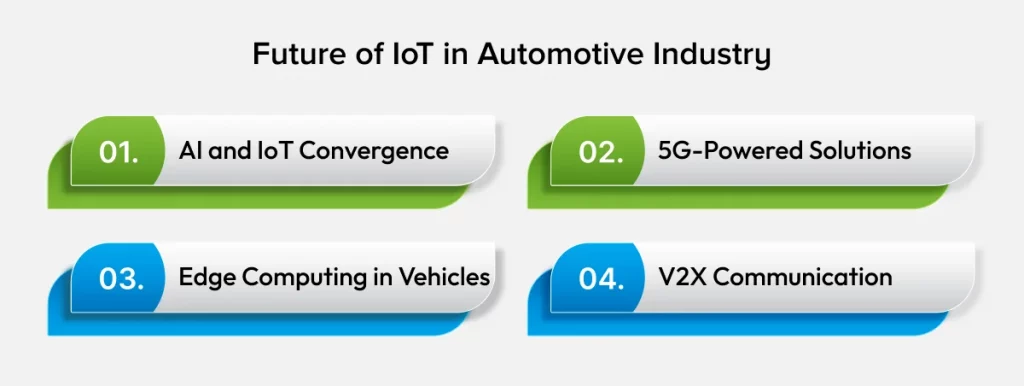
The IoT future in automotive industry is ripe with wonder as the tech is upgrading continuously. In 2025 and beyond, IoT is projected to collaborate with AI, 5G, and edge computing, among other innovative technologies, in order to create more intelligent, safer, and autonomous vehicles.
The adoption of IoT in the automotive sector will not merely be extended by these enhancements but also will be the force that will lead to the new reshaping of the global transportation landscape, making the vehicles more intelligent, connected, and efficient than ever before.
Therefore, let’s have a look at the major trends that are going to be the defining factors automotive sector in the coming years:
1. AI and IoT Convergence
The conjunction of the Internet of Things (IoT) and Artificial Intelligence (AI) will give birth to localities like those of highly adaptive and autonomous vehicles. AI will make solving IoT data from sensors in real time incredibly easy and will bring the driver assistance systems (ADAS) feature of voice recognition and predictive maintenance, among other features. This fusion will be of great help in the IoT in the automotive industry automotive sector, vehicles will now be able to learn from gathered data and respond intelligently.
2. 5G-Powered Automotive Solutions
The deployment of 5G will increase the throughput, reliability, and responsiveness of the interconnected network of IoT. By providing ultra-low latency and high bandwidth, 5G will enable real-time vehicle communication, quick OTA updates, and more accurate traffic monitoring. This step will not only elevate the advantages of IoT in automotive industry but also will be the new enabler for seamless connectivity of autonomous and connected cars.
3. Edge Computing in Vehicles
Edge computing enables cars to locally process the data without having to send it to the cloud, which can be done in real time. It not only reduces the delay but also improves safety-critical features such as collision avoidance or emergency braking. The future of IoT in automotive industry is definitely bright with edge technology that will energize the vehicles to become more agile and efficient, even in areas where the internet is scarce.
4. Vehicle-to-Everything (V2X) Communication
V2X makes it possible for cars to talk to the traffic lights, the roads, to other cars, and even to people. The communication that is based on IoT between the participants can make car accidents disappear, reduce traffic jams, and also serve as a partner for autonomous cars. V2X will gradually become the main IoT application in the automotive industry with the increase in its adoption, which will guarantee a more connected and cooperative driving environment.
How to Implement IoT in Automotive Sector Successfully
The implementation of the IoT in the automotive industry is not just the matter of putting sensors into the vehicles or connecting the cars to the internet, it is a good-planned strategy, using the proper technology stack, and at the same time, the collaboration of the OEMs, software providers, and service teams that is essential.
To reap the real benefits of IoT in automotive, firms must follow a predefined approach that secures privacy, scalability, and the longest possible performance; ideally in collaboration with an experienced Artificial Intelligence development company.
Here is an easy step-by-step guide for a successful IoT implementation in the automotive sector:
1. Define Your IoT Objectives
Start by recognizing the goal you have in mind, whether it is predictive maintenance, real-time tracking, entertainment in the vehicle, or autonomous capabilities. This assists in choosing the proper technology, architecture, and partners.
2. Choose the Right IoT Platform
Choose a scalable and secure IoT platform that offers support for data integration, remote access, real-time analytics, and cloud connectivity. The platform should be in correlation with the automotive standards and, at the same time, be flexible enough to allow for future expansion.
3. Integrate Sensors and Connectivity Modules
Put together the appropriate combination of sensors (GPS, fuel, engine health, etc.) and connectivity (4G, 5G, Wi-Fi, Bluetooth). Make sure the hardware is trustworthy, long-lasting, and meets automotive safety standards.
4. Focus on Data Security and Compliance
IoT collects a large amount of sensitive data. Use good encryption, user authentication, and regularly updated security to ensure the privacy of the car data and comply with privacy laws such as GDPR or ISO 26262.
5. Enable Edge and Cloud Integration
Provide edge computing for latency-critical operations and cloud services for storage, data processing, and remote control. This combined arrangement allows efficient operation and lower latency in vital applications.
6. Collaborate with the Right Development Partners
Seek the assistance of reliable IoT software vendors, trusted system integrators, or an Automotive Software Development Company that is knowledgeable of the problems faced by connected vehicle ecosystems.
7. Test and Monitor Performance Continuously
Conduct trial runs and observe closely the system’s performance. Take input from the users, study the habits of the users, and make adjustments to the system to be sure that a dependable and scalable IoT in automotive solution is guaranteed.
Conclusion
The IoT in automotive industry is revolutionizing the way vehicles are conceptualized, constructed, and operated. The application of IoT in the automotive industry has been instrumental in the development of vehicles that are safer, smarter, and more integrated through smart navigation, predictive maintenance, autonomous driving, and real-time diagnostics.
Therefore, it can be seen from the examples that advantages of IoT in automotive sector go beyond convenience, spine safety, cost reduction, and improving the user experience for drivers and businesses. On the other hand, similar to any technology, the IoT comes with a set of challenges, such as data security, integration, and connectivity, that are to be carefully handled.
Looking forward, AI incorporation, 5G, and V2X communication are the anticipated front runners of the IoT in the automotive industry, which is their promise for further advanced potentials. OEMs, transport companies, and tech providers cannot lose the opportunity to be the ones who lead the pack and set the trend in the fast-paced automotive space by investing in IoT today.
FAQs on IoT in Automotive Industry
In the automotive context, IoT means using internet-connected devices and sensors in vehicles to gather and exchange real-time data for smarter operation.
The IoT is used for vehicle tracking, predictive maintenance, infotainment systems, remote diagnostics, and autonomous driving features.
Some are safety, fuel efficiency, lower maintenance costs, real-time monitoring, and a better driver experience.
Yes, for example, it allows collision alerts, lane assist, or health monitoring of the vehicle in real-time, all helping to prevent accidents.
Some examples would be Tesla OTA updates, BMW ConnectedDrive, Ford SYNC infotainment, and Toyota’s predictive maintenance.
 By
By September 2, 2025


 Get in Touch