


Have you ever wondered how companies like Amazon, Netflix, and Tesla appear to know what you want before you even ask? The answer lies in AI software, enabling smarter business decisions, custom-made experiences, and automated operations.
The term Artificial Intelligence is realizing itself in terms of transforming the pharmaceutical business, competition, and advancement across every industry, from healthcare to finance to e-commerce and logistics. AI software builder will bring new opportunities for innovation and efficiency, no matter if you run a startup or have years of experience behind you.
According to Grand View Research, the global artificial intelligence market was valued at USD 294.16 billion in 2026 and is predicted to grow to USD 1,811.75 billion by 2030, at a CAGR of 35.9% from 2025 to 2030.
In this blog, we will walk you through every essential step involved in creating AI software in a comprehensive and structured way. You will see use cases, development steps, future trends, pros and cons, and everything you need to know before starting AI software Development process.
Let’s begin!
What Is AI Software?
Artificial intelligence software refers to computer programs that can perform tasks usually requiring human intelligence tasks such as learning from data, understanding languages, recognizing images, and making decisions. But unlike traditional software, which carries out the fixed rules it was instructed with, AI software looks at patterns, changes behaviors with new information, and gets better through practice.
Core Components of AI Software
The main building blocks of AI software include:
- Data – The raw material AI learns from
- Algorithms – The logic and mathematical models behind predictions
- Training Models – Where the AI learns from data to perform specific tasks
- Inference Engine – The part that applies learned knowledge in real-world scenarios
Types of Software to Build With AI
There are various types of AI software depending on their functions:
- Machine Learning (ML): Enables AI to understand and generate human language (chatbots, language translators)
- Natural Language Processing (NLP): Enables AI to recognize and interpret images or video (facial recognition, medical imaging)
- Computer Vision: Enables AI to recognize and interpret images or videos (e.g., facial recognition, medical imaging)
- Speech Recognition: Converts speech into text (Virtual assistants: Alexa, Siri)
- Robotic Process Automation (RPA): AI-based automation of manual rule-based business tasks (Invoice processing, data entry)
AI software essentially uses these technologies to build smart, interactive, and efficient digital solutions usable in numerous industries.
Why Should Founders Invest in AI Software Development?
For startups growing in a superior way and faster, and more scalable, an investment in AI software is something very worthy. AI could automate any repetitive task to maximize overall efficiency and then build very personalized user experiences. Of course, this increases customer satisfaction and reduces their operating costs.
From chatbots for customer support to AI algorithms that recommend products to internal tools that help automate things, this means concrete advantages and real impacts on the bottom line. Yet AI software markets are forecast to surpass half a trillion dollars by 2030, with healthcare, finance, retail, and logistics holding the front seat.
Cutting-edge AI adoption for sure would take a business to another level while helping accelerate decision-making through data-backed insights more than they had ever done before. Simply put, AI is not just a future technological step; it is also the smart way to do business.
How AI Software Is Transforming Industries?
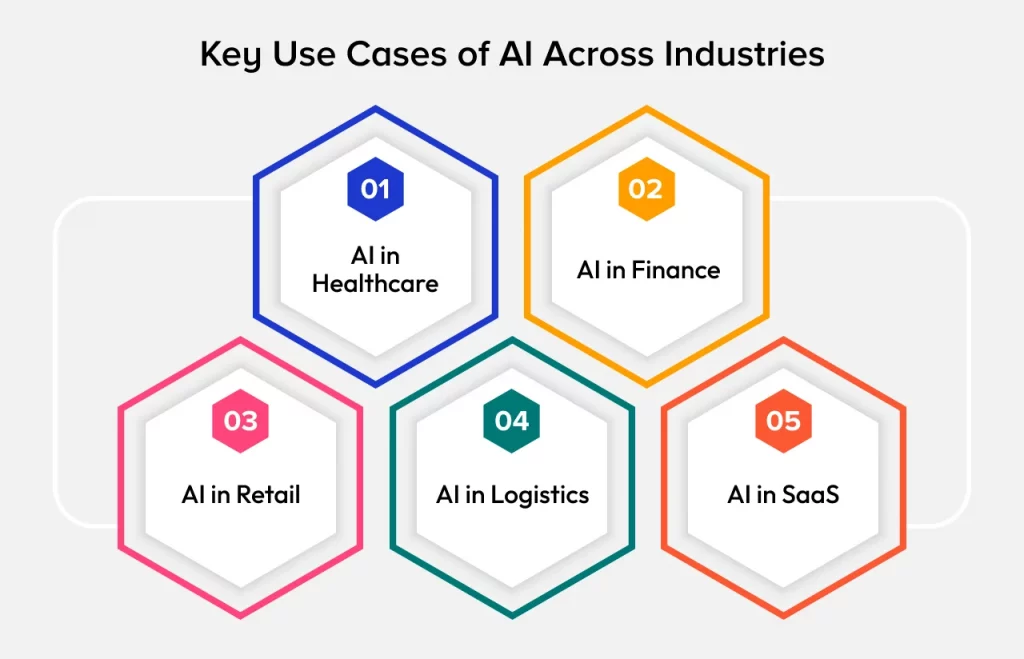
AI is fundamentally changing business sectors by incorporating automation, intelligence, and data-driven decision-making into everyday operations. To mention a few, AI enabled technology in healthcare and SaaS is leading innovation, reducing overheads, and increasing customer satisfaction. Let’s find out how building AI software helps various industries to succeed.
1. AI in Healthcare
In the healthcare arena, AI is helping medical professionals in accurately diagnosing, formulating treatment strategies, and taking care of patients with maximum effectiveness. IBM Watson is one of the tools that assist doctors in catching diseases at the earliest stage by going through medical images and patient data.
Moreover, AI-powered chatbots come for the rescue, as they take the burden off the doctors by answering patients’ queries and providing mental health support.
2. AI in Finance
Financial institutions are conducting their operations in a more efficient manner with the help of AI, detecting fraud, assessing credit scores, and providing customer service. JPMorgan Chase uses AI as an example to state how they can scan and interpret the content of legal documents in a matter of seconds.
A machine learning-powered robo-advisor will always be available for you to monitor, analyze, and adjust your risk and return in the investment portfolio in the most efficient way possible.
3. AI in Retail
AI in retail is using nowadays. In the retail sector, AI is used to create personalized product recommendations, set up dynamic pricing, and efficiently manage inventory. Amazon’s recommendation engine is a great example; it analyzes user behavior to suggest products that drive billions in sales. AI-powered chatbots also help improve shopping experiences with instant support.
4. AI in Logistics
AI has the capabilities to improve route scheduling efficiency, to predict the most accurate freight volumes, and to automate warehousing management in a highly productive way. As one example, FedEx and DHL are the companies that come to my mind first, and they seem to try to eliminate delays in deliveries by using AI to manage along the way precisely.
The development of driverless delivery vehicles and drones is one of the recent initiatives taken, where AI plays a central role.
5. AI in SaaS
In SaaS platforms, AI brings a frictionless user experience with capabilities like predictive analytics, intelligent automation, and natural language processing. Grammarly is an example of a tool where AI is used to provide writing suggestions, whereas CRM systems such as Salesforce Einstein empower enterprises to make more intelligent sales and marketing strategies.

Step-By-Step Process to Build AI Software
Developing AI software might seem difficult, but if we look clearly at the process in steps, it becomes a lot easier to manage. Maybe you are after an AI-powered chatbot or a predictive analytics tool; it does not matter; if you follow the right approach, you will definitely build software with AI that operates well and delivers value. Here are the steps to build AI software:
Step 1: Define the Problem and Business Goal
The first step is to recognize what problem you want the AI software to solve. Clearly define your business goals, whether it is to automate one process, improve customer experience, or get insights from data.
Credit to NASA scientists, the objective is the single most important element for the solution to be workable.
Step 2: Collect and Prepare Data
Gather vast amounts of data free of irrelevant information and high in quality. It should be representative of the problem to which you want to apply the solution. Organize and clean it, since data that is unclean or incomplete may lead to a bad output.
Step 3: Choose the Right AI Technology
Decide on the direction of your efforts and find the most appropriate type of AI: be it machine learning, NLP, or computer vision. Also, choose the right tools and frameworks such as TensorFlow, PyTorch, or Scikit-learn.
Step 4: Build the AI Model
You are curious to know how to build an AI model? At this stage, the AI is like a baby; it is only learning. The data you provide will help the model train, which will lead to pattern recognition, input understanding, or prediction. You’re essentially experimenting with different algorithms until you hit the one that performs the best.
Step 5: Test and Validate the Model
Check the performance of the model with the test data before embarking on production mode. Confirm if it is precise, unprejudiced, and trustworthy. If it does not go well, revise the model, or give it a new training using better data.
Step 6: Integrate the AI into Your Product
At this point, you need to establish a connection between the AI model and the application or system that you are using. It could mean developing APIs or inserting the model into the software that is already in use. The objective is to enable the users to access the AI in real-time.
Step 7: Monitor and Improve Continuously
If not updated, an AI model goes stale and is of less practical application. So, keep monitoring the software performance, take feedback for it, and keep retraining your model with updated data sets to retain its inherent usefulness and performance.
Tools and Technologies to Develop AI Software
A proper bunch of technology and tools is very important to set up a strong and reliable AI software. Every step demands some sort of tools that will take away from the drag of development to ensure maximum accuracy and ultimate scalability-something through which founders and developers seriously rely nowadays. Here is the list of strong AI development tools and best machine learning platforms.
| Category | Tools & Technologies | Purpose/Usage |
| Programming Languages | Python, R, Java, C++, Julia | Writing AI/ML code and logic |
| Machine Learning Frameworks | TensorFlow, PyTorch, Scikit-learn, XGBoost, Keras | Model development and training |
| Data Processing Tools | Pandas, NumPy, Apache Spark, Dask | Data cleaning, analysis, and transformation |
| Natural Language Processing (NLP) | SpaCy, NLTK, Hugging Face Transformers, OpenAI GPT | Text analysis, language modeling, chatbots |
| Computer Vision Libraries | OpenCV, YOLO, Detectron2, MediaPipe | Image and video analysis, object detection |
| Deep Learning Platforms | TensorFlow, PyTorch Lightning, ONNX | Building complex neural networks |
| AutoML Tools | Google AutoML, H2O.ai, DataRobot, Amazon SageMaker Autopilot | Automating model selection and training |
| Data Labeling Tools | Labelbox, Supervisely, V7, CVAT | Annotating datasets for supervised learning |
| Cloud AI Platforms | AWS SageMaker, Google Vertex AI, Azure ML, IBM Watson | Scalable AI development and deployment |
| MLOps Tools | MLflow, Kubeflow, DVC, Airflow | Model versioning, automation, and monitoring |
| Deployment & APIs | Flask, FastAPI, Docker, Kubernetes, REST/GraphQL APIs | Hosting AI models and integrating with apps |
| Visualization Tools | Matplotlib, Seaborn, Plotly, TensorBoard | Data and model performance visualization |
| Database & Storage | MongoDB, PostgreSQL, BigQuery, Hadoop HDFS, S3 | Storing and managing training data |
What’s the Right Choice for Founders: Buying or Building AI Software
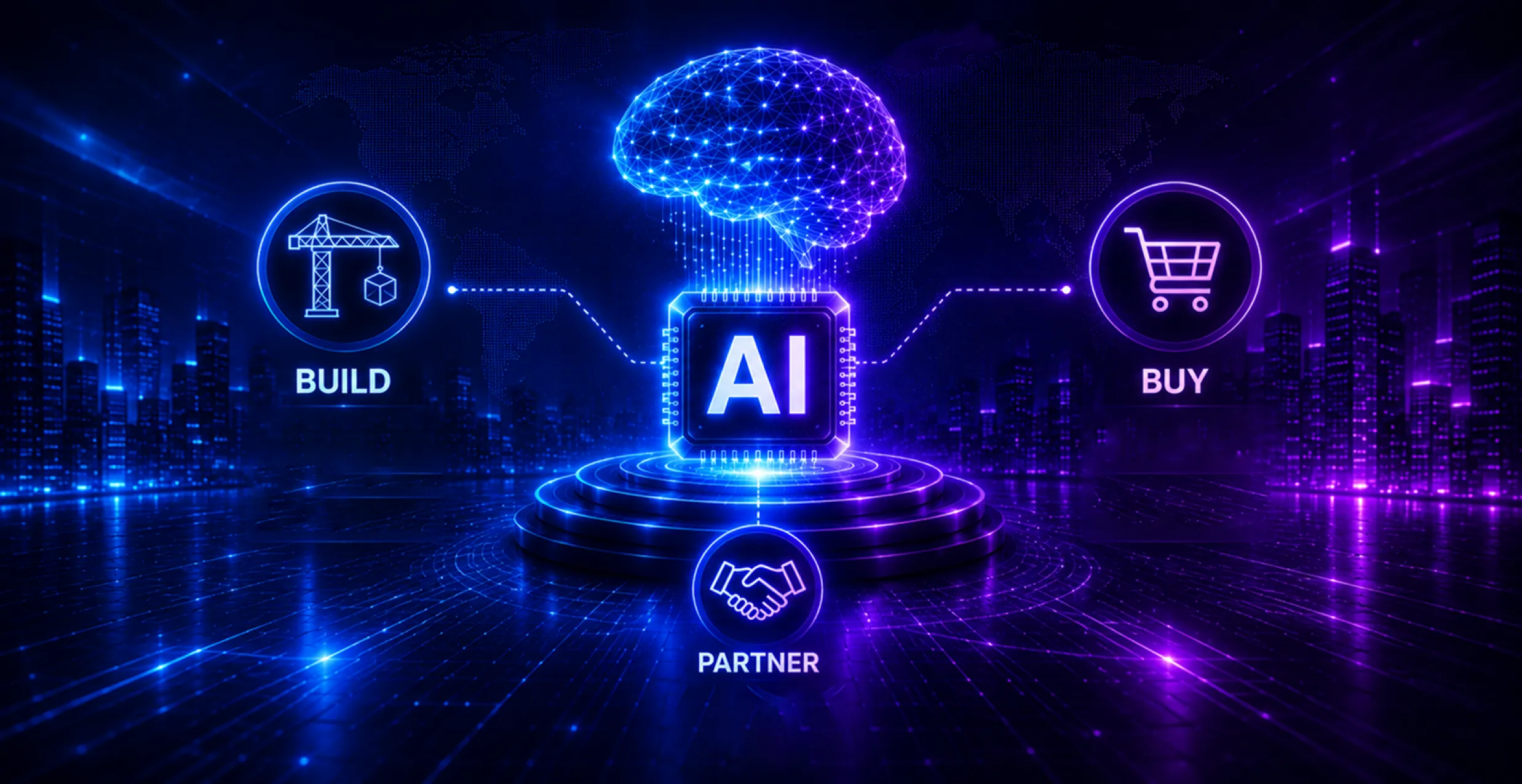
One of the decision-making crossroads faced by any founder lies in whether to develop AI software in-house or procure ready-made software solutions from third parties; the problem with all these is that advantages exist on both sides, varying according to your budget, the deadlines imposed on you, and your business goals.
Here’s a quick comparative list to help you decide which way to go for your startup or enterprise, guided by expert AI consulting services.
| Factor | In-House AI Development | Third-Party AI Solutions |
| Customization | High – tailored to specific business needs | Limited – may not fully match your use case |
| Cost | High initial cost (team, tools, infrastructure) | Lower upfront cost, often subscription-based |
| Development Time | Longer – requires setup, hiring, and testing | Faster – ready to use or requires minimal setup |
| Control & Flexibility | Full control over design, data, and features | Limited control over updates and features |
| Scalability | Scalable with internal resources and planning | Depends on provider’s capabilities and pricing |
| Data Security | More secure – handled internally | Depends on vendor’s data handling policies |
| Maintenance | Requires ongoing effort and cost | Handled by the service provider |
| Innovation | Easier to innovate and experiment | Limited to vendor’s roadmap and features |
Challenges in AI Software Development
While AI definitely has the potential to revolutionize businesses, creating AI software is not always a smooth journey. Luckily, founders still need to work with AI developers for hire to overcome technical, ethical, and financial problems during the development.
If these problems are identified early on, time can be saved and the costs reduced. Besides, the AI solution will be more effective. Some of the most typical problems faced by founders are given below.
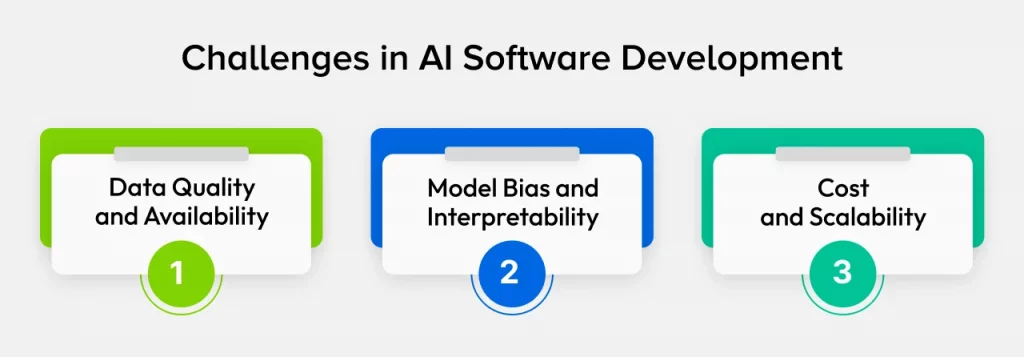
1. Data Quality and Availability
AI models are dependent on enormous quantities of pure and relevant data for decision making and to be successful in the tasks they are designed for. But the problem is that data that is relevant and clean can be almost impossible to find in some cases, especially in new and niche industries.
If the data is of low quality, it has errors, lacks some parts, or is noisy, which will result in an unreliable data set and therefore the AI model will not work as expected, or even the failure of the project.
2. Model Bias and Interpretability
AI models can unknowingly incorporate the erroneous opinions that are part of the training data, which in turn lead to results that are biased or incorrect. An example would be a hiring algorithm that learns biased past decisions; it will continue to repeat those biases.
Besides, lots of AI models operate similar to “black boxes,” so users cannot get the full explanation of how the decisions are arrived at, which consequently causes them to have trust and compliance issues.
3. Cost and Scalability
Software development regarding AI software needs qualified people, strong infrastructure, and regular updates, which all are heavy sources of spending.
As your user base increases, you will need to scale up your AI system as well, which will mean higher costs such as further cloud storage space, more computation power, and system maintenance. To reduce the cost continuously, you need to have the right plan for your scaling from the start.
The cost of building AI software in 2026 will be affected by factors like how complicated the project is, the AI technology used, the industry, and the team structure. Whether one is going to develop a simple AI MVP or a full-fledged enterprise solution, it is crucial to comprehend the part of the money which is spent here and there. To help with your budget plan, I have made a list of estimated costs for different roles.
Estimated Cost to Develop AI Software by Role (2026)
| Role | Hourly Rate (USD) | Monthly Cost (USD) |
| AI/ML Engineer | $60 – $120 | $9,600 – $19,200 |
| Data Scientist | $50 – $110 | $8,000 – $17,600 |
| Data Engineer | $45 – $100 | $7,200 – $16,000 |
| Frontend Developer | $40 – $90 | $6,400 – $14,400 |
| Backend Developer | $45 – $100 | $7,200 – $16,000 |
| DevOps Engineer | $50 – $100 | $8,000 – $16,000 |
| Project Manager | $50 – $90 | $8,000 – $14,400 |
| UI/UX Designer | $40 – $85 | $6,400 – $13,600 |
| QA Engineer | $35 – $75 | $5,600 – $12,000 |
Total AI Software Project Cost Estimates
| Project Type | Team Size | Timeline | Estimated Cost (USD) |
| MVP AI Software | 3–5 members | 3–4 months | $40,000 – $80,000 |
| Mid-Level AI Software | 5–7 members | 6–8 months | $80,000 – $150,000 |
| Enterprise-Grade AI Software | 7–10+ members | 9–12+ months | $150,000 – $300,000+ |
Future Trends in AI Software Development
As technology changes, AI is certainly continuing to grow in its sophistication, accessibility, and human-likeness. It is imperative for founders and tech leaders to keep their fingers on the pulse of the latest trends, as these will determine the nature of the next generation of AI products. The latest trends of AI development are:
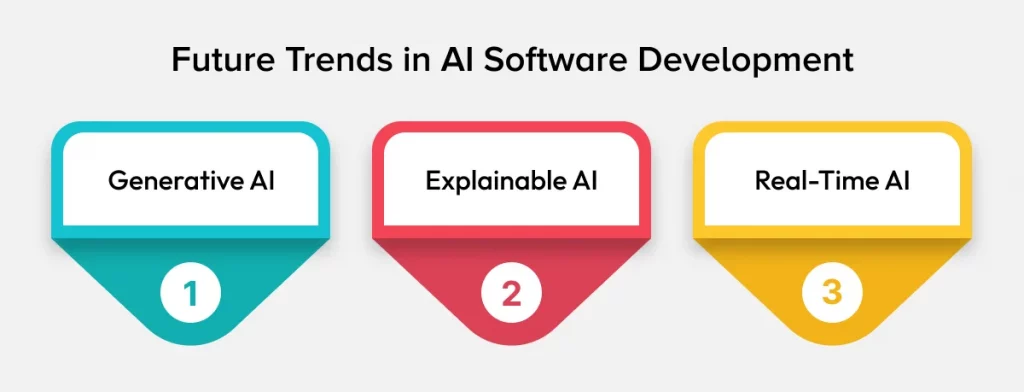
1. Generative AI
Generative AI Development means creating AI systems that are capable of producing new things, like text, images, videos, or code, based on the data they have been trained on. The tools such as ChatGPT and DALL·E are good illustrations of this type of AI.
One of the biggest game-changers in this decade will be generative AI, powering industries from marketing and content creation to gaming and product design, and even coding; this will result in software being more interactive and creative than ever before.
2. Explainable AI (XAI)
Since AI is expected to be deeply involved in areas of life where its impact can be profound, decision-making is becoming more significant, and more users and businesses want to know where the decisions derive from.
Explainable AI is a concept that underlines the human-like AI models, aiming to achieve the engineering, trust, and reliability aspects of AI, and providing reasons on how the outcomes are generated. Relying on black-box models’ decisions that are not explainable can be dangerous in the specified sectors of the economy, where the AI model can pose a risk to a decision.
3. Real-Time AI
Real-time AI is basically systems that get and send data very quickly, only to enable tasks such as voice assistants, fraud detectors, or autonomous vehicles. This wave of innovative technology is facilitated by edge computing and 5G, which are decreasing latency substantially.
Real-time AI would be of utmost importance in creating quick and responsive applications throughout industries.
Final Thoughts
Developing AI software is not restricted to only tech giants. It is a good and feasible period for startups and all kinds of businesses to build AI software. You can do several things with AI, such as automating your processes, providing personalized user experiences, or getting more intelligent insights from your data. AI can be the key to real business value.
Although winning relies on making the correct decisions, starting with a clear understanding of the objectives and choosing the right technology and Artificial intelligence development company, then balancing the cost, scalability, and the long-term vision. As generative AI, explainable AI, and real-time processing are still gaining momentum, founders who are these innovations’ first adopters will be in a better position to lead their industries. Start small, think big, and construct AI software which indeed is a solution to the problems.



 Get in Touch
 By
By September 25, 2026