


Key Highlights
- Streamlines insurance operations and improves efficiency
- Powered by AI, blockchain, and advanced technologies
- Ensures strong security and regulatory compliance
- Flexible solutions with varying cost and scalability options
- Future-ready with trends like AI automation and personalization
- Key Highlights
- A Brief Overview
- What is Health Insurance Software?
- Why Health Insurance Software is Essential in 2026?
- Different Types of Health Insurance Software You Can Build
- Must-Have Features of a Powerful Health Insurance Software
- Real-World Use Cases of Health Insurance Management Software
- Best Technology Stack for Health Insurance Software Development
- Data Protection & Regulatory Compliance in Insurance Solutions
- How to Develop Health Insurance Software: A Step-by-Step Process?
- How Much Does Health Insurance Software Development Cost in 2026?
- Custom vs Off-the-Shelf Health Insurance Software: Which One is Right for You?
- Common Challenges in Health Insurance Software Development and How to Overcome Them
- Latest AI & Technology Trends Shaping Health Insurance Software in 2026
- How to Choose the Right Health Insurance Software Development Company?
- Why Choose Octal IT Solution for Your Health Insurance Software Development?
- The Concluding Remarks
- Frequently Asked Questions
A Brief Overview
The global health insurance industry is undergoing rapid transformation because of technological progress, increasing healthcare expenses, and customers demanding better services. Insurance companies must meet digital-first requirements by providing software development services for health insurance that require swift delivery, data protection, regulation compliance, and tailored user experiences. The global health insurance software development market will reach a value of over $4 trillion by 2030, according to industry reports. The digital health market is expected to reach a value of over $900 billion by 2030.
Digital transformation initiatives receive active funding from more than 70% of insurance companies, which concentrate their efforts on developing AI and automation and cloud-based solutions. The infrastructure of traditional insurance systems relies on outdated technology, which prevents them from fulfilling current market requirements.
Health insurance software has evolved into an operational system that functions as a complete framework that enables real-time connections between insurers, healthcare app development services, agents, and policyholders. The current insurance industry operates through modern solutions that handle claims processing and use AI to detect fraud and deliver personalized policy recommendations.
What is Health Insurance Software?
Health insurance software serves as a dedicated digital system that handles all aspects of insurance business operations. It enables insurers to manage all aspects of their operations, including policy administration, claims processing, billing solutions, customer support, and regulatory compliance, together with their data analysis needs, through one unified platform.
Additionally, it differs from custom health insurance software development services because it does not focus on patient treatment and medical recordkeeping but instead deals with financial transactions, coverage assessment, and risk management activities.
Core Functional Capabilities
A health digital insurance solutions platform needs to provide these main functions for its users to work effectively:
- Policy Lifecycle Management: Creating, updating, renewing, and canceling policies
- Claims Management: Handling claim submission, validation, approval, and settlement
- Billing & Payment Processing: Managing premium payments and reimbursements
- Customer Relationship Management (CRM): Managing interactions and user data
- Analytics & Reporting: Generating insights for better decision-making
Why Health Insurance Software is Essential in 2026?
The demand for digital insurance solutions exists because different business operations face challenges while customer requirements continue to evolve.
1. Rising Customer Expectations
Modern consumers expect digital experiences that match the quality of banking and e-commerce platforms. The consumers require instant policy purchase, real-time claim tracking, transparent communication, and mobile-first access. Businesses that fail to meet these requirements will experience customer dissatisfaction, which leads to customer loss.
2. Increasing Complexity of Insurance Products
Insurance products are now more flexible because they enable customers to create customized plans. The system needs advanced solutions to handle multiple plans, which include different benefits, pricing models, and eligibility requirements.
3. Fraud Detection and Prevention
Insurance fraud stands as a worldwide critical issue. Fraudulent claims not only lead to financial losses but also increase premiums for genuine customers. Advanced software uses AI and machine learning to detect anomalies and prevent fraud.
4. Regulatory Compliance
Governments around the world established strict rules to protect data privacy and public transparency. Health insurance development companies comply with these regulations through:
- Secure data storage
- Audit trails
- Automated reporting
5. Operational Efficiency
Automation technology eliminates the need for manual work while it decreases mistakes and speeds up work activities. Tasks that used to take several days to finish now only need a few minutes for completion. The mid-sized insurance company used automated claims processing to achieve the following results: 60% reduction in claim processing time 35% reduction in operational costs improved customer satisfaction.

Different Types of Health Insurance Software You Can Build
The health insurance sector operates through various interdependent systems which each provide distinct functionalities.
1. Claims Management System
This system manages all aspects of claims processing which begins with submission and ends with settlement.
Use Case:
A hospital patient begins treatment and uses a mobile application to submit their insurance claim. The system verifies policy coverage through automated checks which identify errors and validate documents for claim processing. The claim receives approval within minutes because all elements of the process maintain validity and the payment process commences.
2. Policy Administration System
The system controls all processes that govern insurance policy management.
Use Case:
An insurer launches a new health plan targeting young professionals. The system enables customers to access the health plan immediately because it supports rapid configuration of all essential plan components.
3. Billing & Payment System
It processes premium payments while handling disbursement of claim payments.
Use Case:
Customers establish payment automation for their premiums while insurers execute claim payments through protected digital payment systems.
4. Provider Network Management
It oversees provider partnerships with healthcare practitioners.
Use Case:
A user searches for nearby network hospitals through a health insurance app development and chooses a provider offering cashless treatment.
5. Customer/Member Portal
Delivers self-service options which users can access.
Use Case:
Users can log in to check policy details, download documents, track claims, and raise support requests.
6. Agent/Broker Management System
The software enables agents to assist with their sales activities while they build relationships with their clients.
Use Case:
Agents can track leads, manage policies, and monitor commissions in real time.
Also Read : Top 20 Insurance Software Development Companies
Must-Have Features of a Powerful Health Insurance Software
Listed below are the essential features of health insurance software that ensure seamless policy management, faster claims processing, and improved customer experience.
Policy & Plan Management
This feature enables insurers to develop and control multiple insurance plans which offer different benefits and cost structures. The system allows insurers to implement flexible changes which help them meet changing market requirements.
Use Case:
A health insurance company launches a family health plan that lets customers customize their coverage options. Customers can select additional services and modify their coverage requirements according to their personal needs.
Claims Processing & Automation
Insurance software depends on claims processing as its essential function. The software uses automation to decrease manual tasks while enhancing speed for making decisions.
Use Case:
The mobile app claim submission system uses AI algorithms to conduct automatic verification of submitted claims. The system grants instant claim approval when the system identifies no discrepancies.
Real-Time Eligibility Verification
The system verifies policyholder coverage eligibility before they receive any medical insurance app development.
Use Case:
Checks the patient’s insurance status during hospital admission to provide real-time verification, which allows cashless treatment.
Billing & Payment Integration
The system can process payments through various methods while it handles billing tasks automatically.
Use Case:
The system sends automatic payment alerts to customers who pay for premium services and provides them with payment options through digital wallets and cards and bank transfers.
Fraud Detection System
The system employs advanced analytics to detect fraudulent activities which show suspicious behavior patterns.
Use Case:
The system marks a claim for examination when it receives multiple submissions or detects unusual billing behavior.
Customer Self-Service Portal
The system improves user experience by enabling users to access all services through simple service entry points.
Use Case:
Users can update personal information, download policy documents, and track claims without contacting customer support.
Analytics & Reporting
The system delivers business performance insights to its users.
Use Case:
Insurers study claim patterns to find customers with high risk profiles and develop their pricing models.
Multi-Platform Accessibility
The system provides users with access to its services on different devices.
Use Case:
Users can manage policies and file claims through mobile apps which enhance their ability to handle their tasks.

Real-World Use Cases of Health Insurance Management Software
AI-Powered Claims Adjudication
AI models interpret claims data, identify irregularities, and issue automated verdicts.
Use Case Scenario:
An extensive health insurance company deploys an AI-enabled claims management solution that interfaces with hospital records, EHR systems, and billing systems. Upon receipt of a claim, the AI performs real-time verification of patient information, treatment procedures, covered services, and potential fraud.
For simple and low-risk claims, the system automatically authorizes payments, reducing the manual claims processing time from days to mere minutes. If the claim has high complexity, the AI identifies any discrepancies (like double-billing and coding errors) and forwards the claims to human reviewers along with relevant findings.
The AI-driven claims management system manages to automate over 80 percent of the claims process, cutting down operational expenses by around 40 percent and dramatically increasing customer satisfaction due to timely compensation.
Predictive Analytics
Draws upon historical and real-time data to predict future trends and risks.
Use Case Scenario:
A company provides health insurance software development services. Using predictive analytics that have been built using machine learning techniques, which rely on large datasets comprising years of health insurance claims history, behavioral patterns, and demographics, the company is able to predict whether its customers will develop certain illnesses.
Using these insights, the company offers customized insurance packages for each particular customer based on their individual risk of developing various diseases. For example, if an individual is found to be highly likely to suffer from diabetes or heart disease, they will be offered suitable health insurance coverage.
As a result, the company is able to charge reasonable premiums, avoid unnecessary claims, and maintain good relations with its clients.
Blockchain Integration
Facilitates secure, transparent, and immutable data sharing among various parties.
Use Case Scenario:
A collaboration between health insurance companies, hospitals, and third-party administrators implements a blockchain-powered health insurance environment. All transactions, including issuing an insurance policy, submitting a claim, or updating a medical record, are added to a distributed ledger.
In the event of a claim being made, all relevant parties, including the hospital, the insurance company, and the regulatory body, have access to identical, authenticated information in real-time without any middlemen. As a result, there is no need for manual validation, which saves time and minimizes the risk of any disagreements.
The immutable nature of blockchain ensures that any attempts at fraud, such as filing duplicate claims, forging documents, or altering data, cannot be accomplished successfully.
Chatbots & Virtual Assistants
Offer real-time AI-based customer support on several communication platforms.
Use Case Scenario:
The insurance company uses intelligent bots and assistants integrated into their mobile application, website, and other messaging platforms. The AI-based assistant is built using natural language processing technology that enables it to answer any query asked by the user.
Users can immediately look up their policy details, make claims, track the status of the claims, renew their policies, and even suggest suitable policies based on their requirements, all without the need for any human assistance. In emergency cases where users require immediate medical attention, the health insurance software development services will assist users in finding their nearest network hospitals and make cashless claims.
Wearable & IoT Integration
Health Data Collection from Connected Devices
Use Case Scenario:
A contemporary insurance company enables connectivity between its system and various wearable devices such as fitness bands, smartwatches, and health tracking IoT devices. The system captures information related to the number of steps walked, heart rate, sleeping patterns, calories burned, and even stress levels.
Based on the analysis of the information gathered, the insurer will be able to evaluate the lifestyle and health status of the policyholder. Clients who adhere to healthy habits and lifestyles are provided with rewards in the form of discounts, cash-backs, or extra benefits.
For instance, a client who successfully achieves their daily fitness targets could enjoy a discount ranging from 10 to 15 percent on their renewal premiums. Moreover, through the data, the insurer is able to predict any health risks and make recommendations for the client.
Also Read : Insurance CRM Software Development : Guide
Best Technology Stack for Health Insurance Software Development
| Layer / Component | Technologies Used |
| Frontend | React.js, Angular, Vue.js |
| Backend | Node.js, Java (Spring Boot), Python (Django/FastAPI), .NET Core |
| Database | PostgreSQL, MySQL, MongoDB |
| Data Warehousing | Snowflake, Amazon Redshift |
| Cloud & Hosting | AWS, Microsoft Azure, Google Cloud |
| APIs & Integrations | REST APIs, GraphQL |
| Security & Compliance | OAuth 2.0, JWT, SSL/TLS, HIPAA/GDPR frameworks |
| DevOps & Monitoring | Docker, Kubernetes, Jenkins, GitHub Actions, Prometheus, New Relic |
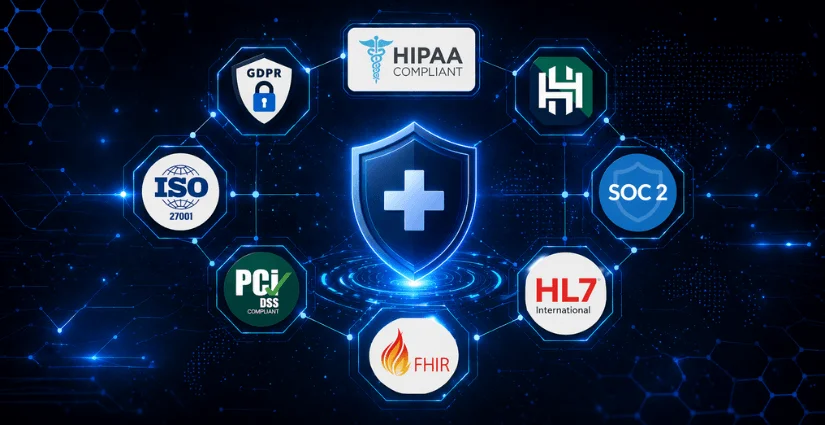
Data Protection & Regulatory Compliance in Insurance Solutions
Healthcare data is highly sensitive, and the following compliance standards ensure its security and protection:
How to Develop Health Insurance Software: A Step-by-Step Process?
Developing a robust health insurance software system entails an organized, agile, and regulated approach throughout the process. Each step involved is instrumental in ensuring scalability, security, and performance of the health insurance software system. The following provides an overview of the end-to-end custom insurance software development process:
1. Requirement Analysis
This is the first stage of the entire development process, involving translation of business needs into functional and non-functional requirements. During this stage, there is collaboration among different stakeholders involved in the development process. The scope of the platform will be determined by analyzing needs of end-users, key features, integrations needed in the platform, and many other aspects.
2. Design
After finalizing the requirements, the attention moves to building an experience-driven product for the target audience. It involves developing UI/UX designs, wireframes, and interactive prototypes to illustrate how the users would interact within the application environment. The key areas covered in the design include ease of navigation, accessibility, and responsive layouts that can be accessed via mobile phones, tablets, and desktop computers.
3. Development
Real application is created using current software technologies. The development process is done iteratively through various sprint sessions. Teams develop front-end components of the application and test them against backend functionalities, APIs, and database systems.
4. Testing
Testing helps ensure that the platform is dependable, secure, and efficient under various circumstances. Often, automated testing software is used together with manual testing to enhance efficiency.
5. Deployment
Once the testing phase is completed successfully, the health insurance software solutions are released into production. State-of-the-art systems for handling insurance services usually run on cloud-based infrastructure (e.g., Amazon Web Services, Microsoft Azure, or Google Cloud).
6. Maintenance & Improvement
The process of development is not limited to just the release of an application but is a continuous process. Once the application is deployed, there comes a phase of performance analysis and bug fixing, followed by regular updates and patches based on feedback from users.
How Much Does Health Insurance Software Development Cost in 2026?
The health insurance software development cost varies based on system size and functionality, including modules like claims processing, policy management, and AI-driven automation. The following section provides a detailed breakdown of estimated costs and key factors influencing development.
Cost Breakdown Based on Software Complexity
The overall development cost largely depends on the complexity of the solution. Basic platforms with limited features cost less, while advanced systems with AI-driven claims processing, automation, and integrations require higher investment due to increased development effort and infrastructure needs.
| Complexity Level | Estimated Cost Range |
| MVP (Minimum Viable Product) | $30,000 – $60,000 |
| Mid-Level Solution | $60,000 – $150,000 |
| Enterprise Solution | $150,000+ |
Cost Variation by Development Region
Development costs can significantly differ based on the geographic location of your development team. Regions like North America and Europe generally have higher hourly rates, while countries like India offer cost-effective development without compromising on quality.
| Region | Cost Level |
| USA | High Cost |
| Europe | Moderate |
| India | Cost-Effective |
Hidden Costs in Health Insurance Software Development
Beyond initial development, there are several hidden costs such as third-party integrations, compliance certifications, cloud infrastructure, maintenance, and security enhancements. Accounting for these ensures better budget planning and avoids unexpected expenses.
| Hidden Cost Area | Estimated Cost (Approx.) |
| Third-Party Integrations | $5,000 – $20,000+ |
| Compliance & Security | $10,000 – $50,000+ |
| Cloud & Infrastructure | $500 – $5,000/month |
| Maintenance & Updates | 15% – 25% of total development cost/year |
| Testing & QA | $5,000 – $15,000 |
| Data Migration | $3,000 – $10,000 |
Custom vs Off-the-Shelf Health Insurance Software: Which One is Right for You?
Choosing between custom-built and off-the-shelf custom health insurance software is a strategic decision that directly impacts scalability, operational efficiency, and long-term ROI. Each approach has its own advantages and limitations, and the right choice depends on your business goals, budget, and growth plans.
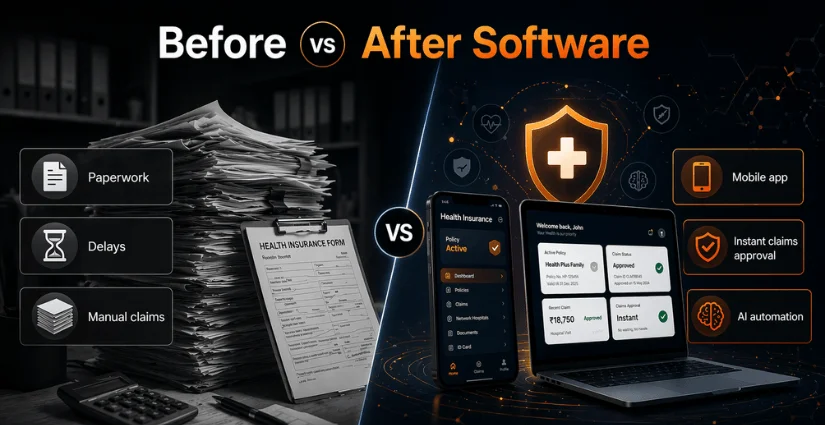
Custom Software
A custom health insurance software application is created entirely to fulfill a company’s specific needs. This makes it extremely flexible and adaptable for use now and into the future.
The best part about using a custom solution is that an insurer can create its own exclusive features, such as claims processing using artificial intelligence technology or policy management. Custom health insurance software does not impose any restrictions when it comes to integrating with electronic medical records, payment gateways, and CRM software development solutions, enabling insurers to centralize customer data, automate workflows, and improve policyholder engagement.
The drawback of custom health insurance software is that it takes more time to develop and costs much more money. Nevertheless, it may be recommended for large organizations.
Off-the-Shelf Software
Off-the-shelf solutions are pre-built platforms that can be quickly deployed with minimal setup. These solutions come with standard features such as policy management, claims processing, and reporting tools, making them ideal for businesses that need a quick start.
They are generally more affordable upfront and require less development time. However, customization options are limited, and businesses often need to adapt their processes to fit the software rather than the other way around.
As the business grows, these limitations can become more evident—especially when integrating with other systems or implementing advanced features. Licensing fees and dependency on the vendor for updates and support are also important considerations.
Key Differences at a Glance
| Factor | Custom Software | Off-the-Shelf Software |
| Flexibility | High | Limited |
| Scalability | Highly scalable | Restricted |
| Development Time | Longer | Quick deployment |
| Initial Cost | Higher | Lower |
| Customization | Fully customizable | Minimal |
| Integration | Seamless | Limited |
| Long-Term ROI | High | Moderate |
Which One Should You Choose?
If your objective is quick deployment at little initial cost, using existing software would be a good choice. But if you are looking to develop in the long run, then investing in customized health insurance software is the better choice.
Many companies also prefer to combine both methods, beginning with existing software and then gradually moving towards customized software solutions.
Common Challenges in Health Insurance Software Development and How to Overcome Them
Building and scaling medical insurance software development comes with a unique set of technical, regulatory, and operational challenges. Addressing these effectively is critical to ensure performance, compliance, and user trust.
Integration Issues
The health insurance systems need to be integrated with various other systems like hospitals’ databases, EHRs, EMRs, payment gateways, and third-party administrators. There could be variations in the formats, protocols, and standards used by all the systems, making their integration difficult.
Old legacy systems also make integration difficult, as they don’t have the necessary modern APIs required for integration. This causes integration problems, resulting in inconsistency in data, delays in claim processing, and a poor user experience.
Security Risks
Healthcare data is very sensitive, which means that insurance portals are an ideal target for hacking. Examples of cyber risks include hacking, data breaches, ransomware attacks, phishing, and other unauthorized access. However, threats can come from internal sources as well, such as poor access controls and mistakes made by developers.
Security issues can have severe repercussions not only financial but also affect company reputation negatively. Therefore, insurtech software development should ensure adequate protection using such approaches as data encryption, two-factor authentication, APIs, and monitoring.
Regulatory Changes
The healthcare and insurance sectors are among the most highly regulated fields, and compliance regulations are always changing.
Regulations like HIPAA, GDPR, and others in various regions have strict standards for collecting, storing, and exchanging data.
With constant changes in these regulations, there will be a need for regular system modification and documentation, not to mention compliance testing. For companies working in several regions at once, this task becomes increasingly difficult.
Being up-to-date with regulatory changes to medical software development while remaining agile and innovative is an enormous challenge.
Latest AI & Technology Trends Shaping Health Insurance Software in 2026
The health insurance market is undergoing rapid transformation due to technological innovation and shifting customer demands. The following trends are expected to drive the future direction of the industry in 2026:
AI Automation
AI technologies are revolutionizing all facets of health insurance, including underwriting, claims management, and customer care. AI algorithms can process vast amounts of data, identify fraudulent activities, make decisions automatically, and increase efficiency.
By 2026, health insurers are using more AI tools to minimize human involvement, expedite procedures, and achieve greater precision. Besides reducing operational expenses, such an approach improves customer satisfaction because of increased speed and accuracy.
Embedded Insurance
There is a growing tendency towards embedded insurance, which means that insurance products are integrated into another platform or service. For instance, insurance policies may be included in packages of fitness applications, telehealth solutions, or employee benefit schemes.
This approach helps make the process of purchasing simpler, and insurance becomes accessible at the very moment when the need arises. Besides, embedded insurance creates new opportunities for selling as companies do not use standard sales methods and reach their customers through other channels.
Personalized Insurance Plans
In today’s world, people want their experiences to be more personal, and the same applies to health insurance. Using data analytics, artificial intelligence, and sensors, companies can create customized insurance plans according to each person’s health status, habits, and risk profile.
Thus, in 2026, health insurance will become more personalized not only in terms of premium prices but also in regard to the list of covered issues, wellness programs, advice about how to stay healthy, and so forth.
How to Choose the Right Health Insurance Software Development Company?
The choice of the right software developer is vital for determining whether your health insurance software will be a success or a failure. Not only do you need to choose a professional software developer with the necessary expertise and skills, but also one who understands all the ins and outs of the insurance and health care industry.
In choosing a software development company, companies need to take into account three crucial points, namely expertise, scalability, and knowledge of compliance requirements.
Why Choose Octal IT Solution for Your Health Insurance Software Development?
Deep Industry Knowledge
Octal IT Solution has ample expertise in creating software products for the healthcare and insurance sectors. They know how to develop applications that meet industry-specific workflows, such as claims management, policy management, and compliance requirements, thus helping you build a product that is relevant and effective.
Scalable and Future-Proof Solutions
Experts have expertise in developing scalable software architecture that allows for growth. No matter whether you need an MVP or a fully-fledged platform, they will ensure that your solution is scalable enough to accommodate rising user traffic and integrate sophisticated features such as AI, analytics, and IoT.
Strict Compliance and Security Policy
Given their knowledge of international regulations, Octal IT Solution knows how to comply with standards such as HIPAA-compliant software development, GDPR, and other similar requirements. Their first priority in any project is the security of information, which means there will be no risks to your users’ data.
End-to-End Software Development Process
Octal IT Solution provides end-to-end custom software development services, including requirement analysis, UX/UI design, software development, testing, release, and maintenance.
Agile Methodology & Transparent Communication
Using agile development practices, the team delivers projects in iterative cycles, allowing for continuous feedback and faster time-to-market. Transparent communication keeps you informed at every stage of development.

The Concluding Remarks
Nowadays, an insurance software development company is not just an improvement of their technological capabilities, it is the way they compete and operate. In such a fast-changing technological environment, a company without a properly developed software solution would find itself unable to meet the demands of its customers and regulations.
The use of advanced technological tools such as artificial intelligence, analytics, blockchain technologies, and Internet of Things allows custom healthcare software development company to optimize their processes, cut expenses, and provide their clients with faster and more accurate solutions. User-oriented design will help to attract customers and make them stay loyal.
Finally, a health insurance software development company investing in the right technological solutions, together with the right development providers, will be able to compete effectively in the health insurance sphere in 2026 and beyond.


 Get in Touch
 By
By September 25, 2026