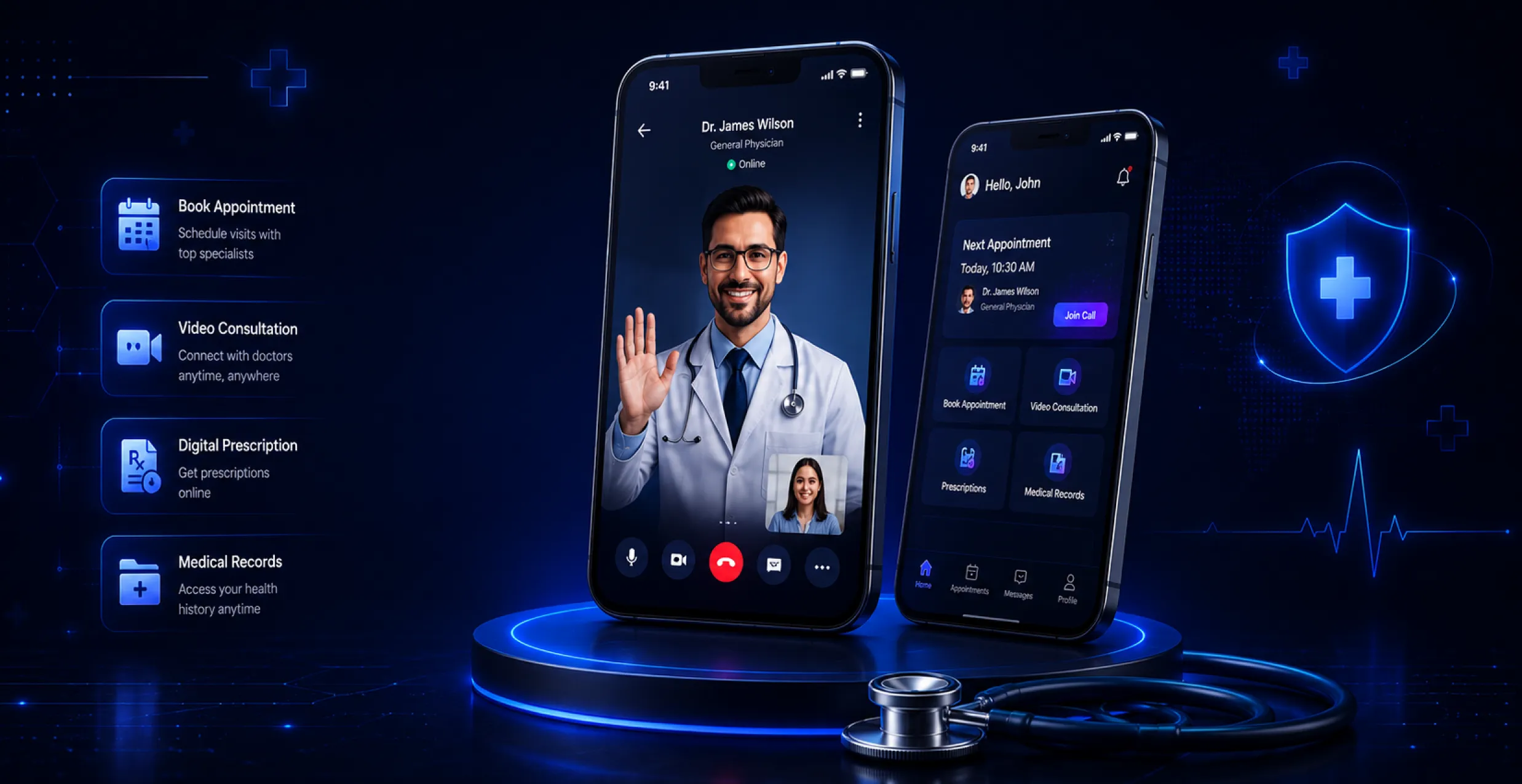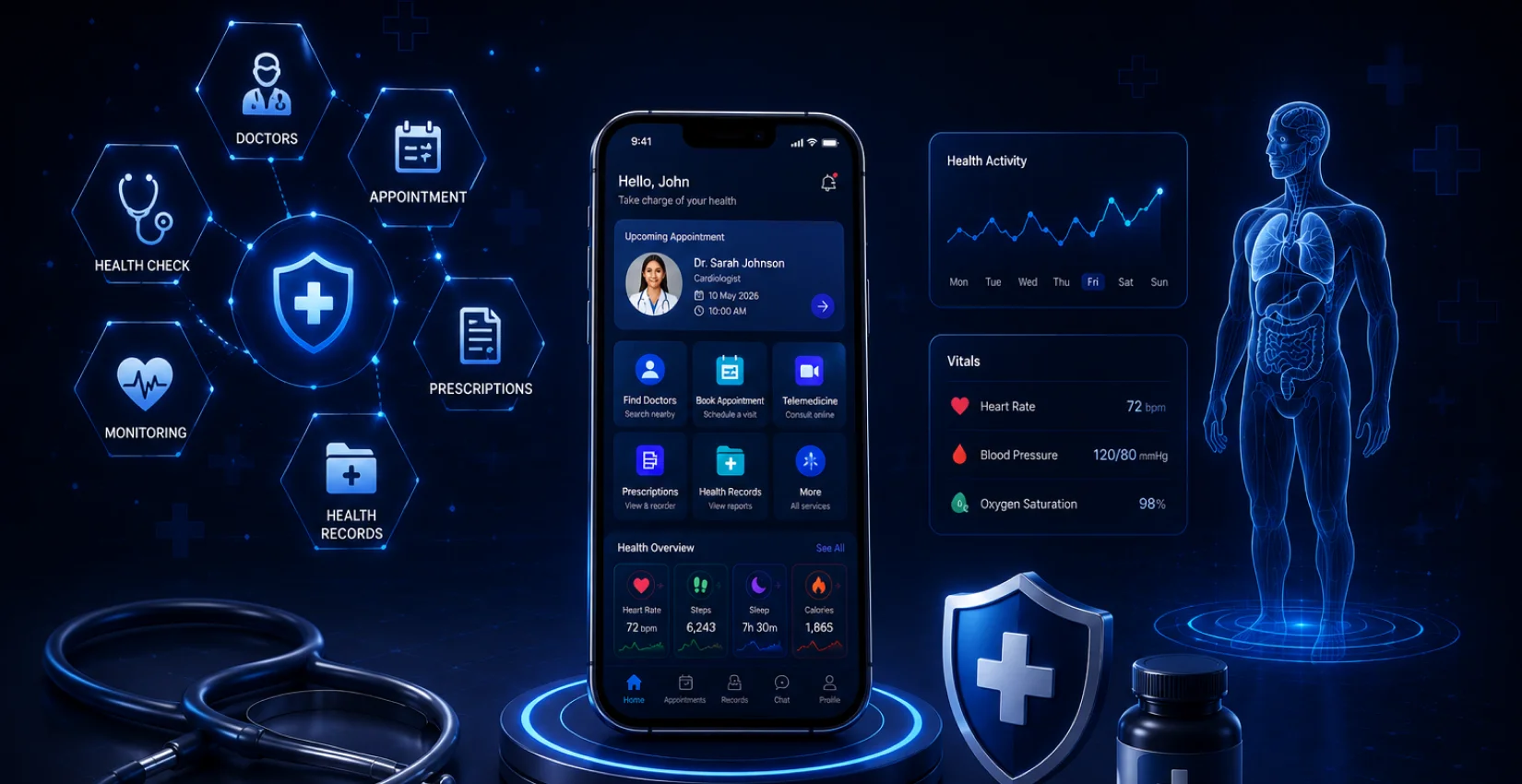




The demand for digital healthcare has evolved from a temporary solution into a long-term necessity. In 2026, telemedicine is not just about virtual consultations, it’s about creating fully connected healthcare ecosystems that combine video consultations, EHR integrations, e-prescriptions, and real-time patient monitoring.
The first thing that comes to mind while developing a telemedicine app is how much it’s going to cost. Depending on what you are doing, who is developing it, and where they’re established, the telemedicine app development cost may range from $30,000 to $300,000.
Telehealth is becoming a need rather than a fad. Grand View Research reports the global telemedicine market was valued at $141.19 billion in 2024 and is projected to reach $380.33 billion by 2030, growing at a CAGR of 17.55% from 2025 to 2030. This blog lays it all out, surely and without a doubt, whether you are an established health care provider seeking to go digital or a startup exploring the cost of telemedicine.
Key Factors Affecting the Cost of Developing Telemedicine Apps
Before obtaining an estimate from any development team, you need to verify the important elements that impact pricing fluctuations.
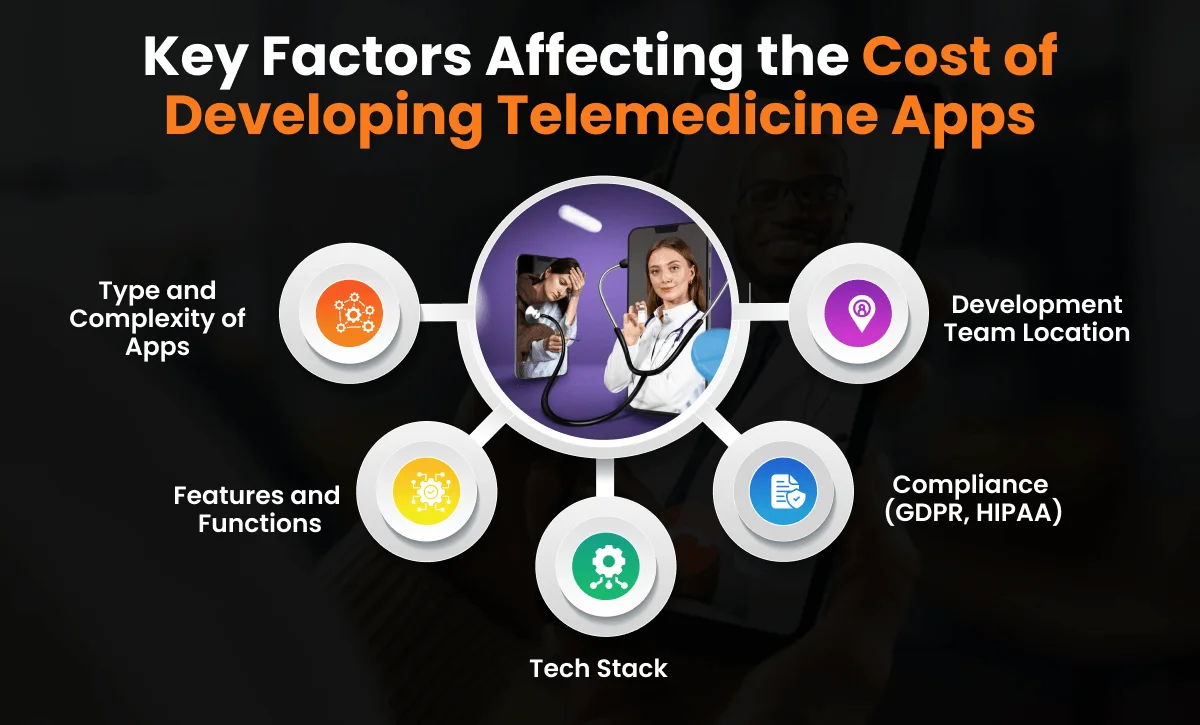
Type and Complexity of Apps
A completely functional platform with AI diagnostics and remote monitoring is drastically more expensive than a primary MVP with important features like video calls, appointment scheduling, and an interactive dashboard. Typically, there are 3 levels:
- Basic app: $30,000 – $60,000
- Mid-level app: $60,000 – $150,000
- Advanced/enterprise app: $150,000 – $300,000+
Features and Functions
The value will increase as more capabilities are added. Every feature, along with video consultation, EHR integration, multilingual help, real-time chat, and prescription management, provides development time, and time equals money.
Tech Stack
Your choice of technology is important. It is more expensive to build natively for each iOS and Android than to apply cross-platform frameworks like React Native or Flutter. The overall cost of developing telemedicine app also relies on your backend structure, cloud hosting (AWS, Azure, Google Cloud), and third-party API integrations.
Compliance (GDPR, HIPAA)
This one cannot be compromised. HIPAA compliance is critical in case you’re creating for the USA marketplace. GDPR is relevant in Europe. Compliance is more than simply checking a container; it requires steady video transmission, encrypted data storage, audit information, and legal evaluations. You need to finance an additional $10,000 to $30,000 for compliance-related obligations alone.
Development Team Location
The location of your team has a huge impact on development cost of telemedicine platform. In the United States, a senior developer makes between $100 and $200 in an hour. In India, the identical level of knowledge cost among $25 and $50 an hour. For this purpose, to be able to limit costs without compromising quality, many agencies collaborate with an offshore healthcare app development company.
Visit: Top 20 Custom Software Development Companies in Dubai 2026
Telemedicine App Development Cost Breakdown
Here’s a step-by-step breakdown of how your money is definitely spent when you invest in telemedicine app development services:
Planning and Discovery
Understanding your customers, mapping features, growing technical specs, and setting up the product roadmap are all foundational. One of the most highly-priced mistakes you may make is to skip this stage.
Estimated cost: $3,000 – $8,000
UI/UX Design
Both physicians and patients require an interface that is clean, easy to use, and available. Good UX layout in healthcare has a direct impact on patient engagement and acceptance; as a consequence, it goes beyond aesthetics.
Estimated cost: $5,000 – $15,000
Development
This represents the most important part of your budget. The front-end, back-end, database configuration, real-time communication features, and API connectors. This is where it all takes place. This stage grows in case you’re developing for both iOS and Android. Here, working with a complete-stack team or a good Android app development agency can make a huge impact.
Estimated cost: $20,000 – $150,000+
QA and Testing
There is no room for errors in a healthcare app. Security audits, load testing, purposeful testing, and compliance verification are all covered in the checkout. Although this level is critical, it’s often regularly neglected.
Estimated cost: $5,000 – $20,000
Post-Launch Support
After release, your app continues to make money. Security patches, OS updates, malicious program fixes, server costs, and new feature rollouts are all ongoing. The majority of companies set aside 15–20% of the annual development budget every year for renovation.
Estimated annual cost: $10,000 – $40,000+

Comparison Table of Cost to Build Telemedicine App
Seeing everything side by side is beneficial after you have a section-by-section understanding of where the cash flows. This chart allows you to decide where your project clearly fits by providing you with a realistic view of what you get at every investment level.
| Factors | MVP / Basic | Mid-Level | Enterprise |
| Target | Startups, early validation | Growing clinics, funded startups | Hospitals, large health networks |
| Timeline | 3–5 months | 6–9 months | 12–18 months |
| Cost Range | $30,000 – $60,000 | $60,000 – $150,000 | $150,000 – $300,000+ |
| Video Consultation | Basic | HD + recording | Multi-party, encrypted |
| Appointment Scheduling | Basic booking | Real-time + reminders | Advanced + calendar sync |
| Patient & Doctor Panel | Basic profiles | Full dashboards | Role-based access control |
| Payment Integration | Single gateway | Multi-gateway + refunds | Insurance billing + multi-currency |
| EHR Integration | – | Basic | Full (Epic, Cerner) |
| AI Features | – | Chatbot only | AI diagnosis + RPM |
| HIPAA/GDPR Compliance | Basic | Full | Full + annual audits |
| Admin Panel | Basic | Analytics + reporting | Custom dashboards + BI tools |
| Maintenance (annual) | $8,000 – $15,000 | $15,000 – $30,000 | $30,000 – $60,000+ |
Which Tier is Right for You?
- The MVP tier is a smart place to start in case you’re a startup exploring a singular concept or confirming product-market fit. You get the important telemedicine app features such as video, scheduling, primary panels, and payments, without going over the price range, before you know what your users honestly require.
- The mid-level is suitable for businesses that require a more refined, scalable service and have already confirmed demand. The majority of increasing telehealth organizations settle right here, and the telemedicine platform cost begins to reflect proper competitive capability.
- Organizations with complex workflows, high patient volumes, and stringent integration demands have to choose the enterprise tier. Consider multi-specialty care providers, coverage-sponsored structures, or health center networks. At this level, the telemedicine app cost consists of infrastructure, security architecture, and regulatory depth capability.
It’s crucial to keep in mind that those values are predicated on offshore or hybrid development teams. Add 60–80% to each tier if you are hiring just in the United States or Western Europe.
Check Also: Top Telemedicine App Development Companies in USA
Features that Shape Your Telemedicine App Development Budget
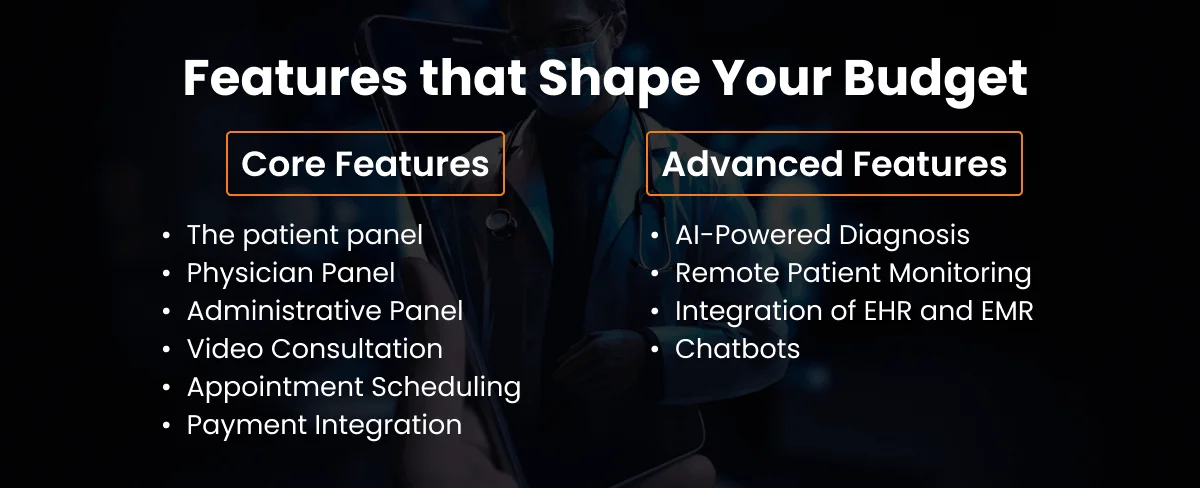
Core Features
Every telemedicine app needs to have those capabilities:
- The patient panel: Access to medicinal drugs, reports, appointment scheduling, clinical history, registration, and profile control.
- Physician Panel: Earnings dashboard, prescription writing, patient data, consultation records, and timetable management.
- Administrative Panel: Analytics, content management, payment supervision, customer management, and support tools.
- Video Consultation: The core of any app for telemedicine. Ought to be reliable, low-latency, and steady. Generally constructed with WebRTC or third-party SDKs, which include Agora or Twilio.
- Appointment Scheduling: Push, email, and SMS reminders, cancellations, and real-time slot availability.
- Payment Integration: PayPal, Stripe, or local gateways. Refunds, coverage billing, and multi-forex.
The improvement of these essential telemedicine app development features alone may also take 3 to 6 months.
Advanced Features
These are the factors that significantly boost the value of your application and increase it from mediocre to excellent:
- AI-Powered Diagnosis: Clinical selection aid, initial opinions, and symptom assessments. AI in healthcare is growing fast, and relying on complexity, integrating these tools may cost anywhere from $15,000 to $50,000.
- Remote Patient Monitoring: Real-time tracking of crucial signs and symptoms, including blood pressure, glucose levels, and heart rate, through integration with wearables and IoT devices
- Integration of EHR and EMR: Although technically hard, connecting your app to modern EHR structures (such as Epic or Cerner) is essential for enterprise-level deployments.
- Chatbots: AI-driven digital assistants for patient inquiries, appointment scheduling, and symptom triage. Can finally appreciably cut operating charges.
Telemedicine Platform Development Cost by Region
Selecting the location of your healthcare software development company is one of the most realistic techniques to manage your finances.
| Region | Hourly Rate | Cost for Mid-Level App |
| USA / Canada | $100 – $200/hr | $120,000 – $250,000 |
| Western Europe | $80 – $150/hr | $120,000 – $250,000 |
| Eastern Europe | $40 – $80/hr | $60,000 – $120,000 |
| India | $25 – $50/hr | $30,000 – $80,000 |
Cost in India
It is the most cost-effective without compromising excellence, and it is home to numerous leading telemedicine software development services. Boasts a huge skill pool of healthcare IT professionals.
Cost in the United States
It is the highest, but it makes sense if you have compliance requirements that call for a US-based legal and technical team, want in-person cooperation, or need time-zone alignment.
Cost in Europe
Eastern Europe, especially Poland and Romania, offers strong technical talent at rates well below US or Western European prices, with the added advantage of cultural and regulatory familiarity.
Build Custom Or Buy White-Label: Which One Makes Sense?
Before committing to a complete custom construct, more startups and healthcare businesses ought to ask themselves this question. To be honest, the answer isn’t “build.”
A White-Label Telemedicine Solution: What’s it?
White-label platforms are telemedicine software that have already evolved and can be rapidly rebranded. Platforms from corporations like Doxy. Me, SimplePractice, or Vsee may be configured and deployed in a matter of weeks rather than months. You receive a functional product, your domain, and your brand, without having to pay for development.
So, Why Isn’t White-Label Always Used by People?
Due to the reality that it has real barriers. You are confined to the feature roadmap of every other person. Customization is constrained; at the same time, colors and logos can be altered, but the product’s capability cannot be appreciably altered. Differentiation becomes extremely challenging if your rivals are using the same platform. Per-user licensing charges can also surpass the value of a bespoke creation over a duration of a few years as your consumer base expands.
Here’s A Clear Insight
| White-Label | Custom Build | |
| Time to launch | 2–8 weeks | 4–18 months |
| Upfront cost | $500 – $5,000/month | $30,000 – $300,000+ |
| Customization | Limited | Full control |
| Scalability | Platform-dependent | Built to your needs |
| Data ownership | Shared/vendor-controlled | 100% yours |
| Long-term cost | Higher (recurring fees) | Lower over time |
| Best for | Quick launch, tight budget | Unique product, long-term growth |
When White-Label Makes Sense?
A steady video session with simple scheduling is all you want if you have a small clinic or are a solo practitioner. You have less than two months to release. While you validate demand, your first telemedicine cost needs to remain low. Technical complexity needs, such as AI capability or custom EHR integration, are not required.
When Custom Development Makes Sense?
You are developing a product that should be significantly different from the current product. No off-the-shelf tool can accommodate the precise workflows you have. You’re thinking about the long term, and you care about record ownership. You need to create something that grows and, sooner or later, turns into a platform that other people utilize. This is exactly the factor at which spending money on suitable telemedicine software development services will pay off.
The Hybrid Approach
Some businesses begin with a white-label approach to unexpectedly meet demand, and when they have finance and real customers, they transfer to a custom-designed platform. Technically speaking, it’s no longer the cleanest path; it’s a wise business decision. Instead of batting on a $150,000 idea, you’re investing $5,000 consistent with month to validate it, then building appropriately once you are sure it’s more successful.
In summary, white-labeling is a shortcut as opposed to an approach. Custom development is the fine path of action if you’re serious about creating a unique telehealth product. However, making use of white-label to quickly attain the market while your custom production is underway isn’t a signal of weakness.
Timeline for Developing Telemedicine Apps
What is the average timeline required to create a telemedicine application? This is a realistic breakdown:
| Phase | Duration |
| Planning & Discovery | 2–4 weeks |
| UI/UX Design | 3–6 weeks |
| Core Development | 3–6 months |
| Testing & QA | 3–6 weeks |
| Launch & Deployment | 1–2 weeks |
It normally takes 4 to 6 months to create a primary MVP. It takes 9 to 18 months to broaden a fully functional platform. The team size, the number of features, and the speed at which selections are taken to your end all have a tremendous impact on the telemedicine app development timeline.
Telemedicine App Development Cost: Ongoing & Hidden Expenses You Must Consider
Costs that weren’t included in the first cost can surprise clients. These are the typical ones:
Costs of Third-Party APIs: Push notification services, payment gateways, mapping tools, and video SDKs (Twilio, Agora) all have monthly usage or subscription costs.
Cloud-based infrastructure: Azure, Google Cloud, or WS web hosting. Your server cost will increase as your consumer base does.
Legal and compliance: HIPAA compliance requires ongoing guidance. Recurring prices encompass BAA contracts with providers, annual security audits, and legal advice.
App Store Fees: Both Apple and Google take a portion of in-app purchases, in addition to charging yearly developer costs.
Tools for Customer Support: Your operating price range is elevated through CRM connectors, live chat tools, and ticketing systems.
To account for those hidden charges, it is a good idea to add 20–30% to your development quote. The cost of telehealth implementation always comes at a better value than the development invoice.

How to Reduce the Cost to Develop Telemedicine App?
The cost of developing a telemedicine app doesn’t have to be excessively high. Here’s how smart businesses manage expenses:
- Make an MVP First
First, develop the critical features. Start, examine, and then develop. This lowers the initial cost and allows your plan to be guided by real-world statistics.
- Use Cross-Platform Development
Building for both iOS and Android from a single codebase is feasible with Flutter or React Native, which reduces charges by using 30–40% when compared to native development.
- Leverage Modern SDKs and APIs:
Don’t assemble what is already there. Instead of starting from scratch, use pre-existing video, price, and notification SDKs.
- Employ Offshore Expertise:
The same quality may be had at a fraction of the USA cost from a good telemedicine app development company in Eastern Europe or India.
- Plan Features Properly Upfront:
One of the main drivers of software project cost is scope creep. You’ll encounter fewer pricey mid-construct changes if you specify requirements more exactly before development begins.
Final Thoughts
In a world where customers demand digital-first healthcare, creating a telemedicine app is a sustainable investment with tangible, quantifiable results. Knowing how much does it costs to develop a telemedicine app can help you plan more efficiently, prevent overspending, and make decisions that benefit your company and your clients.
The secret is to put together for the entire lifespan, no longer simply the launch day, start with an MVP, pick out the right development partner, and be serious about your goals. Clarity of pricing, scope, and strategy is the first step in the direction of a successful telehealth solution, irrespective of the size of the healthcare enterprise.
Are you ready to build? Connect with our healthcare app development company that focuses on scalable, compliant telehealth solutions.


 Get in Touch
 By
By September 25, 2026