



Key Takeaways
- Android app budgeting is driven by app scope, feature complexity, and the chosen technology stack.
- Clear planning and accurate cost estimation prevent budget overruns and development delays.
- Long-term expenses like maintenance, updates, and scalability must be planned from the start.
- Selecting the right development approach ensures cost efficiency and sustainable business growth.
- Introduction
- Understanding the Scope of Your Android App
- Key App Development Cost Factors to Consider
- Android App Cost Estimation Process
- Choosing the Right Android Development Pricing Models
- How Much Does an Android App Cost Based on App Type?
- Role of Design and User Experience in Budgeting
- Importance of Technology Stack and Tools
- Post-Launch Costs You Should Not Ignore
- Working with the Right Development Partner
- Strategies to Optimize Your Android App Budget
- Conclusion
- FAQs
Introduction
Budgeting for an Android app is one of the most important decisions a business must make before developing a mobile app. A clear budget not only helps define the scope and quality of your application but also affects timelines, scalability, as well as long-term returns on investment. Most companies make underestimates, which result in delays in the project lifecycle, loss of features, or mid-project development surprise costs.
Understanding the budgeting mechanism for Android apps helps the decision-maker align technical needs with business goals. The selection of the appropriate features and development method, considering the maintenance that will be required after the launch, and so on, each phase has an effect on the final investment. In addition, design complexity, backend infrastructure, third-party integration, and testing requirements are considered to have a significant cost effect.
This is a business-oriented breakdown of the planning of an Android app budget that is clear and easily understood. Whether you’re a startup looking to experiment with its first mobile product or a company looking to grow its online offerings, you will find this blog useful for making informed financial decisions without sacrificing quality or performance.
Understanding the Scope of Your Android App
The initial stage in the budget planning of your Android app is to identify the purpose of the app and the scope of the app. Truly simple apps that offer basic functionality, such as registration of users, display of content, and notifications, will cost significantly less to develop, as compared to a platform with more features, such as real-time content, trade, or artificial intelligence. Companies need to describe the issue that is addressed by the app and how it contributes to the general purpose.
The apps can be classified into basic, mid-level, and complex categories. Basic apps are concerned with information delivery, mid-level apps offer connectivity via the back-end and APIs, and complex apps offer such advanced features as real-time chat, geolocation, or machine learning. The more functionality you incorporate, the more the number of development hours are needed, directly affecting the Android app development cost.
Key App Development Cost Factors to Consider
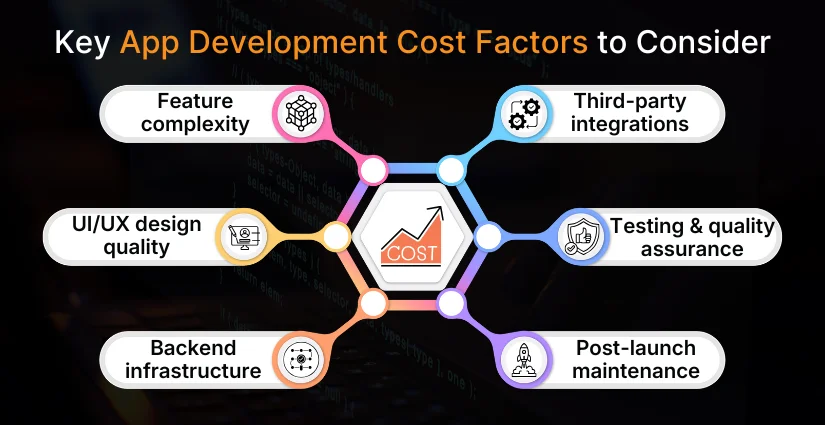
There are a number of cost aspects of app development, which will determine the cost of your Android app in terms of finance. The most evident one is the feature complexity, yet it is not the only one. The design of the apps is significant, as an easy-to-use interface/UX requires extensive research, wireframing, android development frameworks and usability testing.
Another cost driver is the Backend infrastructure. Applications that are based on cloud hosting, databases, administration interfaces, or third-party systems demand further server coding and threat strategies. Connection with payment gateways, analytics, or customer relationship management systems further amplifies the development work.
Quality assurance and testing are also important. A powerful QA will guarantee that your application is compatible with a variety of devices and operating systems and works on Android. Testing is usually avoided or minimized because of the cost involved in testing, but this costs less than doing structural fixes after the product is launched.
Android App Cost Estimation Process
Proper estimation of Android application cost starts with the specifications of the requirement documentation. Companies ought to create a features list, user flowcharts, and desired performance criteria, and then take these to the developers. This makes the development teams estimate timelines and resources.
The estimation process usually involves requirement analysis, design effort estimation, estimation of hours to develop, estimation of testing time, and planning the deployment. Buffer time also comes in experienced teams in case of some unforeseen changes or refinements. Businesses are prone to budget overruns and scope creep without estimating them properly.
It is a clever idea to use prototypes or minimum viable products (MVPs) to lessen the initial investment. MVP enables companies to test the concepts, get user feedback, and iterate until they have a complete build.
Choosing the Right Android Development Pricing Models
Choosing the appropriate Android development cost models also has a great influence on your budgeting process. Fixed-price models are most effective in those cases when requirements are clear and not likely to be changed. They are predictable in cost but not that flexible in making changes.
The most suitable models to use to evolve projects are time-and-material models. Businesses are charged for actual hours of development, so there is flexibility in the addition or changes of features. Nonetheless, this model needs effective project management to avoid an increase in cost.
Team models that are dedicated are applicable in long-term or big projects. Companies outsource Android development and use a dedicated team that solely focuses on their application, which is scaled and delivered within a shorter time at a costlier monthly expense.
Knowledge of these models assists businesses in identifying the budget allocation in relation to the complexity of the project, as well as the growth plans.
Read More: MVP Development for Android Apps: Cost, Features & Timeline
How Much Does an Android App Cost Based on App Type?
The commonest question that businesses ask is how much an Android app costs. It depends on the type and functionality of the app. Simple applications may be cheaper to invest in, whereas an enterprise-level application may require a higher budget due to security, scaffolding, and compliance requirements.
E-commerce applications, on-demand services platforms, fintech applications, and healthcare applications are in higher cost brackets because of advanced functionality and regulatory demands. The real-time data processing of social networking or marketplace apps is also necessary and contributes to the infrastructure and development costs.
Companies must not be too preoccupied with the upfront cost of development. Budget planning must cover long-term costs like updates, optimization of performance, and the addition of new features.
The following table presents straightforward, business-friendly calculations of the approximate cost of an Android app, depending on the type of app to use, handy with blogs and decision-makers.
Approximate Android App Cost Based on App Type
| App Type | Key Features Included | Approximate Cost Range (USD) |
| Basic App | User login, static content, basic UI, push notifications | $8,000 – $15,000 |
| Mid-Level App | APIs, backend integration, payment gateway, analytics | $15,000 – $30,000 |
| E-commerce App | Product listings, cart, payments, order tracking, admin panel | $25,000 – $45,000 |
| On-Demand Service App | Real-time tracking, service booking, notifications, payments | $30,000 – $50,000 |
| Social Networking App | Real-time chat, media sharing, feeds, cloud storage | $35,000 – $60,000 |
| Marketplace App | Multi-vendor support, commission system, dashboards | $40,000 – $70,000 |
| Fintech App | Secure transactions, encryption, compliance, APIs | $45,000 – $80,000 |
| Healthcare App | Data security, compliance, patient records, integrations | $50,000 – $90,000 |
| Enterprise Android App | Advanced security, scalability, integrations, and custom workflows | $60,000 – $100,000+ |
Role of Design and User Experience in Budgeting
The type of technology stack that you use in your Android application influences the speed at which the application is developed and the cost. Native Android development will guarantee high performance and improved compatibility with the devices; however, it needs specialized knowledge. The third-party SDKs and libraries can accelerate the development, but might require a cost in terms of a license.
There is an additional cost overlay of advanced features such as AI-powered suggestions, chatbots, or predictive analytics. The intelligent features can be incorporated in companies that provide the best artificial intelligence development services; however, companies have to spend on the processing of data, training of the model, and continuous optimization.
Importance of Technology Stack and Tools
The budget planning is not over after launching the app. Post-launch expenses involve maintenance of servers, bug fixes, security updates, and OS compatibility upgrades. There should also be marketing costs for promoting the app and acquiring users.
Constant updates should be considered to keep pace with the competition and to avoid violating the Google Play policies. Maintenance is an area that should not be overlooked because it leads to deteriorating application performance and customer dissatisfaction.
Common Technology Stack and Tools Used in Android App Development
| Development Layer | Technologies / Tools | Purpose & Usage |
| Android App Development | Kotlin, Java | Native Android app development with high performance and device compatibility |
| UI / UX Design | Figma, Adobe XD, Sketch | Wireframing, prototyping, and user interface design |
| Backend Development | Node.js, Spring Boot, Python, PHP | Server-side logic, APIs, and app data handling |
| Database | Firebase, MySQL, PostgreSQL, MongoDB | User data storage, real-time database, and content management |
| Cloud & Hosting | AWS, Google Cloud Platform, Microsoft Azure | Scalable hosting, storage, and performance optimization |
| APIs & Integrations | REST APIs, GraphQL | Data exchange between frontend and backend systems |
| Payments & Transactions | Stripe, Razorpay, PayPal | Secure online payments and transaction handling |
| Analytics & Monitoring | Firebase Analytics, Google Analytics, Crashlytics | User behavior tracking, performance monitoring, error reporting |
| Push Notifications | Firebase Cloud Messaging (FCM) | Real-time alerts and user engagement |
| Security | OAuth 2.0, SSL/TLS, JWT | Authentication, authorization, and data protection |
| AI & Machine Learning | TensorFlow Lite, Google ML Kit, OpenAI APIs | Chatbots, recommendations, predictive analytics |
| Testing & QA | Espresso, JUnit, Appium | Functional, UI, and automated testing |
| CI/CD & DevOps | GitHub Actions, Jenkins, GitLab CI | Automated builds, testing, and deployment |
Post-Launch Costs You Should Not Ignore
By collaborating with seasoned individuals, costs can be optimized without affecting the quality. Trusted teams offer open market prices, achievable schedules, and forward-thinking suggestions. Companies that have chosen custom Android app development Services benefit by having custom-made solutions that are in line with their long-term objectives in an effort to save unnecessary costs incurred through generic applications.
An effective development partner will also help in cost optimization techniques, including feature prioritization and incremental development.
Learn More: Why Businesses Should Invest in Android App Development
Working with the Right Development Partner
Partnering with experienced professionals helps optimize costs without sacrificing quality. Reliable teams provide transparent pricing, realistic timelines, and strategic recommendations. Businesses opting for custom Android app development Services gain tailored solutions aligned with long-term goals, reducing unnecessary expenses caused by generic implementations.
A good development partner also assists with cost optimization strategies, such as feature prioritization and phased development.
Strategies to Optimize Your Android App Budget
Cost control can be achieved by businesses by focusing on the key features, applying MVP methods, and not over-engineering. Effective communication with development teams eliminates rework as well as delays. Periodic reviews of progress ensure the identification of problems in time, which saves time and money.
Scalable architecture is less expensive to invest in initially, thereby saving on future redevelopment. Smart budgeting is about value creation and not corner-cutting.

Conclusion
An Android app budget cannot be planned just by estimating the time required to develop it. It entails the realization of business objectives, the determination of the scope of the app, the appropriate pricing models, and long-term cost considerations. Companies that take time to make the right budget have more control over how their projects are carried out and have higher ROI.
By using the strategic approach, unforeseen costs are prevented, and the resources are distributed effectively in terms of designing, development, testing, and maintenance. The businesses can develop quality apps on Android without having to spend unnecessary money by taking into account the most important cost drivers and collaborating with partners with extensive experience.
Finally, a strategized budget fits technical potentials with business aspirations. It reinvigorates your app into a value-producing growth engine that delivers value, scale, and success over time in a competitive online environment.
Read More : Android app development companies
FAQs
The most significant cost drivers are feature complexity, design requirements, third-party integrations, test work, and regular maintenance. Applications characterized by real-time functionality, a high level of security, or tailored UI components tend to be more costly in terms of development hours. Besides, the level of experience of the development team and project schedules can have a major influence on prices.
The cost estimation is also good when the requirements are well-known. The documentation, prototyping, and feature lists also minimize budget fluctuations during development. But one may still experience the effect of the change in scope or new feature, or some unexpected technical difficulties, so businesses should maintain a contingency buffer.
Fixed-price or MVP-based models are usually popular with startups because they are more predictable and allow the company to enter the market more quickly. Time-and-material models are appropriate in the development of app ideas in which incessant modification, experimentation, and end-user reaction are necessitated to enhance the capabilities over time.
The prices differ depending on functionality and the size of the apps. The apps related to small businesses usually demand less investment, particularly when centered on basic functions only. The options to use a scalable architecture enable businesses to add new sophisticated features in the future without the need to refactor the whole app.
They should be. The maintenance, updates, hosting, security patches, and marketing will be recurring costs, which largely affect the overall investment in the app. The neglect to consider post-launch costs usually results in performance problems and a low level of user satisfaction.
Yes. The focus on must-have features, MVP model, reusable components, and experienced developers can minimize the costs and still ensure a high level of quality, scalability, and overall longevity of the app.


 Get in Touch
 By
By October 16, 2026