



Imagine your most trusted banking app was not made by a bank. Instead, it was built by a focused Android team. That change is happening now.
The wider FinTech market is growing fast. It was listed at about USD 2.03 trillion in 2026. By 2032, it is expected to rise to about USD 3.58 trillion. That would be a 9.8% CAGR. Source: Research & Markets. Most people carry Android devices. That gives Android a strong role in new product growth.
If you are planning FinTech Android app development, 2026 is a key year. New expectations are forming. People want more personal experiences. Payment features are being added inside apps. Security steps are also getting stronger.
In this guide, we lay out the major trends. We also cover the common features and the usual steps for creating financial apps that earn user trust.
What Is FinTech Android App Development?
FinTech Android app development means creating, testing, and releasing money-related apps for Android. Companies use these apps in many parts of the finance sector. They want a way to deliver Android apps for financial services that is safe and can grow as demand rises. The goal is to serve large numbers of people around the world, including
- Digital & mobile banking apps
- Payment & digital wallet apps
- Lending & BNPL platforms
- Investment & WealthTech apps
- Insurance (InsurTech) apps
Why Choose Android for FinTech App Development?
Android is still the top choice for FinTech Android app development because it reaches so many people and it is easy to adapt. A company that only talks about “mobile apps” can feel too broad. When you focus on Android, fintech teams can manage costs, customization, and scale effectively.
- Global Market Share — Android leads in global phone use. That means fintech apps can reach more users right away.
- Google Pay Ecosystem — Android also fits well with Google Pay. Payments, wallets, and the checkout step work together more smoothly when they are built for the same platform.
- Device Diversity — There are many Android phones and tablets at different prices. That variety helps fintech products find users across different markets.
- Open-Source Flexibility—Android is open, so developers can adjust the system more deeply. This supports more customization for Android-based financial apps.
- Cost Efficiency vs. iOS — Building for Android often costs less than building for iOS. That can help teams launch faster and hit deadlines sooner for Android financial app development projects.
Top FinTech Android App Development Trends in 2026
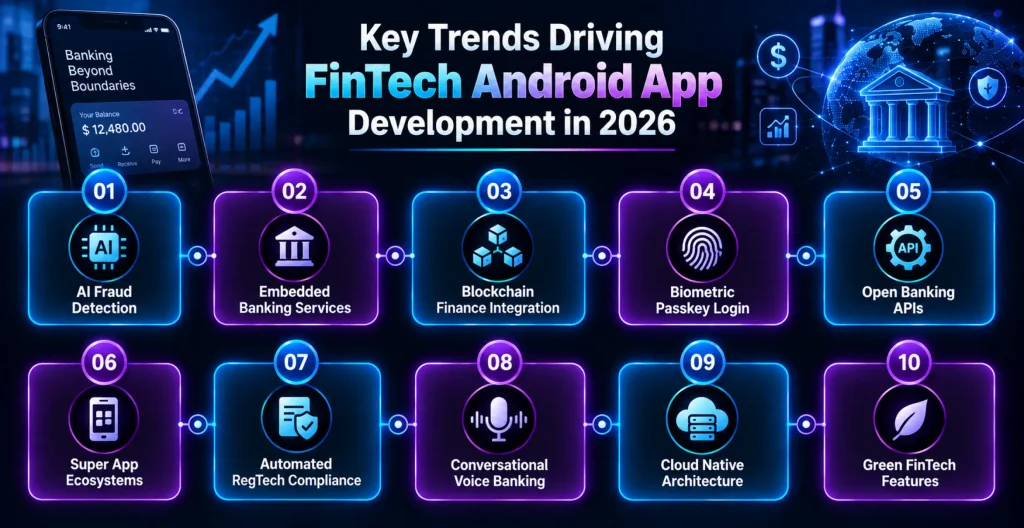
The next shift will shape how Android apps get built. Here are the points most teams expect to matter in 2026, from AI upgrades to more open transaction data.
1. AI & ML-Powered Personalization and Fraud Detection
AI and machine learning now power real-time fraud detection, personalized budgeting insights, and predictive financial recommendations, making Android FinTech App Development smarter, faster, and more responsive to individual user behavior.
2. Embedded Finance & Banking-as-a-Service (BaaS)
Banking-as-a-Service lets outside product teams plug in banking functions. That may cover transfers, lending, and basic account features. With this setup, Android FinTech work can go beyond the traditional path of only building bank-style apps.
3. Blockchain & Decentralized Finance Integration
Blockchain can make it simpler to check that a payment or record is valid. The goal is clearer visibility and stronger safety. If you team up with a Web3 development company and your Android group, you can bring in features like crypto wallets and smart contracts.
4. Biometric Authentication & Passkeys
Android gives robust ways to log in without relying on simple passwords. Biometric Prompt and the Play Integrity API can power face or fingerprint sign-in. That lowers password use and supports a quicker, safer sign-in process in Android money apps.
5. Open Banking APIs & Real-Time Data Sharing
Open banking APIs let fintech apps share money data between banks fast. The data moves through secure routes. That helps users see more accounts in one spot. It can also make loan reviews quicker. Android developers can build more types of financial apps.
6. Super Apps & All-in-One Financial Ecosystems
Super apps combine banking, payments, investing, and shopping in one view. So many fintech teams want Android code that is easy to swap and expand. They need it to fit new needs later.
7. RegTech & Automated Compliance Monitoring
Compliance and risk checks can run all day with automated tools. They point out regulatory issues as they happen. That means fewer manual reviews and more time for product work. Android teams in the FinTech space can react as rules change around the world.
8. Voice & Conversational Banking
Many AI chat assistants now help users handle common tasks. People can ask for balances or move money using simple speech. The goal is to make everyday banking feel natural inside an Android FinTech app.
9. Cloud-Native & Microservices Architecture
A cloud setup helps a lot too. With a microservices style, each part can grow on its own. Updates can go out sooner. The system can also handle failures better. This approach is becoming common in Android FinTech application development.
10. Sustainable / Green FinTech Features
Some banks are adding green tools. Users can see carbon use tied to spending. ESG scoring features are showing up in more apps. This can become a selling point for Android banking apps.
Must-Have Key Features of a FinTech Android App
Most FinTech Android app development companies start from a small set of must-haves. If you know that list early, you can estimate Android app costs more safely before you bring in Android developers. Below are the features you cannot skip if you want users secure and engaged.
1. Secure Onboarding & eKYC
Digital KYC helps people start quickly. They can use an ID scan and a face check. That cuts down the time to finish signup and supports compliance from the start.
2. Multi-Factor & Biometric Authentication
Use more than one check for access. A password plus fingerprint or face unlock adds real protection. It also helps guard private money data while keeping the flow smooth.
3. Digital Wallet & Multi-Currency Support
A wallet inside the app lets users hold funds, switch currencies, and pay. Multi-currency support matters if your app serves more than one region.
4. Real-Time Payments & QR/UPI Integration
QR and UPI payments happen quickly. It feels smooth, not slow. People expect this from today’s finance apps.
5. Push Notifications & Transaction Alerts
The app can send updates for each transaction. It can also warn about low balance and odd activity. This helps users feel safer and more confident.
6. In-App Chat/Support & Chatbots
A chat feature can answer common questions fast. Chatbots handle many requests right away. This can cut down wait times and lower support load.
7. Budgeting & Expense Tracking Tools
There are tools to track expenses and sort them by type. Users can also plan budgets and set save targets. This keeps users coming back during the day.
8. Investment & Robo-Advisory Modules
There are automated options for investing. They can suggest a portfolio and match it to a risk level. For many people, this removes the stress of getting started.
Advanced/Differentiating Features for 2026
Here is what makes the best FinTech Android app builders in 2026 stand out. These points separate the winners from everyone else.
1. AI-Driven Credit Scoring & Risk Assessment
First, they use smarter credit checks. Instead of relying only on old credit files, the models also look at other signals. That can lead to lending choices that are quicker and more fair for people who have had limited access.
2. Predictive Analytics & Spend Insights
Next, there is predictive analysis for day to day money planning. It can highlight spending trends and estimate future cash flow. Users get help to plan ahead, not just react after a surprise.
3. Open API Integrations
They also build with open API links. With connections to banks, credit bureaus, payment services, and even a CRM setup, the app can pull customer and financial details into one flow.
4. Offline Mode & Low-Connectivity Resilience
Finally, they plan for weak internet. Offline features keep key tasks working, like balance views and saved transaction history. Even if the connection drops, the app still stays usable.
Security & Regulatory Compliance for Android FinTech Apps
Security is part of Android FinTech apps, not optional. If you skip it, you lose trust.
1. End-to-End Encryption & Data Protection
Encryption must be handled well. Data should be protected when it moves across the network and when it is stored. That helps stop spying and keeps user details safer.
2. KYC/AML Compliance
You also need KYC and AML. The app should check identities and watch for odd behavior. This supports financial crime rules and helps reduce fraud.
3. PCI DSS, GDPR & Regional Regulations
Payment and privacy laws matter too. Apps must align with PCI DSS and GDPR, plus any rules that apply in each location. The goal is simple: handle payment and personal data the right way in every market.
4. Android-Specific Security
Use the Play Integrity API, apply code hardening, and detect rooting or tampering. These steps make it harder to break the app or copy it. A reliable custom Android app development company includes this from the beginning when they build a custom app.
Tech Stack for FinTech Android App Development
Choosing the FinTech Android app development technologies is also key. The tools you pick shape security, scaling, and long-term upkeep. Here are the options that strong Android app development teams often use for apps built for financial use.
| Layer | Technologies |
| Programming Language | Kotlin, Java |
| UI Framework | Jetpack Compose, XML/View-based UI |
| Architecture | MVVM, Android Architecture Components (LiveData, ViewModel, Room) |
| Backend | Node.js, Java Spring Boot, Python (Django/FastAPI) |
| Cloud & Hosting | AWS, Google Cloud, Microsoft Azure |
| Database | PostgreSQL, Firebase, MongoDB |
| Security | Biometric API, Play Integrity API, OAuth 2.0 |
| Payments | Google Pay API, Stripe, Razorpay, Plaid |
| Testing | Espresso, JUnit, Firebase Test Lab |
FinTech Android App Development Process
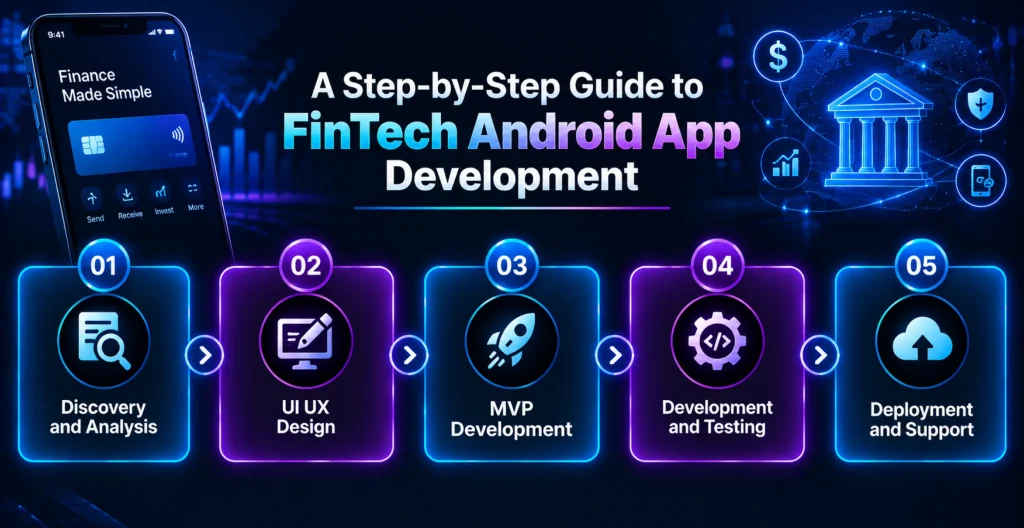
A robust plan for a FinTech Android app development can help teams follow the rules and still scale later. People should not rush into code on day one. Instead, they move step by step, in a set flow like this.
1. Discovery & Requirement Analysis
First, the team names the users and groups the needs. They review the rules that apply and note the risk level. After that, they write down the key features. This work is based on user study and talks with leaders inside and outside the company.
2. UI/UX Design
Next, designers build wireframes and simple screen drafts. They test the flow so the app feels easy to use. For apps that deal with money, clear screens matter more than flashy designs.
3. MVP Development
Then they create a minimum viable product. This is a small product with the main functions only. It lets the company test the idea with real users. It also cuts down on time spent on features people do not ask for.
4. Development & QA/Security Testing
After the MVP, the team builds the rest of the features. QA runs test cases to catch bugs and check how the system holds up. Security checks come too, including penetration tests. The goal is to spot issues early, not after release.
5. Deployment & Post-Launch Support
When the app is on the Play Store, the team keeps track of how it runs. They also gather comments from users. Updates happen on a steady rhythm to match the rules and keep protection strong.
FinTech Android App Development Cost in 2026
FinTech Android App Development Cost varies widely based on complexity, features, and region. Here’s a realistic breakdown to help you budget accurately for 2026.
| App Complexity | Core Features | Estimated Cost (USD) |
| Basic (MVP) | Wallet, payments, basic authentication | $25,000 – $50,000 |
| Mid-Complexity | KYC, budgeting tools, chat support, multi-currency | $50,000 – $120,000 |
| Advanced/Enterprise | AI features, investment tools, blockchain, full compliance | $120,000 – $300,000+ |
Development cost also shifts by region:
| Region | Hourly Rate (USD) |
| North America | $100 – $200/hr |
| Western Europe | $70 – $150/hr |
| Eastern Europe | $40 – $80/hr |
| India / South Asia | $20 – $50/hr |
Android app development costs usually come down to a few basics. Feature scope matters most, then the level of security and compliance effort. It also depends on how many platforms you support, where the team sits, and how many third-party tools you need to connect.
Challenges in FinTech Android App Development & How to Solve Them
FinTech Android app development is not smooth sailing. Teams run into issues that can slow release dates or cause rework. Below are five challenge spots and what experienced teams do about them.
1. Regulatory Complexity
Challenge: FinTech apps sit in a world of rules that differ from one place to another. Updates happen often. If you wait, you can end up with compliance gaps, penalties, or a launch that gets pushed back.
Solution: Hire Android app developers who already know KYC and AML plus the local compliance model. That way, the build follows the rules from day one, and you avoid a full rewrite later.
2. Data Security Risks
Challenge: Financial apps store and move sensitive details. That makes them an easy target. Hackers, fake login pages, and breach events can hit fast, and trust can fall just as fast.
Solution: To reduce risk, teams add encryption and biometric login. They also run penetration tests again and again during the build. This helps catch weak spots before the app ships.
3. Fragmented Android Devices
Challenge: Android runs on a huge mix of phones and tablets. OS versions vary. Screen sizes vary. All of this makes it hard to keep speed, security, and the same UI look across devices.
Solution: A common fix is heavy testing across device models and OS versions. Teams use FinTech Android app development services such as Firebase Test Lab to check behavior in real setups. The goal is that the app feels steady no matter where it runs.
4. Legacy System Integration
Challenge: Many banks still depend on old platform code. It often has no modern APIs. Because of that, sharing data with new Android apps can take longer than it should.
Solution: An API-first setup can help here. With the right middleware, the new app side can talk to the older bank systems in a smoother way.
5. Scaling User Base
Challenge: When users rise quickly, servers and databases may not keep up. That can lead to slow screens, outages, or crashes. This is a bad time for any FinTech team, since customers expect stability.
Solution: A cloud-native design can reduce that risk. Using microservices, the app can grow across more servers as demand increases. Teams often do not need to rebuild the whole system.
Why Choose Octal IT Solution for FinTech Android App Development?
Octal IT Solution is a full-service FinTech app development company. We mix FinTech know-how with strong Android engineering to build apps that need security and scale.
- Our experts built secure Android FinTech apps for banks, lenders, and wealthtech products.
- We added security checks and compliance steps in the work from start to finish.
- Our experienced developers used an agile approach with clear delivery dates and steady milestones.
- Developers at Octal IT Solution worked with a focused team that already knew the FinTech space.
- Here we also offer post-launch support, plus ongoing updates for compliance and performance.
Real-World Use Cases of FinTech Android Apps
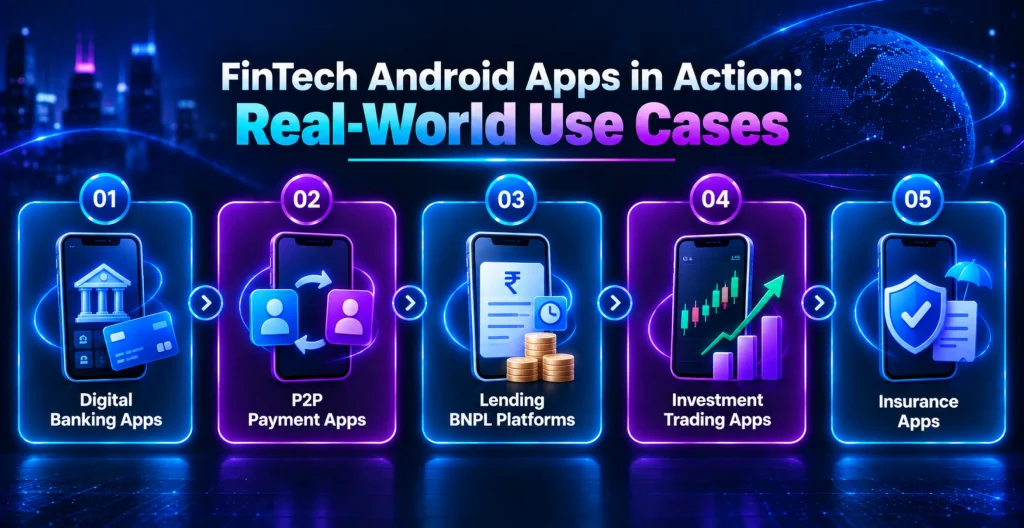
FinTech Android apps are now part of daily money tasks. They provide many kinds of services. Here are five real-world use cases proving how this technology is transforming money management.
1. Digital Banking Apps
Some neobanks run everything through an Android app. You can open an account, move money, and handle cards without going to a branch.
2. P2P Payment Apps
P2P apps help people pay each other. Friends can split a bill and send money right away. Many apps use a phone number or a QR code.
3. Lending & BNPL Platforms
Buy-now-pay-later apps can approve an application fast. Then you can pay for a purchase over time. This can happen inside the Android app as you choose a plan.
4. Investment & Trading Apps
Trading apps and robo tools let users buy assets from a phone. People can invest in stocks and ETFs, and some apps also cover crypto. Even small amounts can be used.
5. Insurance Apps
InsurTech apps make it easier to compare policies. You can also file a claim and pay the premium in the app. The whole flow is built for mobile use.
Conclusion
The FinTech Android app development during 2026 requires developers to create functional applications that also include security measures and AI-based personalization and regulatory compliance for building user trust in financial operations.
This guide presents businesses with a detailed development path that covers the entire onboarding process and advanced features, including predictive analytics and blockchain integration for Android app development in FinTech during the current year and future years.
The first step toward long-term business growth requires you to establish core business operations, which will help you launch your MVP or grow your current platform.
FAQs
1. How long does it take to build a FinTech Android app?
A FinTech Android app often takes about 4 to 9 months to get ready. The schedule shifts with feature depth, required policies, and how tough it is to connect to third-party systems. Most teams can ship an MVP faster, usually in 3 to 4 months.
2. Should I build native Android or use a cross-platform framework for a fintech app?
Building a FinTech app for Android can run faster and fit better with security tools on the phone. It can also make use of device features such as fingerprint or face unlock. This is a good fit when Android is your main platform, or your only one.
3. What ongoing costs come after launching a FinTech Android app?
After launch, you still have ongoing expenses. You need servers to host services. You also have to do compliance checks, keep an eye on security, and roll out updates for new needs. Customer support takes time too. Many teams budget around 15 to 20% of the first build cost each year.
4. Can a FinTech Android app integrate with existing banking systems?
Yes, most FinTech teams focus on an API-first setup. They also use middleware so the app can talk to core banking systems in a safe way. The same approach helps connect to payment services and other finance data sources.
5. What makes a FinTech Android app compliant across multiple countries?
Rules differ by place. You must adjust to KYC and AML needs. You also have to meet PCI DSS and local rules on data privacy, including GDPR where it applies. Many projects handle this with modules that can be changed per region.


 Get in Touch
 By
By October 16, 2026