



There are more failures of software projects than people acknowledge. The Standish Group’s Chaos Report has consistently reported that more than 60% of software projects are over budget and/or over schedule. Many do not even reach completion. It’s always the same root cause that includes changing requirements between the processes.
This is how adaptive software development came into the picture.
The push to develop more swiftly, intelligently, and flexibly is greater than ever in 2026. AI tools have revolutionized code writing, testing, and pull request reviews for teams. Markets shift weekly. Customers’ expectations change as they use more and more products.
It is an environment for which adaptive software development (ASD) is a methodology. It sees change as an opportunity and not a problem. Furthermore, AI is integrated throughout the software development lifecycle, making ASD one of the most potent frameworks available to software teams in 2026.
This guide has all the answers you need. From the entrepreneur’s point of view of planning a new product to the CTOs ‘ review of reviewing their development processes, this blog provides a practical, technical, and business-ready perspective on ASD today.
- What Is Adaptive Software Development?
- How Does ASD Differ from Agile and Why Does It Matter?
- The 3 Phases of Adaptive Software Development: Speculate, Collaborate, and Learn
- 7 Core Principles of the ASD Methodology
- Key Benefits of Adaptive Software Development
- ASD vs Agile vs Scrum vs DevOps
- Best ASD Tools in 2026
- How Much Does ASD Cost in 2026?
- AI-Powered ASD: What's Changed in 2026?
- Future Trends in Adaptive Software Development
- Real-World ASD Use Cases Across Industries
- Step-by-Step ASD Process Breakdown
- Common ASD Challenges and How to Fix Them
- What Can You Build with Adaptive Software Solutions?
- How to Choose the Right Adaptive Software Development Partner
- Conclusion
- Frequently Asked Questions (FAQs)
What Is Adaptive Software Development?
Adaptive software development is a methodology for creating digital platforms developed in the 1990s by Jim Highsmith and Sam Bayer. It was produced from chaos and complex adaptive systems thinking. It’s very simple in the middle: software development is a complex and unpredictable process. Thus, the development methodology should be adaptive as well.
Adaptive software development is a model that discards the notion of a linear plan and embraces “speculation, collaboration, and learning” in an iterative fashion. Working software is delivered at the end of each cycle. Each cycle provides feedback that influences the next cycle.
The adaptive software development life cycle doesn’t presume you know all things at the beginning. Rather, it assumes that requirements are going to change. It creates a process around that evolution instead of coming against it.
Adaptive system development is inspired by notions such as edge-of-chaos thinking, self-organization, and emergence. These ideas are derived from the experience of natural complex systems, such as ecosystems or markets, which manage change without any central control.
In practical terms, ASD means the following:
- Short, time-boxed iterations (typically two to six weeks)
- Cross-functional teams collaborating continuously
- Regular customer feedback is built into every cycle
- Learning from each cycle to improve the next one
ASD in the software engineering field is more than a project management style. It’s about a change of thinking. It invites teams to be comfortable with uncertainty, not to simply act as if it does not exist.
How Does ASD Differ from Agile and Why Does It Matter?
Many entrepreneurs often misunderstand Agile and ASD, though they are connected. Comparing adaptive and agile software development helps you choose the best approach for your project.
Agile is an umbrella term. Includes many frameworks such as Scrum, Kanban, SAFe, XP, and more. The Agile values include flexibility, collaboration, and working software. However, a majority of Agile frameworks rely on the fact that a person can plan the sprint, measure velocity, and have a fairly stable backlog.
Adaptive software development is more than that. Not only does it not resist change, but it actually embraces it. It foresees it structurally. The ASD methodology in software development integrates chaos management right into the computer software development process. It deliberately employs the term “speculation” rather than “planning.” It’s an honest assessment of the future being uncertain.
Here is what separates ASD from standard Agile frameworks in practice:
- ASD uses “speculation” instead of planning as its foundational concept
- Adaptive software development explicitly incorporates risk-driven thinking at every cycle
- ASD emphasizes learning as a formal, structured phase and not just a retrospective
- This approach is particularly well-suited for projects with high uncertainty, complex domains, or rapidly changing requirements
Adaptive vs agile software development for entrepreneurs in competitive or emerging markets is all about this. Agile frameworks enable you to go faster. ASD assists you in making more effective and intelligent moves in truly unpredictable environments.
Agile software development is about incremental delivery of value. ASD focuses on learning your way to the right product. Both matter, however, for really new or complex constructions, ASD offers a more solid ground.
The 3 Phases of Adaptive Software Development: Speculate, Collaborate, and Learn
The adaptive software development phases are structurally unique. Each ASD cycle follows three phases in chronological order. The team completes them as outlined below:
Phase 1: Speculate: Why ASD Replaces Planning with Speculation?
The term ‘speculate’ is there on purpose, and has significance. Traditional planning takes the attitude that one can know what is needed before constructing it. ASD does not accept this premise.
During the speculation, the group establishes a project mission. They set the broad direction and outline of the current cycle. The team develops feature lists and timelines. But all this they consider as a rough frame as they are aware that requirements will be variable.
Adaptive planning at this stage involves creating direction but not necessarily committing to all the specifics. What we need to build is our best current knowledge about it based on the question, “What is our best current understanding of what we need to build? They use that understanding and are open to revision.
For instance, a start-up fintech company developing a trading platform. During the Speculate phase, the team identifies 5 main characteristics for the next 6 weeks. They gauge work effort and take responsibility. They don’t freeze requirements, though. The team can adapt if the market changes mid-cycle.
It is a deliberate, knowledge-based, and adaptable planning. This is an important difference.
Phase 2: Collaborate: How Teams Work Together in ASD?
The Collaborate phase is the stage where the actual software is created. Development of different features happens in parallel by cross-functional teams. They share code, peer-review one another’s work, and resolve conflicts in an ongoing way.
Communication is not the only part of collaboration in ASD. It’s all about concurrent engineering. There are several concurrent workstreams. This involves having good tooling, clear ownership, and a culture of open feedback.
Adaptive planning is ongoing during this phase. If a team member blocks another or finds a new way of doing things, the team changes accordingly. They don’t wait for the next sprint planning session.
This step has been significantly enhanced by modern AI tools. Automated code review, AI pair programming, and intelligent conflict resolution have greatly lowered the friction in collaborative development.
Phase 3: Learn: How Feedback Drives the Next Cycle
The Learn phase is the unique part of ASD. It’s not simply a retrospective; it is an organized, data-informed recap of all aspects of the cycle.
The team looks at feedback from customers, quality metrics, team performance data, and technical decisions. They are able to pull out certain lessons. Then they take those lessons right into the next phase.
The team learns directly from this phase for adaptive planning for the next cycle. This is truly a learning loop, rather than a checklist retrospective.
For instance, a health care software team may find that a specific function baffled users during their test. During this learning phase, they note down the reasons why and revisit the UX decision-making that led to it, and then reframe the approach for the next iteration.
7 Core Principles of the ASD Methodology
Adaptive software development is based upon seven principles. Each one influences the authentic decision-making of teams. Let’s go through the core principles of ASD.
Mission-Driven Development
Each project begins with a mission statement. This mission drives everything the team is doing. The mission determines the conflict if needs are in opposition.
For instance, a logistics company might have a mission such as ‘support real-time adaptive routing decisions for fleet managers.’ All features either contribute to this mission or are deprioritized.
Feature-Based Delivery
ASD provides value in features, not phases. The team no longer follows “design” with “development” and then “testing”; instead, they design and develop entire features through to testing within each cycle.
This provides customers with a tangible object to respond to. Feedback is more specific and action-oriented.
Iterative and Time-Boxed Cycles
Each cycle of ASD is a set amount of time. Teams don’t extend the cycle when work is incomplete. That is because they descope, learn why the scope was off, and plan better next time.
Time-boxing creates accountability. It also provides regular data on team velocity and estimation accuracy.
Risk-Driven Planning
ASD front-loads risk. The highest risk, highest uncertainty features are tackled first. This ensures that teams find issues early that are easier to address.
Adaptive planning in ASD is never undertaken without being aware of the risks. Teams clearly prioritize features according to uncertainty and address the most challenging features first.
Change Tolerance
Tolerance is embedded in all processes at ASD. Change requests do not represent disruptions. They are inputs. The team reviews the new information in light of the mission and determines what to do with it.
This is particularly crucial for startups and product companies in rapidly changing markets.
Concurrent Engineering
Multiple features develop simultaneously. This needs to have good communication and conflict resolution procedures. It also implies testing, and QA are not done after development.
Continuous Learning and Adaptation
In ASD, learning is not a choice. It is a formal stage and has well-defined products. Those who do not go through the Learn phase are not following ASD. They are following the agile methodology as a whole. Real and documented learning is needed at the end of each cycle in the adaptive software process.
Key Benefits of Adaptive Software Development
Learning about the adaptive software development benefits is important for companies that are creating complex products or developing new ones. Below are some of the major advantages of ASD.
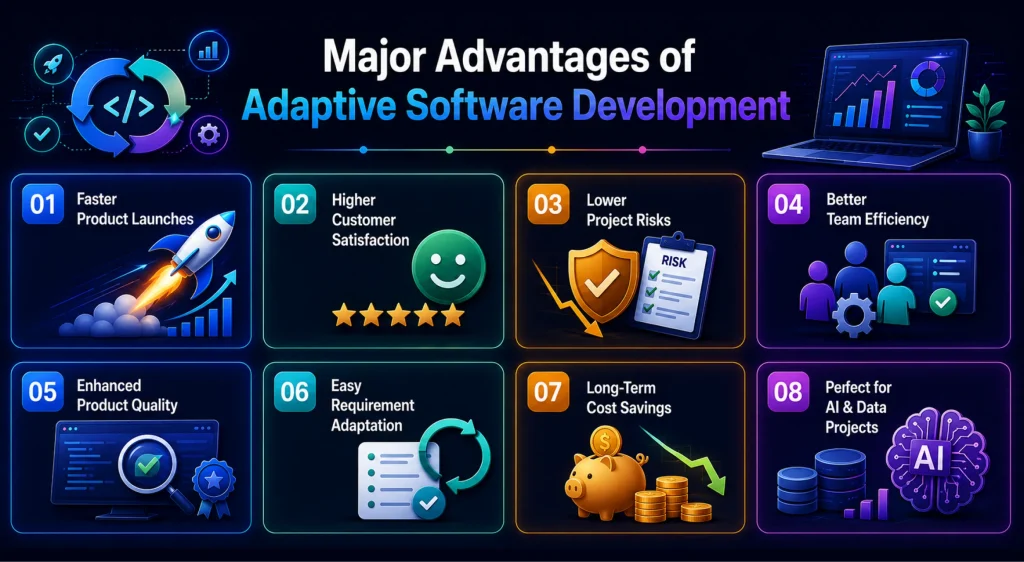
Faster Time-to-Market
Teams produce working features at the end of each cycle, which means that products get to customers sooner. For entrepreneurs, they can begin to make money or get feedback from users before the product is fully finished.
Higher Customer Satisfaction
There’s a tangible improvement that customers experience on a regular basis. They actively influence the product through their feedback. This can help them come up with a product that truly addresses their issues as opposed to an assumption.
Reduced Project Failure Risk
ASD significantly minimizes the risk of constructing the wrong product by applying risk up front and incorporating frequent feedback. Teams find issues early, not after months of investment.
Better Team Productivity
Teams remain productive through concurrent development, clear team ownership, and frequent learning cycles. In 2026, AI tools take this one step further; they’re helping to automate repetitive tasks and offer real-time support.
Improved Product Quality
Quality problems are detected early due to continuous testing and real-world feedback. The adaptive software development model considers quality as a continuous activity and not as a gate.
Handles Evolving Requirements Easily
This is probably the most significant benefit. Markets change, users change, and regulations change. ASD is created to cope with all of this without derailing the project.
Cost Efficiency Over Long Projects
The adaptive software development advantages for multi-year projects are that they can be controlled with regard to their costs. It’s much cheaper to catch an incorrect assumption during the second iteration than the tenth month. This efficiency will continue to grow over time.
Ideal for AI and Data-Heavy Projects
AI and machine learning projects have a certain level of uncertainty about them. The quality of the data influences the performance of the model. This is because the process of feature engineering is continually evolving.
ASD vs Agile vs Scrum vs DevOps
Entrepreneurs often ask how these methodologies compare. Here is a clear breakdown:
| Methodology | Core Focus | Planning Style | Change Handling | Best For |
| ASD | Learning and adaptation | Speculative | Built-in | Complex, uncertain projects |
| Agile | Iterative delivery | Sprint-based | Accommodated | Most software projects |
| Scrum | Team process and sprints | Sprint planning | Within sprint limits | Teams needing structure |
| DevOps | Deployment and operations | Continuous | Pipeline-driven | Mature products in production |
The adaptive software development methodology is a strategy that determines how a team relates structurally to change. The learning factor is also made explicit in the ASD methodology in software development, rather than being a habit to be practiced after the software has been developed.
In 2026, the top-performing teams frequently merge strategies. They plan using ASD principles, coordinate through Scrum ceremonies, and and deploy using DevOps pipelines. When used strategically, these frameworks complement each other.
Best ASD Tools in 2026
The right tooling makes the adaptive software development process significantly more effective. Below are the essential tools that will be needed for software development.
Project Management Tools
- Jira
- Linear
- ClickUp
Collaboration and Documentation Tools
- Confluence
- Notion
- Miro
AI-Assisted Development Tools
- GitHub Copilot
- Cursor
- Devin (Cognition AI)
Testing and QA Tools for ASD Teams
- Playwright
- Cypress
- Testim
- Mabl
- SonarQube
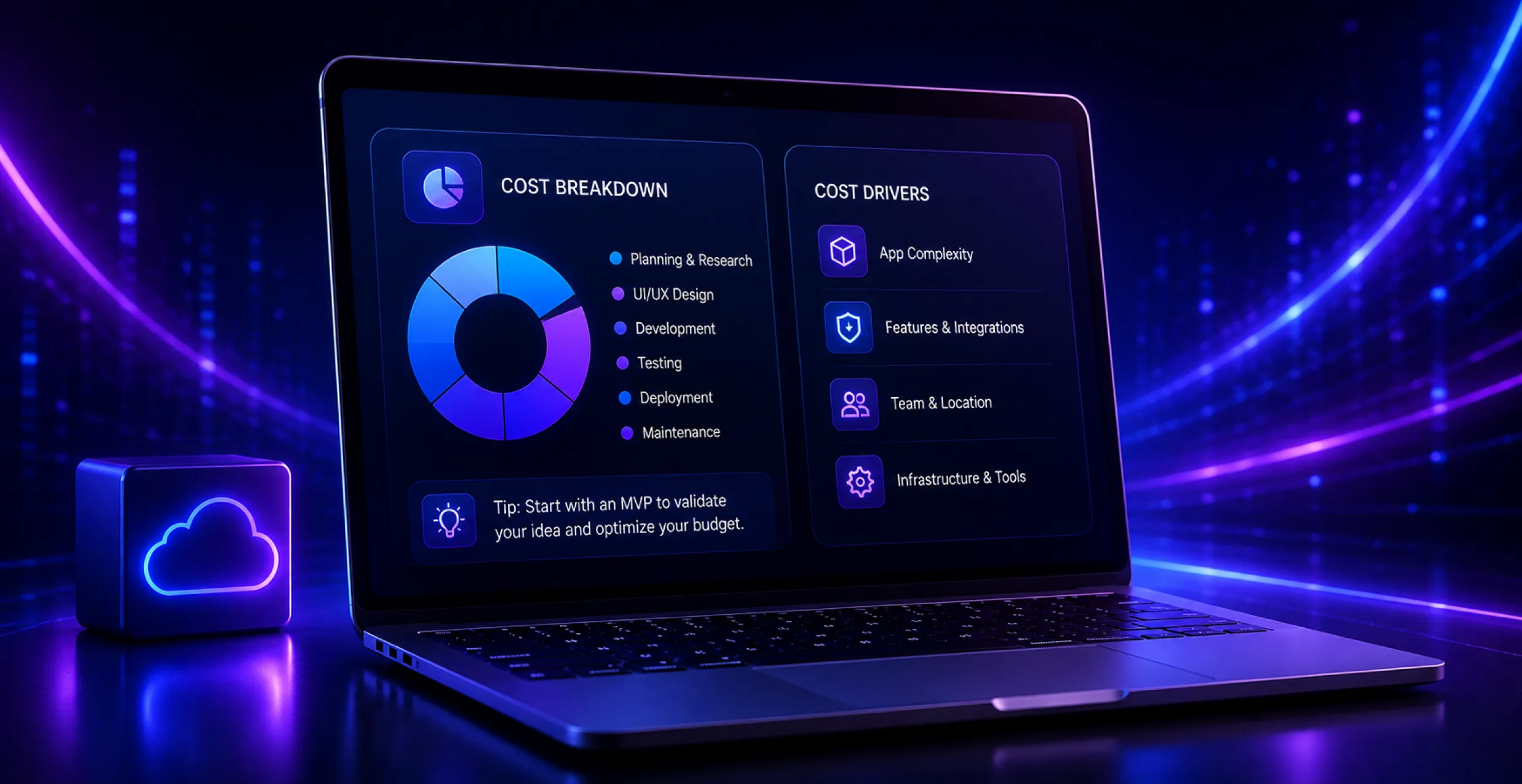
How Much Does ASD Cost in 2026?
Here are some of the factors entrepreneurs often have when considering adaptive software development costs. Let’s go through some of those major factors.
What Factors Affect ASD Project Cost?
- Team size and seniority: Senior developers have a higher hourly rate, but they are likely to produce a higher quality with fewer defects, decreasing the total cost.
- Cycle length and number of cycles: The more cycles in a project, the greater the total cost of the project, but the more risk is distributed.
- Technology stack: Some stacks (such as Go or Rust) are more costly for developers than others (such as Python or PHP).
- AI tooling adoption: AI development tools can increase the speed of the teams using them, even if they come with a higher tooling cost, potentially lowering the overall cost of the project.
- Geographic location of the development team: Outsourcing to India or Eastern Europe makes a huge difference in hourly charges.
ASD Cost by Project Size
| Project Size | Typical Duration | Estimated Cost Range |
| Small (startup MVP) | 3-6 months | $25,000 – $80,000 |
| Mid-size (SaaS product) | 6-12 months | $80,000 – $300,000 |
| Enterprise (complex platform) | 12-24+ months | $300,000 – $1,500,000+ |
Ranges are the average figures for the world in 2026. The pricing is very different depending on the team’s location and the project’s scope.
ASD vs Waterfall vs Agile: Which Is More Cost-Effective?
Sometimes, for a project less than 3 months, the waterfall is more cost-effective because it needs less process overhead.
In cases of longer, more complex software, the cost of adaptive software development will be lower than the costs of either waterfall or standard Agile development because ASD will identify incorrect assumptions earlier. The adaptive SDLC model is effective in bringing change cost as far forward as possible in the cycles to aid discovery.
A project that uncovers a requirement error at the fundamental level in cycle 2 will cost 20-30% more to correct than if the error is identified in planning. However, the same mistake made in the 8th month of a waterfall project might require 200-400% more to correct. So, we recommend going for an adaptive approach for developing software.
How to Estimate Your ASD Budget Before Starting?
Work with your development partner to estimate the approximate budget for software development:
- Define the project mission and top-level feature set
- Identify the three to five highest-risk features
- Estimate cycle length and number of cycles
- Calculate team composition and hourly rates
- Add 20-25% contingency for adaptation costs
An excellent partner that provides Software Development Services will assist you in creating a realistic budget that takes into consideration the iterative nature of ASD while providing you with no uncontrolled cost overruns.
AI-Powered ASD: What’s Changed in 2026?
AI’s role in the adaptive software development lifecycle (SDLC) is the story of 2026. All the stages have been changed with the introduction of artificial intelligence.
AI in the Speculate Phase: Smarter Requirement Forecasting
Now, AI tools can delve into data from past projects, market signals, and user behavior patterns to help prioritize requirements. Solutions such as Aha! and ProductBoard now incorporate AI to recommend the most impactful and feasible features to address first.
This makes adaptive planning more data-driven than ever before. Cycle planning is no longer based on pure intuition across teams.
AI in the Collaborate Phase: Automated Code Review and Pair Programming
AI pair programming has become a standard practice with the introduction of tools such as GitHub Copilot, Cursor, etc.
More issues are caught by code review than by humans. Teams that fully embraced these tools have seen a 30-50% decrease in the turnaround time for their pull requests.
Today, automated code review technologies can detect architectural anti-patterns, security issues, and performance hits as well as syntax errors. This means teams that work on enterprise application development services can maintain high code quality standards even at high development speed.
AI in the Learn Phase: Intelligent Retrospectives and Analytics
AI retrospective tools are now available to dig into sprints, code commit history, customer feedback, and team communication. It brings up insights that humans may not have noticed. They pinpoint patterns of roadblocks, alert staff members who are overworked, and recommend changes to processes based on data.
This makes the Learn stage a data-driven decision-making stage, rather than a subjective discussion. This results in more focused and predictable adaptive planning for the next cycle.
Real-World Case Study: 40% Faster Delivery with AI-Assisted ASD
In early 2025, a US healthtech firm that is rebuilding its patient management platform adopted AI-assisted ASD through Octal IT Solution’s expert AI developers. They adopted GitHub Copilot for development, Mabl for automated testing, and their own AI retrospective tool using GPT-4.
Results after eight ASD cycles:
- Development cycle length dropped from six weeks to four weeks
- Defect rate in production fell by 35%
- Customer satisfaction scores rose from 62 to 84 (NPS scale)
- Total delivery time for the core platform was 40% faster than their previous waterfall project
The AI wasn’t meant to replace the team. It eliminated friction in all of these, and the team concentrated on the decisions that could only be made by humans.
Future Trends in Adaptive Software Development
The ASD in software engineering world is evolving fast. Below are the trends for the next few years.
Self-Learning Development Teams Powered by AI
Some teams are starting to employ AI systems tailored to their own codebase, past choices, and team dynamics. These systems become more valuable with the passage of time as they not only understand the generic coding best practices but also take into account the context of your team.
Hyper-Personalized Adaptive Applications
The 2027 adaptive application solutions will adapt, not only during development but also during production. Applications will tailor their own actions to the pattern of each user, what the AI can infer about their preferences, and the context of the moment. The products are to be built using a development process that can continuously adapt.
ASD Meets Low-Code and No-Code Platforms
Low-code platforms such as OutSystems and Mendix are incorporating ASD-friendly workflows. This enables the non-technical members of a team to more actively get involved in the Collaborate phase, thereby driving delivery faster without increasing the number of developers.
Autonomous Testing and Continuous Deployment in ASD
By 2027, the number of test suites created, executed, and maintained by AI-powered testing agents will exceed the number of those created, executed, and maintained by human agents across the ASD lifecycle. This, together with the continuous deployment pipelines, means that working software is delivered to customers in hours rather than at the end of a cycle.
Real-World ASD Use Cases Across Industries
ASD in Healthcare: Building Compliant, Ever-Evolving Apps
The healthcare software should be compliant and adapt to fast evolution (HIPAA, GDPR, and FDA guidelines). This is well addressed within ASD as part of the Learn component, where compliance is covered. Understanding clinical workflow and regulatory alignment is paramount as teams work to develop healthcare platforms with ASD.
For instance, ASD was used to rebuild the appointment scheduling module of a telehealth platform. The team provided a feature in 6, two-week cycles that reduced no-shows by 28% directly as a result of feedback from the clinic administrators collected in each cycle.
ASD in Fintech: Rapid Iteration for Trading and Banking Platforms
Changes to regulation, market conditions, and user behavior must be addressed at the same time by financial products. The risk-driven planning and short cycles are perfect for fintech with ASD. ASD was employed by a trading platform team to provide a real-time options pricing capability in only 10 weeks. They estimated the same work took six months with their waterfall predecessor.
This is the reason why teams often call in for Product Engineering Services providers for the build-out of the fintech platforms.
ASD in E-Commerce: Adapting to User Behaviour and Seasonal Demand
The demand for e-commerce sites is incredibly volatile, and features are constantly being competed for. ASD enables eCommerce teams to react to user-behavior data during one cycle, in the following cycle’s feature set. An e-commerce mid-sized business leveraged ASD to revamp its checkout process over five iterations, resulting in a 22% drop in cart abandonment.
ASD in EdTech: Evolving Curriculum-Delivery Platforms
EdTech products need to be flexible to teacher feedback, student results data, and curriculum changes. Feedback from teachers can be integrated into every development cycle in ASD’s structured Learn phase. In fact, one EdTech startup had been able to use ASD to test and test and test their ‘AI tutor’ function, and after a year of tweaking and testing, they were able to improve student engagement scores by 41%.
The ASD is a common approach for Application Modernization Services teams when upgrading legacy EdTech systems, where they can make incremental, validated modernization instead of risky big-bang upgrades.
ASD in Logistics: Real-Time Adaptive Routing and Supply Chain Software
In the real world, there are a number of events that logistics software should be able to react to: traffic, weather, carrier delays, and demand spikes. It is here that adaptive system development is a logical fit, since the domain is adaptive. A logistics business designed a dynamic routing system in 8 iterations, integrating live GPS data, carrier API, and dispatcher feedback during each iteration of ASD.
Step-by-Step ASD Process Breakdown
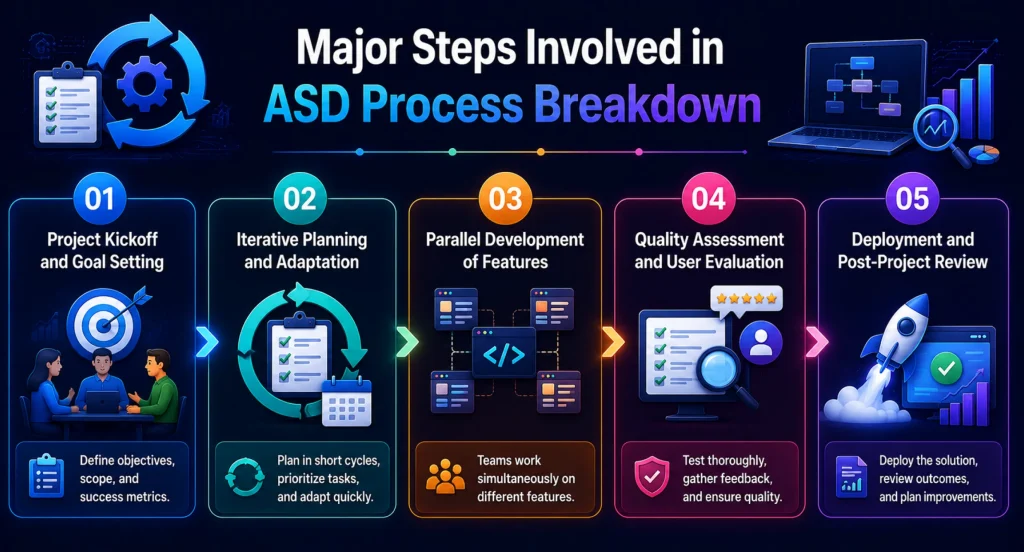
The adaptive software development process has a definite sequence. Below are a few major steps involved in this.
Step 1: Project Initiation and Mission Definition
The project is agreed upon with the team and client. They establish success parameters and determine who and how to communicate. The team also determines the key risk areas and technology limitations.
This step is not as long as in waterfall, but as in ASD. It is not meant to be exhaustive. It’s all about direction and alignment.
Step 2: Adaptive Cycle Planning
Team selects features for the cycle. They estimate effort in ways such as story points or T-shirt sizing. They create and set the “definition of done” in the cycle.
Here, adaptive planning involves selecting features that will benefit the most, based on knowledge. The team is aware and understands that this plan will change. They use particular review marks.
Step 3: Concurrent Feature Development
Teams develop features concurrently. Standups make sure that all the parties are aligned with each other every day. If there are blockers, they are handled immediately. AI-powered tools are used to perform real-time code quality checks.
This phase in the Adaptive Software Development Life Cycle is a disciplined one. If you don’t have good collaboration habits, concurrent development can cause chaos.
Step 4: Quality Review and Customer Feedback
At specific times in the cycle the team demonstrates working software to a customer or stakeholders. They collect responses in a systematic way. Automated and manual testing done by the QA teams. Issues are entered and given priority.
This is the benefit of the adaptive SDLC model. As a cycle is being developed, there’s genuine feedback from customers for the next cycle.
Step 5: Final Release and Retrospective
The release or release candidate marks the end of the cycle. The team has a proper retrospective; this is the “Learn” phase. They record lessons, share feedback with the team on their working practices, and provide input for the next cycle of the Speculate phase.
The phases of the adaptive software development are repeated here in an improved context. This process of adaptive software development life cycle then repeats, with improved information.
Common ASD Challenges and How to Fix Them
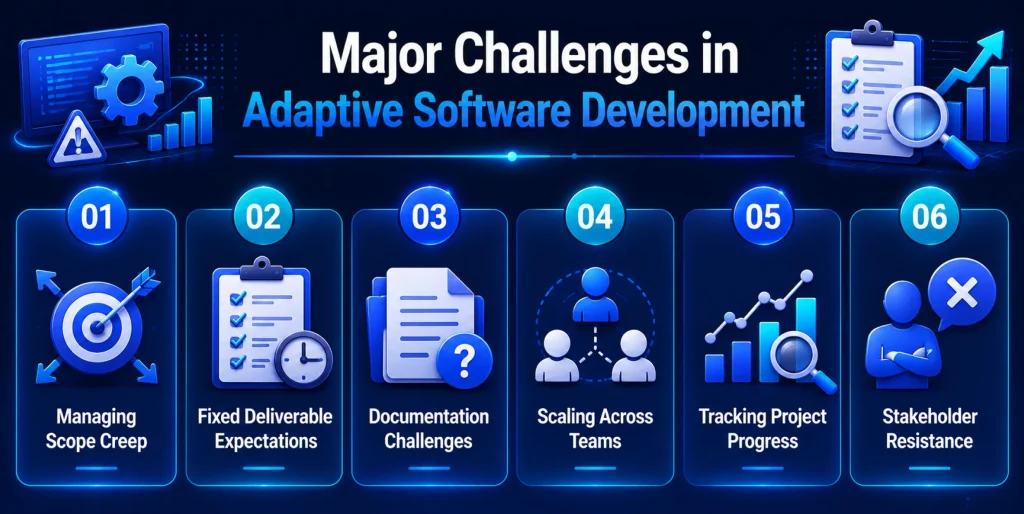
Every method has its problems. Below are some of the most common issues teams experience and how to address them.
Scope Creep Disguised as Adaptation
ASD’s flexibility means that teams can make the case for adding features without proper evaluation.
All scope change requests are to be subject to the formal mission-alignment review process. The question should include “Does this change meet the mission of the project? If so, what does it do to the cycle time? Document the decision in every aspect.
Clients Expecting Fixed Deliverables
Sometimes clients prefer a fixed list of features and pricing prior to the project’s commencement.
Advise clients on adaptive software development and scope-free development. Determine a set of features that aligns with the mission and are flexible in implementation. Use ranges rather than points.
Documentation Gaps in Fast-Moving Cycles
Documentation debt is the result of fast cycles. Teams are faster at building than they are at documenting.
Adopt AI documentation tools that automatically produce documentation from code, commit messages, and meeting minutes. Include documentation as a Definition of done for each feature.
Scaling ASD Across Large Distributed Teams
With multiple developers in different time zones, it is more difficult to keep ASD a collaborative organization.
Adopt a “team of teams” organization. Each sub-team carries out its own ASD cycles. The adaptive software process at the sub-team level is aggregated up to a coordination layer, which is synced weekly across teams. This coordination is sometimes accomplished using shared pipeline tooling and automated dependency management by DevOps Development Services teams.
Measuring Progress Without Traditional Milestones
Executives who are accustomed to using Gantt charts will not be able to see progress on ASD.
The primary metrics are feature-completion rate, customer satisfaction scores, and defect trends. Create dashboards to show this information in real time. Inform stakeholders that working software is a better measure of progress than a completed Gantt bar.
Resistance from Traditional-Mindset Stakeholders
Some stakeholders feel that software must be completely designed prior to its construction.
Do a brief trial run of an ASD cycle before you adopt ASD. Show concrete results. Show how adaptive planning can be more effective than up-front design in complex environments using the pilot data. This type of pilot is frequently the starting point of a software consulting contract.
What Can You Build with Adaptive Software Solutions?
These kinds of solutions work for practically all contemporary digital products. These are the most popular categories:
SaaS Platforms and Cloud-Based Applications
User feedback is a never-ending process in SaaS products, and that is why they constantly improve. With the competition in the market, there is a need for continuous innovation. It is the natural fit for ASD because evolution is not an exception, but rather the rule.
AI and ML-Powered Tools
AI products are of an iterative nature. As you learn more, you develop new model selection strategies, data pipelines, feature engineering, and evaluation metrics. An adaptive system development process is a process that is suitable for the experimental, hypothesis-driven nature of AI system development. Digital transformation services providers are extensively leveraging ASD when creating AI products for enterprise clients.
Mobile Apps with Evolving Feature Sets
Mobile apps are continuously updated with new versions. Continuous feedback from user ratings, app store reviews, and analytics. ASD cycles and mobile release cadences go hand in hand.
Enterprise Digital Transformation Solutions
For large enterprises trying to replace legacy systems, it is important to have a methodology that merges political complexity, changing requirements, and partial rollouts. ASD is dealing with all three. ASD reduces the risk of the most common failure mode. It includes an enterprise-scale version of the wrong thing for teams using enterprise application development services for digital transformation projects.
Real-Time Dashboards and Data Platforms
Data platforms are not static and have needs that change as users engage with data, uncovering new needs for insights. ASD enables data teams to make improvements to visualizations, data models, and performance properties cycle after cycle.
How to Choose the Right Adaptive Software Development Partner
One of the most crucial choices you’ll make is in selecting the right partner. The worst partner can ruin any methodology.
7 Questions to Ask Before Hiring an ASD Vendor
- Can you show me examples of projects where requirements changed significantly mid-engagement? How did you handle it?
- How do you document learning between cycles? Can I see a sample retrospective report?
- What AI tools does your team use in the development process?
- How do you handle scope change requests? What is your formal process?
- What is your definition of “done” for a feature in an ASD cycle?
- How do you involve customers or end-users in each cycle?
- What metrics do you use to measure team performance and product quality?
Red Flags to Watch Out for in ASD Proposals
- A vendor who cannot explain the Speculate-Collaborate-Learn structure clearly
- Fixed-scope proposals presented as “ASD” with no adaptation mechanism
- No explicit process for customer feedback integration
- Vague or missing retrospective processes
- Teams that have never used AI development tools in their workflow
What Certifications and Experience Should They Have?
Look for teams with:
- Experience with Agile frameworks and iterative delivery (as a foundation)
- Demonstrated history of delivering complex products in uncertain domains
- Certifications in relevant technologies (AWS, GCP, Azure for cloud; relevant language certifications)
- Familiarity with AI-assisted development tooling
- Portfolio examples that show mid-project pivots handled successfully
Why Octal IT Solution Is a Trusted ASD Partner?
For more than ten years, Octal IT Solution has been assisting entrepreneurs and enterprises to develop software that is agile, evolves and creates business value. They have extensive capabilities in healthcare, fintech, e-commerce, logistics, and enterprise software.
We are a leading custom software development company that can leverage ASD methodology, latest AI tooling, and highly skilled architects, along with a structured approach of communication with clients on every iteration.
From developing new AI-powered products from scratch to refactoring legacy systems to incorporate AI capabilities or embedding AI into existing platforms, Octal’s adaptive methodology helps you build the right thing and not just the planned thing.
We also provide Software Consulting for organizations wanting to assess their current software development practices and chart a course for improvement. All engagements begin with an understanding of the business mission and a development process that is designed to actually support that mission.
Conclusion
Adaptive Software Development isn’t a trend. It’s a reaction to reality. Software is complex. Markets are unpredictable. Requirements change. The teams that embrace it and design processes around it, always outperform those that believe that everything should be planned up front and that there shouldn’t be any uncertainty.
By 2026, AI has enhanced Adaptive Software Development to an unprecedented level of capabilities. AI-powered requirement analysis makes the Speculate phase more intelligent. AI-powered pair programming and automated code reviews speed up the Collaborate phase. The learning phase gets richer by the power of intelligent retrospective analytics.
ASD is a way for entrepreneurs to create products that will address actual user problems, rather than the products that were based on a 6-month-old assumption. Cost effective on longer projects. It deals with change without chaos. It creates a piece of software that is real and working, and to which customers can respond – within weeks, not months.
The important part is to work with a team that has the knowledge of the methodology and the tooling ecosystem that exists around it today. Asd keeps its promise on a regular basis with the right partner.
Learn what your mission is and create your first cycle. That’s the strategy for developing fully-functional software in 2026.
 By
By September 23, 2026




 Get in Touch