


Key Takeaways
Depending on complexity, capabilities, and cluster scope, the general cost of developing a cross-platform application in 2026 can range from $15,000 to $150,000+.
The cross platform app development frameworks market is expected to grow at a compound annual growth rate (CAGR) of 16.8%, from an estimated $546.7 billion in 2023 to $546.7 billion in 2033.
By 2026, Flutter and React Native together will account for more than 80% of the cross-platform development market.
When opposed to creating two distinct native apps, cross-platform development can result in cost savings of 30–50%.
If you haven’t budgeted for the front end now, hidden costs like renewals, app store fees, quality assurance, and security can raise your price range by 30 to 50%.
Your budget, team location, preferences, and engagement strategy all have a big impact on the final decision and cost. Choosing the right cross platform app development company could make all the difference.
Introduction
If you want to enhance mobile applications in 2026, you’ll be surprised by how much one of the primary things will cost.
To be honest, the reason for this guide is to give real, concrete statistics instead of vague scores that confuse you even more.
For companies trying to target both iOS and Android customers, doubling their investments, a cross-platform mobile app development has emerged due to the favorable approach. You design a common codebase and implement it across entire structures in favor of building two different apps. Because of this original idea, the demand for cross platform app development services has increased in recent years.
However, the costs have not been contained to the levels of development. It’s about the business you build, the framework you choose, the team you assemble, and the ongoing costs of publishing. With up-to-date 2026 numbers, accurate market data, and useful guidance to help you plan smarter, this guide covers it all.
This breakdown will help you understand every dollar that goes into your cross-platform mobile app development service and a way to make the most of it, regardless of whether you’re a startup trying to expand your first app or a growing business hoping to scale.
Cross-Platform App Market Overview & Growth (2026-2033)
The statistics make it quite clear that cross-platform app development is now a standard process instead of a low-cost solution.
Persistence Market Research estimates that the running platform app development framework market may grow at a compound annual growth rate(CAGR) of 16.8% from its estimated $120 billion in 2023 to $546.7 billion by 2033.
In the meantime, the market for mobile applications is growing just as nicely. The worldwide mobile app industry is expected to reach $753.49 billion by 2033 from a value of $235.4 billion in 2024 at a compound annual growth rate (CAGR) of 13.8%.
By 2033, the cross-platform app development frameworks market in the US alone is expected to grow to $104.7 billion, with $293.1 billion coming from the Asia Pacific.
Also Read : Octal IT Solution at LEAP Global
What is Driving This Growth?
- Growing demand for flawless apps on desktop, web, iOS, and Android.
- Cost-effectiveness of the single codebase compared to individual native builds.
- The maturity of frameworks like Flutter and React Native cross platform app development, which currently address more than 90% of real-world use cases.
- BYOD (Bring Your Own Devices) policies are more than uncommon among organizations.
- Growing smartphone adoption in a growing number of countries in Latin America, Asia, and Africa.
Currently, over 45% of the latest mobile complexes use diagonal frameworks as a minimum of architecture, and this percentage is increasing.
Visit:Custom Software Development Company in Saudi Arabia
Cross-Platform vs. Native App Development: Cost Comparison
It makes sense that almost all organizations start by asking this question. Before you even commit to a strategy, it is important to understand the pricing variations in native vs cross platform mobile app development.
Great applications grow in native development, one for iOS in Swift/Objective-C and another for Android in Kotlin/Java. Private device integration and superior overall performance are yours; you mainly pay for two separate development efforts.
A common codebase that works with each of the systems is used in cross-platform development. As a result, time-to-market is extended, maintenance costs are significantly reduced, and costs are reduced by 30–50% compared to dual-native builds.
Here is a Clear Comparison:
| Factor | Native Development | Cross-Platform Development |
| Initial Development Cost | $80,000 – $200,000+ | $25,000 – $100,000+ |
| Separate Codebases | Yes (iOS + Android) | No (Single codebase) |
| Time to Market | Slower | 30–40% faster |
| Maintenance Cost | High (2x updates) | Lower (1x updates) |
| Performance | Highest | Near-native (90%+ parity) |
| Team Size Needed | Larger (2 teams) | Smaller (1 team) |
| Best For | Hardware-heavy, high-security apps | Most business apps, MVPs, and startups |
By 2026, there will be a big shift in cross platform app development vs native development for almost all business functions, e-commerce, proposals, healthcare MVPs, social systems, and internal tools. The cost savings are genuine, and the performance gap has narrowed significantly.
But even if your application requires and accesses intensive hardware (such as augmented data, complex biometrics, or IoT interfaces), very high security environments, or features that are not well supported by existing cross-platform frameworks, native is still the best option.
Different Types of Cross-Platform Apps & Their Development Costs
Now, it helps to recognize that not all cross-platform apps were built the same way before finance. Performance, cost, developer availability, and long-term innovation are all affected by the underlying architecture. The four primary technical types are as follows.
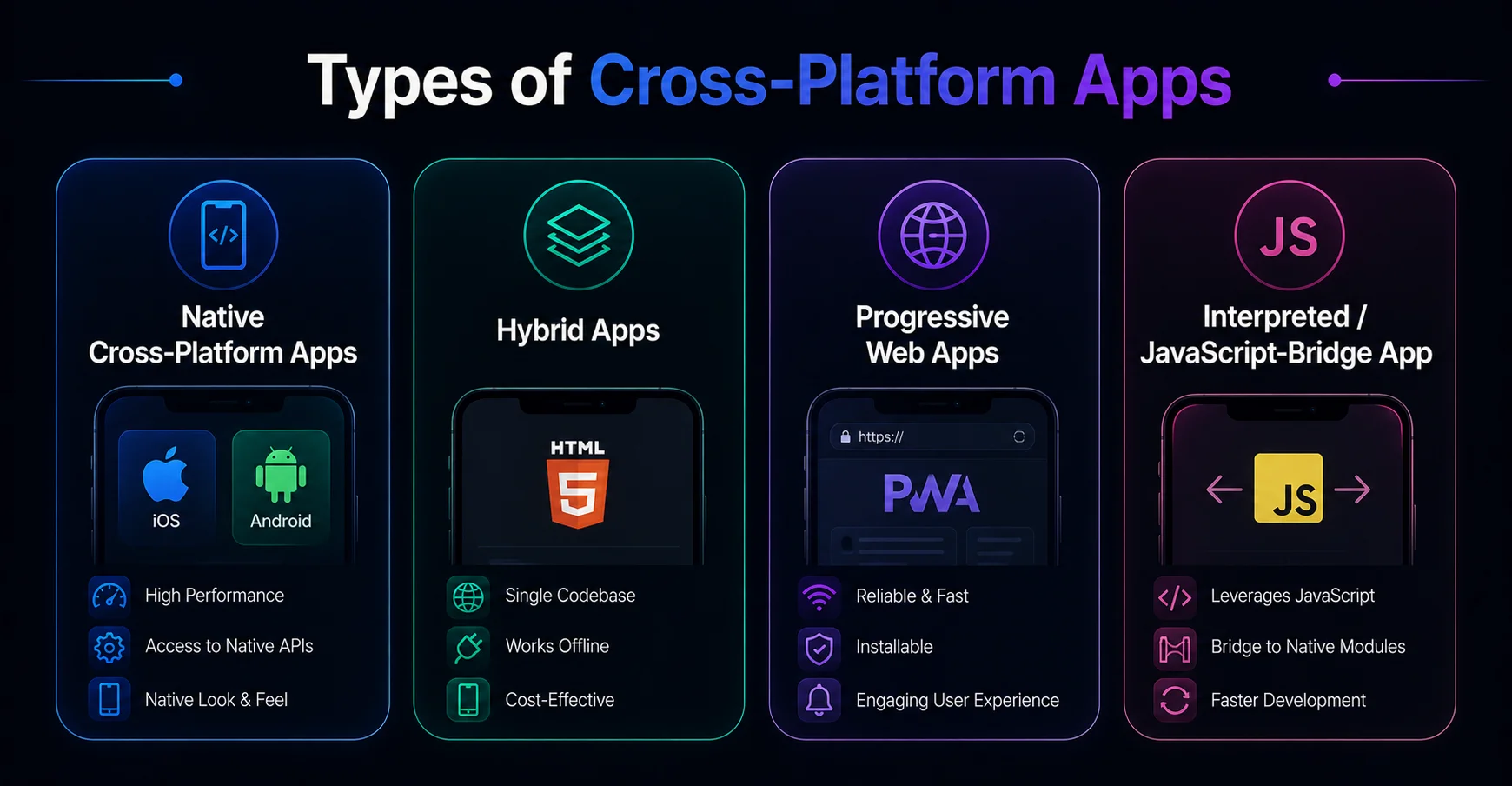
1. Native Cross-Platform Apps (Flutter & React Native)
This framework provides performance that is particularly similar to a native application through code compilation to native code without delay. Flutter and React native cross-platform app development are the most popular techniques in 2026, and for the right purpose. They are supported through huge developer teams, provide a seamless user interface, and help with real device functionality. For business applications of any size, most cross-platform app development companies recommend starting here. The price range is from $30,000 to $150,000+.
2. Hybrid Applications (Ionic, Cordova, and Capacitor)
Web applications that can be packaged into a native shell to work on mobile devices and deployed to app stores are called hybrid applications. For basic applications, internal tools, or early-degree MVPs where speed and affordability are more important than top overall performance, cross platform hybrid apps development services with tools like Ionic or Capacitor are the most affordable choice. $15,000 to $60,000 is the price range.
3. Progressive Web Applications (PWAs)
PWAs are websites that function similarly to apps; they are mounted in the browser, have offline capabilities, and support push notifications. With little protection overhead and no reliance on app saves, PWAs are the weakest solution for cross platform web app development. Ideal for businesses that require a robust mobile web experience without a whole local build, or for content-driven products. The cost range is between $10,000 and $50,000.
4. Interpreted / Bridge -Based Apps (NativeScript, Other Architecture)
This older model communicates with native modules by using JavaScript over a bridge. Though it is still present in older codebases, it has mostly been superseded by more recent architectures, such as React Native’s Fabric. Moving to current cross-platform app development frameworks is usually a first-class long-term option, even if one of them is legacy. Costs vary from $20,000 to $80,000.
| Technical Type | Frameworks | Cost Range | Best For |
| Native Cross-Platform | Flutter, React Native | $30,000 – $150,000+ | Business apps, high-performance needs |
| Hybrid Apps | Ionic, Cordova, Capacitor | $15,000 – $60,000 | Simple apps, MVPs, internal tools |
| Progressive Web Apps | PWA (web technologies) | $10,000 – $50,000 | Content apps, mobile web experience |
| Interpreted / Bridge | NativeScript, older RN | $20,000 – $80,000 | Legacy rebuilds, migration projects |
Cross-Platform App Development Cost By Complexity
This is a useful overview of the cross-platform app development cost, with the app complexity.
1. Basic/Simple Applications ($15,000 – $40.000)
These applications have 3 to 6 screens, a standard user interface, a small background, and basic features such as content view, user login, and easy forms. Consider early-stage MVPs, internal enterprise applications, or utility tools. Development usually takes 3 months. For businesses looking to validate concepts before committing to larger builds, they’re an affordable starting point. When you develop a cross platform mobile app at this level, the goal is speed and concept validation above all else.
2. Medium Complexity Apps ($40,000 – $80,000)
Push alerts, payment integration, third-party API integration, user authentication, and some UI customization are some of those packages. These include health inspectors, reservation systems, on-call for mobile operations, and small online stores. Development usually takes three to six months, and a robust screen is essential. This is where React Native and Flutter app development services excel, providing scalable and accessible apps beyond the native price.
3. Complex / Enterprise Apps ($80,000 – $150,000)
Real-time capabilities, multiple user roles, up-to-date integration, custom animations, AI capabilities, and complex backend structures are all features of a complex package at this stage, including banking tools, telemedicine software applications, logistics, and organizational dashboards. It can take days. While costs can add up when hiring mobile app developers, the scope and tailored capabilities make the investment worthwhile.
| App Type | Estimated Cost | Timeline |
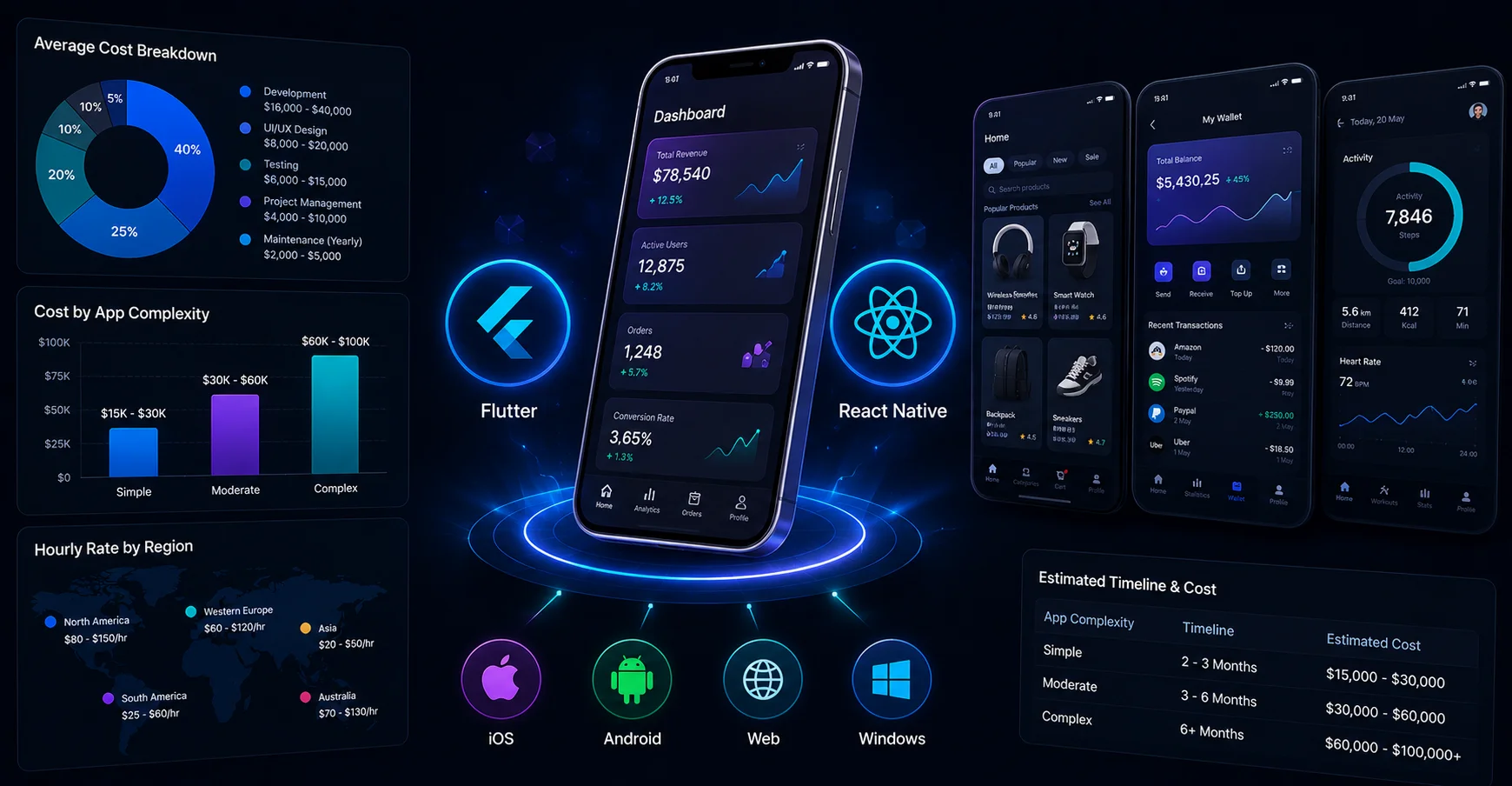
| Simple / MVP | $15,000 – $40,000 | 2–3 months |
| Medium Complexity | $40,000 – $80,000 | 3–6 months |
| Complex / Enterprise | $80,000 – $150,000+ | 6–12+ months |
Cross-Platform App Development Costs by Frameworks
Your budget, schedule, team, and long-term retention are all directly impacted by the use of the cross platform app development frameworks you choose in 2026. The top frameworks are pointed right here.
1. Flutter (Google)
With a market share of 46% among mobile developers by 2026, Flutter has emerged as the main framework. It compiles Dart code to native ARM to create a fairly stable user interface through structures and renders the whole thing using its very own engine, Impeller. Because Dart has a smaller pool of expertise, Flutter app development companies generally charge a little more per hour; However, the frameworks’ faster development cycles often make up for this. Prices vary from $25,000 to 120,000 dollars.
2. React Native (Meta)
React Native cross-platform app development is the preferred option for organizations that currently use JavaScript. The new structure (Fabric + TurboModules, default since 2024) significantly reduced the performance gap with native. Many teams working with a react native app development company choose this path for its speed to MVP and hiring flexibility. Cost range: $30,000 – $130,000.
3. Xamarin / .NET MAUI (Microsoft)
Businesses within the Microsoft environment can benefit from Xamarin cross-platform app development. While it has a smaller development community and may cost more to integrate and license, Microsoft has since shifted focus to .NET MAUI as the evolution of Xamarin, making it more relevant for enterprise projects. If you’re exploring react native app development cost vs .NET MAUI, the latter often runs higher due to the specialist skill set required. Cost range: $40,000 – $150,000+.
4. Ionic
Ionic has minimal initial fees and is built on web technologies (HTML, CSS, and JS). It’s ideal for teams with lots of web experience, content-pushing apps, and internal tools. However, it may require multiple plugins and may clash with sophisticated local functionality. Teams comparing hybrid mobile app development cost across options will find Ionic consistently at the lower end. Cost range: $15,000 – $60,000.
| Framework | Market Share (2026) | Cost Range | Best For |
| Flutter | ~46% | $25,000 – $120,000 | Custom UI, animations, long-term scale |
| React Native | ~35% | $30,000 – $130,000 | JS teams, fast MVP, standard business apps |
| .NET MAUI / Xamarin | Niche (Enterprise) | $40,000 – $150,000+ | Microsoft ecosystem, enterprise apps |
| Ionic | ~2–3% | $15,000 – $60,000 | Simple content apps, internal tools |
When compared to separate native iOS and Android developments, both Flutter and React Native offer 30–60% cost savings.
Whether you are going to work with a specific company or hire cross platform app developers, ensure that they will certainly show expertise with your chosen framework in exchange for common knowledge of improving mobile.
Key Factors Influencing Cross-Platform App Development Cost
These are the factors that have the most significant impact on the cost when you get a quote from a cross platform app development company in usa.
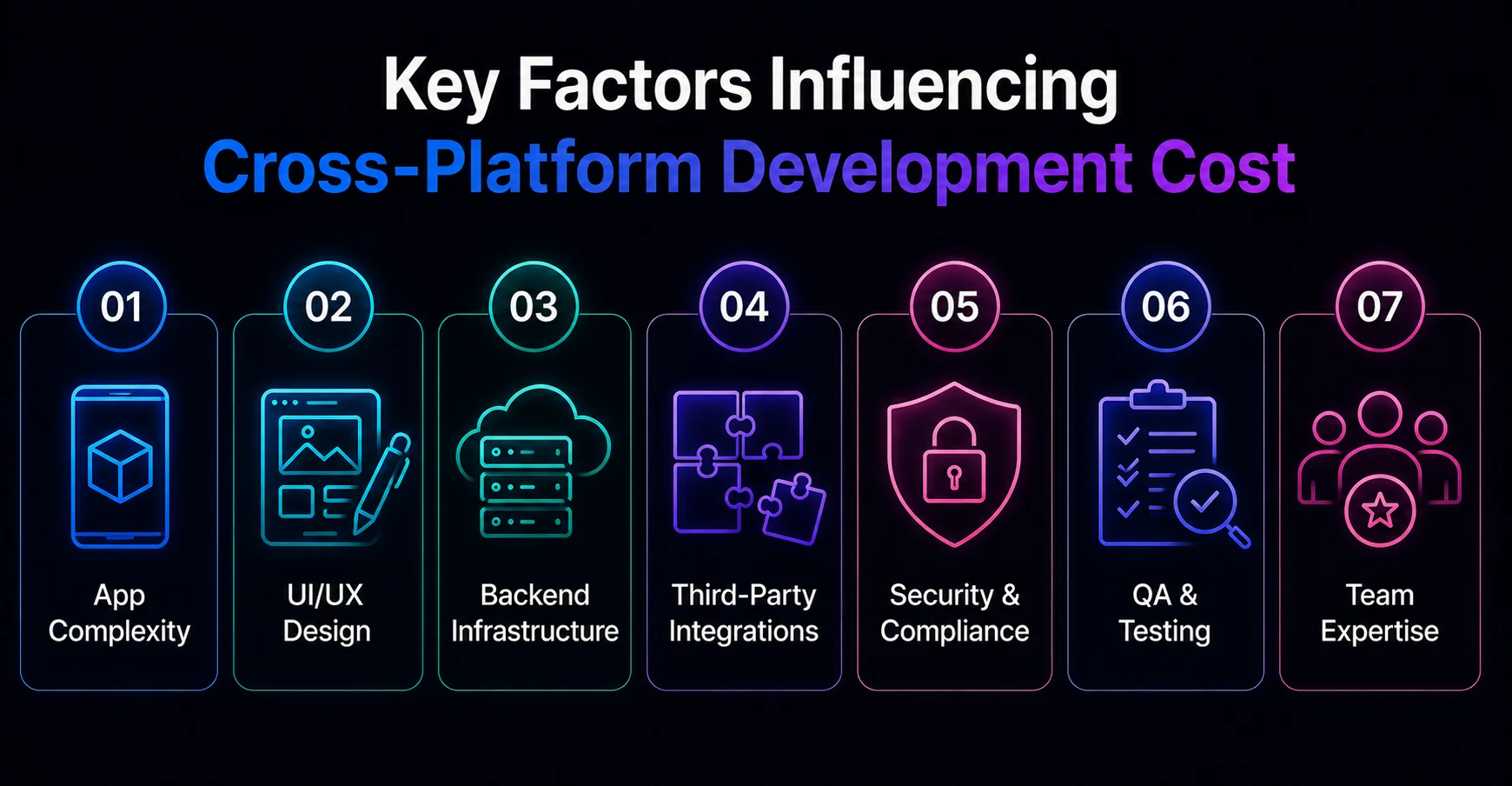
1. App Complexity & Feature Set
The single largest cost driver is the number of monitors, character flow, logic branches, and integrations you need. Beyond the visual user interface, features like real-time chat, live monitoring, offline syncing, video streaming, and AI-powered suggestions all require good engineering work.
2. UI/UX Design Specification
Using a standard user interface (UI) with framework connectors (Material Design, Cupertino) reduces costs. Your conversion costs can additionally increase by 20–40% depending on whether you use a custom, branded design with some kind of animation, interaction, and buyers in 2026 call for polished stories right away, which is why incredible layout matters.
3. Backend Infrastructure
Almost all applications require a server, a database, and an API layer. A wide range of clients, fact-processing needs, and third-party connections all add to the backend complexity. More complex backends that use cloud infrastructure, device recognition, or real-time statistical synchronization are more costly and require professionals.
4. Third Party Integration
Each integration – which includes payment gateways, cards, push alerts, social sign-ins, analytics gear, and CRM integration – adds time for testing and development and will cost more if your app relies on multiple APIs.
5. Security & Compliance Requirements
Additional layers of protection, encryption, compliance assessment, and documentation are required for apps in regulated industries that include healthcare, finance, and law. These should be embraced early on as they are capable of commanding the overall budget by $10,000 to $50,000.
6. Testing and QA
15–25% of the total repair cost is usually allocated to quality warranty. Cross-platform applications should be tested on multiple hardware, screen sizes, and operating systems. The quickest route to expensive post-launch problem repairs is to forgo adequate quality assurance.
7. Seniority and Team Size
Although they charge more by the hour, a senior team working with a specialized cross platform mobile app development agency will produce greater architecture, fewer bugs, and lower long-term maintenance costs.
Cross-Platform App Development Cost by Industry
An industry reference can be essential. Depending on your sector’s infrastructure needs, data sensitivity, and compliance requirements, apps with the same list of features can cost vastly different amounts.
1. Healthcare ($80,000 – $300,000+)
Healthcare apps must securely access patient data, comply with HIPAA policies, and often combine with scientific instruments or electronic health record (EHR) systems. While a complete platform with wearable connectivity and compliance testing can cost over $150,000–$300,000, a telemedicine MVP that enables video consultations and medications can cost between $80,000 and $100,000 on Flutter. Hybrid app development services with compliance information are important, no matter if you’re in this market.
2. Fintech ($100,000 – $400,000+)
Fintech applications require KYC/AML technology, PCI-DSS compliance, real-time transaction processing, and security here. Cutting corners on security is just not an option anymore, as they are one of the most expensive apps to develop well. Cross-platform frameworks like Flutter in fintech can, however, reduce overall cost by 30–40% compared to on-premises, especially for MVPs, where compliance and audit costs are higher anyway.
3. E-Commerce ($40,000 – $150,000)
Product catalogs, searches, carts, payment processing, order tracking, and admin screens are all important for e-commerce applications. An average setup with a strong backend and good user experience typically costs between $50,000 and $100,000. This is one of the best cross-platform ROI scenarios, considering that Flutter and React Native, the top cross platform app development tools, tackle specific use cases very successfully.
4. Education / EdTech ($50,000 – $250,000)
Education apps range from simple learning platforms to complex, gamified, AI-driven systems with multi-user collaboration, video streaming, and adaptive learning paths. Basic versions start around $50,000–$70,000, while advanced platforms can reach $200,000–$250,000. Working with experienced react native app development companies or Flutter specialists can help keep costs predictable in this category.
5. Logistics and On-Demand ($60,000–$2 100,000)
Real-time GPS, dual-user apps (consumer + supplier), payment processing, and sophisticated backend matching algorithms are necessary for applications such as delivery platforms, ride-hailing clones, or service marketplaces. For a well-scoped MVP, these mid-to-complex projects fall firmly within $70,000 to $150,000.
| Industry | Estimated Cost Range | Key Cost Drivers |
| Healthcare | $80,000 – $300,000+ | HIPAA compliance, EHR integration, security |
| Fintech | $100,000 – $400,000+ | PCI-DSS, KYC/AML, real-time processing |
| E-Commerce | $40,000 – $150,000 | Product catalog, payments, order management |
| Education / EdTech | $50,000 – $250,000 | Video, AI learning, gamification |
| On-Demand / Logistics | $60,000 – $200,000 | Real-time GPS, dual apps, matching algorithms |
Cost by Development Team Location
The location of your team is one of the most useful levers you have for the cross platform app development cost. Geographical variation in hourly rates can shift your typical budget by tens of many dollars.
| Region | Hourly Rate (2026) |
| USA / Canada | $100 – $200/hr |
| Western Europe | $80 – $150/hr |
| Eastern Europe | $30 – $75/hr |
| India / South Asia | $15 – $45/hr |
| Latin America | $30 – $65/hr |
If you carefully screen the team, go over case studies, and establish clear communication processes, moving with an offshore cross-platform app developing service – especially from India or Eastern Europe – can always cut your budget by 30 to 60% without sacrificing quality.
However, the least expensive choice isn’t always the best one. A senior team from a respectable cross platform app development agency in India will typically deliver significantly more value than any lower-budget team. Pay attention to quality and demonstrated knowledge rather than just the hourly rate.
Before you sign any agreement, consistently ask for samples of delivered products, client testimonials, and their presentation and launch assistance tactics, whether you are going to work with a large company or hire cross platform app developer.
Estimated Cost to Develop A Cross-Platform App in 2026
Considering a whole lot, below is a concrete chart for cross platform mobile app development cost for different project sizes in 2026:
| Project Type | Estimated Cost | Timeline | Example Apps |
| Simple MVP | $15,000 – $40,000 | 2–3 months | Utility apps, internal tools, basic booking |
| Medium Business App | $40,000 – $80,000 | 3–6 months | E-commerce, fitness, on-demand MVP |
| Complex App | $80,000 – $150,000 | 6–9 months | Telemedicine, logistics, marketplaces |
| Enterprise Platform | $150,000 – $400,000+ | 9–18+ months | Fintech, healthcare platforms, large-scale SaaS |
While the majority of SMEs fall between $50,000 and $120,000, the accumulated industry data from more than 5,000 app improvement projects suggests that the typical cost of developing a custom cell app in It will be 2025–2015–2016. dollars.
Start with the shortest version that supports your original idea as a broad rule. Create a strong MVP, test it with real users, and then incrementally make features based on comments instead of guesswork. This is how smart teams manage the cost of growing move-platform apps without compromising on deliciousness.
Hidden Costs Most Businesses Overlook
Most guides miss this part, and customers are often greatly surprised by it. The build is covered by your development quote. But that rarely covers all the real value you’ll get in the first 12 months.
What is the price range after the initial development stage is as follows.
1. App Store Fees
Apple developer software: $99 per year. The one-time cost for a Google Play developer account is $25. Small in itself, but still important to know.
2. Testing and QA
QA will usually increase the production fee from 15% to 25% if it is not always included in your maintenance charge. For cross-platform apps, it is important to go through adequate testing of the working structure of many smartphones.
3. Subscriptions to Third-Party API Services
Depending on usage, monthly prices for analytics tools, push notification offers, value processors, map SDKs, and social access APIs can vary from $30 to $1,000+.
4. Cloud Hosting and Infrastructure
Databases, server web hosting, and API ingestion are all evolving, as is your user base. Depending on visitor statistics and extension, cloud infrastructure (AWS, Google Cloud, Azure) can cost between $200 and $5,000+ per month.
5. Compliance and Security Audits
The annual cost of security audits for fintech and healthcare apps ranges from $3,000 to $10,000. Using GDPR, CCPA, app store coverage adjustments, and compliance updates come with regular engineering fees throughout the year.
6. Marketing & User Acquisitions
This catches nearly everyone off guard. Marketing costs often run 50–100% of the development budget in the first year. A great app nobody downloads costs just as much as a bad one.
In total, first-year costs including development, QA, infrastructure, third-party services, and marketing can easily run 30–50% higher than the initial development quote. Understanding how hybrid app development can reduce costs in each of these areas – through shared infrastructure, open-source tooling, and reusable components – is one of the smartest ways to plan and stay within budget.
Post-Launch & Maintenance Cost
Launching your app is the beginning of a new set of expenses instead of the end.
For mobile platform applications, first-year maintenance costs are typically 25 to 50 percent of the initial development cost. It could be between $15,000 and $30,000 in just the primary year for the $60,000 software.
What is the actual scope of maintenance?
1. Performance Enhancement & Debugging
As the user base grows and the variety of devices increases, disadvantages emerge. Each of them needs to be learned, edited, and revisited across all platforms. Cross-platform apps benefit from having a single codebase, as single recoveries can be implemented on both iOS and Android.
2. Update to OS
Every year, Apple and Google deliver major OS updates. Each update has the potential to interrupt current functionality, require UI changes, or require API adjustments. Corresponding technical work is required to maintain compliance.
3. Feature Updates & Improvements
Requests for new features, UX upgrades, and performance improvements will be influenced by user input. For expanding apps, a $10,000–$50,000 yearly budget for feature development is reasonable.
4. Infrastructure & Server Scaling
The cost of your infrastructure increases as your user base grows. Reactive scaling is generally more costly than planned scaling, and as a result, you should prepare for this in advance.
A popular corporate theory is to set aside 15–20% of your initial development cost for improvements every 12 months. 80.000 dollars for the app, which means allocating between 12.000 and 16.000 dollars per year to maintain its competitiveness, health, and modernity.
When to Choose Cross-Platform Over Native
Cross platform native app development is not suitable for every task. Remember this simple system to help you decide:
Choose Cross-Platform When:
- Finances are good, and you should move between iOS and Android clients.
- When developing an MVP, speed to market is more important than most fulfillment performances.
- No huge hardware requirements, your app is a standard business tool for e-commerce, orders, productivity, social media, and content.
- You want a single workforce to monitor both systems and minimize long-term maintenance costs.
- As a startup, you validate the product concept before making a full local funding commitment.
Stick to Native When:
- Deep hardware gets access rights, state-of-the-art AR/VR, IoT device management, or biometric features with even higher security are all crucial for your app.
- You cultivate a performance-intensive application that includes a real-time fintech trading platform or a highly reduced mobile game.
- By design, your application is unique to iOS or Android.
- Rebuilding isn’t always absolutely necessary because you already have a well-established native codebase.
Cross-platform is the perfect place to start for almost any business reading this guide, especially those considering whether to develop cross platform mobile apps for the first time. For the first-tier majority of the enterprise application class, Flutter and React Native are definitely build-ready in 2026.
You can always evaluate architectures as your product evolves, price discounts are important, and the overall performance gap is reduced significantly with native.
If you are not sure, you can invest money by booking a scoping consultation with a reliable cross platform mobile app development company. Save you months of rebuilding and a significant budget down the line.
Native vs hybrid app development cost comparisons often make the decision clearer once you see the numbers side by side for your specific feature set.
Advantages of Cross-Platform App Development
The benefits of cross platform app development go beyond economic and financial savings. The following explains why so many organizations, from Fortune 500 companies to startups, are adopting this approach in 2026:
1. Two Platforms, One Codebase
Write it once, use it everywhere. Your team can stay away from duplication by maintaining a set of logic, functions, and version types thanks to a common codebase. From a resource management perspective, those are some of the most compelling benefits of cross-platform application development.
2. Faster Time to Market
When using cross-platform frameworks instead of creating two native apps, teams claim 30–40% faster development cycles. Particularly for companies rushing to confirm their idea, the speed advantage directly translates into a competitive benefit.
3. Lower Development & Maintenance Costs
Your staffing fees are reduced, sprint planning is simplified, and bug fixes are deployed simultaneously on each platform, while the long-term cost of ownership is remarkably low compared to dealing with two local codebases that require a team per platform.
4. Consistent User Experiences
UI compatibility between iOS and Android is ensured via a single codebase. No matter which device your customer chooses, your brand should look and feel consistent across systems.
Wider Audience Reach From Day One
If you publish to both app stores at the same time, you can reach 100% of your potential mobile target audience with your first launch. This is crucial for user growth, especially in areas where iOS and Android each have a wide market share.
Access to Native Features
Without the need for a full local build, modern application development tools like Flutter and React Native provide reliable access to local capabilities like digicams, GPS, push notifications, biometrics, and hardware sensors. When you hire app developers with the right expertise, you get near-native capability at cross-platform cost.
Easier Scalability
As your product grows, an integrated codebase becomes easier to refactor, optimize, and scale. Instead of being duplicated across entire specific codebases, architectural changes are directly applicable across all boundaries.
How to Optimize & Reduce Cross-Platform App Development Costs
These approaches really make a difference in building cross-platform mobile apps without going over budget:
1. Start with the MVP.
Developing a functional product before establishing that real people prefer it is the most costly mistake in app development. Establish a core loop that validates your idea, or the minimum viable version of your app, and just start with that. Instead of assumptions, add attributes based primarily on user data.
2. Prioritize Your Features
Create a list of all the features you’ve chosen and set a price before you start building. Make the most efficient build that matters for launch. Fees for installation, development, effort, and maintenance rise with each new feature, while most users make the best use of a small fraction of its capabilities.
3. Use Pre-Built Libraries & Open Source Tool
Rich ecosystems of open source applications, widgets, and templates can be found in Flutter and React Native. You can save your development time and prices by 20–30% by using these instead of starting from scratch. This is one of the most cost-effective techniques to reduce the hybrid app development cost without sacrificing functionality.
4. Keep UI Simple At Launch
The intricate design structures and custom animations are redundant. Start with an easy-to-use user interface (UI) and use the included plugins using the framework. Once the profits have supported the costs, you could practice custom polishes in the next iterations.
5. Choose the Right Development Partner
If you work with a specialized cross platform mobile app developer instead of a public company, you may not have to pay for the learning curve. You can look for groups that have demonstrated knowledge of their field and explain what you want. Additionally, cross platform app development experts’ precision passporting and application development can be leveraged to identify scope creep before it happens.
6. Plan for Phased Development
Build your roadmap in stages rather than doing it all at once. Start with step 1, get access, and then the design phase, 2 configuration with user requirements. This strategy ensures that each successive expenditure is supported using real facts while pragmatically maintaining the initial budget.
7. Consider Offshore & Hybrid Teams Strategically
If you choose the right development partner, put money into clear communication, and maintain strong company control, a step with a respectable company offshore cross-platform app development provider in Eastern Europe or India can reduce cost by 30-50% without significant sacrifice. If you want to hire react native app developers offshore, ensure they have a strong portfolio of shipped products and solid client reviews before committing.
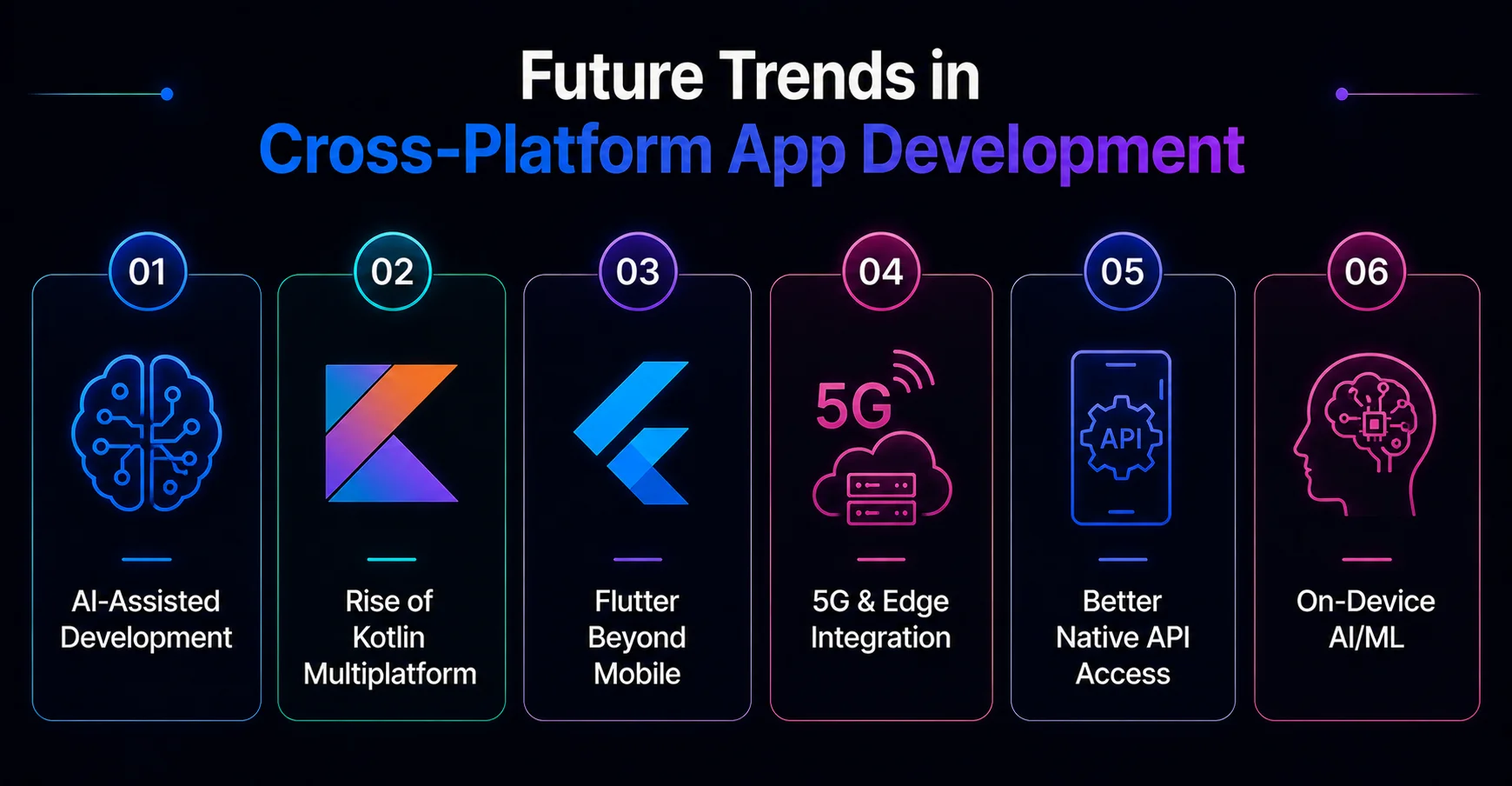
Future Trends in Cross-Platform App Development
The best cross-platform mobile app development frameworks are changing rapidly, so the choices you make now need to take into account the future trends of the environment.
1. AI-Powered Development
By 2026, integrated IDE assistants and AI coding tools like GitHub Copilot could be commonplace. They shorten timelines and reduce costs by helping developers write boilerplates faster, identify bugs early, score goals, and reduce costs. Teams using AI-assisted workflows record 30–40% faster delivery of medium complexity applications.
2. The Rise of the Kotlin Multi-Platform (KMP) 2
The Kotlin multiplatform has a wide reputation, especially among companies with established local teams, although the dominance of Flutter and React Native KMP provides a compelling middle ground between fully native optimization and pure cross-platform optimization, allowing teams to apply basic business logic and maintain UI.
3. Flutter Beyond Mobile
Static support for mobile, web, desktop, and embedded systems has grown for Flutter. In 2026, Flutter-based cross-platform web application development will become more feasible, particularly for apps that need a common user interface (UI) across online and mobile platforms without requiring a fantastic front-end code base.
4. 5G and Edge Computing Integration
Real-time, low-latency applications that were previously impractical at this point are possible due to the ongoing implementation of 5G. Upgrading to a common codebase allows these capabilities to be used quickly and deployed to any number of systems at once, making cross-platform frameworks well-positioned to benefit.
5. Improved Native API Access
Every major framework model reduces the gap between ultimate performance and capability with pure native development using deeper access to native device APIs. Now there is typically a clear cross-platform solution for anything that needed a native workaround two years ago.
6. On-Device ML and AI
Machine learning, adjacent data processing for faster predictions, advanced privacy, and offline capabilities are enabled by Flutter for TensorFlow Lite. Cross-platform hybrid application development services are in growing demand to serve this rising need across consumer healthcare and financial applications.
Also Read : Connecting Employers, HR & Employees in One Platform
Why is Octal IT Solution the Right Cross-Platform App Development Partner?
Experience and areas of expertise are only as important as price in terms of cross platform app development companies. Both are provided through Octal IT solution.
With years of practical experience translating into mobile platforms and mobile app enhancements in the healthcare, fintech, e-business, logistics, and education sectors, Octal IT Solution is now a full-cycle development partner rather than merely a coding funnel. What distinguishes Octal IT solution among others:
1. Framework Expertise Across the Board
The team’s expertise in Flutter, React Native, and Xamarin cross-platform app development is proven, and their advice is entirely based on your actual project requirements instead of internal options.
2. Transparent Pricing
As a trusted mobile app development company, we ensure complete cost transparency with no hidden steps. Before a single line of code is written, you receive a detailed breakdown based on your project scope, timeline, team structure, and platform requirements.
3. End-To-End Delivery
Octal IT Solution covers the entire lifecycle, from discovery to UI/UX configuration to development, quality assurance, deployment, and even post-launch support. The coordination burden of setting up many providers is eliminated when you hire cross-platform app developer through a full-service partner.
4. Industry-Specific Knowledge
There are industry-specific differences in integration complexity, protection requirements, and compliance requirements. Thanks to Octal IT Solution’s understanding of both regulated and unregulated industries, your app should have an appropriate architecture from the start. As a trusted cross-platform app development service partner, the team stays up to date with the latest framework updates, OS changes, and industry compliance requirements so you don’t have to.
5. Scalable Engagement Models
The engagement model suits your business, whether you need to hire dedicated cross platform app developer on a benchmark basis, have a fixed-price project, or want a dedicated team.
Octal IT Solution is a worthy discussion if you are looking for the best cross platform mobile app development companions for your upcoming project. Get an in-depth estimate. This is customized to your exact concept; There would be no standard charges or hidden surprises.
Wrapping It Up
Cross platform app development in 2026 should be extra competent, within your price range, and strategically sound. The setting is fully elevated. There is a huge pool of expertise. MVPs are not exclusively use cases.
However, the figures in this guide are just a starting point; they can be a boost factor. The exact job you need, the company you build, the team you brainstorm with, and the choices you make along the way all have an impact on your final cost. The businesses that spend the most money are not the ones that get great results. They were the ones who made realistic plans, set smart priorities, and collaborated with experienced individuals.
Use this method to set proper expectations before talking to professionals who can provide you with project-specific information, whether you’re planning your first app or evaluating cross platform mobile app development service for a more ambitious product.
Also Read : Securing Corporate Data on iOS Devices


 Get in Touch
 By
By September 30, 2026