


Key Takeaways
- The average React native app development cost in 2026 will be between $15,000 and $300,000+, depending on complexity, features, and cluster affinity.
- A full-featured enterprise software can require up to $200,000, while a basic MVP app typically requires between $15,000 and $30,000.
- The react native developer hourly rate ranges from $20 in South Asia to $150 in North America.
- Development costs can rise by 20–40% with hidden costs, retrofits, app store costs, and third-party APIs.
- Costs can be reduced by 40–60% without compromising high-quality, marine-oriented development processes.
- The cost is immediately driven through the timeline: depending on group size, a 3-month project is significantly less high-value than a 9-month project with the same characteristics.
Introduction
Almost every founder discussion about product assembly, pitch decks, and mobile software starts off with the question “how much will this really cost?” What would a React Native app undoubtedly cost in 2026? This issue becomes more specific for organizations that have already decided to use React Native as their preferred framework.
Authentic feedback is complicated. There isn’t a single figure that works for each team, each market, or each software. However, there must be a legal way to consider costs, and this blog is designed to provide you with just that.
This is your go-to resource if you’re a CTO evaluating suppliers and choosing how to work on a campaign, leading a product development effort and building a business case, or a first-time entrepreneur working on an early financial model. We designed carefully, up-to-date, and without the vague generalizations that characterize most website reports in this guide.
Line-item price breakdowns, comparisons of native builder costs, sketch comparisons, hidden costs, and the honest operations that really make a difference when trying to build something remarkable without wasting money are all covered. Everything in this guide is designed to help you better understand any interaction you come across and reflect the state of the market from 2026 onwards.
React Native App Development Market Overview
The market for mobile applications is growing rapidly all over the world. According to Grand View Research, the industry is expected to grow at a compound annual growth rate (CAGR) of more than 14% and by 2030 is projected to exceed $583 billion. The demand for mobile developers is rising as a result of this expansion, which has an impact on the react native mobile app development cost in all regions and engagement models.
React Native in 2026: Market Position & What It Means for Your Budget
This market environment is important for firms because it explains price movements. Competitive Pressure in the React Native app development services pricing has kept costs fairly stable, even in normal financial inflation, as more companies work with React Native and the pool of developers grows globally, especially in South Asia, Latin America, and Eastern Europe.
The good news for customers is that you now have additional options, standards, and negotiation power compared to 5 years ago. You are in a much more powerful position if you are aware of the current standards in React native app pricing before entering into any vendor discussions.
React Native vs Flutter vs Swift/Kotlin: Cost Comparison
Your average cost is immediately affected by the structure you choose. Basically, React Native is economically in line with its top competitors as follows.
| Framework | Language | Code Sharing | Avg. Dev Rate (Offshore) | Relative Build Cost | Best For |
| React Native | JavaScript / TypeScript | 70–90% | $25–$75/hr | Moderate | JS-familiar teams, fast MVPs, broad talent pool |
| Flutter | Dart | 80–95% | $30–$80/hr | Moderate–Low | UI-heavy apps, smaller talent pool |
| Swift (iOS only) | Swift | 0% (iOS only) | $50–$120/hr | High (iOS only) | Premium iOS apps needing full native performance |
| Kotlin (Android only) | Kotlin | 0% (Android only) | $40–$100/hr | High (Android only) | Android-first apps with deep system integration |
| Native (iOS+Android) | Swift + Kotlin | 0% (separate builds) | $80–$150/hr combined | Very High | Maximum performance, no budget constraints |
Code reuse is the biggest cost advantage of React Native over native development. Those levels of development graphics are immediately reduced by half as your team quickly builds business logic, API calls, and state management, and delivers each to iOS and Android. Similar performance is provided with the help of Flutter, but React Native’s JavaScript/TypeScript ecosystem gives you access to a much wider talent pool, which improves the pricing proposition and allows for hiring.
React Native provides the best stability of cost-effectiveness, time-to-market, and long-term maintainability for almost any business that weighs the cost to build a react native app against native options when your app wants deep OS level integration that React Native’s local JSI or JSI can’t handle.
How Much Does A React Native App Cost (By App Type)
Here’s a useful short reference to help you ground before delving into specific breakdowns. These estimates fully assess the entire product specification and form the market rates for offshore to adjacent development teams in 2026. With US-based teams, costs go up.
Basic Apps ($10,000–$50,000)
Basic applications, such as calculators, opportunity apps, information tools, and early-stage community products, have a small range of monitors (5–15), lightweight BaaS backgrounds (Firebase, Supabase), and one or two straightforward connections.
Usually, a small team consisting of one or two mobile app developers and a designer may complete the project in 6 to 14 weeks. This tier often includes the react native MVP development cost, which is purposefully scoped to prove a fundamental idea before committing to a full build.
Mid-Complexity Apps ($50K–$150K)
Much of the real international enterprise work with social media networks, ordering applications, health monitoring, marketplaces, and delivery applications is covered here with custom REST or GraphQL APIs, multi-tasking authentication, third-party integrations, and a team of three to six individuals working for four to eight months is necessary for this.
A single sophisticated feature, such as real-time chat or live video, can change your budget by $15,000 to $30,000. The custom react native app development cost in this range is extremely sensitive to scoping choices.
Complex/Enterprise Apps ($150K–$500K+)
Compliance requirements, deep system integrations, microservices design, and high availability demands define enterprise apps, which include banking platforms, healthcare apps, large-scale on-demand systems, and multi-tenant SaaS.
These projects, which run for 9 to 18 months, require 8 to 15 or more individuals in design, development, quality assurance, and DevOps. At this stage, the react native app development budget changes from feature-based estimation to capacity-based planning; instead of purchasing a deliverable, you are creating a product team.
React Native App Development Cost Breakdown: Every Line Item
A proper react native app development cost breakdown goes beyond “developer salaries” tons. You can be in a much better position when evaluating proposals and vendor ratings if you are aware of the costs associated with each stage of building a business app.
Discovery & Planning
This phase involves gathering requirements, mapping user experience, technical feasibility, and planning architectures. It usually takes one to several weeks and costs between $2,000 and $8,000. It is the most underappreciated line item in every budget debate, and it is the most high-value exclusion to see that there are tons of much less valuable ones here to resolve misunderstandings that are far from bringing this to the center of creation.
UX/UI Design
Wireframes, user flows, visual layouts, prototyping, and deliverable documentation are all covered in the design. For work that is near template, react native UI UX design costs range from $3000 to over $25,000 for a fully specialized installation system. Don’t cut corners right here: a perfectly designed app outperforms a robotically useful yet poorly designed app, and user retention is determined within the first thirty seconds of onboarding.
Frontend Development
This includes every React Native interface, component, navigation mechanism, and interaction. Basic applications cost between $8,000 and $30,000, medium complexity applications between $30,000 and $80,000, and enterprise front-ends cost more than $100,000. Since later monitors have higher interdependencies, class relationships, and state management complexity than earlier ones, frontend costs have been thrown upward nonlinearly.
Backend Development
Database configurations, server logic, REST or GraphQL APIs, authentication systems, and admin dashboards are examples of backend diagrams. A completely custom backend with a real-time infrastructure can cost $50,000 to $100,000+, while a Firebase/Supabase-assisted backend costs $3,000 to $10,000. Scope creep is inside the back end, so before the development starts, clearly state the needs in the SOW.
AI & Third-Party Integrations
Each charges for integration, costing, analytics, mapping, video calls, and AI recommendations. A sophisticated AI hiring engine takes 80–200 hours to make calls, while Stripe integration takes 10–20 hours. Integrations constantly need to be budgeted as separate line items instead of individual rates because of the huge range in them.
QA, Testing & Device Compatibility
Performance testing, UAT, cross-device compatibility, computerized testing suites, and tutorial efforts are all part of QA. Set aside $3,000 to $20,000, depending on complexity and equipment insurance. Testing on real machines, no longer just simulators, is important; If QA doesn’t find bugs that unique Android hardware shows the simplest of things, your customers will definitely find them.
DevOps & CI/CD Setup
DevOps includes environment management, cloud infrastructure (AWS, GCP, Azure), and CI/CD pipelines (Bitrise, GitHub operations, Fastlane). There is an initial cost of $2,000 to $12,000. By reducing manual deployment errors and speeding up the QA cycle, a well-configured pipeline pays for itself in the first strike.
App Store Submission & Compliance
Inventory lists, screenshots, signature credentials, and TestFlight or Play Console configurations are all covered in the React native app deployment cost to provide protection. Set aside between $800 and $3,000. Developers are $25 one-time (Google) and $99 annually (Apple). Additionally, apps that handle payments, health information, or children’s material will require more time for compliance reviews.
Hidden Costs You Should Know About
Most sellers quote the prices listed in Section 5. Three to six months after launch, the expenses listed below are the ones that startle companies. They are not optional, so budget for them all up front.
Post-Launch Updates & Maintenance
Every OS update provided by Apple and Google has the potential to disrupt modern app capabilities related to permissions, rendering, or local modules. Typically, the annual react native maintenance cost is around 15–20% of the initial development price, or around $10,500–$14,000 for a $70,000 initiative.
This includes minor UX updates, dependency updates, and bug fixes. Unmaintained apps eventually die, crashing on newer devices and being removed from stores.
OTA Update Infrastructure (CodePush / EAS)
One of the great operational benefits of React Native is its ability to deliver updates over the air without App Store approval. This is made possible with equipment such as Microsoft CodePush and Expo EAS Update, whose monthly infrastructure fees range from $50 to $500 for consumer apps.
Depending on update frequency and user extension, this infrastructure can quickly pay for itself, as the react native app upgrade cost is far less than that of a complete re-submission.
Scaling Costs (Performance & Infrastructure)
The cost of your backend infrastructure increases as your user base grows. AWS, GCP, and Azure are examples of cloud website hosting that are growing with the amount of compute, storage, and bandwidth. With 1,000 users, spending $100 equivalent per month could cost around $2,000, depending on the backend month.
Costs include load balancers, auto-scaling settings, database read replicas, and CDN consumption. It is costly to retrofit scalability; design your architecture with scalability in mind from the beginning.
Security Audits & Compliance
Security and compliance are non-negotiable line items if your app handles children’s data, private fitness data, or financial activity. Professional entrance exams range in price from $3,000 to $15,000. Implementing GDPR compliance increases development time by spending between $5,000 and $20,000.
Considering BAA setup, encryption requirements, audit controls, and data residency rules, HIPAA compliance for healthcare applications can cost anywhere from $15,000 to $50,000 if you count in standard batches, so you’ll need to cover the area if you don’t check them before starting a registration process.
Key Factors Affecting React Native App Development Cost
Several technical, business, and operational factors influence the overall React Native app development cost. Understanding these cost drivers helps businesses plan budgets more accurately and avoid unexpected expenses during development.
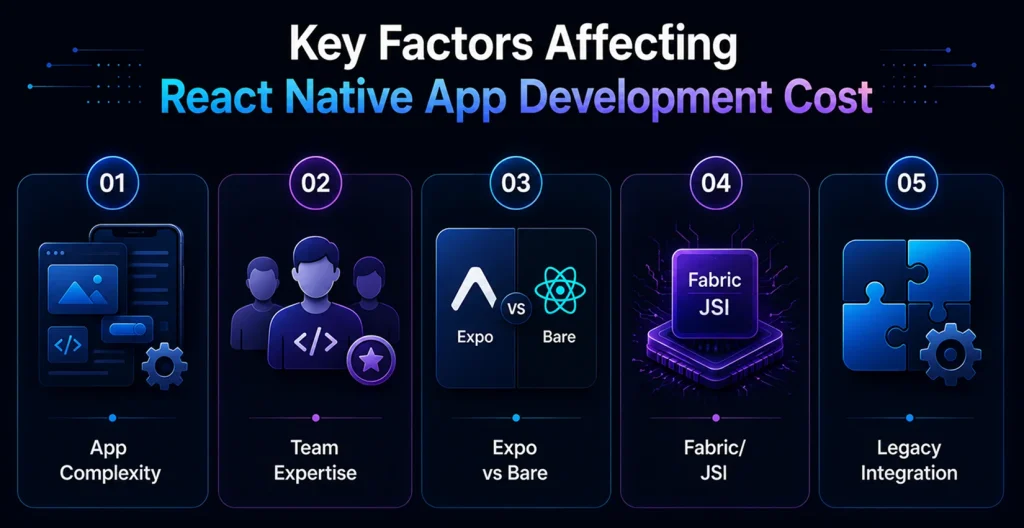
App Complexity & Feature Set
Factors that immediately affect cost include feature count and complexity. 40–80 hours for real-time conversation, 120-200 hours for continuous video streaming, and 60–100 hours for loyalty rewards engine. Get a react native app cost estimation from your development partner and each to the accurate diagnosis of the symptoms. Vague scope affects vague and unreliable citations.
Team Composition & Seniority
Although senior designers are 3 times more expensive per hour than junior developers, they produce fewer bugs, build faster, and make slower architectural choices. A thin mix of 1 or two senior developers and one or a mid-level developer is a low budget for an MVP. A good senior-to-junior ratio for organization apps is of high quality. Good dash making plans offset the low and misunderstood reward value, as a result of which a dedicated PM will additionally pay for itself.
Export vs Bare Workflow
Expo managed is ideal for MVPs because it accelerates early development while still limiting access to getting native. For most business events, Expo Bare offers complete local access with low setup costs. Most flexibility is provided through the Vanilla React Native CLI, but it requires native iOS and Android understanding, which is more important for employees. The initial correction value and the difficulty of long-term retention are affected by the method you choose.
New Architecture (Fabric/JSI) Considerations
By 2026, all new projects will use React Native’s new architecture, which replaces the previous Bridge with JSI and the legacy renderer with Fabric. Even though they come up with reliable and efficient products, developers with truly innovative architectural talents pay $5–$15 more per hour than those using legacy techniques. This premium is cheaper for new builds and worth considering when comparing fees to growing a react native app.
Legacy App Modernization & Technology Integration
Applications developed 3 to 5 years ago using old bridge architectures have technical debt that makes modernization more steeply costly than new builds. Before starting a new job, audit and rebuild the existing code. A complete JSI/Fabric migration can require between $40,000 and $10,000+, while a targeted development costs between $10,000 and $25,000. Start with ongoing paid code audits ($2,000–$5,000) before committing to the scope.
How Mobile App Architecture Decisions Affect Your Budget
Every dollar spent over the next 5 years is influenced by choices made during the primary workweek. Refactoring later is more expensive than getting it right up front. The principle architecture decision and associated costs are as follows.
State Management Strategy
As features are introduced, the choice of Redux, Zustand, Jotai, React Query, or Context API affects the complexity of your application. Prop-drilling nightmares, overall performance problems, and costly refactoring categories are the result of poor decision-making by national leadership. Junior-heavy teams watch this from time to time, and later it pays off for senior engineers to take care of organizing a proper display.
Microservice vs Monolithic Service
For most applications with fewer than 10,000 active customers, a monolithic backend is more affordable to build to begin with. Although it requires more up front, the design of microservices scales more than retail, with enough visitors. Choosing microservices for a small application very quickly leads to $20,000 to $50,000 wasted in pointless infrastructure complexity. Make a choice based entirely on your affordable expectations rather than idealistic ones.
Custom Backend vs. BaaS
For apps that suit their data model, backend-as-a-service systems (Firebase, Supabase, AWS Amplify) significantly cut backend development time and cost. BaaS can reduce backend prices by 50–70% for apps with lightweight information systems, traditional testing, and moderate verification. Custom backends are important and worth the price for applications with detailed relational data, specialized business enterprise logic, or regulatory filing residency requirements.
Offline-First Design
Significant architectural complexity is introduced in the development of an offline-first utility that operates without a community connection and synchronizes when connectivity is restored. Additional deployment, enhancements, and testing of libraries such as Redux Offline and WatermelonDB are needed. Depending on the amount of offline help required, it may charge for medium complex software applications ranging from $10,000 to $30,000. However, these costs have a direct impact on user retention of apps that target markets with unreliable connectivity.
White Labeling and Multi-Tenancy
A multi-tenancy architecture needs to be designed from the beginning, whether you are growing a platform that will be white-labeled for many customers or serving many companies with specific information and configuration. The most valuable software program transformation commitments are realigning multitenancy rights to single-tenant works; It requires a much higher starting price range to build it properly.
Performance Architecture
In applications that rely heavily on speed or computation, React Native’s JavaScript threads can also become a bottleneck. By using Hermes as a JavaScript engine, lazy loading, memorization styles, Reanimated 2/3 for animation, and an active unified display architecture, superfluous customization sprints within the future are avoided. Make sure your senior engineers clearly understand a unified display architecture because of the facts known by the group.
React Native App Development: Timeline & Its Impact on Cost
There is a direct yet non-linear relationship between the timeline and the cost. Depending on the size of the team, time does not consistently lead to additional costs. Moreover, adding developers to shorten deadlines does not necessarily result in financial cost savings; In fact, coordination costs (also known as “Brooks’s Law”) can raise general costs when teams are larger, which is good for the complexity of the project.
| Phase | Basic App | Mid-Complexity App | Enterprise App | Key Activities |
| Discovery & Planning | 1 week | 2–3 weeks | 4–6 weeks | Requirements, architecture, team assembly |
| UI/UX Design | 1–2 weeks | 3–5 weeks | 6–10 weeks | Wireframes, prototypes, design system |
| Development Sprints | 4–8 weeks | 12–24 weeks | 24–52 weeks | Feature development, iterative builds |
| QA & Testing | 1–2 weeks | 3–5 weeks | 6–10 weeks | Bug fixing, UAT, device testing |
| Deployment | 1 week | 1–2 weeks | 2–3 weeks | Store submission, infrastructure go-live |
| Total Timeline | 7–14 weeks | 4–8 months | 9–18 months | – |
The most important timeline lesson is that buyer selection is often the main purpose of the delay. Projects that used to end up on the agenda are often not on schedule after weeks because of installation approvals, content materials, stakeholder sign-offs, access to third-party credentials, and client selection of milestones you need to include in the project plan and give them the same priority as development.
React native app development charges associated with a larger, more efficient team (faster shipping) regularly represent a better return on investment (ROI) than a slower, much less efficient team for businesses, where speed-to-market is a primary competitive advantage.
React Native Developer Rates by Region: Global Comparison
The most comprehensive cost variable in your work and finances is team location. This is an in-depth analysis of the react native app development rates in the top global markets in 2026:
| Region | Junior Dev ($/hr) | Mid-Level Dev ($/hr) | Senior Dev ($/hr) | Agency Day Rate ($/day) |
| United States / Canada | $60–$90 | $90–$130 | $120–$180 | $800–$1,500 |
| Western Europe (UK, Germany) | $50–$80 | $80–$120 | $100–$160 | $700–$1,200 |
| Eastern Europe (Poland, Ukraine, Romania) | $30–$45 | $45–$70 | $65–$95 | $350–$700 |
| Latin America (Brazil, Colombia, Mexico) | $25–$40 | $40–$65 | $55–$85 | $300–$600 |
| India | $15–$25 | $25–$45 | $40–$70 | $150–$400 |
| Southeast Asia (Philippines, Vietnam) | $15–$28 | $28–$50 | $45–$75 | $180–$450 |
| Middle East / North Africa | $20–$35 | $35–$55 | $50–$80 | $250–$500 |
The react native app development hourly rate between senior engineers in the US and India for developing React native apps is sort of 2.5-4x times. This shows that a 2,000-hour effort costing $250,000 with an American group can be completed with an experienced Indian community for $80,000- $140.000 dollars, saving $110,000 – $%170,000.
The most frequently mentioned criterion in company discussions is the react native app development cost in the USA, which is often the most treacherous for companies to get access to global capabilities. When a local team is needed due to proximity, time zone synchronization, or regulatory restrictions, U.S. fees are charged. They are not necessary for the majority of business app builds.
Experience with new architectures, overall performance optimization, CI/CD setup, and specialized domain information (fintech, health, etc.) all have a big impact on the hourly rate for React native developers at any location. Applicants often only have to prove their build applications instead of their department.
In-House vs. Freelancer vs. Agency vs. Offshore vs. Dedicated Team
Your choice of framework and method of engagement is equally important. Depending on the size and level of work, each model has its own fee profile, risk profile, and applicability. Here’s an honest contrast:
| Model | Typical Cost Range | Best For | Strengths | Weaknesses |
| In-House Team | $120K–$600K+/yr (fully loaded per person) | Long-term products with ongoing development | Full alignment, institutional knowledge, direct oversight | High fixed overhead, slow hiring, and benefits burden |
| Freelancers | $20–$120/hr depending on region | Small tasks, tight budgets, single-skill needs | Cost-flexible, fast to engage | Coordination risk, availability gaps, and no team continuity |
| Local Agency | $100–$200/hr blended rate | High-touch projects, regulated industries | Accountability, professional PM, established process | Most expensive option by far |
| Offshore Agency | $25–$75/hr blended rate | Most commercial projects with a defined scope | Strong ROI, full-service teams, proven delivery models | Time zone management and cultural alignment are needed |
| Dedicated Team | $15,000–$80,000/month depending on team size and region | Mid-to-long-term projects needing team continuity | Deep product knowledge, team loyalty, and flexible scaling | Monthly fixed commitment requires a good client-side PM |
Because it falls between business enterprise and residential in terms of control and cost, an engaged team model deserves special attention. Without the overhead of hiring, you essentially hire a pre-assembled team, including PMs, designers, producers, and QA.
The team develops institutional understanding over time, working fully for your product and scaling up or down as needed by your roadmap. It’s frequently the most economical option available for items that have undergone continuous feature development after initial introduction.
If you choose a partner with experienced React Native knowledge, a clear interview framework, and verifiable build references from offshore tied staffing companies, react native application development pricing is typically 40–60% less than equivalent local agency rates for equivalent technical output.
Budget Risks: What Goes Wrong & How to Prevent It
Scope Creep: The Budget Killer
Risk: At the center of a task, features are delivered without following proper scope review techniques, which ends up with more hours and costs than expected.
Prevention: Before development begins, lock in the scope of the radical action declaration. Establish an orderly change request technique where every change is priced, approved, and scoped before a developer can build any code.
Uncertain or Inadequate Requirements
Risk: Uncertain requirements are interpreted differently by manufacturers than product owners, leading to rework.
Prevention: Invest in a comprehensive discovery piece. Perform thorough user testimonials with reputation claims. Before starting the correction, the wireframe should be cleaned.
Choosing the Wrong Development Partner
Risk: It’s more expensive to have broken, poorly designed code created through low-value kits that lack the proper React Native training it would need to develop properly.
Prevention: Explore the portfolio of productivity apps. Talk to past customers. Before committing to full commitment, do a paid week trial sprint. Always verify familiarity with the new architecture.
Ignoring Technical Debt
Risk: To offset the impact of the cut-off date, rush to shortcuts that add up to more valuable rework actions 6 to 12 months later
Prevention: From the beginning, spend 10-15% of your time at Dash tackling tech debt. Code quality should not be seen as a problem after release.
Third-Party API Surprises
Risk: Price barriers, incompatible information codecs, or lack of documentation can add several times the expected integration time to an API that looks simple within the description.
Prevention: Develop proof-of-concept integrations for APIs at the discovery stage instead of at some stage of the development sprint. Before committing to time frames, consider the complexity of surface integration.
App Store Rejections
Risk: When an app is rejected by Apple or Google due to policy violations, it must be rebuilt and resubmitted, launch is delayed, and legal liability and development costs rise.
Prevention: Before you start developing the UI layout, carefully review the Google Play rules and App Store review guidelines. Any skills (invoices, materials handling, health records) that can improve assessment procedures need to be flagged as soon as possible.
How to Reduce React Native Costs Without Sacrificing Quality
Cutting prices in app development is not about paying much less for the same product; It approaches using price grades more smartly as an alternative. These are good measures, along with useful management tips for each.
Using AI-Assisted Development Tools
The majority of commercial React Native workflows are now AI coding tools like GitHub Copilot, Cursor, and Codeium. They save 15–30% of the time in boilerplate and iterative models when used by experienced engineers. Ask partners how they found the use of AI technology when evaluating the react native consulting services cost. Teams that have already accomplished so much produce work more quickly for the same hourly rate, which immediately reduces the overall cost for your project.
Reusable Component Libraries
Building from scratch is eliminated by using open source libraries like Gluestack UI, Tamagui, and React Native Paper, which provide production-ready UI bundles that reduce frontend development time by 20–35% when used judiciously. Custom components are favored through customer engagement, competing for visual recognition, but certain design similarities are a highly desirable trade-off for B2B and utilitarian apps.
Phased Feature Rollouts
The most reliable method to keep costs under control without major compromises is to build in batches: MVP first, then v1.1, then v2. Since real user data always shows that certain intentional features didn’t matter as much as others that weren’t on the roadmap, the cost to develop react native apps by stages is now typically 20–30% cheaper than building the entire batch.
Use the Development Pricing Calculator
Before making an agent chat, the react native app development cost calculator will show you detailed variations. When evaluating specific offers from 3 development companies, use the preliminary estimate obtained by writing your agenda, platform, and team model as an anchor. Calculation results should in no way be used as your final budget; Instead, they should be used as a starting point.
Make Backend Simplicity a Priority Early
Start with the most basic surface that meets your needs right now. Many early-stage app needs are met with the help of Firebase or Supabase, which can store $15,000–$40,000 on a custom backend. Don’t move because you think you’ve studied, you’ll probably want to have in eternity, but because, for some reason, you’ve been allowed to get accurate.
Faster Feedback Cycles
Silent budget killers that show up on invoices as PM hours or timeframe overruns include delayed feedback, ambiguous decision ownership, and missed approvals. Every project’s budget adherence is consistently improved by a straightforward procedure that costs nothing to adopt and includes weekly calls, async updates, and a 48-hour SLA on design comments.
Trends That Will Reshape Your React Native Budget in 2026-27
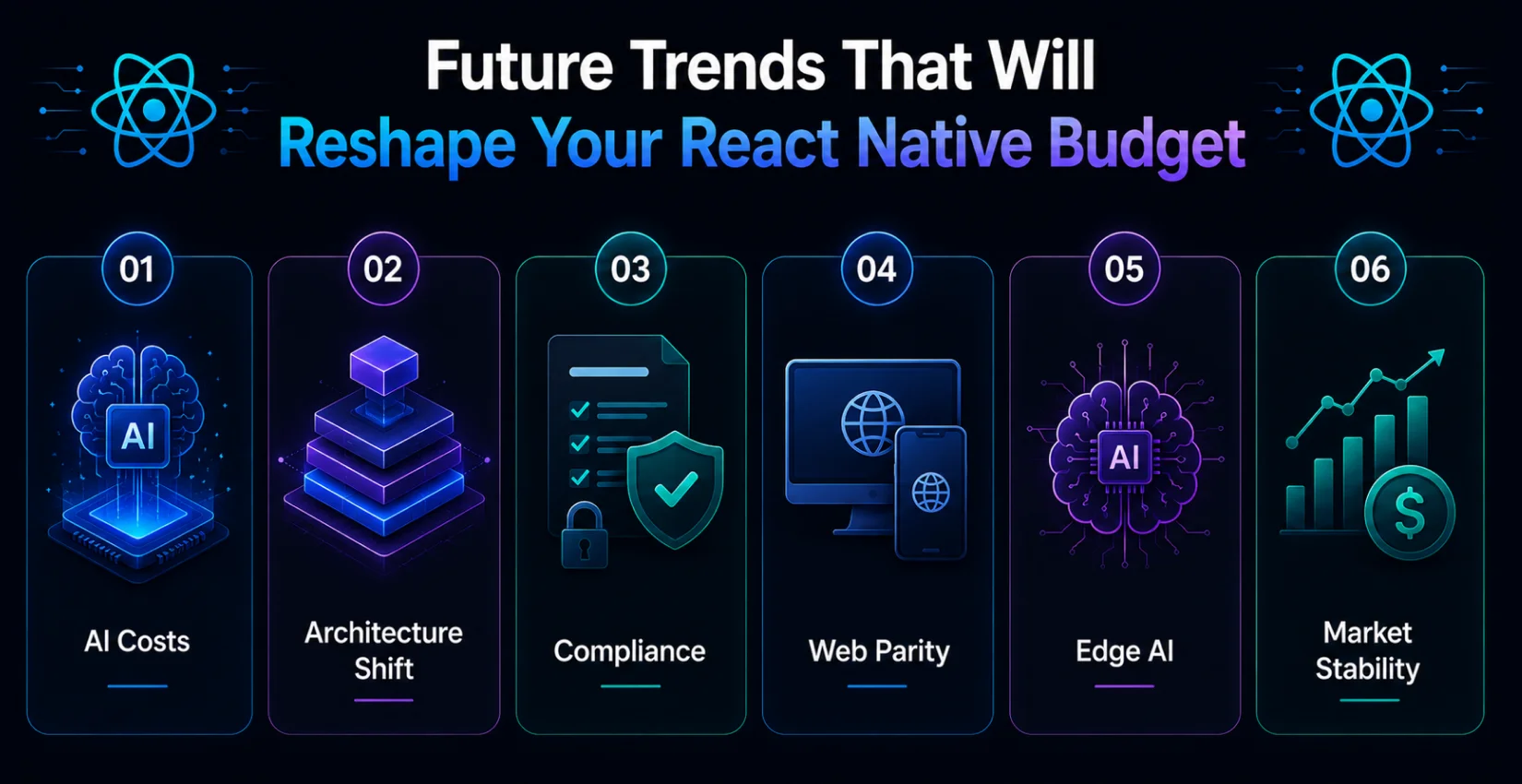
Emerging technologies, evolving development practices, and changing user expectations are redefining how businesses budget for React Native app development in 2026–27. Staying ahead of these trends can help you optimize costs while building future-ready mobile applications.
AI Integration Cost Curve
By 2026, the cost of integrating AI capabilities will have greatly reduced. The cost of smart search, recommendations, and content coming has dropped from $30,000–$60,000 two years ago to $8,000–$20,000 now because OpenAI, Google Gemini, and Meta’s Llama have well-documented React Native ways that cellular AI SDKs shouldn’t stand this price until 2027, to say the least.
New Architecture Adoption Timeline
The larger library environment has been basically migrated to a new configuration, a great way to serve as a foundation for any new React Native efforts in 2026. The likelihood of postponing the migration is less for organizations whose current packages do use the old bridge architecture. Recent OS updates by Apple and Google have all begun to highlight balance issues in bridge-dependent operations, making 2026 the year when waiting proves to be quantitatively more valuable than speeding up.
Privacy & Regulatory Compliance Cost
GDPR, Brazil’s LGPD, India’s DPDPA, and U.S. state-level privacy regulations now create a complex environment that affects all apps that handle personal data. Set aside $5,000 to $25,000 for inspection work, depending on your markets. Include this in your budget for developing React Native apps from scratch.
Cross-Platform Web Parity Pressure
As companies look to prioritize sites, React Native Web – embedding your mobile application in browsers – is becoming more familiar. Due to the responsive design and browser compatibility requirements, the support network offers around 20–35% towards the repair fee. But, for products that cater to both mobile and web viewers, the unified codebase still saves significant money compared to keeping pure utility separated.
On-Device AI & Edge Inference
Using TensorFlow Lite, Core ML, or ML Kit to run AI models immediately on the device reduces latency and background costs at the same time. Depending on the complexity of the model, current development fees for on-tool AI capabilities range from $10,000 to $40,000. However, the toolset is growing rapidly, and costs are expected to decrease by 2027 as React Native bridge support grows.
Developer Market Stabilization
After the cost volatility of 2021–2023, the market position of React Native developers has stabilized. React native app development rates will remain competitive in 2026 due to the expansion of skill pools in Latin America, Eastern Europe, and India. Expect this business level to survive multiples into 2027; however, as senior manufacturers with proven new design and AI integration efficiencies command full-size top rates above the usual generalists.
Why Work With A Specialized React Native Partner
Your budget will show the difference between a general development partner and an expert React Native companion. In the first week, experts make the best architectural choice that avoids steeply priced renovations within the sixth month. They are aware of which App Store part instances carry rejections, which open-source libraries are frequently maintained, and how to solve performance issues that public teams have been discussing for weeks.
Look for building apps in the store with verified reviews, a clear understanding of brand new architecture, punctuated quotes, and QA and DevOps in-house, no longer excluded when evaluating for react native app development services provider.
Often pays 10–20% more per hour to work with one of the top React native app development companies with true agreement, saving 30–50% of the total project cost because fewer bugs and cleaner transport as engaged teams build institutional product knowledge that evolves with new React native opportunities.
Hiring react native app developers on a committed basis gives you added value to companies with a non-stop roadmap. A professional app development company with offshore services can provide senior expertise for a fraction of the US market price if the price range is managed. Satisfaction is the most important aspect of due diligence before delivery is made.
Wrapping It Up
One of the best mobile investments a company can make in 2026 is growing a React Native app, however best if it has a clean knowledge of the entire process. Every dollar should be allocated for everything from initial repairs, installation, to integration, hidden fees, and long-term improvements.
The discussion about the react native app development cost in 2026 doesn’t stop at launch; It insists that it grows as your product grows. When analyzing cost, evaluating partners, or providing budgets to stakeholders, draw on the breakdowns and tables in this guide.
Cross platform app development cost advantage over bi-native builds remains one of the framework’s most compelling arguments in 2026. The environment is well-positioned, the expertise pool is competitive and global, and the framework has proven performance in a variety of comprehensive mobile apps, along with React Native mobile app developers.


 Get in Touch
 By
By September 3, 2026