


Key Takeaways
- RAG Development integrates Retrieval-Augmented Generation to enhance AI accuracy by utilizing up-to-date enterprise data.
- It consists of crucial steps: data retrieval, augmentation, and generation for creating trustworthy responses.
- Companies choose RAG for sectors like healthcare, finance, and customer support to improve efficiency and reduce errors.
- Different RAG architectures, like Naive, Hybrid, and Agentic RAG, serve varied retrieval needs and impact answer quality.
- Monitoring key metrics, ensuring security, and planning for scalability are essential for effective RAG Deployment.
A support lead at a medium-sized financial firm wrote a simple policy question to the company’s new AI assistant. It answered immediately and with total confidence. But the answer was completely wrong. Multiply that moment by many employees, and you get a real reason why so many enterprise AI deployments quietly fail.
The problem is not the model; it is what the model can see. A general-purpose LLM has no idea of internal files, pricing guidelines, or last week’s policy change. RAG artificial intelligence helps close that gap by giving the model access to trusted enterprise data. According to Next Move Strategy Consulting, the global RAG market is projected to grow from $3.33 billion in 2026 to $81.51 billion by 2035. It guides you through what RAG really is, how to build it right, and where most teams go wrong.
What Is RAG & How Does It Work
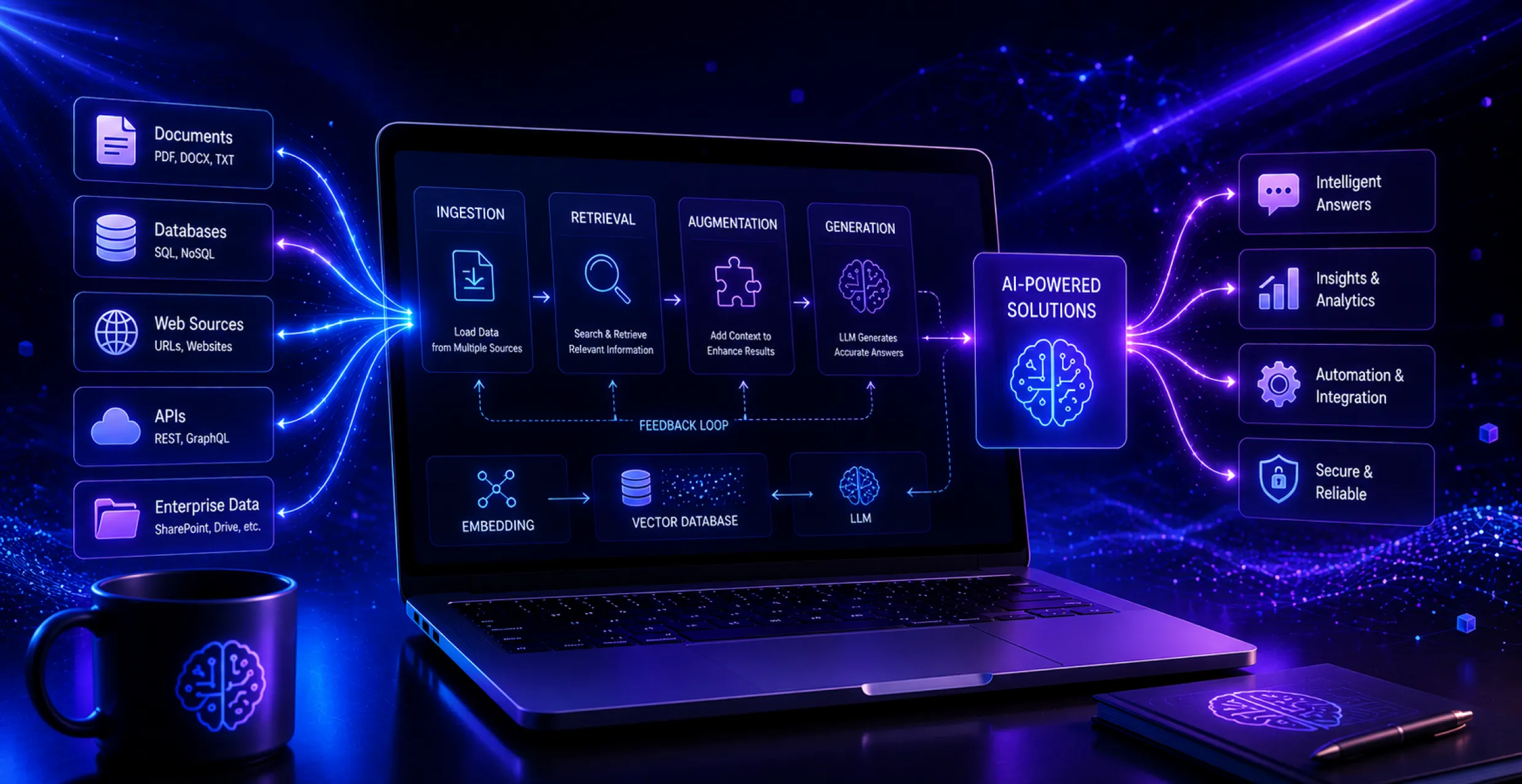
RAG stands for Retrieval-Augmented Generation. It pairs the language model with the live search step. So the solution comes from your real-world information, not just from the model’s training memory.
Think of RAG as a smart study assistant. Before generating an answer, it retrieves relevant information from your knowledge base and passes it to the model.
So how RAG works comes down to 3 connected steps. Retrieval finds the relevant pieces, augmentation puts them into the prompt, and the model generates the grounded answer.
The full RAG process starts earlier, with data preparation. Documents are cleaned, split into chunks, converted into embeddings, and stored in a searchable index.
If you want the plainest RAG system explained, think of it as an open-book AI. Standard models answer from memory alone; RAG-based models first examine the actual sources.
RAG vs. Fine-Tuning vs. Long Context LLMs
Once teams understand the RAG approach, the next question is always the same. RAG, fine-tuning, or a longer context window? Each solves a specific problem, and choosing the wrong one is a waste of budget.
| Approach | Best For | Update Speed | Relative Cost |
| Fine-Tuning | Tone, style, specialized reasoning patterns | Slow – needs retraining | High |
| Long-Context Prompting | Small, mostly static knowledge sets | Instant | High per query |
| RAG | Large, frequently changing enterprise data | Instant | Low and predictable |
Most production systems don’t choose just one. Many teams lightly fine-tune the model and rely on strong retrieval. Test this combination against your own data before choosing an AI development services company.
Types of RAG Architecture & Retrieval Strategies
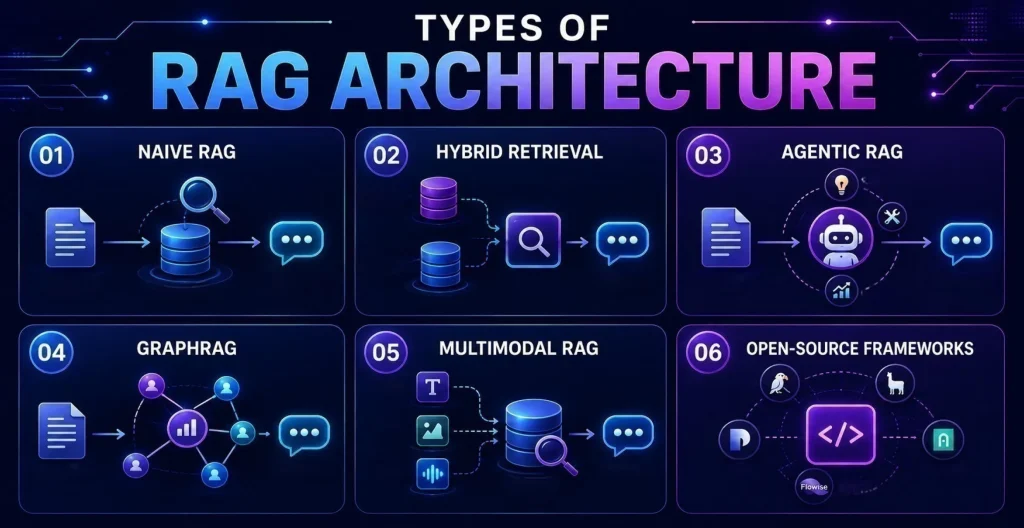
Not every retrieval setup seems the same way. Choosing the right retrieval strategy and architecture can have a major impact on answer quality.
- Naive RAG
Naive RAG retrieves the top matching chunks and sends them directly to the LLM. This is fast to build but can miss context or return loosely related results.
- Hybrid Retrieval
Hybrid retrieval combines dense vector search with keyword-based search, such as BM25. Vector search understands meaning; keyword search captures exact terms, such as product codes or regulation numbers.
- Agentic RAG
Agentic RAG lets the system reason across multiple steps, instead of one search and one answer. It can search, compare results, perform another retrieval step, and use external tools when needed.
- GraphRAG
GraphRAG adds a knowledge-graph layer on top of retrieval, mapping relationships between entities. This helps the system answer queries that contain multiple linked records.
- Multimodal RAG
Modern RAG applications increasingly retrieve across text, images, tables, and audio transcripts together. A technician might get a diagram pulled alongside the manual that explains it.
- RAG Frameworks
Open source RAG frameworks, such as LangChain, LlamaIndex, and Haystack, give teams more flexibility. They offer flexibility for teams, but configuring them well requires skilled engineering.
Enterprise RAG Use Cases & Benefits Across Industries
Many companies face the same underlying problem. No one has time to search for valuable knowledge locked away in documents. Here’s how retrieval-grounded AI actually solves it.
- Healthcare
Clinical staff spend hours searching through patient files and research papers. A retrieval-grounded assistant can immediately retrieve the right protocol, with a citation attached.
- Legal & Compliance
Legal teams face the same bottleneck with contracts and regulations. A system built through strong generative AI development services can flag risky clauses in seconds instead of hours.
- Financial Services
Analysts often want modern market data mixed with internal reports. RAG-powered research assistants can retrieve information from both sources and attach citations to each claim.
- Customer Support
A well-designed custom chatbot development project can answer policy or billing questions using current documents. This approach avoids relying on outdated training data. Support tickets drop fast.
- Retail & E-commerce
Store employees can ask questions about stock, warranty terms, or returns and get answers immediately. This type of internal adoption typically delivers ROI before consumer-facing use cases do.
- Manufacturing & Logistics
Old manuals and SOPs require real cleanup before they work well. Teams often include this work in broader legacy application modernization services. Once completed, technicians find answers instead of digging through binders.
Benefits AT A Glance
- Faster, more accurate solutions based on real company data.
- Built-in citations that audit AI responses.
- Knowledge updated immediately, without retraining the model.
- Fewer repetitive support tickets and less time searching internally.
- A scalable foundation for future AI agents and automation.
The RAG Maturity Model: Where Does Your Organization Stand?
Most companies do not need an advanced RAG architecture from day one. They usually start with a focused pilot and mature the system as their needs grow.
Level 0 is the starting point: there is no retrieval system, so teams rely on basic chatbots or manual folders. Answers are inconsistent because the model relies mainly on its training data.
Level 1 is a naive RAG pilot, usually intended to prove that an idea works for a use case. Accuracy is decent but shaky, especially with technical or ambiguous phrasing.
Level 2 marks the actual, production-grade RAG solution. Hybrid retrieval, reranking, access controls, and monitoring should all be in place. Most firms should aim to reach this level before a company-wide rollout.
Level 3 adds agent-based behavior. The system can plan multi-step tasks, retrieve information dynamically, and use tools to complete them. At this stage, RAG can handle more complex, multi-step tasks.
Level 4 is the most advanced stage where retrieval, agents, and business systems operate as a connected layer. Very few organizations sit here today, and yet this is clearly where enterprise AI is heading.
What Do RAG Development Services Include?
Start with discovery before writing the first line of code. Before choosing an architecture, map out your data sources, user roles, and exact business problems.
A typical RAG development engagement includes five core areas. These pieces take the process from raw data to a live, monitored system.
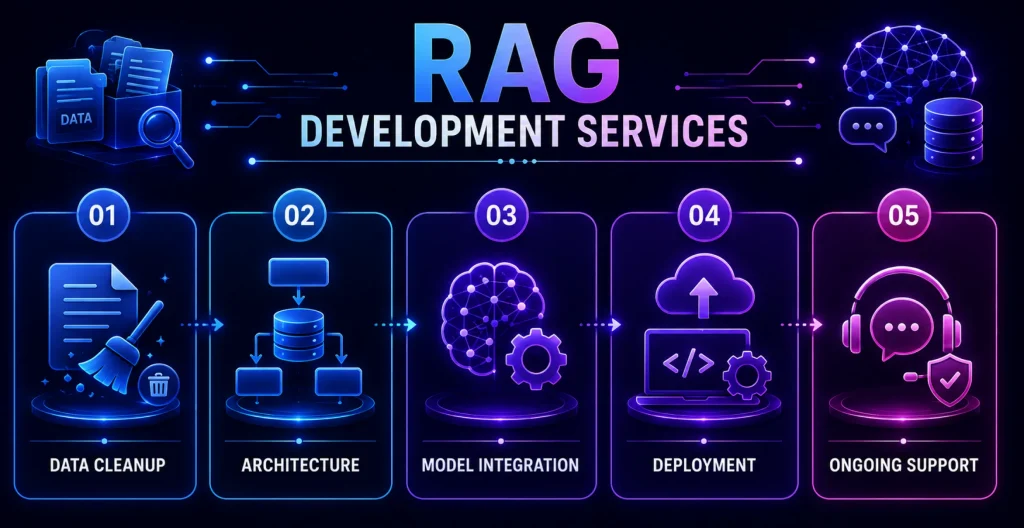
- Data Integration and Cleanup
This includes ingesting PDFs, CRM files, wikis, and scanned documents through OCR, so the information can be searched.
- Architectural Design
Custom RAG development services tailor the stack to your compliance needs, instead of reusing standard templates.
- Model integration
A successful RAG AI development company evaluates several LLMs against your actual records before making a recommendation.
- Deployment & Monitoring
Teams can use dashboards to monitor accuracy, latency, and cost, with tuning that continues well after launch.
- Ongoing Support
Teams often package this approach as RAG as a service. It also pairs well with comprehensive AI consulting services when teams build their roadmap.
RAG Development Cost Breakdown: What Enterprises Actually Pay
RAG development costs vary based on data volume, system complexity, integrations, and security needs. Understanding these factors helps enterprises estimate budgets and avoid unexpected costs.
| RAG Type | Timeline: | Cost |
| Simple RAG Pilot | 4–8 weeks | 30K-60K |
| Production-Grade RAG | 8–12 weeks | 80K-150K |
| Advanced RAG | 16–24 weeks | 200K-400K+ |
Cost Factors
- Data volume
- Retrieval complexity
- Security/compliance
- Integrations
- Number of users
- Model choice
ROI
- Productivity
- Support-ticket reduction
- Faster knowledge retrieval
- Reduced operational cost
Data Preparation, Chunking & Embedding Best Practices
Retrieval is only as good as the data behind it, regardless of how advanced the model is. Getting those four steps right is what separates a sharp, reliable system from a shaky, unreliable one.
- Cleaning & Structuring Data
The quality of RAG-generated output depends entirely on how clean the source data is. A messy, duplicate, or outdated document immediately leads to messy, outdated answers.
- Smart Chunking
Large chunks can include too much irrelevant text and increase retrieval time. Very small chunks can lose important context. A better approach follows natural document structure, such as headings and sections.
- Metadata Tagging
Tagging each chunk with its source, date, and access level enables smarter filtering later. Machine learning development services often manage this pipeline. They help process and connect content at each stage.
- Embedding and Refresh Cycle
Embedding models convert each chunk into a numerical representation of its meaning. Updating them regularly keeps the index aligned with your latest documents.
RAG Technology Stack: LLMs, Vector Databases & Frameworks
Every RAG platform development company relies on a handful of core building blocks, no matter the use case.
| Category | Examples | What It Does |
| LLMs | GPT, Claude, Gemini, Llama, Mistral | Generates the final answer; proprietary or open-weight, hosted privately or via API. |
| Vector Databases | Pinecone, Weaviate, Milvus, pgvector | Stores and searches document embeddings by similarity, for fast, relevant retrieval |
| Orchestration Frameworks | LangChain, LlamaIndex, Haystack | The most widely adopted RAG framework options, tying retrieval, prompting, and generation together. |
| Rerankers | Cohere Rerank, cross-encoders | Reorders retrieved results by true relevance before they ever reach the model. |
| Integration Layer | REST APIs, webhooks, connectors | Links the retrieval system to CRMs, ITSM tools, and internal portals. |
A professional RAG system development company helps you choose the right data sources. It aligns them with your budget and compliance needs.
A development partner also helps evaluate these choices against your budget and compliance requirements. It helps you avoid costly vector database choices that are hard to change later.
None of this works in isolation. Solid API integration services connect the retrieval layer into your CRM, ITSM, or internal portal.
Reliable cloud application development helps turn a prototype into a working solution. Your entire organization can then use it confidently.
Prompt & Context Engineering for Grounded Responses
Prompt design can have a significant impact on answer quality. The other half comes down to prompt design. Even perfect search results can lead to ambiguous answers if the prompt is weak.
A strong prompt tells the model to answer only from the retrieved content. It should not add unsupported information. A line like “If the answer isn’t in context, say so” can reduce unsupported answers.
Organization is also important because models weigh the start and end of a prompt more heavily. The level of tuning is exactly the kind of detail an artificial intelligence development service should handle for you.
Citations should be built in a consistent format from day one, not bolted on later. Asking the model to refer to its source for each claim builds users’ trust immediately.
RAG Evaluation, Quality Metrics & Monitoring
You can’t improve what you don’t measure, and RAG is no exception. Here’s what enterprise teams should be monitoring from day one.
| Metric | What It Tells You |
| Retrieval Recall | Whether the right documents were found at all |
| Answer Faithfulness | Whether the response stuck to what was actually retrieved |
| Citation Accuracy | Whether sources point to the correct document |
| Latency | How fast users get a response |
| Cost per Query | How efficiently the system runs at scale |
Evaluation should not stop after launch. Business systems need continuous monitoring because new files and model updates change system performance over time.
Security, Governance & Compliance in Enterprise RAG
Enterprise information is sensitive by default, from HR records to financial documents. A chatbot should only expose information that the user is authorized to access. A production RAG system should enforce policies that your organization already lives with from day one.
- Role-Based Access Control
A RAG system needs to respect the same access rules that your organization already manages elsewhere. Retrieval should never surface a document that a user isn’t cleared to see.
- Encryption and Data Protection
Encrypt documents and generated responses both at rest and in transit. These controls are especially important when handling healthcare, financial, and other sensitive enterprise data.
- Audit Logging & Traceability
Every retrieval and generated response should be traceable to the source document and user request. This is what sets enterprise-grade RAGs apart from rapid in-house prototypes.
- Industry Compliance
Requirements vary widely by sector, from HIPAA in healthcare to GDPR across Europe. Building these controls from scratch is much cheaper than adding them after an audit.
Scaling RAG: Performance, Latency & Cost Optimization
A RAG pilot that works well for 10 users may struggle when usage reaches 10,000. Planning for scale early on avoids painful, costly rebuilds later.
| Cost Driver | Optimization Strategy | Impact |
| Repeated queries | Cache frequent Q&A pairs | Cuts latency and compute cost |
| Oversized context | Send fewer, more relevant chunks | Lowers token usage, keeps accuracy |
| Embedding generation | Batch and schedule refreshes | Reduces redundant processing |
| Reranking overhead | Apply reranking only on ambiguous queries | Balances accuracy and speed |
| Model choice | Use smaller models for simple queries | Cuts inference cost at scale |
As adoption grows, teams also need to manage users, processes, and governance. Planning for that change in advance, as part of comprehensive digital transformation services, helps avoid costly performance and infrastructure issues later.
Common RAG Challenges & How to Fix Them
Most RAG problems trace back to a handful of root causes, not dozens of unrelated errors. Here are the most common problems and practical ways to address them before they affect production.
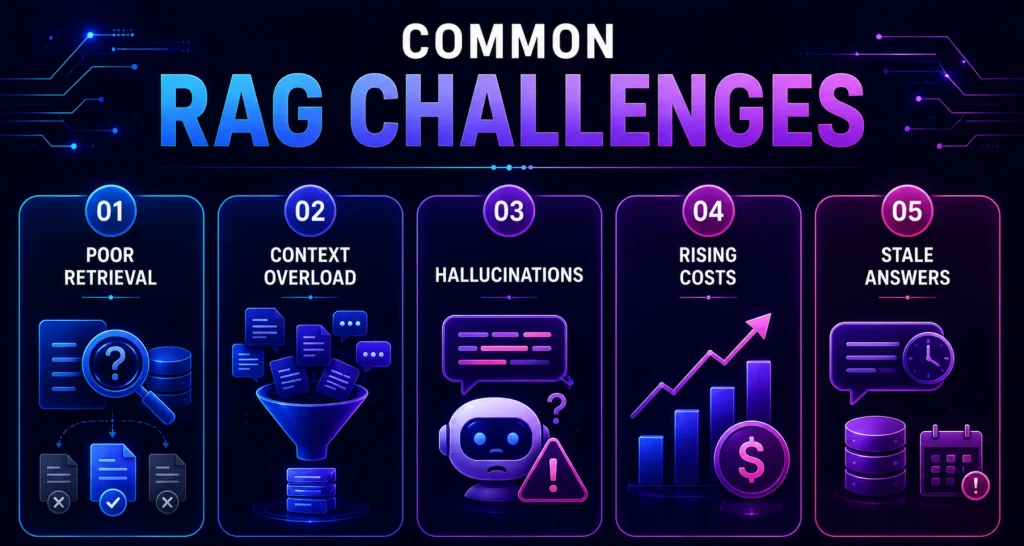
- Challenge 1: Poor Retrieval Quality
Solution: Add a query transformation and reranking to improve the relevance of retrieved results. Teams that consistently skip re-rankings will see lower accuracy.
- Challenge 2: Context Overload
Solution: Tighten chunking and filter more strictly before content reaches the prompt. A smaller amount of relevant context is better than a larger amount of loosely related information.
- Challenge 3: Hallucinations
Solution: Use grounding instructions and strict citation rules. These controls can reduce unsupported answers, though a robust RAG process cannot eliminate hallucinations.
- Challenge 4: Rising Costs
Solution: Reduce unnecessary context, collect FAQs, and choose the model based on the complexity of each task. As usage grows, you can adjust the RAG solution to match your needs and budget.
- Challenge 5: Stale Answers
Solution: Schedule regular index refreshes and reindex the data when source documents change. Enterprise RAG services should not run on an information base that’s months out of date.
Build vs. Buy vs. Partner: Cost & Timeline
Every team ultimately faces the same challenge: build, buy, or partner. The right solution depends on your timeline, budget, technical resources, and how unique your use case is.
| Path | Timeline | Cost | Best For |
| Build In-House | 3–6 months | High (hiring + infra) | Teams with dedicated ML talent |
| RAG as a Service | 2–4 weeks | Low, subscription-based | Simple, well-defined use cases |
| Partner-Led (RAG development company) | 2–4 months | Medium | Custom needs, no internal AI team |
| On-Premise Build | 3–5 months | High upfront | Regulated, data-residency needs |
A RAG as a service company can be the fastest option for simple, well-defined use cases. This option may be less suitable for complex workflows or highly customized requirements.
Many RAG as a service companies already offer pre-built retrieval infrastructure. You can configure it in days, instead of months. Some of this pre-built infrastructure now arrives bundled into an Ai platform for business alongside model access and agent tooling, rather than as a standalone retrieval product. That suits teams whose retrieval need sits next to other AI workloads and who would otherwise procure each piece
A RAG application development company provides a custom architecture. It avoids the overhead of building the entire infrastructure from scratch.
On-premise development companies manage private infrastructure in-house. They support banks and healthcare providers with strict data residency rules.
Many teams start with RAG consulting before selecting a path. A brief consultation explains the scope and budget upfront.
When comparing RAG as a service provider, consider pricing, support, security, scalability, and integration options.
Enterprise RAG Development Roadmap
Enterprise RAG development typically follows a phased approach. It follows a step-by-step process, and each step reduces the risk of the next.
| Phase | Duration | Key Activities |
| Discovery | 2–4 weeks | Define the business problem, map data sources, flag compliance needs |
| Pilot | 4–8 weeks | Build a focused proof of concept, test retrieval accuracy |
| Hardening | 4–6 weeks | Add security controls, monitoring, and scalability testing |
| Rollout | 6–12 weeks | Expand access, train users, track adoption |
| Expansion | Ongoing | Add agentic capabilities and deeper API integration services |
Hardening and product-readiness work turns that pilot into an enterprise RAG solution, ready for enterprise-wide adoption.
How Octal IT Solution Approaches RAG Development
Octal IT Solution starts with the business problem, rather than a specific model. The team maps your data, users, workflows, and monitoring needs before selecting the architecture.
The team uses hybrid retrieval, careful chunking, and continuous assessment to improve system performance. These practices continue beyond the initial deployment.
That’s how the tool grows after go-live, instead of quietly drifting out of date the way many first attempts do.
A RAG AI development company provides more than retrieval capabilities. It supports the full AI application, not just the AI layer.
Security and monitoring controls are part of the core build. The team enforces them from the start instead of adding them after problems arise.
Where needed, we provide custom software development services. Also, our team builds software around your users’ daily needs.
For teams using different systems, we also provide deeper AI integration services. These services connect AI outputs to the CRMs and portals people already use.
As an enterprise RAG development company, we design for scale from the beginning. The team implements condition-based access, audit logging, and release testing from the start.
That foundation makes the pilot safe to scale across the enterprise. It prevents the team from rebuilding the system when real deployment begins.
For teams that need to grow after release, we also provide ongoing AI automation solutions. We can layer automation workflows onto existing systems as your needs grow.
Conclusion
RAG has evolved from a research concept into a practical AI architecture for enterprise applications. Teams get better results when they combine reliable retrieval with continuous evaluation. They also need strong security and governance throughout development and deployment. Reliable RAG services need ongoing evaluation, monitoring, and maintenance.
The RAG field will evolve significantly in the next few years. Better data analytics solutions will improve the data that powers these systems.
If you’re ready to move from concept to a production-ready solution, Octal IT Solution can help. We help you move faster while reducing failure risks.
 By
By September 25, 2026



 Get in Touch