


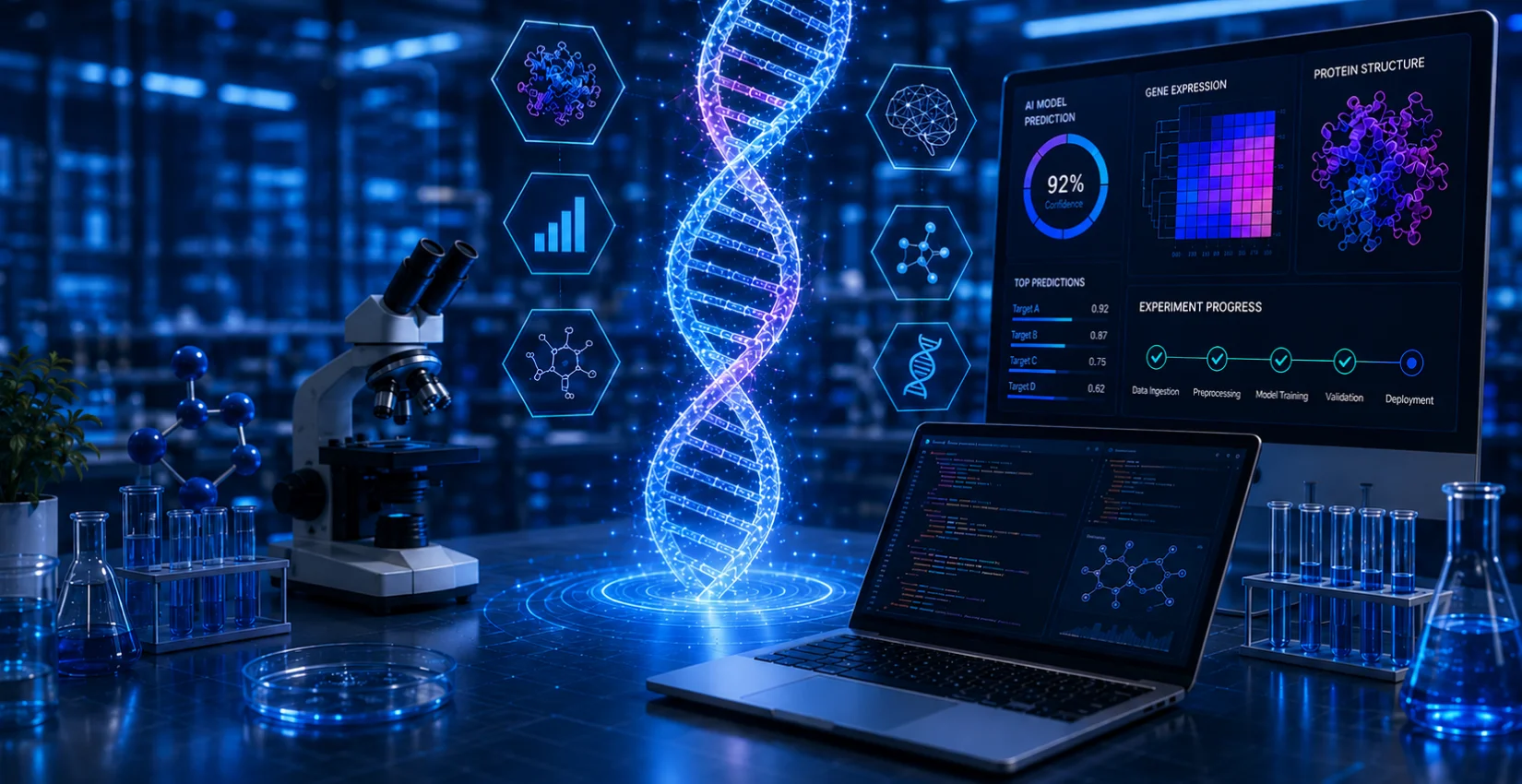
Can software rewrite the code of human biology? As biological information gets bigger than what most people can actually hold in their heads, life sciences and advanced computing are kind of colliding into what feels like a brand new frontier for medical wins. Relying on generic digital tools isn’t really enough anymore for all these moving parts and layered complexity.
Driven by rapid computational innovations, the global biotechnology market is projected to skyrocket from $2.42 trillion in 2026 to over $4.41 trillion by 2031, resulting in a robust compound annual growth rate (CAGR) of 12.67%, according to Mordor Intelligence.
This enormous growth shows how urgently the biotech industry needs specialized software tools. Modern businesses are accomplishing a full biotech digital transformation by incorporating AI in biotech software development. These smart platforms help break the traditional data gaps, and they start surfacing meaningful biological signals at a record pace.
What is Biotech Software Development?
Biotechnology software development is the specialized way of building software, a kind of engineering custom digital platforms meant to process, analyze, and coordinate complicated biological workflows, genomic datasets, and actual laboratory operations. While typical healthcare software usually leans on clinical routines, administrative billing, and more basic patient data management, this specialized molecular engineering track goes much deeper into complicated multi-omic datasets, raw DNA sequencing strings, and dynamic chemical simulations.
Over the years, the life sciences sector has basically shifted in a profound direction. In earlier times, many labs were stuck with static, separated legacy databases that required hours of manual input and basically gave zero forecast-like insight. Now, the market has turned a lot more toward intelligent, cloud-based ecosystems. Current biotechnology software solutions behave like living operational spaces, mixing real-time cloud data streams with higher-grade computational logic, turning raw lab observations into noticeably actionable, predictive scientific outcomes.
The Crucial Role of AI in Biotech Software Development
The integration of artificial intelligence is reshaping the life sciences landscape, slowly but surely. AI has shifted from a kind of experimental garnish into the main operational engine behind today’s laboratory innovation and focused therapeutic development.
1. Beyond the Buzzwords: The Tangible Use of AI in Biotechnology
AI in biotech is mostly about moving past manual hypothesis testing and into automated high-throughput workflows. A lot of modern biotech software development services now bring intelligent algorithms that help interpret molecular bindings, anticipate protein folding geometries, and model complicated cellular relationships. As a result, early-stage target validation time drops dramatically, from years down to days, which is not small at all.
2. How AI-Aided Biotechnology Software Evaluates Large Datasets (Big Data)
Today’s sequencing platforms can output exabytes of messy multi-omic information. Specialized AI in biotech platforms uses deep learning models to sift through those huge datasets, and then it flags subtle genetic mutations and unusual cellular signals. An experienced artificial intelligence development company can design these systems specifically to handle non-linear biological variables that traditional relational databases simply can’t read properly.
3. Key AI Solution Providers and Niche Intelligent Applications
Forward-looking laboratories rely a lot on specialized biotech AI solution providers to push deep-learning architectures into routine work. These intelligent software suites do most of the heavy lifting for high-content screening, routine image analysis, and phenotypic profiling. Rather than leaning on subjective human observations, teams switch to more objective machine learning metrics. In practice, this gives a strong if slightly surprising, boost in precision and reproducibility across many experimental workflows, even the messy ones.
4. Machine Learning and Neural Networks in Pharmacogenetics & Metabolomics
Neural networks are especially adept at describing how a patient’s genetic signature responds when exposed to different chemical agents. When machine learning is woven correctly into metabolomic pipelines, customized software can expose metabolic biomarkers that would otherwise remain out of sight. That supports research groups in building more refined, more targeted therapeutic decisions tuned quite closely to separate patient sub-populations.
Core Applications of Biotechnology Software in Healthcare & Life Sciences
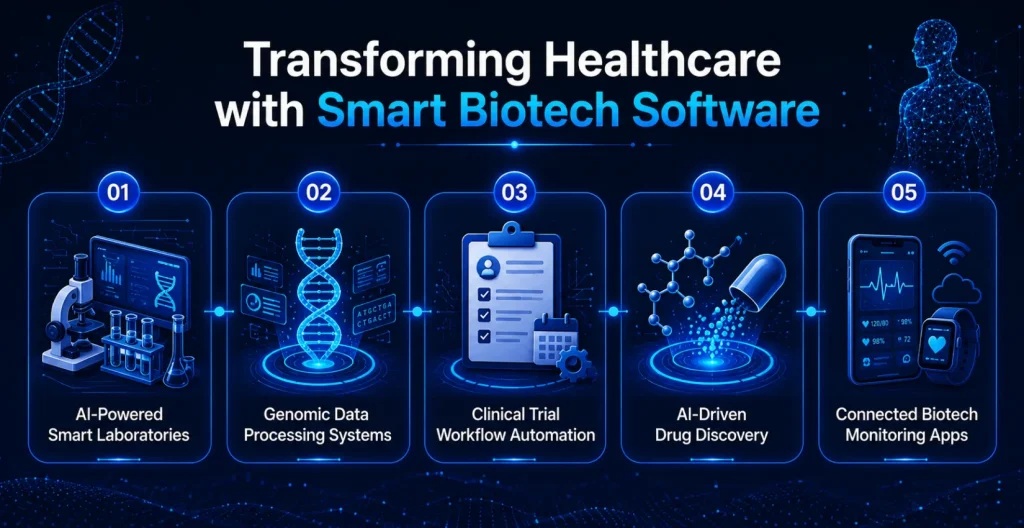
Specialized biotech software influences patient outcomes mostly by shortening the full R&D process from early molecular discovery all the way to real clinical delivery at the bedside.
1. Laboratory Management Software (LIMS) & Electronic Laboratory Notebooks (ELN)
Modern laboratory management software (LIMS) platforms can connect straight to automated lab hardware, like tube analyzers, centrifuges, and robotic sample-handling arms. By centralizing the choreography of those instruments, software can track sample lifecycles in a more seamless way, record real-time telemetry data, and cut down on manual transcription errors during high-throughput screening cycles.
2. Advanced Bioinformatics Software Development & DNA Sequencing
High-performance computational algorithms are needed to align, assemble, and scrutinize massive structural variations through genomic sequences. Dedicated biotech software development solutions let labs run complicated variant calling pipelines, giving the infrastructure to scale up population-level genomics and supporting comparative evolutionary study at the same time.
3. AI-Driven Clinical Data Management Software & Clinical Trial Management Systems (CTMS)
Traditional clinical trials often run into operational friction, delayed manual data gathering, and stubbornly high patient dropout rates. By bringing in intelligent clinical data management software, teams can automate patient compliance tracking, reconcile electronic data capture (EDC) inputs, and apply predictive modeling to flag early warning signals for adverse drug reactions.
4. AI-Powered Drug Discovery & Bioimaging Software (MRI, CT, and Ultrasound Irregularity Detection)
AI-based image processing software quietly surveys high-resolution MRI, CT, and ultrasound scans so it can surface microscopic anatomical irregularities. When biotech industry software tools are integrated into drug discovery pipelines, researchers can follow phenotypic shifts in cell cultures as they happen, in turn speeding up credible hit-to-lead therapeutic choices.
5. Medical Biotechnology App Development & Remote Patient Monitoring (RPM)
The contemporary patient journey goes well beyond the confines of a clinic. With advanced medical biotech app development, engineers create highly secure mobile platforms that collect real-time biometric streams from wearable sensors. Those signals then flow continuously into decentralized clinical trial systems for ongoing observation, and yes, it’s more active than before.
Essential Tech Stack & Architecture for AI-Powered Biotech Solutions
Building scalable, compliant biotech software means you need a robust, modern tech stack that can juggle high-performance computing workloads while still protecting data with absolute integrity and no “almost ok” shortcuts.
To put the whole system together, an experienced custom software development company has to strike a careful balance between adaptable data processing libraries and cloud environments that enforce strict regulatory compliance. The table generally lists the core technologies you’ll want for an enterprise-grade biotech platform.
| Architecture Layer | Technology Options |
| Backend Logic | Python, Go, Node.js, .NET Core |
| AI/ML Engine | AWS SageMaker, PyTorch, Azure ML, Vertex AI |
| Interoperability | HAPI FHIR, HL7 Integration Engines, Apache Camel |
| Database & Big Data | PostgreSQL, MongoDB, AWS S3, Apache Spark |
| Containerization | Docker, Kubernetes, AWS EKS |
The Biotech Software Development Process: A Step-by-Step Blueprint
Creating high-stakes life science software takes a very methodical lifecycle approach. This guarantees the finished product is fully auditable, scalable, and dependable.
Phase 1: Product Planning, Workflow Mapping & System Compliance Review
Before any code shows up, a specialized biotech software development company maps out each laboratory workflow, every user touchpoint, and the full chain of data transitions. In other words, this phase is where you set the boundaries and put security and data compliance guardrails in place while you’re still at the architectural blueprint stage, not later.
Phase 2: User Experience (UI/UX) Design for Modern Labs and Technicians
Lab technicians and researchers work in environments that never really stop. So the UI/UX can’t be vague. It needs to make complex data visualizations easier to read, think about gene expression heatmaps and multi-sample alignment grids. This provides clear scannability, reduces user fatigue, and minimizes sample logging errors.
Phase 3: Secure Backend Development & AI Logic Training
Engineers build robust backend architectures using Python or Go to process very complex biological computations. At the same time, data scientists train machine learning models with curated, vetted, high-quality biological reference datasets, making sure they stay precise and doing everything possible to stop overfitting.
Phase 4: Bi-Directional API Integration (EHR, PMS, and Pharmacy Management Solutions)
A modern biotech platform really can’t exist in total separation. Developers set up secure, bi-directional APIs to connect the core system with lab instruments and other external ecosystems; it’s not just “one link” either. When you connect directly to pharmacy management solutions, then communication stays smooth between active drug discoveries, clinical trials, and the real-world medication distribution networks.
Phase 5: Rigorous V&V (Validation and Verification) Testing, CI/CD, and Deployment
Software verification is the step where you prove it was built according to engineering specifications. This is what makes sure it actually fulfills its intended scientific purpose, not only on paper. Automated testing pipelines run on every module, looking for data leaks and processing regressions and compliance deviations, before the final deployment moment arrives.
Overcoming Challenges in Biotech Software Development
Building software for the life sciences sector brings special engineering hurdles, so you need specialized strategies in order to keep the platform viable for the long term.
1. Managing Big Data Complexity and Data Silos
- The Challenge: Raw genomic sequences plus biological images just pile up into petabytes of scattered, unstructured stuff, and the classic database infrastructures really can’t handle it efficiently.
- The Solution: Set up decentralized data lakehouses, for example, using Apache Spark together with AWS S3. This approach allows real-time distributed querying across unstructured multi-omic fragments, but it also keeps the storage layer organized and more structured for standard metadata.
2. Technical Debt Management vs. Software Development Speed
- The Challenge: When teams rush to ship features for active research groups. Then the codebase becomes kind of messy and brittle, and later updates take longer, plus the whole platform starts feeling unstable.
- The Solution: Work with a custom software development company that has real experience, and they should run strict microservice architectures plus automated linting. That keeps each part distinct and also easy to maintain across long timeframes, even when requirements shift.
3. Cross-Functional Collaboration: Bridging the Gap Between Biologists, Clinicians, and Software Engineers
- The Challenge: Engineers communicate using code and architecture, while lab researchers talk in terms of molecular biology details and clinical trial protocols. So there’s a big mismatch in vocabulary and expectations, and projects can slow down fast.
- The Solution: Use domain-specific software consulting specialists who function as technical product owners. They turn complex biological needs into concrete, actionable engineering sprints and structured development tasks.
4. Hardening Security: Protecting Proprietary R&D Data and PHI (Protected Health Information)
- The Challenge: Biotech platforms are prime targets for cyberattacks and industrial espionage because they keep incredibly valuable proprietary drug formulations and also store highly sensitive patient genomic profiles.
- The Solution: Enforce strict field-level data encryption, both at rest and in transit via TLS 1.3; set up role-based access control (RBAC); and then run automated threat detection scripts across cloud environments continuously.
Strict Regulatory Compliance & Security Frameworks
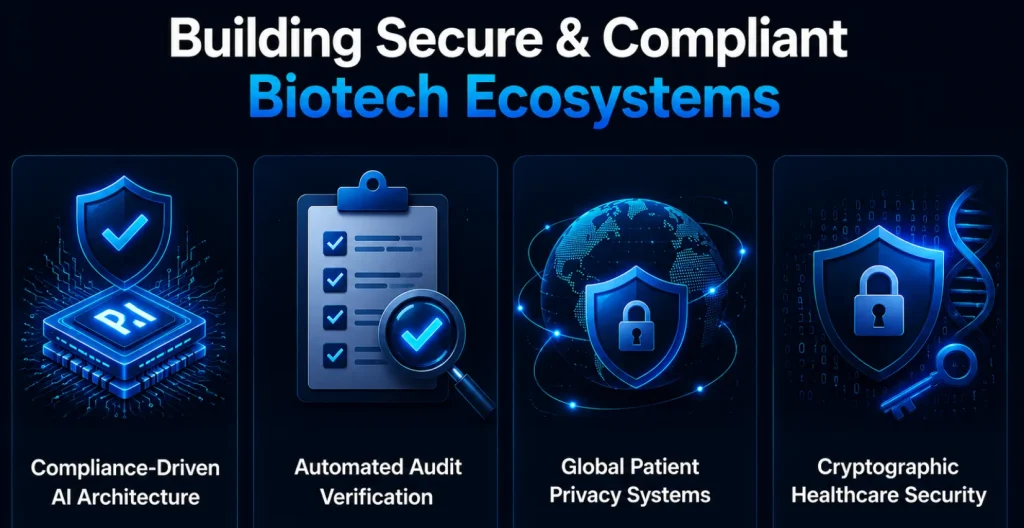
In biotech software engineering, regulatory compliance is a fundamental structural design constraint that impacts the entire system architecture, not an end-of-project checklist item.
1. Treating Regulatory Requirements as Design Constraints, Not Checkboxes
Regulatory mandates determine how data is stored, changed, and validated. If you do not plan for those compliance rules early during production, you can end up needing a full, expensive rewrite of the software architecture later on.
2. Designing Automated Audit Trails & Digital Signatures (FDA 21 CFR Part 11)
To comply with FDA 21 CFR Part 11, biotech software developers have to set up immutable, time-stamped system audit logs, and not in a sloppy way. This should automatically capture each data creation, change, and removal moment, while tying every action to a verified digital identity.
3. Global Data Protection Standards: HIPAA, DSCSA, and GDPR in Medical Software Development
When working with human biological samples, platforms are expected to stick to strict global data standards altogether, not separately. In practice, seasoned teams focused on medical software development use advanced anonymization and pseudonymization methods so that protected health information (PHI) stays insulated from unauthorized viewing.
4. Advanced Protections: Leveraging Blockchain Technology for Cryptographically Secure Health Records
By adding private permissioned blockchain ledgers, it gains a tamper-resistant record of data access history; it is like a chronicle that cannot be quietly edited. This verification layer, built with cryptography, helps stop unauthorized manipulation, and it also gives clinical trial auditing bodies direct evidence of data integrity during multi-center trial assessments and reconciliations.
Biotechnology Software Development Cost Breakdown
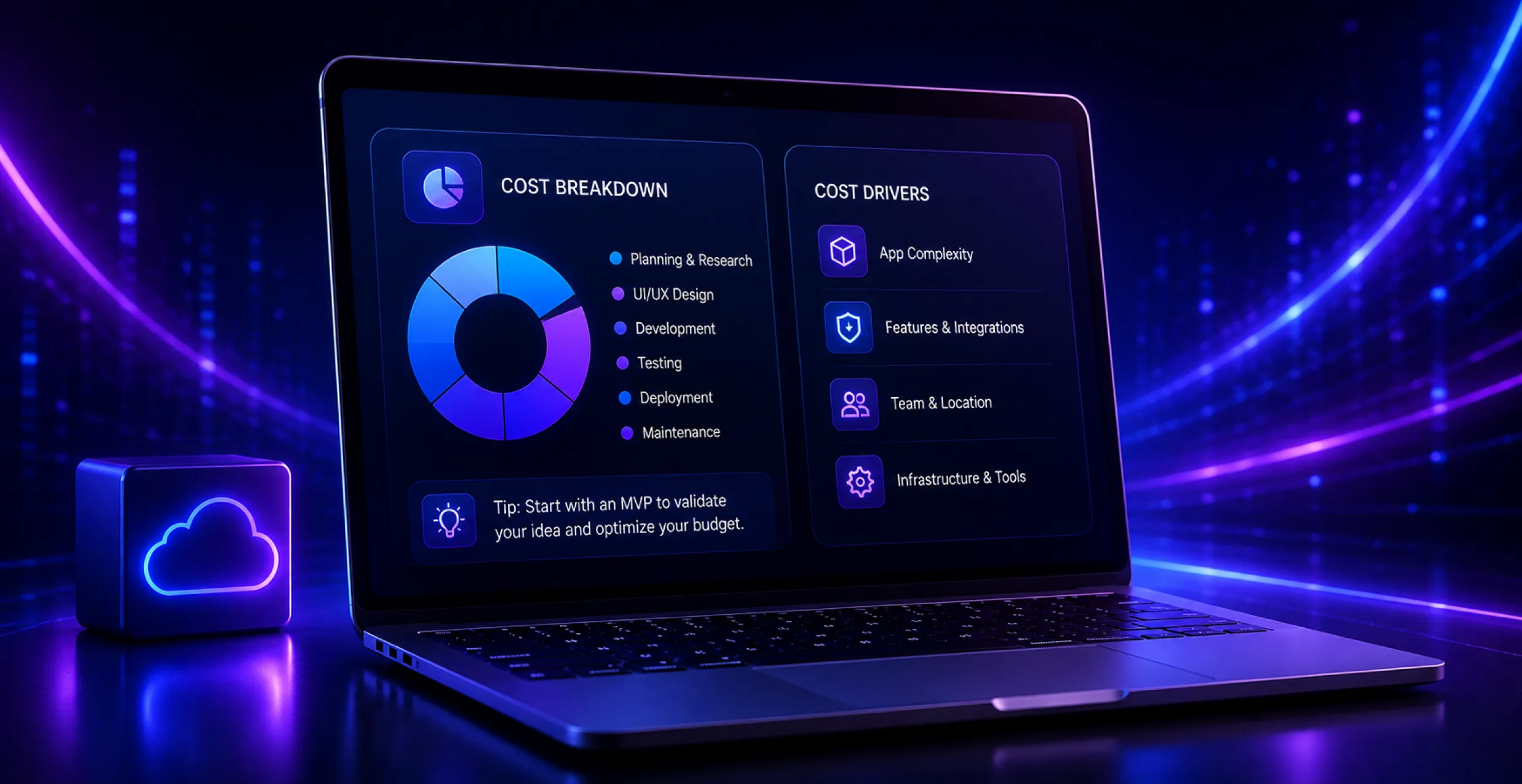
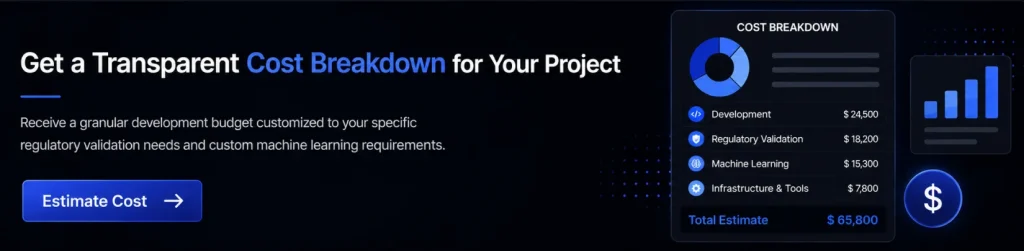
Understanding the funding needs for high-stakes software development is crucial for realistic budgeting and project outcomes. The overall biotechnology software development cost will largely depend on project complexity, security expectations, and how deeply you have to integrate with existing systems.
If you hire dedicated developers, you must pay extra costs later due to compliance reworks that show up too late. On the other hand, investing in specialized biotech software to deliver architectures that are built correctly the first time, instead of patching repeatedly.
The following tables give a breakdown of the costs of development by different dimensions of the project.
Cost by Project Phase
| Development Phase | Cost Allocation (%) | Estimated Cost Range (USD) |
| Discovery, Architecture, & Compliance Planning | 15% | $30,000 – $75,000 |
| UI/UX Design & High-Fidelity Prototyping | 10% | $20,000 – $50,000 |
| Backend Development & AI Model Integration | 45% | $90,000 – $225,000 |
| Bi-Directional API & EHR/LIMS Integration | 15% | $30,000 – $75,000 |
| Validation Testing (V&V) & Regulatory Audit | 15% | $30,000 – $75,000 |
Cost by Engineering Role
| Specialist Role | Average Hourly Rate (USD) | Primary Project Focus |
| Principal Biotech Software Architect | $150 – $220 | System topology, regulatory safety, cloud compliance |
| Senior AI / Machine Learning Engineer | $130 – $190 | Model training, predictive analytics, pipeline engineering |
| Bioinformatics Software Developer | $110 – $160 | Genomic alignment tools, multi-omic parsing algorithms |
| Healthcare Integration Specialist | $100 – $150 | HL7/FHIR pipeline builds, EHR API connections |
| Healthcare QA Validation Engineer | $80 – $120 | Automated verification scripts, 21 CFR Part 11 auditing |
Cost by Software Complexity
| System Complexity Level | Estimated Total Cost (USD) | Expected Development Timeline |
| Minimum Viable Product (MVP): Basic LIMS / ELN platform | $80,000 – $150,000 | 3 – 5 Months |
| Medium Complexity: AI-powered discovery app with standard APIs | $150,000 – $350,000 | 6 – 9 Months |
| Enterprise Grade: Multi-omic AI analytics platform with full compliance | $350,000 – $750,000+ | 10 – 18+ Months |
Cost by Development Region
| Global Development Hub | Average Hourly Rate Range (USD) | Regional Advantages |
| North America (USA / Canada) | $140 – $210 | Close proximity to major biotech hubs, local FDA experience |
| Western Europe (UK / Germany) | $120 – $180 | Strong data privacy focus, excellent compliance expertise |
| Eastern Europe (Poland / Romania) | $60 – $95 | Highly technical software engineers, great cost-to-quality ratio |
| Asia-Pacific (India / Philippines) | $40 – $75 | Massive talent pool, great for round-the-clock maintenance |
Modernizing Legacy Biotech Software Infrastructure
Outdated systems kind of stifle innovation. If organizations want to stay competitive, they should put biotech app modernization first, turning rigid, aging systems into more agile platforms that can support fast, data-centric scientific discovery.
1. Legacy Architecture Assessment
Engineers run deep code audits to spot systemic technical debt. That work reveals performance bottlenecks, outdated frameworks, and key security vulnerabilities that basically stop your systems from connecting with modern, high-throughput analytics tools.
2. Structural Data Transformation
Fragile proprietary files get migrated in a step-by-step manner into highly interoperable cloud-native formats. This structural pivot makes sure your historical records are accessible in a straightforward manner to advanced automated data-processing pipelines, with no information loss.
3. Core Microservices Transition
Big monolithic codebases are broken up into smaller, isolated, scalable services using the Strangler Fig pattern. This modern engineering approach replaces legacy capabilities incrementally, so the standardized system keeps running smoothly while the infrastructure is overhauled for a longer time.
4. Automated Compliance Alignment
Upgrading legacy software integrates automated validation testing and immutable logging directly into the core environment. This structural update ensures the modernized platform effortlessly satisfies rigid global regulatory mandates and data safety standards.
5. AI-Ready Pipeline Deployment
Modernization introduces advanced compute frameworks capable of running complex machine learning loops. These updated pipelines allow laboratories to seamlessly transition away from slow, manual analysis and adopt proactive, predictive modeling.
Future Trends in Biotech Software and Artificial Intelligence
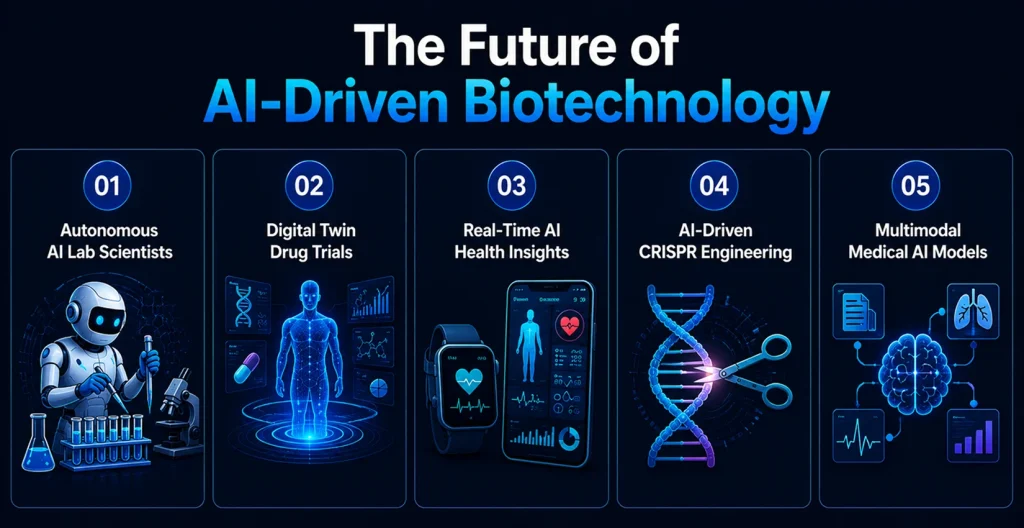
The limits of biological research are kind of drifting away from the physical petri dishes toward high-speed silicon chips. A bunch of emerging trends implies that the next platforms will lean on deeply integrated autonomous computational models that dynamically bridge raw multi-domain data with real-world clinical application.
1. Autonomous AI Agents in the Laboratory
Instead of only working through past experiments, future tools will use autonomous agents to observe experimental runs. Those agents do real-time equipment adjustments to influence yields in bioreactors without needing someone just standing there all the time.
2. In-Silico Drug Trials via Digital Twins
Advanced biotech software development solutions create really detailed virtual copies of human cells. These digital twins echo cellular reactions to drugs at the molecular level, cut physical testing, reduce validation overhead, and help surface possible side effects earlier than you’d expect.
3. Real-Time On-Demand Health Evidence
When predictive discovery software gets stitched together with more advanced healthcare IT solutions, you end up with these ongoing learning cycles. The link lets researchers assess the immediate effects of clinical treatment, can make regulatory journeys faster, and also helps prove therapeutic worth using real-world, not just textbook, data.
4. Generative CRISPR and Gene-Editing Software
Advanced machine learning is reshaping gene-editing routines. Intelligent systems predict the most accurate molecular cutting sites, and they also model genomic repairs before any wet-lab work starts. This increases clinical safety and overall precision of targeted gene therapies.
5. Multimodal Data Foundation Models
The newest software releases move past single-source analytics and start leaning into large multimodal AI models. They mix messy bio-imaging, EHR context, and raw DNA strings to pull out disease signals that are otherwise obscured or just hard to see.
Final Words
The future of biological innovation is being written in code, honestly, and in real time. Creating custom biotech software is no longer a simple IT upgrade; it’s a strategic necessity for labs that want to keep going in a crowded, data-heavy market. If teams step away from inflexible legacy setups and instead choose scalable smart platforms, they can better automate repetitive lab chores, protect intellectual property, and uncover those less obvious insights hidden inside huge multi-omics datasets.
So, whether you want to build a compliant LIMS platform or roll out predictive modeling that actually holds up, partnering with a proven custom healthcare software development company matters. The partner can help keep your software stable, scalable, and fully auditable. Put money into strong biotech software development now, and you’re basically laying the groundwork for the next generation of life-saving discoveries.


 Get in Touch
 By
By September 30, 2026