


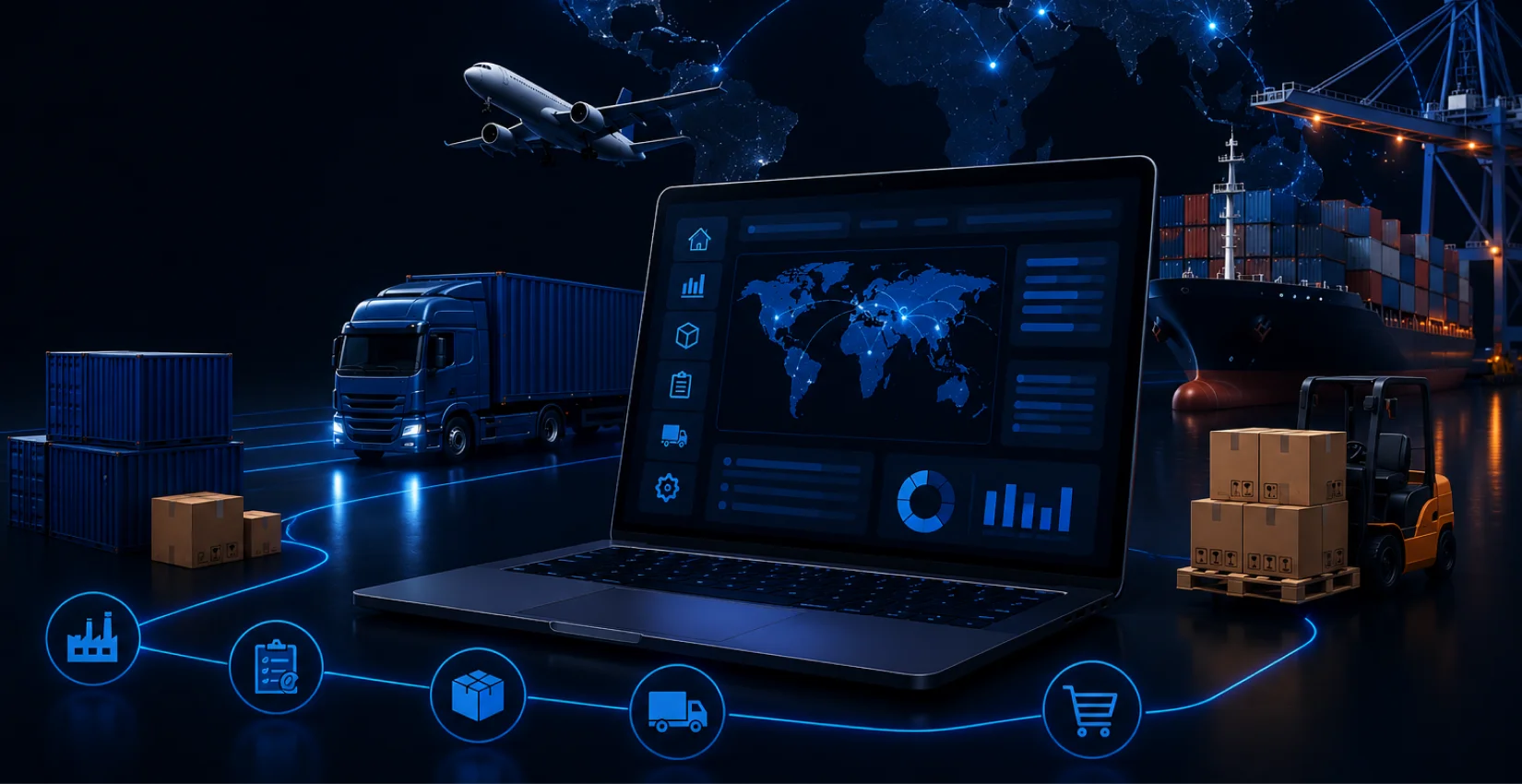
How are businesses managing faster deliveries, real-time tracking, and growing customer demands without operational delays? It sounds simple, but in practice it’s not, and the answer is modern supply chain software systems. Nowadays, companies are putting serious effort into supply chain software development so they can automate logistics, see inventory better, and keep operations smoother.
More advanced solutions let companies reduce repetitive manual tasks, enhance forecasting accuracy, and usually improve the whole customer experience. According to Fortune Business Insights, the global supply chain management market size stood at USD 29.34 billion in 2025. The market is expected to grow from USD 32.9 billion in 2026 to USD 72.82 billion by 2034 at a CAGR of 10.40% during the forecast period.
In this blog, we will discover everything about supply chains, like features, market trends, types, integrating processes, future trends, costs, and much more. Let’s start with the basics.
What is Supply Chain Management Software?
Supply chain management software is used to run procurement, inventory, warehousing, transportation, and deliveries all from one centralized workspace. In modern supply chain software development, the main focus is on improving visibility, reducing delays, and automating day-to-day workflows rather than relying on old-style coordination.
And unlike the older logistics setup that depends on spreadsheets and manual updates, digital SCM platforms come with real-time analytics and cloud operations. Many businesses connect these platforms with logistics software development solutions, so delivery coordination gets stricter, and operational efficiency improves across wider, global supply chains.
Why Do Businesses Need Custom Supply Chain Software Development?
Businesses today need flexible, scalable logistics systems because operational complexity is rising day by day. Custom supply chain software can assist companies in automating everyday workflows, make inventory handling smoother, and maybe even cut down those operational inefficiencies that nobody really wants to deal with.
Then modern supply chain automation software often rolls in real-time tracking as well, and that supports quicker decision-making. A lot of organizations also merge that with warehouse management software development to improve warehouse operations and inventory control.
1. Better Operational Visibility
Custom SCM systems offer a bit more real-time tracking for shipments, orders, and inventory, so companies can observe logistics work with better clarity and then make smarter choices across the entire supply chain.
2. Improved Inventory Forecasting
AI-driven forecasting tools help organizations sense customer demand earlier, reduce the risk of stockouts, and adjust inventory planning so the whole operation runs more smoothly with less wasted inventory.
3. Reduced Delays and Errors
Automated workflows reduce the number of manual steps in procurement, shipping, and inventory handling, support precision, and help companies cut down operational pauses fairly effectively.
4. Enhanced Customer Experience
Real-time shipment tracking paired with automatic order updates brings more transparency for customers; it also strengthens delivery reliability and usually overall customer satisfaction.
5. Scalable Logistics Infrastructure
Custom SCM platforms let businesses expand logistics work, pick up newer technologies, and handle higher volumes without breaking current workflows.
Market Trends Driving Digital Logistics Transformation
Businesses are rapidly adopting digital technologies to raise logistics visibility and improve daily operational efficiency. Digital logistics transformation is gaining momentum, so companies are installing AI, automation, and cloud-powered systems. New smart logistics software also allows organizations to fine-tune transportation, warehousing, and supply chain coordination. Additionally, businesses sometimes connect these tools with AI in fleet management platforms for route optimization and fleet tracking.
1. AI-Powered Logistics Operations
AI tools help with demand prediction, warehouse mechanization, and route planning, so in the end companies can lower operational expenses and push better delivery performance.
2. Increasing IoT Adoption
When connected, IoT sensors and devices are used properly; they give real-time shipment status, warehouse monitoring, and fleet awareness across spread-out supply chain networks.
3. Cloud-Based Supply Chain Platforms
Cloud-driven logistics setups add operational flexibility, plus centralized monitoring and remote access, especially for businesses handling worldwide supply chains.
4. Sustainability and Green Logistics
Organizations are investing in energy-saving warehouse systems and more precise transportation routes, which allows them to trim carbon output and keep sustainable logistics moving in a positive direction.
5. Growing Enterprise Automation
Companies are automating procurement, inventory refresh steps, and shipment supervision, improving overall throughput and cutting down repetitive manual tasks.
Also Read : How to Design Mobile Responsive Website – Step By Step Guide
Key Features of Supply Chain Software Solutions
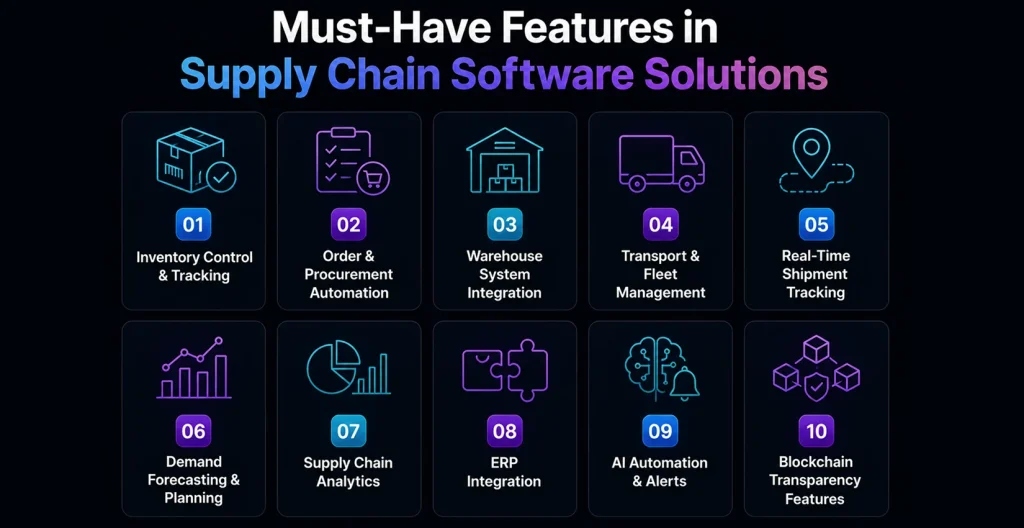
Modern supply chain software solutions help companies organize up procurement, logistics, inventory oversight, and warehouse operations. As procurement workflows become more complex, companies often benefit from comparing procure-to-pay platforms to find solutions that match their operational needs. More advanced SCM platforms provide stronger operational insight and can automate day-to-day workflows.
1. Inventory Management and Stock Tracking
Real-time inventory monitoring helps a business track stock levels more precisely while also cutting down on overstocking and even inventory shortages, depending on the cycle.
2. Order and Procurement Management
Automated ordering systems make supplier back-and-forth easier, along with order approvals, and the purchasing workflows feel smoother, so operational efficiency stays quite stable overall.
3. Warehouse Management Integration
When warehouse systems get integrated, storage, picking, packing, and inventory movement start getting optimized across multiple distribution hubs, not just one place.
4. Transportation and Fleet Management
Transportation tools support route optimization; they also help reduce fuel costs and keep shipment coordination efficient.
5. Real-Time Shipment Tracking
Advanced tracking systems provide live delivery updates, boost transparency, and let logistics teams resolve shipment issues faster.
6. Demand Forecasting and Planning
AI-driven tools show how customer demand trends over time, so the business can make better decisions on inventory control and procurement.
7. Supply Chain Data Analytics and Reporting
Analytics dashboards offer insights into logistics performance, inventory trends, and supplier efficiency for better decision-making.
8. ERP Integration for Supply Chain
ERP integration connects logistics, procurement, inventory, and finance steps into one centralized platform; this keeps the workflow coordinated.
9. AI-Powered Automation and Alerts
Automation systems can send smart alerts when shipments are delayed, when inventory is low or when there are operational disruptions, allowing for faster responses.
10. Blockchain Supply Chain Software Capabilities
Blockchain-enabled solutions improve product traceability, reinforce transaction protection, and help confirm suppliers across logistics processes; they can be quite useful during audits or when verifying records.
Types of Supply Chain Solutions for Different Industries
Different industries need sort of customized logistics systems to handle inventory, buying procurement stuff, storage and warehousing routines, and transportation flows without too much friction. The latest, more modern approaches for supply chain operations tend to help companies boost efficiency and avoid those frustrating operational delays.
Nowadays, organizations are more often adopting automotive supply chain solutions, plus other industry-centric logistics platforms. A lot of teams also link these systems with blockchain in supply chain technologies, so there’s better transparency and auditing, even when things get unorganized.
1. Retail and eCommerce Supply Chain Solutions
Retailers run SCM systems to manage inventory, order fulfillment, returns management, and customer deliveries in a more organized way.
2. Automotive Supply Chain Solutions
Automotive firms depend on logistics platforms to coordinate suppliers, spare parts movement, manufacturing timing, and production workflows.
3. Restaurant Supply Chain Solutions
Restaurants often rely on automated inventory tracking, along with supplier coordination systems, to minimize food waste and also refine procurement planning.
4. Manufacturing and Industrial Logistics Solutions
Manufacturers use SCM platforms to smooth raw material sourcing, storage management, and production operations.
5. Healthcare and Pharmaceutical Supply Chains
Healthcare orgs depend on secure logistics setups for medicine traceability, cold-chain supervision, and regulatory compliance management.
Role of AI in Supply Chain Software Development
Artificial intelligence is gradually reshaping logistics and warehouse routines around the world. These days, AI features in supply chain software development help companies automate workflows, improve forecasting accuracy, and lift operational efficiency. A lot of teams are also weaving generative AI in supply chain systems, so planning gets more intelligent, and order handling becomes more guided. In most cases, organizations are working with a custom software development company to build AI-powered logistics platforms.
1. Predictive Demand Forecasting
AI reviews historical patterns and live signals together to predict demand shapes, then strengthens inventory approaches.
2. AI-Powered Route Optimization
AI-driven logistics tools can identify faster delivery routes to reduce transportation spending and also raise shipment efficiency.
3. Intelligent Warehouse Automation
AI-enabled systems coordinate inventory movement, picking duties, and sorting sequences so warehouse output feels steadier, more productive, and less chaotic.
4. Fraud Detection and Risk Management
AI systems monitor the logistics activities to spot fraud risks and also ramp up operational security across supply chain networks.
5. AI Procurement Assistants
AI chatbots help organizations automate supplier messaging, order monitoring, and procurement management process flows, so there is less manual work and smoother coordination.
Blockchain Supply Chain Software: Benefits and Use Cases
Modern blockchain supply chain software supports companies with better transparency, greater security, and stronger product traceability across logistics networks. These advanced supply chain technology solutions, driven by blockchain, lower fraud risk a bit and also strengthen supplier verification workflows. Many companies also rely on those platforms while thinking about ERP software development cost strategies for enterprise logistics stacks.
1. Improved Transparency and Traceability
Blockchain stores each shipment and transaction in a secure record, helping businesses follow the product trail all along the supply chain.
2. Smart Contracts for Automation
Smart contracts help automate approvals and even transactions when certain logistics conditions are met in advance. It’s based on the predefined triggers and rules.
3. Reduced Fraud and Counterfeit Risks
Blockchain platforms can verify product authenticity. This improves trust across the whole chain, suppliers, distributors, and customers.
4. Supplier Verification and Compliance
Companies can keep supplier certifications and compliance records in a secure way. This supports operational accountability.
5. Real-World Industry Applications
In healthcare, in food distribution, and in manufacturing, blockchain is used for secure tracking. It also adds logistics transparency.
Supply Chain Automation Software: Transforming Operations
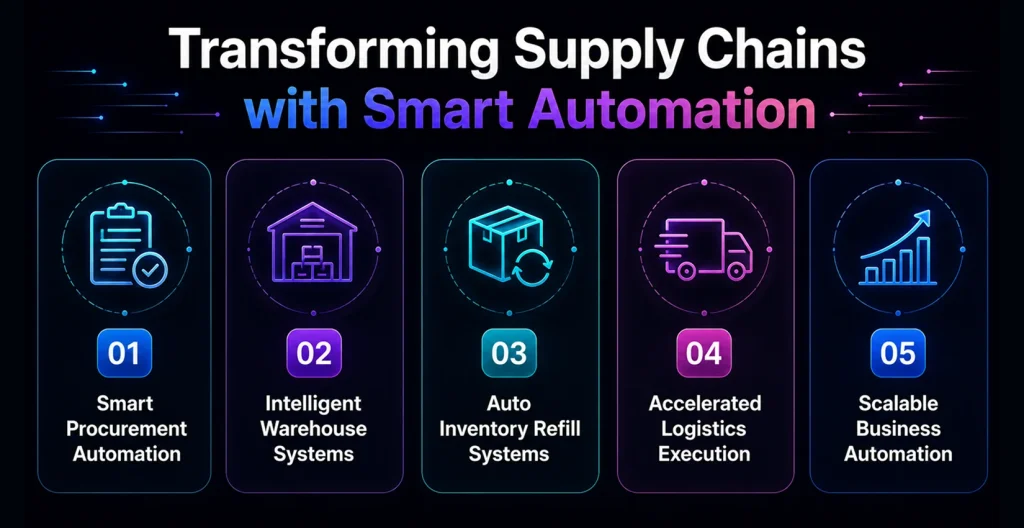
Modern Supply Chain Automation Software supports businesses by automating procurement, inventory management, warehousing, and shipment coordination. Organizations investing in SCM software development often gain faster operations, and they can remove a lot of the manual work. Many teams also pair automation platforms with warehouse management software development for more intelligent warehouse workflows.
1. Automated Procurement Workflows
Automation systems simplify supplier communication, plus approvals, and the whole order management side; it just runs smoother with less back-and-forth.
2. Smart Warehouse Automation
Smart warehouse automation works on picking, packing, and even the inventory handling part, so efficiency goes up without tons of manual checks.
3. Automated Inventory Replenishment
Automation tools keep track of inventory and automatically initiate replenishment processes to prevent stockouts.
4. Faster Logistics Operations
Automated shipment coordination and route planning help deliveries move quicker, and they also reduce those annoying transportation delays.
5. Improved Business Scalability
Automation systems let enterprises handle growing logistics operations while workflow efficiency stays more or less intact.
Enterprise Logistics Solutions and Smart Logistics Software
Large enterprises really need advanced logistics systems for moving freight, managing warehousing, and handling deliveries in an organized way. Modern enterprise logistics solutions can increase shipment visibility and help operational coordination stay aligned.
A lot of companies are also adopting smart logistics software to optimize freight operations and get real-time tracking that feels more immediate. Many times, these platforms get connected with logistics software development services to build a scalable logistics infrastructure.
1. Cloud-Based Logistics Platforms
Cloud-based systems give centralized monitoring, and they also make remote access kind of easier across the whole supply chain operation.
2. Real-Time Shipment Coordination
Smart logistics tools deliver live shipment status, and they help teams communicate better with customers in real time.
3. Digital Freight Optimization
Freight management platforms optimize route selection and also cut transportation expenses so deliveries arrive quicker.
4. Scalable Enterprise Logistics Infrastructure
Enterprise logistics systems can handle big warehouse tasks and transportation runs more efficiently, without collapsing.
Step-by-Step SCM Software Development Process
Building modern SCM software really depends on good planning, system architecture, and also workflow fine-tuning. When businesses follow a clear supply chain software development process, they tend to get scalable and secure logistics systems.
Companies investing in supply chain management software development usually prioritize automation and operational visibility, too. And a lot of companies connect these systems with inventory management software development solutions for improved warehouse efficiency.
1. Business Requirement Analysis
The whole thing starts by sorting out logistical trouble spots, operational goals, and end-user requirements.
2. Supply Chain Workflow Planning
Developers map out procurement routes, storage levels, warehousing approaches, and transport flows first, and only after that do they go into the actual development part.
3. UI/UX Design for Logistics Platforms
User-friendly dashboard screens improve accessibility and help day-to-day logistics work move faster, plus it gives managers clearer visibility.
4. Backend and API Development
Developers set up a dependable server-side backend and programming interfaces so the information handling stays secure.
5. ERP and Third-Party Integration
SCM platforms connect with ERP, CRM, warehouse systems, and payment services, so operations remain more centralized with less additional friction.
6. Testing and Quality Assurance
Testing teams look for bottlenecks and check for performance rough edges, and then they confirm the system behaves smoothly before it hits production.
7. Deployment and Cloud Infrastructure
Cloud deployment helps scalability, security, and remote accessibility and is big for logistics operations that keep shifting around constantly.
8. Ongoing Maintenance and Optimization
Continuous maintenance enables teams to fine-tune system efficiency and also adjust when operational requirements shift or when the supply chain gets a bit unstable.
Technologies Used in Supply Chain Software Development
Modern supply chain software development services are using advanced technologies to bring more visibility and raise overall operational efficiency in a practical way. A lot of companies mix AI, IoT, cloud computing, and blockchain into their logistics stack; it’s not always perfectly aligned, but it works for many teams. Some organizations also utilize these tools with AI-based fleet management systems to get improved transportation tracking.
| Technology | Purpose |
| AI & Machine Learning | Forecasting and automation |
| Blockchain Technology | Secure tracking and traceability |
| IoT Devices & Sensors | Real-time shipment monitoring |
| Cloud Computing | Centralized logistics management |
| Big Data Analytics | Supply chain reporting and insights |
| GPS & Telematics | Route optimization and fleet tracking |
| ERP & CRM Integrations | Workflow coordination |
| Mobile App Technologies | Remote logistics access |
Cost of Supply Chain Software Development
The cost of supply chain software development usually depends on the features you actually want, the integrations you’re planning, the amount of AI, the overall project complexity, and even the development region. If a business invests in custom supply chain software development, they often choose scalable systems too because it supports long-term operational efficiency.
Cost Based on Roles
| Development Role | Hourly Cost (USD) |
| Project Manager | $30 – $70 |
| UI/UX Designer | $20 – $50 |
| Backend Developer | $30 – $80 |
| AI/ML Developer | $50 – $120 |
| QA Engineer | $20 – $45 |
Cost Based on Project Complexity
| Complexity | Estimated Cost |
| Basic SCM Software | $20,000 – $50,000 |
| Mid-Level Platform | $50,000 – $120,000 |
| Enterprise SCM Platform | $120,000 – $300,000+ |
Cost Based on Region
| Region | Hourly Rate |
| North America | $80 – $200 |
| Europe | $60 – $150 |
| Asia | $20 – $60 |
Key Cost Factors
- AI and automation features can add higher development complexity, so the effort goes up.
- ERP integration plus cloud infrastructure tends to shape the final pricing more than teams expect at the beginning.
- Ongoing maintenance and support costs also matter a lot; they become part of long-term operational expenses.
Challenges in Supply Chain Management Software Development
Building advanced SCM systems involves this mix of operational and technical hurdles, even when teams plan ahead. When companies put money into supply chain software development, they often hit integration headaches, scalability worries, and security issues that show up faster than expected.
Modern supply chain technology solutions really require a stable foundation and integrations that are clean; otherwise, everything seems to slow down, sometimes gradually, sometimes suddenly. A lot of organizations finally end up partnering with a custom software development company, just to handle those obstacles in a more organized way.
1. Integration with Legacy Systems
Older logistics platforms are often poorly suited to newer technologies or cloud-based architectures
2. Data Security and Compliance
SCM platforms handle pretty sensitive logistics details together with financial information, so they really need strong cybersecurity controls and compliance rules.
3. Managing Real-Time Logistics Data
Supply chain solutions work with huge volumes of shipment data and inventory details; they come in continuously.
4. Scalability and Performance Issues
As logistics operations expand, they stay scalable and still fast enough to process heavy transaction loads without losing their footing or stalling entirely.
5. User Adoption Challenges
Users still need training; otherwise, they find it difficult to adopt the updated workflows and new logistics technology.
Future Trends in Supply Chain Technology Solutions
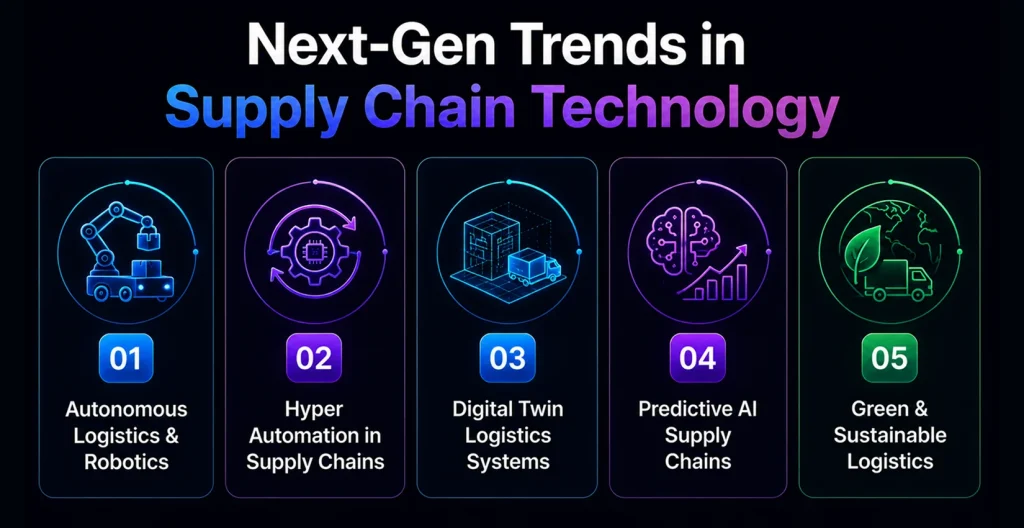
The future of logistics feels like it is getting more automated, intelligent, and data-driven. Right now, modern solutions for supply chains are moving quickly, with AI blended in, robotics doing their thing, and predictive analytics showing up everywhere. A lot of companies are putting serious effort and money toward AI, especially in supply chain software development, so they can build more intelligent logistics ecosystems that just kind of work together. At the same time, many of them are integrating blockchain in supply chain systems for improved transparency.
1. Autonomous Logistics and Robotics
Warehouse robots, plus autonomous delivery systems, are pushing day-to-day operational efficiency forward in a quite noticeable way.
2. Hyperautomation in Supply Chain Operations
A large number of organizations are automating procurement, inventory management, and shipment coordination tasks, almost from start to finish.
3. Digital Twins in Logistics
Digital twin technology helps businesses simulate logistics operations, and then it lets them foresee disruptions before they fully appear.
4. AI-Powered Predictive Supply Chains
Predictive AI tools improve forecasting accuracy, and they help tune logistics planning even when demand acts weirdly or unpredictably.
5. Sustainable Logistics Systems
Eco-focused logistics technologies support companies in cutting carbon emissions while also moving toward sustainability goals that actually matter.
How to Choose the Right Supply Chain Software Development Company?
Selecting the right supply chain software development company really matters, especially if you want logistics systems that can grow but also stay safe and secure. Companies investing in SCM software development should look at how deep the industry knowledge goes, what tech skills they actually bring, and whether they offer useful support after launch. A lot of teams also lean toward partners who have done warehouse management software development before, because it makes things more predictable.
1. Evaluate Industry Experience
Try to select a vendor with real experience in logistics, warehousing, and transportation software development.
2. Assess Technical Capabilities
Your development partner should work comfortably with AI, IoT, blockchain, cloud, and automation, not only “basic” integration.
3. Check Scalability Expertise
A reliable company should be able to design platforms that support increased operations later, without turning the whole setup.
4. Prioritize Security Standards
Strong cybersecurity practices and compliance routines are essential for logistics software platforms.
5. Review Support Services
Businesses can sustain long-term operational efficiency with the aid of post-launch maintenance and optimization services.
Final Remarks
Modern businesses need smart but also scalable logistics setups so they can run operations more efficiently and without too many hiccups. Investing in supply chain software development lets organizations automate routine workflows, boost overall visibility, and reduce operational expenses.
More advanced supply chain systems, driven by AI, IoT, and blockchain, are really changing how logistics works in many places around the world. Companies also combine these solutions with inventory management software to make warehouse productivity better and to enhance customer experiences.


 Get in Touch
 By
By September 30, 2026