


Today, Logistics and Transportation companies leverage the power of digital, the speed of digital, the accuracy of digital, and the real-time capability of digital. As the mass demand for faster deliveries and seamless tracking continues to grow, the Android App development for logistics and transportation gets more intricate.
With logistics and transportation providers adopting mobile-First strategies, the way that operators control and manage operations becomes predictive and data-driven. Android, being the user-friendly and widely used operating system provide operators, managers, and customers with a real-time connection and easy ROI. Therefore, understand how the transportation Android app development can shift the future of your logistics.
- Market Statistics: Android Applications are Driving Logistic Growth
- Why Android Is Ideal for Logistics & Transportation Apps
- Core Android App Use Cases in Logistics & Transportation
- Android App Development Procedure for Logistics Platforms
- Key Features of Logistics & Transportation Android Apps
- Why Custom Android Logistics Apps Deliver Better ROI
- Conclusion
- FAQs
Market Statistics: Android Applications are Driving Logistic Growth
The global market for logistics is continuously increasing with the help of smart logistics software development. The global logistics market is expected to grow to USD 14.08 trillion by 2028, driven by the digital Transformation of the logistics industry and the mobile solutions available to logistics companies.
Route optimization and automation can minimize operational costs for mobile-based logistics, resulting in an expected 14.4% growth up to 2030. Android is the leading operating system in the Mobility Enterprise space, with an estimated 70% of the global operating system market share. Therefore, Android is naturally the most popular platform for developing logistics apps.
Why Android Is Ideal for Logistics & Transportation Apps
Android provides unrivaled compatibility, scalability, and flexibility for logistics companies. As logistics companies’ delivery networks become increasingly complex, their businesses require a Software Development Platform (SDP) that can respond quickly to changes in the network. Considering Android app development for logistics & transportation helps businesses in the following ways;
1. Device Compatibility
Android supports a wide variety of GPS devices, barcode scanners, rugged tablets & IoT sensors without any Vendor Lock-in. Consequently, logistics teams can deploy a diverse array of hardware while ensuring that their applications provide the same level of performance on all devices used throughout the fleet and warehouse.
2. Cost-Effective
Android’s Open-Source architecture enables logistics companies to significantly reduce their licensing costs. As a result, a logistics company can equip a large fleet of drivers with an enterprise-class application. This will help them manage their development and operational budgets more effectively and predictably.
3. Real-Time Synchronization of Operational Data
The logistics mobile app solutions provide immediate updates to all involved parties, from the dispatchers to the drivers to the warehouse locations. This allows managers to monitor all aspects of the logistics company, from vehicle location to delays to inventory changes.
4. Ability to Scale
Android solutions allow for smooth expansion of all logistics businesses as the number of Routes/Drivers, or fleets increase within an organization. Therefore, logistics businesses can effectively expand into National or Regional jurisdictions without having to rebuild their entire Technology Infrastructure.
Core Android App Use Cases in Logistics & Transportation
The Transportation & Logistics Industry can integrate various functions into a single software application on Android devices. This allows for real-time visibility of logistics operations and fleet management more economically. Here are the places where a transportation Android app development can offer maximum benefits.
Operations and Fleet Management of Vehicles
Fleet Management Android apps, such as Samsara and Verizon Connect, allow Logistics companies to monitor how much fuel their vehicles consume, monitor driver behavior, and the health of the vehicle. As a result, these logistics companies can reduce vehicle breakdowns, enhance safety compliance, and extend the usable life of their assets.
Visibility and Coordination of Supply Chain
Logistics mobile provides visibility and coordination of shipment information across suppliers, warehouses, and carriers. This allows managers to coordinate the movement of inventory faster, thus helping to create less delay and stockouts.
Route Information and Real-Time Location
GPS tracking Android apps with Fleet Complete or Google Maps allow for live tracking of vehicles and real-time, dynamic, optimized routing. As a result, Logistics businesses can reduce fuel costs, avoid areas of high traffic congestion, and consistently meet their delivery timelines.
Read More: IoT in Transportation and Logistics: Top Use Cases and Benefits
Android App Development Procedure for Logistics Platforms
Android applications in logistics require a thorough understanding of the industry and extreme precision with technicality. As the complexity of workflows becomes greater, having a methodical, structured approach to application development will ensure that applications are highly reliable, scalable, and performant.
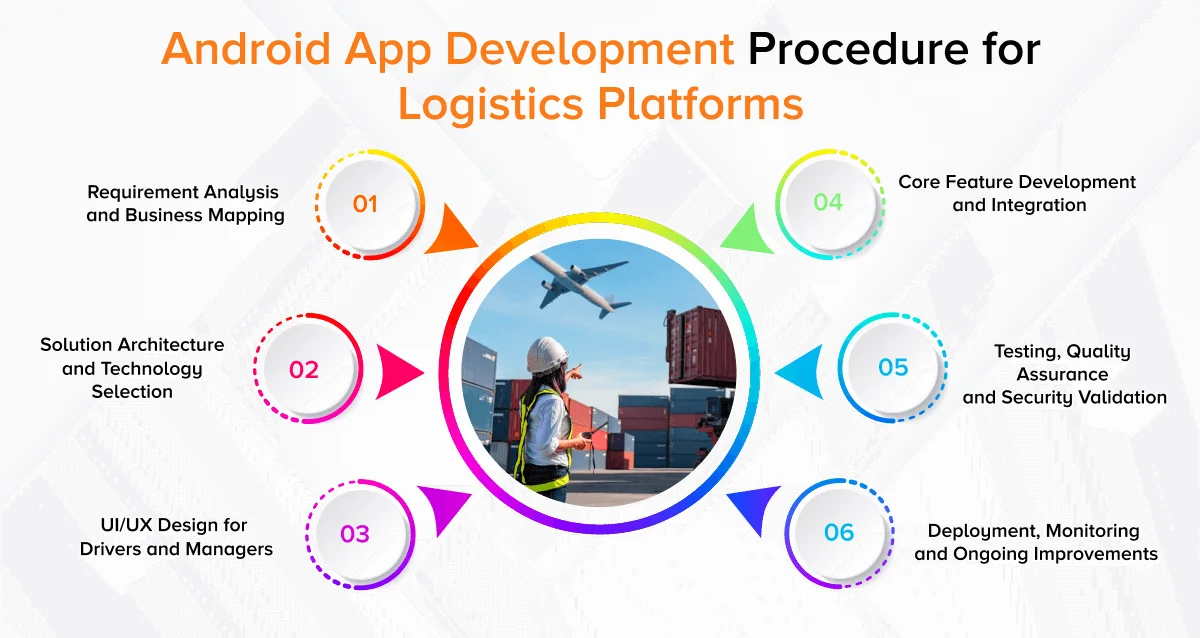
A detailed application development process can transform your operational needs into highly functional mobile systems that cater to the requirements of today’s transportation methods. Therefore, the logistics software development Android apps will include the following steps;
1. Requirement Analysis and Business Mapping
To start the application development process for a logistics-based application, the development team must conduct a thorough analysis of the logistics workflow, delivery method, and compliance needs. The development team must document fleet size, routing complexity, and integration points. All of this information collected during the business mapping phase will enable developers to design the application specifically for real-world logistics challenges.
2. Solution Architecture and Technology Selection
This phase consists of defining the backend architecture, APIs, database, and cloud Infrastructure. Developers will select technologies that will easily support a continuous flow of data across the application in real-time and offline access. Following this, the logistics mobile app solutions will be developed to scale smoothly, handle peaks of performance, and grow into additional markets and geographies.
3. UI/UX Design for Drivers and Managers
Designers will create user-friendly dashboard designs for drivers, dispatchers, and management. All dashboards must be designed with easy navigation, therefore minimizing the time needed for training and mitigating errors whilst using the dashboards. The use of a good dashboard design will enable users to quickly access critical features that are required for successful work, especially when time-sensitive deliveries are being executed.
4. Core Feature Development and Integration
Engineers will develop all modules, including routing, notifications, reporting, and automation. Then all these systems will be integrated with the Enterprise Resource Planning (ERP), Customer Relationship Management (CRM), and Warehouse Management System (WMS). Trusted Android App development services in USA emphasize this stage to offer you maximum value of the app.
5. Testing, Quality Assurance, and Security Validation
In this stage, the functional, performance, and security testing of applications will be conducted in real-world environments. The testing phase will confirm that the application can be used offline and that sensitive data is encrypted and controlled with the appropriate level of role-based access. Testing also verifies that the application is functionally correct and performs reliably on a wide variety of devices and network environments.
6. Deployment, Monitoring, and Ongoing Improvements
After the application has been deployed, the logistics software development will focus solely on performance metrics and feedback from customers. Updates to the application can add new functions and automated processes to collect performance metrics. The continuously changing logistics requirements of the organization will create a continuous cycle of ongoing improvement of the logistics mobile application, as it is developed further.
Key Features of Logistics & Transportation Android Apps
Modern Android logistics applications provide the usability and access controls needed for businesses to accurately and efficiently manage the entire transportation and delivery operation. These capabilities enable businesses to build a dependable digital infrastructure to support the entire range of logistics and transportation functions.
| Features | Description | Business Value |
| Real-time Vehicle Tracking | Live monitoring of vehicle location and movement | Improves delivery accuracy and ETA reliability |
| Route Optimization | AI-based route planning with traffic awareness | Reduces fuel costs and delivery delays |
| Driver Management | Tracks driver performance, availability, and compliance | Enhances safety and accountability |
| Proof of Delivery | Digital signatures, photos, and timestamps | Minimizes disputes and improves transparency |
| Offline Mode | Access to tasks without network connectivity | Ensures uninterrupted operations |
Why Custom Android Logistics Apps Deliver Better ROI
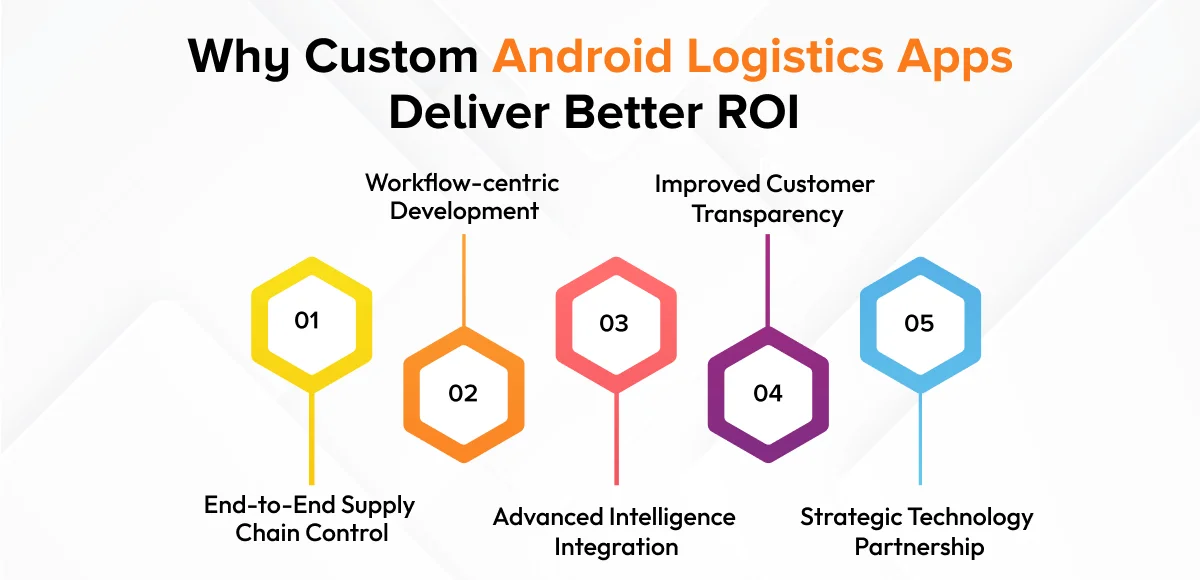
Custom Android logistics apps offer much greater ROI than generic, pre-built software applications. The moment an organization’s operations become integrated with a technology solution, this facility improves productivity, improves cost stability, and therefore, steadily increases the return on investment.
- End-to-End Supply Chain Control
With the supply chain mobile app development, organizations can view the entire supply chain from end to end. They can make decisions based on real-time data versus mere estimations. This increases the speed of decision-making, which indirectly leverages more profit.
- Workflow-centric Development
A large part of the development of an “Application” is based on the Workflow Structure and functionality of the organization creating the application. So in essence, Custom Android Apps are designed to replicate while speeding up the daily processes of dispatching and routing.
- Advanced Intelligence Integration
Transport enables organizations to optimize operational processes through predictability and to reduce operational risk. Therefore, organizations using customized AI in logistics will find that they have fewer risks in operations.
- Improved Customer Transparency
A customized delivery tracking Android app offers unique value propositions by providing customer-facing tools consisting of delivery tracking functionality. Customers who get the chance to check real-time insights into when their product will arrive usually show faith. When they receive proof of delivery, they will more likely continue to use the same company for their products. This offers long-term value for logistics companies.
- Strategic Technology Partnership
Working with a transportation App development company offers organizations many benefits, including scalability, security compliance, and long-term technology support. This profitable partnership will continue to grow as the organization develops and expands.

Conclusion
Custom-built Android applications for logistics will provide businesses with a significant return on investment. Through increased efficiency, enhanced visibility, and reduced long-term costs, custom solutions will have a significant advantage over generic offerings as logistics networks continue to grow. Therefore, the advantages of customizing your logistics mobile app solutions will go beyond just speed and accuracy to offer you real profits.
Read More : Android app development companies


 Get in Touch
 By
By September 23, 2026