


Introduction: Why Blockchain vs DLT Matters for Businesses
Have you ever given a thought to why so many companies are planning to implement blockchain vs DLT in 2026 and later? The selection of the appropriate technology, DLT or Blockchain, will determine the level of security, transparency, and efficiency of your business operations.
As per Globe News Wire, the global market for blockchain technology will be around USD 687.4 billion by 2032, representing a growth rate of almost 49% CAGR, owing to the transformation of enterprises digitally and the penetration of this technology in different sectors like finance, supply chain, and healthcare. As a result, the more extensive Blockchain Distributed Ledger Technology (DLT) market will also see a rise in the coming decade as decentralized systems become extremely important for trustless business processes.
Knowing the DLT vs Blockchain difference enables companies to plan their solutions and technologies, e.g., app development of blockchain for business, NFT marketplace development, or decentralized exchange, without incurring expensive rework since they will already be making the right decisions from the start.
What Is Blockchain Technology and Distributed Ledger Technology (DLT)?
The term blockchain refers to a specific type of DLT, wherein the data is organized in blocks that are securely connected to each other, forming a chain. In the discussion on Blockchain vs DLT, blockchain is really noticeable for its unique property of immutability and transparency as well. Blockchain is very much a part of app development, smart contracts development, NFT marketplace development, and the whole world of digital finance.
Distributed Ledger Technology (DLT) is a more generic term that covers various ways the data remains accessible to all and periodically gets updated across multiple nodes simultaneously without a central authority. A comparison between DLT vs Blockchain suggests DLT is more permissive in terms of data structure and processing time. DLT technology vs Blockchain is commonly seen in enterprise applications, supply chains, and scalable blockchain app development for business.
Blockchain vs DLT: Core Differences Explained
The main DLT vs Blockchain difference can be seen in the aspects of data structure, flexibility, scalability, and enterprise usability, thus each one being tailored to a different business requirement.
1. Data Structure
In the case of Blockchain, sdata is stored in linked blocks; on the other hand, DLT systems, depending on the case, can use flexible structures that can make such technology more adaptable for enterprises than the case of Blockchain.
2. Flexibility & Control
In the case of Blockchain, the rules are set, and it has fixed protocols, while DLT provides a permissioned access that allows businesses to implement strong security measures, making it a part of the blockchain app development platform.
3. Scalability & Speed
DLT is a faster technology when it comes to transaction processing, and that is why enterprises are going for DLT in terms of scalable blockchain mobile application development for their business.
4. Use Case Focus
Blockchain provides the best infrastructure for public networks like DeFi; on the other hand, DLT is more suitable for private systems made by a dapp development company.
5. Development Ecosystem
In the case of Blockchain, a wide variety of mature tools and blockchain programming languages are supported, while the DLT offers tailored frameworks for industry-specific applications.
DLT vs Blockchain Difference: Comparison Table
The DLT vs Blockchain difference is quickly understood when one focuses on the criteria of structure, scalability, and business suitability, thus helping enterprises to select the best technology for their long-term growth.
| Aspect | Blockchain | Distributed Ledger Technology (DLT) |
| Core Concept | A specific type of DLT using blocks linked in a chain | A broader system of distributed data records |
| Data Structure | Linear, block-based structure | Flexible structures like DAG or Hashgraph |
| Flexibility | Limited customization | High flexibility for enterprise use |
| Scalability | Moderate scalability | High scalability for large networks |
| Transaction Speed | Slower due to block validation | Faster due to parallel processing |
| Energy Consumption | Higher, especially in public blockchains | Lower and more efficient |
| Security Model | Cryptographic hashing and consensus | Permissioned access and identity-based security |
| Transparency | Fully transparent public records | Configurable transparency |
| Smart Contracts | Widely supported for automation | Limited or customized support |
| Business Use Cases | DeFi, NFT marketplace development, crypto platforms | Supply chain, payments, enterprise systems |
| Development Focus | Ideal for blockchain app development | Preferred for blockchain app development for business |
| Technology Scope | Narrower scope | Broader than blockchain |
| Blockchain vs DLT Suitability | Best for decentralized public ecosystems | Best for scalable enterprise solutions |
| DLT technology vs Blockchain Advantage | High trust and immutability | Speed, flexibility, and performance |

Explore Article: Carbon Credit Platform Development Companies
How DLT Technology vs Blockchain Works?
Comprehending the disparity between DLT technology vs Blockchain illuminates the reasons behind the selection of various architectures by the business for security, scalability, and the development of modern decentralized applications.
1. Transaction Processing
The Blockchain collects transactions into blocks; on the other hand, DLT vs Blockchain systems accept or reject transactions on an individual basis, thus speeding up transaction processing for applications developed with blockchain technology for enterprises.
2. Consensus Mechanism
Blockchain makes use of heavy methods for consensus, and, on the contrary, the DLT applies simple validation, which results in a reduced cost of blockchain application development for business.
3. Data Synchronization
Blockchain performs ledger updates after a block is complete, in contrast to DLT, which continuously syncs data, hence supporting real-time systems that are built by the best blockchain development companies.
4. Network Participation
Blockchain networks are usually open to the public side, while DLT gives permissioned access, which makes the technology of DLT vs Blockchain suited for industries with strict regulations.
5. Application Enablement
The public platforms are powered by Blockchain, while DLT facilitates enterprise systems that are interconnected with the decentralized exchange development solutions.
Types of DLT and Blockchain Networks
Different types of Blockchain vs DLT networks dictate the way the data is distributed, who has the right to access it, and how the solutions can be scaled both in the public and enterprise environments.
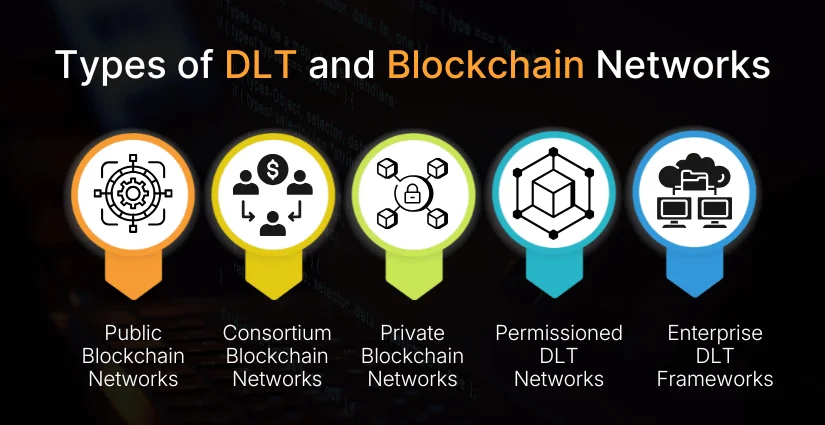
1. Public Blockchain Networks
Public blockchains are available to all; they are the best option for developing applications such as crypto, NFTs, and token mining that need to be very transparent.
2. Consortium Blockchain Networks
Consortium blockchains have shared control among organizations, and they are often at the top of the list for leading blockchain development companies in finance and supply chain solutions.
3. Private Blockchain Networks
Private blockchains limit access, but enable enterprises to create safe systems through blockchain app development for business with controlled involvement.
4. Permissioned DLT Networks
Permissioned DLT networks are accessible only to vetted participants, thus making DLT technology vs Blockchain the right choice for controlled sectors and enterprise processes.
5. Enterprise DLT Frameworks
Enterprise DLT frameworks put the spotlight on scalability and customization; they are able to support advanced blockchain usage in banking, healthcare, and logistics.
Blockchain vs DLT Use Cases Across Industries
Real-world Blockchain vs DLT use cases differ by industry, largely depending on flexibility to transact openly, high scalability requirements, and enterprise-level control.
1. Supply Chain Management
DLT guarantees real-time tracking and data sharing; on the other hand, blockchain brings about trust and auditability to complicated blockchain use cases.
2. Finance & Payments
Blockchain enables DeFi platforms, while DLT vs Blockchain networks enable faster payment systems that are compliant, thus creating decentralized exchange development.
3. Gaming & Digital Assets
Blockchain is the backbone of NFTs and play-to-earn mechanisms, while the mobile game development company is able to create invisible and transparent digital ownership systems.
4. Enterprise & Business Systems
DLT is the go-to technology for enterprise automation, and blockchain works on trust as a backbone for developing business solutions that are blockchain-based.
5. Development Ecosystem
Mature blockchain programming languages are the backbone of the blockchain platforms, while the DLT frameworks provide flexible architectures for the applications particular to the industry.
Learn More: Top Blockchain App Development Organizations in USA
Business Benefits to Choose Blockchain vs DLT
The decision between Blockchain and DLT is based on your business objectives, the necessity for data transparency, the level of scalability that you expect, and the regulations that you will have to follow. By being aware of the DLT versus Blockchain distinction, firms are able to commit to the right technology for a secure, efficient, and long-term investment in blockchain app development.
- Choose blockchain for public, trust-based platforms, such as the creation of NFT markets and decentralized applications.
- Go for DLT where the access is controlled, but the enterprise system is very fast and needs to be private.
- Blockchain is perfect for projects that demand a high level of immutability and transparency.
- DLT is more advantageous for scalable blockchain app development in business use cases.
- The expert advice from leading companies in blockchain development will secure the correct selection.
Real-World Applications and Emerging Trends
The growing adoption of Blockchain vs DLT is the main reason behind real-world applications and new blockchain trends and technologies in finance, gaming, enterprise systems, and digital assets.
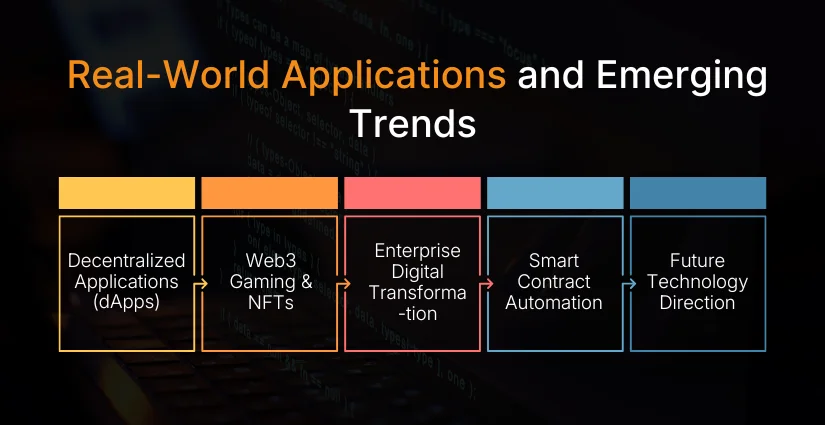
1. Decentralized Applications (dApps)
The public dApps are powered by blockchain, and the DLT vs Blockchain debate favors the development of permissioned platforms by a reliable dApp development company.
2. Web3 Gaming & NFTs
Tokens and NFT trading are made possible by blockchain, which is unlocking a mobile game development company’s ability to create accessible, player-owned digital ecosystems.
3. Enterprise Digital Transformation
DLT drives the pace of the digital transformation of enterprise systems, while blockchain guarantees the trust-driven development of blockchain app platforms.
4. Smart Contract Automation
Blockchain is the winner in the field of smart contract development, whereas DLT provides a tailored automation solution for the controlled enterprise workflows.
5. Future Technology Direction
The battle between DLT technology vs Blockchain has produced a winner, that is, businesses are going for a hybrid model that combines the three: flexibility, security, and scalable blockchain app development.
Future Outlook: Blockchain vs DLT in 2026 and Beyond
The expansion of Blockchain versus DLT will depend on the demands for scalability, enterprise uptake, changing regulations, and the progress of technology in both the decentralized and the business-oriented digital realms.
1. Enterprise Adoption
DLT will enable widespread adoption of enterprise systems, while blockchain continues to support the creation of public networks that are characterized by transparency and the development of blockchain-based applications for enterprises.
2. Strategic Implementation
Companies will combine DLT and blockchain technologies, with the help of blockchain app development platforms that offer scalable and future-proof solutions.
3. Technology Evolution
Improvements in blockchain technology are addressing mainly the issues of scalability and energy consumption, whereas the competition between DLT and blockchain is leading to the development of solutions that can be deployed in the enterprise more quickly and with more flexibility.
4. Developer Ecosystem
The increase in blockchain demand is closely related to the availability of modern blockchain programming languages, whereas DLT is drawing enterprises needing custom-made architectures to their frameworks.
5. Market Innovation
Emerging blockchain trends such as tokenization and Web3 are driving blockchain adoption, while DLT is making its way into regulated sectors.
Final Thoughts: Making the Right Technology Choice
The choice between Blockchain and DLT is not a matter of being in vogue or not. Rather, it is a question of choosing the right technology to serve the business’s real needs. Grasping the DLT vs Blockchain distinction permits firms to establish a proper base for protection, expansion, and growth over a long period.
One would always think of blockchain technology in a positive light whenever such industries as DeFi platforms, NFTs, and trust-driven blockchain app development are mentioned, whereas DLT tends to be more appropriate for systems that are demanding the highest level of performance, along with speed, flexibility, and access control.
The battle between DLT and Blockchain is likely to continue for some time, and in the meantime, companies will have to consider their use cases, regulatory compliance, and future scalability before committing funds. Collaborating with specialists in token mining app development would guarantee successful implementation, lower risks, and the highest ROI in the fast-changing digital landscape.



 Get in Touch
 By
By September 8, 2026