



The automotive industry is undergoing one of the most significant transformations in its history. Cars are no longer characterized by horsepower, torque, and physical appearance alone. Software is the lifeblood of mobility today, and it defines how vehicles drive, as well as how customers communicate with them.
Recent market research highlights the magnitude of this change. According to Grand View Research, the global software-defined vehicle (SDV) market was valued at USD 207.8 billion in 2024 and is projected to reach USD 271.8 billion in 2025, expanding at a CAGR of more than 31% through 2033. Other forecasts are even more bullish, placing the market at USD 391.2 billion in 2024, expected to climb to USD 1.6 trillion by 2030, at an annual growth rate of 27.3%.
These numbers are not abstract to the CEOs of the automotive companies. They are an important point of departure. The competitive environment is being redefined, and the organizations that do not embrace a software-oriented approach to vehicles may end up becoming irrelevant to the more competitive, technologically advanced competitors.
So in this blog, we have covered the importance of SDV strategy and how it can be a game-changer for your automotive business. Let’s get started!
What Do You Mean by SDV?
A Software-Defined Vehicle (SDV) is not just any car with high levels of infotainment. It is a platform where software, not hardware, determines vehicle features, functions, and upgrades.
Traditionally, cars have had dozens of electronic control units (ECUs), each dedicated to a particular task, such as braking, lighting, or navigation. These functions could only be updated physically. By contrast, an SDV concentrates compute capability in high-performance controllers and implements software abstraction layers, enabling additional or improved features to be added or improved via over-the-air (OTA) updates.
Consider it a replacement of flip phones with smartphones. A flip phone could not do more than what it was designed to do. However, a smartphone acquires new features with each software update. Likewise, SDVs can develop during their lifetime, and they do not have to be frozen at the time of sale.
That paradigm shift is turning cars into digital platforms, which can execute a range of services, open new business models, and deliver value even when customers have driven them off the lot.
Top Benefits of Opting Software Defined Vehicles Strategy
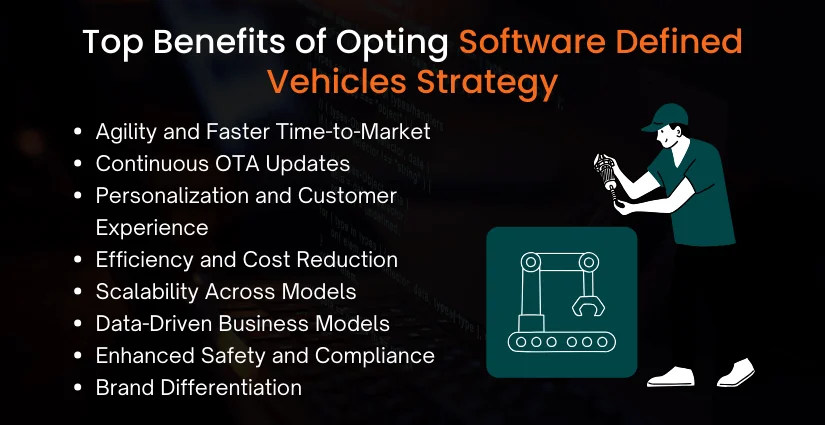
Here are the top benefits of opting for a software-defined vehicle strategy. Have a look at the compelling reasons why one should choose it for their automotive business.
Agility and Faster Time-to-Market
The virtual development and simulation environment reduces the design-to-production cycle by a drastic margin. Before a prototype can even be put on the road, companies can test thousands of possibilities in a virtual environment. This helps in speeding up innovation, in addition to minimizing risks incurred when the design is changed late. To CEOs, it implies quicker launching, greater first-mover advantage, and greater market responsiveness.
Continuous OTA Updates
SDVs are patched to the latest real-time, as opposed to software bugs or performance adjustments, which require recalls. This ability saves money, prevents a loss of reputation, and builds customer confidence. Customers also feel that their cars are getting better with time, making ownership a dynamic process. It creates long-lasting interest and trust in the innovativeness of the brand.
Personalization and Customer Experience
Drivers can unlock premium features on demand, like adaptive cruise control or performance upgrades, through subscriptions. Personalization increases loyalty and provides new sources of recurring revenue. It also brings automakers near consumer-tech companies, where customer experience is the product. OEMs can build a strong emotional bond with drivers by offering customized options that meet their specific requirements.
Efficiency and Cost Reduction
Having several ECUs combined into zonal controllers simplifies the wiring, decreases weight, and simplifies the supply chain. The outcome is reduced costs of production and increased efficiency of energy. It is also useful in improving the reliability of the vehicles in terms of hardware interconnections. These efficiencies reduce profitability over time, with OEMs allocating more resources to innovations.
Scalability Across Models
A single software stack can be used across several platforms, thus scaling becomes much easier. Collaboration with suppliers of automotive software development services will ensure that the manufacturers do not have to reinvent the wheel to adapt solutions across the vehicle lines. This saves development time as well as maintains consistency throughout a brand portfolio. To executives, scalability equates to international access and quicker payouts on software investments.
Data-Driven Business Models
Real-time vehicle data supports predictive maintenance, fleet optimization, and data monetization partnerships. This is where IoT in Automotive Industry integration becomes especially powerful, allowing vehicles to act as connected data hubs. This knowledge can be transferred to the insurance, energy, and urban planning industries and lead to the formation of completely new ecosystems. The outcome is closer cooperation across industries and diversification of revenues.
Enhanced Safety and Compliance
Safety-critical systems can be tested in a virtualized environment that can simulate thousands of conditions and lower probabilities of failure in practice. This makes sure that vehicles meet ever-stricter international regulations before making it to the market. Proactive testing also reduces liability to the consumers and the company. With safety in mind, the CEOs are not only protecting their brand but also improving customer trust.
Brand Differentiation
Innovation is becoming associated by consumers with a digital experience. Those that provide continuously refining, customizable cars will be ahead of those who remain trapped in hardware-focused models. An effective SDV plan enables a brand to be differentiated in an oversaturated EV and mobility industry. Software differentiation is the most important factor in staying relevant in a commoditized hardware world.
SDV Architecture: Building the Future Step by Step
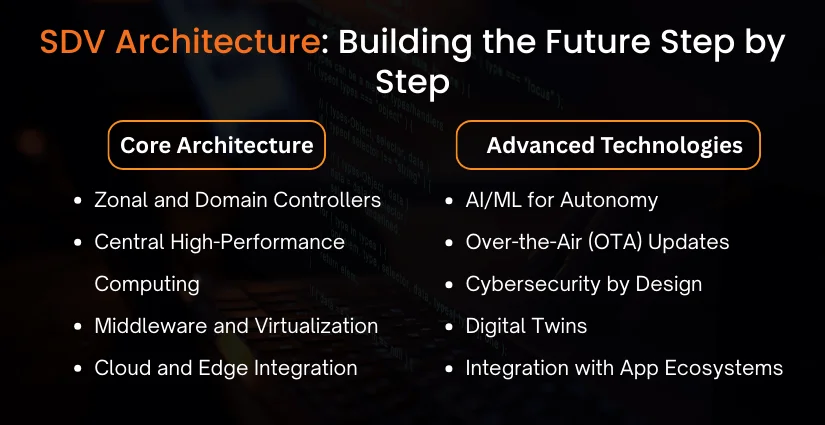
Creating a software-driven vehicle (SDV) means a radical reconsideration of the design, construction and servicing of vehicles. In contrast to conventional vehicles whose electronic control system consists of dozens of independent electronic control units (ECUs), SDVs are built on a single electronic and software platform. This is not simply a hardware upgrade but a complete redesign that enables intelligence, flexibility, and constant improvement to become part and parcel of the automobile. To CEOs, the architecture underlying SDVs is important, since it directly influences scalability, profitability, and long-term competitiveness.
Core Architecture
At the foundation of SDV design lies a new hardware and software structure that replaces fragmentation with integration.
Zonal and Domain Controllers:SDVs combine features, such as airbags and infotainment, into zonal controllers instead of providing each feature with its own ECU. The zones control a group of functions in the vehicle and are dramatically less wired, less weighty, and more reliable. Not only does this simplification help reduce costs, but it also forms an agile platform, which enables faster upgrades.
Central High-Performance Computing: As the brain of the car, central compute units coordinate workloads between basic driver-assistance and advanced navigation and passenger personalization. They enable cars to become a rolling data center, large enough to execute more and more complicated applications by processing instructions in parallel. This change guarantees compatibility of SDVs with new software layers over the years, which increases lifecycle value.
Middleware and Virtualization: In order to enable smooth software implementation, SDVs are based on middleware that hides the difference in hardware. This guarantees that applications are runnable across the respective underlying components, therefore making development less complex. Virtualization also allows partitioning, thus allowing non-critical systems to co-exist with safety-critical systems.
Cloud and Edge Integration: No SDV operates in isolation. The car models are designed to be constantly connected to the cloud to enable diagnostic and data transfer and service updates. Edge computing by itself means that real-time decisions, like collision avoidance, can be real time, and cloud connectivity enables a deeper understanding and better business models in the future.
Advanced Technologies
Beyond the architectural foundation, SDVs integrate advanced technologies that push the boundaries of mobility.
AI/ML for Autonomy: AI and machine learning help vehicles see the world around them, calculate routes, and decide how to make a driving decision in a second. Such functions are necessary to autonomous driving and adaptive safety systems, the future of self-driving.
Over-the-Air (OTA) Updates: One of the characteristics of SDVs is the fact that they can be modified once they have been manufactured. Nano updates enable the transmission of new features, bug fixes and security patches, eliminating the need to recall them. This feature transforms the relationship with customers into an ever-enhanced product.
Cybersecurity by Design: Protecting vehicles from cyber threats is non-negotiable. As one industry expert put it: Cybersecurity is no longer optional for SDVs; it underpins their safety, reliability, and the future of transportation. Secure-by-design principles ensure trust, compliance, and brand reputation remain intact in a hyper-connected world.
Digital Twins: With digital twin technology, entire vehicles can be recreated in software. Engineers test features under thousands of simulated scenarios without physical prototypes, saving time and cost while improving reliability. This technique drastically reduces risk during development cycles.
Integration with App Ecosystems: Much like smartphones, SDVs are becoming platforms for third-party applications. From entertainment to mobility services, the ability to host applications gives rise to Best Automotive App Ideas, creating fresh revenue opportunities for automakers. This ecosystem-centric approach ensures that vehicles remain relevant long after initial purchase.
Driving Development Efficiency
To achieve such an ambitious architecture, automakers are looking more and more to automation in software development. The software lifecycle can be partially automated to speed up the validation, minimise the number of human errors, and maintain consistency across millions of lines of code. In the case of CEOs, this is not only an efficiency practice but also a strategic requirement to align with the swift development of digital mobility.
By definition, SDV architecture is the intermediate between the current disjointed automotive electronics and the connected, intelligent mobility systems of tomorrow. People who master it will not only reinvent vehicles but also transform the competitive environment of the industry.

What is the Cost of Developing a Smarter Vehicle- SDV Development Process and Cost
Creating a smarter, software-controlled car is not a linear exercise, but a multi-step process that entails reconfiguring hardware, software innovation, and repeatedly managing the lifecycle. Every stage of the process is costly and requires expertise, thus being a high-stakes and high-reward approach to automotive CEOs.
Define software stack and architecture
The first step is the establishment of groundwork: the software stack and system architecture. This step defines a scalable and consistent interaction between applications, middleware and hardware across vehicle lines. Lack of such clarity initially only increases costs and complexity many times over later.
Invest in centralized compute and zonal controllers
After the architecture is known, automakers are substituting fragmented ECUs with zonal controllers and central high-performance computing units. This saves wiring, reduces weight, and allows it to be more flexible in adding new features in the future. Although this change is capital-intensive, it enables efficiencies that lead to long-term profitability.
Build and integrate applications
Applications like advanced driver-assistance systems (ADAS), infotainment, and power management applications are at the heart of the user experience. These have to be integrated with cross-disciplinary knowledge in automobile software development services, cloud interconnectedness, and safety standards. Every application needs to be compatible with other applications and provide functionality and value to the customer.
Validate through virtualization and digital twins
Testing is one of the most resource-heavy phases. Virtualized environments and digital twins allow engineers to simulate thousands of scenarios before physical prototypes are built. This reduces errors, accelerates timelines, and lowers costs while ensuring compliance with global safety regulations.
Implement cybersecurity and compliance checks
Security cannot be an appendix. The arrangements of cybersecurity are, at this stage, incorporated in all layers of the system. Adherence to ISO 21434 and other standards means that vehicles are safe and there are fewer chances of recall or damaged image.
Pilot deployment with OTA updates
Prior to scaling, pilot programs test the SDV performance in the field. Bugs are addressed using over-the-air updates, which also help to bring new features to vehicles and keep them constantly developing. Future upgrades are also informed by early customer feedback.
Scale to production fleets and monetize
Finally, the SDV platform scales into production fleets. Monetization strategies, ranging from data services to subscription-based features, begin to generate recurring revenue. This stage transforms vehicles into long-term digital assets rather than one-time purchases.
Throughout these stages, manufacturers increasingly rely on software development services partners. A custom software development company provides specialized integration skills, accelerates timelines, and ensures consistency across a highly complex ecosystem. This collaboration allows OEMs to remain competitive while focusing internal teams on strategic innovation.
Cost Overview
The cost of development varies according to the different features, but this can be like a time investment and can be profitable in the long run. The average cost of development includes.
| Phase | Approximate Cost Range (USD) |
| Architecture & Stack Definition | $50M – $100M |
| Centralized Compute & Hardware | $500M – $1B |
| Application Development (ADAS, UX) | $1B – $3B |
| Testing & Validation (Digital Twin) | $500M – $1B |
| Cybersecurity & Compliance | $200M – $500M |
| Pilot & OTA Infrastructure | $100M – $300M |
| Scaling to Production & Monetization | $2B – $5B |
The range can vary depending upon the requirement of the different companies, models, and other factors; it can also exceed millions for some global automakers.
Future Opportunities
The road ahead is full of opportunities for the automotive industry and the business owners to work and gain a huge amount of ROI and business benefits. In this section, we have mentioned some of these pointers.
- Level 3+ autonomous features: Autonomous gradual implementation of Level 3+ autonomy through OTA updates.
- Mobility-as-a-Service: Cars are used as a means of transport that are shared and subscribed to.
- Individualized In-Car Experiences: Artificial co-pilots, intelligent assistants, and customized interiors.
- Data Insights: Fleet management and city planning run on rich vehicle telemetry.
- Cross-Industry Partnerships: Partnerships with tech giants in cloud, AI, and mapping.
- Customer Engagement Platforms: Improved loyalty with automotive CRM software development and integrated digital ecosystems.
- End-to-End Automobile Industry Solutions: SDVs are nodes in a wider digital ecosystem (via predictive maintenance to connected city infrastructure).

Conclusion
Mobility is being defined not by horsepower but by code lines. In the case of automotive business owners, the SDV strategy is no longer a choice, but a fact of being. The advantages include accelerated innovation and revenue generation, as well as enhanced customer loyalty and operational efficiency. But the voyage comes at a big price, cultural transformation, and unfamiliar risk management models.
Leaders who act boldly and invest in platforms, partnerships, and agile cultures will turn their companies into digital mobility leaders. The slow movers may lose out on the business that is fast becoming software-driven.
 By
By July 4, 2025


 Get in Touch