



Many businesses regularly handle customer questions, complaints, and urgent requests. Customers can get immediate help from AI chatbots instead of waiting on hold or sending long emails. It can understand natural language, give accurate answers, and even anticipate customer needs.
Businesses can then reduce wait times and running costs while upping satisfaction rates. Customers, on the other hand, can expect faster resolution and a seamless experience.
Yet, technology is not yet perfect. Companies are quickly realizing that chatbots can confidently handle standard queries. They struggle with complex emotions and sensitive situations, nuances, or sensitive situations.
Indeed, how are AI chatbots transforming customer service in 2026? As well as their advantages, drawbacks, and strategies companies need to use to realize their full potential.
- Opening Insights on AI Chatbots in Customer Service
- What Are AI Chatbots in Customer Service?
- The Growing Market of AI Chatbots in Customer Service
- Benefits of Chatbots in Customer Service
- Top Use Cases of Chatbots in Customer Service
- Advantages vs. Disadvantages of Chatbots in Customer Service
- Challenges of AI Chatbots in Customer Service
- Chatbots and Human Agents: Finding the Right Balance
- The Role of AI and Chatbots in Digital Customer Service Ecosystems
- Use Cases of AI Chatbots in Customer Service
- Future Trends in AI Chatbots for Customer Service
- Final Words
- How Octal IT Solution Can Help?
- Frequently Asked Questions
Opening Insights on AI Chatbots in Customer Service
In recent years, customer service has moved far beyond the traditional call centers and email queues. Businesses are increasingly using AI-powered chatbots to deliver personalized support anytime customers need help.
Digital assistants play a key role in connecting brands with customers across retail, banking, healthcare, and travel.
On the other hand, AI chatbot development company are transforming service delivery with speed and efficiency. But they also bring a new set of challenges that organizations must navigate carefully.
What Are AI Chatbots in Customer Service?
Chatbots in customer service are virtual assistants powered by AI that engage customers via text or voice communication. Unlike traditional chatbots, which can only perform actions based on pre-set rules. Indeed, an AI chatbot uses NLP-ML techniques to process queries, recognize intent, and respond in human speech.
They help businesses deal with common queries, provide some instant support, and help customers through processes. Such as checking orders, booking appointments, troubleshooting problems, or managing accounts.
Since they work around the clock and continue to learn through each interaction. These chatbots reduce wait times while elevating the customer satisfaction index and decreasing maintenance costs.

The Growing Market of AI Chatbots in Customer Service
The points listed below will highlight key market statistics of the AI chatbots in customer service for 2026 and beyond. It helps to showcase rapid growth, adoption across the industries, and future potential.
- The global chatbot market currently stands at $15.57 billion and could grow to $46.64 billion by 2029.
- Chatbot market in 2026 ranges from $10 to $15 billion, based on the expectation to reach $46 to $47 billion by 2029.
- The chatbot market could grow from $13.14 billion in 2026 to $31.11 billion by 2029, growing at a CAGR of 29.3%.
- AI customer service market stood at $12.06 billion in 2024 and may reach $47.82 billion by 2030.
- The projected value growth in chat-based AI is from $10.7 billion in 2023 to $29.8 billion by 2028.
Benefits of Chatbots in Customer Service
The advent of AI chatbots has changed the way in which businesses interact among their customers. This provides them with speed, convenience, and round-the-clock assistance. Below are benefits of chatbots in customer service where such a tool proves essential for a contemporary business.
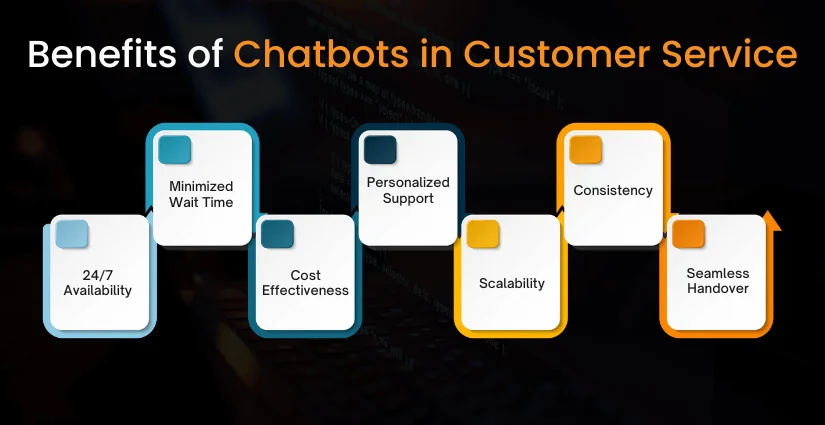
1. 24/7 Availability
Chatbots, unlike human agents with fixed working shifts, are active in the wee hours. This ensures an instant response to customers across different time zones without the barrier of business-hour constraints.
2. Minimized Wait Time
In a way, handling thousands of conversations at once is done by chatbots. AI chatbots provide instant assistance and eliminate long wait times. This aids in drastically boosting customer satisfaction and brand value.
3. Cost Effectiveness
Companies can save millions each year through chatbots that solve simple queries for users. Queries like password resets, order status, or general information. This will allow operators to focus on AI chatbot development cost that require their attention.
4. Personalized Support
AI chatbots use customer history and behavior to propose personalized recommendations. That offers solutions, making the engagement more meaningful and, hence, more engaging.
5. Scalability
Chatbots can scale instantly to high traffic, such as during the holiday season or a product launch. The process would require training and extra resources for human teams.
6. Consistency
Chatbots always put forth the exact right information in every interaction. Thus, avoiding errors caused by fatigue, stress, communications, or whatever transient conditions would have caused such errors normally. They hence assure a consistent customer experience.
7. Seamless Handover
Chatbots can transfer complex issues to human agents along with chat history, transferring the history of chats. Hence cutting down the repetition and hastening the resolution.
Also Read: How to Develop an AI Chatbot App Like Replika?
Top Use Cases of Chatbots in Customer Service
Below are the most impactful uses of chatbots in customer service that showcase how businesses are using this technology.
1. Order Tracking & Status Updates
E-commerce and retail bots let users check order status, shipping details, and delivery timeline. Therefore, lowering the dependency on customer support agents.
2. Billing & Payments
Chatbots allow banks, communications service providers, and agencies offering subscription services to respond to clients’ queries on bill payments. It additionally notifies clients about dues and even processes low-level payments securely.
3. Appointment Scheduling
Within healthcare, beauty, or other professional services, chatbots improve customer convenience by enabling scheduling, rescheduling, or cancellation of appointments.
4. Product Recommendations
These AI bots track browsing behavior, purchase histories, and customer profiles. This offers relevant product recommendations for cross-selling and up-selling.
5. Technical Support
Chatbots are the first line of IT or product support, guiding users through certain troubleshooting steps. Additionally, resolving common problems and answering FAQs.
6. Travel Assistance
Airlines and travel platforms utilize chatbots and AI in customer service to communicate flight updates. As well as bookings, travel upgrades, cancellations, or changes pending for the passengers.
7. Feedback Collection
The bot can solicit quick ratings or feedback surveys after an interaction. The company gains insights into customer satisfaction and improves service quality.
Advantages vs. Disadvantages of Chatbots in Customer Service
Like every invention, AI chatbots come with their advantages and drawbacks. Understanding the aspects of chatbots in customer service, like the advantages of chatbots in customer service and the drawbacks. This will allow businesses to weigh their decisions wisely.
1. Advantages
Instant Support
No more holding on the call or waiting hours for an email. Chatbots provide immediate answers, given this level of satisfaction with response times. AI chatbots provide instant answers to basic queries.
High Availability
Traditionally, human agents would have fixed working hours, unlike chatbots that work 24/7. AI in customer service and chatbots helps accommodate customers across diverse time zones.
Cost Reduction
Businesses can use AI chatbots to manage simple queries, including password resets and order updates. So companies can reduce maintenance costs fairly and reduce the necessity for the support team.
Ability to Adapt
Black Friday sales, travel season, and product launches all represent times when thousands of customers are having simultaneous conversations. Chatbots can handle thousands of conversations simultaneously without affecting quality.
Data Collection
Every interaction through the chatbot has now generated customer information: preferences, complaints, and the buyer’s pattern. Even though companies can use this information to improve their products and tailor their future experience.
Consistency
Chatbots give the same answers every single time, which provides accurate answers. It further prevents human agents from committing errors due to being tired, stressed, or inconsistent.
2. Limitations
Lacking Emotional Intelligence
Chatbots struggle with grasping human emotions such as anger, sarcasm, or urgency. Lacking empathy sometimes makes customers feel as though their concerns went unheard.
Complex Query Handling
Chatbots work properly for basic tasks, but they may have trouble with complicated requests that need human expertise.
Language and Culture Barriers
Despite NLP advances, bots still mess up with slang and anti-dialect in some areas. Or maybe some cultural oddity, resulting in confused or wrong answers.
Trust Issues for Customers
Some customers don’t want to interact with machines and want to talk to a person instead. The over-reliance on chatbots will drive away such users, lowering the reputation.
Costs of Implementation
Building AI chatbots with NLP and machine learning takes time, resources, and investment, making adoption harder for smaller companies.
Overdependence
Companies that rely too much on chatbots are undermining human support, primarily. As long as such support includes empathy, negotiation, or really complex solutions.
Read More: Top 15+ Chatbot Development Frameworks
Challenges of AI Chatbots in Customer Service
While AI chatbots bring efficiency and capacity for growth. They also come with certain limitations that can impact customer satisfaction if not addressed. Below are some key challenges of AI chatbots in customer service that businesses must be mindful of.
1. Contextual Comprehension
AI chatbots are typically excellent at picking up keywords. Even advanced ones may have a hard time following deeper contexts. For instance, there are multiple issues when a customer reports, “My payment failed, but I was still charged.” The majority of bots will not understand it correctly.
2. Personalization at Scale
Personalization will hit the forefront of customer expectations in the year 2026. Yes, chatbots do collect data but obviously do not create real human conversations.
3. Data Privacy & Security Concerns
The chatbots manage extremely sensitive data like account details, credit card information, or health-related information. How do we comply with GDPR and additionally try to prevent data breaches? But it remains a big challenge.
4. Integration with Legacy Systems
Almost all organizations are still working using an outdated CRM or ERP. Integrating legacy systems with AI chatbots can be expensive and complex. It may further limit functionality.
5. Language & Multilingual Support
Companies serving global audiences need bots fluent in their respective languages. Despite recent advances, NLP systems often struggle to understand rare languages and cultural contexts.
6. Customer Resistance
Workflow automation services are not always accepted by customers. Some customers dislike chatbots because they lack a personal touch. Especially when the user wants to talk to a human immediately.
7. Development and Maintenance
The basic chatbots can be cheap to build, but the more advanced ones learn, adapt, and integrate. With enterprise systems, thus requiring ongoing investment in infrastructure, training, and updates.
Chatbots and Human Agents: Finding the Right Balance
AI chatbots are the very definition of speed, efficiency, and repetition. And it can never replace the empathy, creative ability, and problem-solving skills of the human agents.
Chatbots can be first-line support, answering masses of straightforward questions like order tracking, password resets, billing questions, etc. Once a query becomes too complex, emotionally sensitive, or outside a programmed scope.
The system should quietly transfer the conversation to a human agent with the full context of the chat history. This discourages customers from repeating themselves and guarantees continuous, smooth service.
With this hybrid approach, companies can:
- Cut operating expenses as bots handle more than 50 percent of queries.
- Businesses should rely on human support when empathy and critical thinking matter.
- Enable faster resolutions with chatbots pre-qualifying issues before escalation.
- Raise customer satisfaction levels with both instant automation and human understanding.
Businesses should use AI to enhance human support and provide a more customer-centric service experience. In addition to expanding the scope of chatbot use cases in customer service.
Learn More: AI Virtual Assistant App Development: Cost and Key Features
The Role of AI and Chatbots in Digital Customer Service Ecosystems
In today’s digital-first world, customer care is no longer limited to calls and emails. Still, it extends to websites, mobile apps, social media, and messaging platforms.
Within this complex ecosystem, the chatbots connect different customer touchpoints and ensure a seamless support experience. Additionally, it ensures customers receive quick, customized, and consistent support anywhere.
AI-powered chatbots are more than just automatic responder systems. Because they plug into CRMs, analytics tools, and knowledge bases to provide their users with contextual answers. For instance, a chatbot integrated into an e-commerce app could pull order information in real time.
Hence, social media chatbots can respond to FAQs without the intervention of an agent. Chatbots integrate different channels, making them essential for providing smooth and consistent customer service.
AI chatbots can predict customer needs by analyzing their behavior, allowing businesses to offer proactive assistance. Furthermore, offer solutions proactively, or even detect complaints through sentiment analysis. Altogether, they can assist in reducing churn, creating customer loyalty, and increasing management efficiency.
Human agents can spend more time on complex customer needs because AI chatbots handle routine requests. It creates a balanced ecosystem where automation and human intelligence work together rather than compete.
In essence, AI and chatbots act as the backbone of digital transformation services ecosystems. These shall be scalable, smart, and customer-centric in 2026 and beyond.
Use Cases of AI Chatbots in Customer Service
Businesses are using AI chatbots in customer service in a few practical ways. Here are the most important ones.
24/7 FAQ Handling
Customers no longer have to wait for business hours. AI chatbots handle common queries around the clock, allowing support teams to focus on more complex issues.
Order Tracking & Status Updates
Customers just type “Where’s my order?” and the chatbot pulls live shipping data and responds in seconds. No hold music, no ticket, just a quick and accurate answer.
Smart Ticket Routing
When a customer raises a query, AI reads it, understands the problem, and automatically sends it to the right team. No manual sorting. No lost tickets. No wasted time.
Agent Assist Tools
While agents talk to customers, AI provides reply suggestions, summarizes past chats, and analyzes sentiment to improve support.
Multilingual Support
AI chatbots are able to recognize the customer’s language and provide fluid responses. Without employing separate regional teams or translators, brands can assist consumers in dozens of languages.
Proactive Support
The chatbot is the first to reach out if a customer is stuck for too long on a checkout page. It identifies friction before the customer becomes frustrated, reducing abandonment and support tickets.
Personalized Product Recommendations
The chatbot looks at your browsing history and past purchases and recommends the right product as you chat. It transforms a support chat into a silent, powerful sales moment.
Future Trends in AI Chatbots for Customer Service
The development of AI chatbots has been a rapid one; consequently, customer service is undergoing a lot of changes. This will extend far beyond the handling of trivial questions. Beyond 2026, businesses will witness a few transforming trends shaping chatbot-framed assistance:
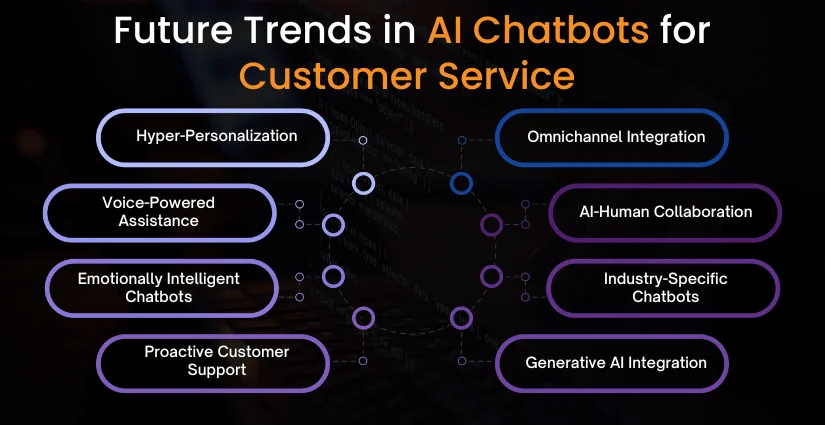
1. Hyper-Personalization
Chatbots will move from generic responses to highly tailored conversations using customer data, purchase history, or behavior patterns. This will give an experience that is almost human.
2. Voice-Powered Assistance
The rise of voice interfaces such as Alexa, Siri, and Google Assistant. Advanced chatbots will enable users to interact through voice, creating a faster and more seamless experience.
3. Emotionally Intelligent Chatbots
Advances in sentiment analysis will allow chatbots to pick up on frustration, urgency, and satisfaction in customer tone. Additionally, it adjusts their responses accordingly to bridge the empathy gap.
4. Proactive Customer Support
AI chatbots will identify potential problems, like delayed deliveries, and notify customers in advance. Also, it will reach out with solutions before anyone has the chance to complain.
5. Omnichannel Integration
Bot-supported assistance is now shifting to an omnichannel approach. Chatbots run across platforms while maintaining consistent service across all touchpoints. Such as websites, mobile apps, WhatsApp, social media, or even AR/VR environments.
6. AI-Human Collaboration
The future will not see bots replacing humans but will rather focus on enhancing human capabilities. Smart chatbots will gather details and pass cases on to human agents that are complex with complete context. Additionally, resulting in expediting smoother customer service.
7. Industry-Specific Chatbots
Specialized bots will develop for industries like banking, healthcare, travel, and retail, being trained with particular data. So, that sector is providing more accurate, dependable support tailored to the unique needs of the industry.
Developers will provide these chatbots through scalable cloud platforms to support rising demand for SaaS development services. This is making them easier to adopt, update, and integrate within diverse digital ecosystems.
8. Generative AI Integration
Next-generation chatbots will use generative AI to hold conversations that flow naturally and are aware of context. Also, they are muc

Final Words
AI chatbots are essential components of customer support in the digital age. Chatbots are transforming customer service with round-the-clock assistance.
Chatbots enable hyper-personalized and proactive interactions. But, companies still face challenges related to emotional intelligence, data privacy, and balancing automation with human support.
The way forward for the customer service experience is to harness the speed of AI. And then combine it with the empathy of human agents to build customer experiences that are efficient yet meaningful. Those businesses that follow this hybrid route will delight their customers and own a competitive edge in their markets.
How Octal IT Solution Can Help?
Octal IT Solution provides Artificial Intelligence development services tailored to your industry and customer needs. Our team will ensure smooth integration into your existing systems and compliance with data privacy laws. As well as enrichment by natural language processing and machine learning capabilities.
Octal IT Solution helps businesses improve support, create personalized experiences, and manage customer interactions at scale. Our developers build and deploy the chatbots that matter. We combine AI, mobile app development, and enterprise solutions to help businesses create next-generation customer experiences.
Frequently Asked Questions
AI chatbots are digital assistants with AI and NLP capacities. They interpret queries, provide instant responses, and perform an activity using an automated procedure. Through interaction, they learn to support through increased accuracy and tools.
The AI chatbot offers 24-hour service, quick responses, and the ability to cut costs. AI chatbots can handle thousands of customer queries simultaneously without making an error.
Challenges include handling complex or emotionally charged queries and providing accurate responses. Other challenges are that the setup cost of these is high, and they need regular updates.
No: AI chatbots cannot perform all functions of a human agent. They handle routine questions well but fail to handle anything sensitive and complex. The best-case hybrid scenario has chatbots managing routine matters with humans taking care of advanced support.
The companies must implement secure encryption and comply according to prevailing laws such as the GDPR and CCPA. Businesses strengthen customer trust when they are transparent about data practices.

 By
By September 10, 2026



 Latest Stories
 Get in Touch